
Global Modular Homes Market Size, Growth & Revenue 2025-2034
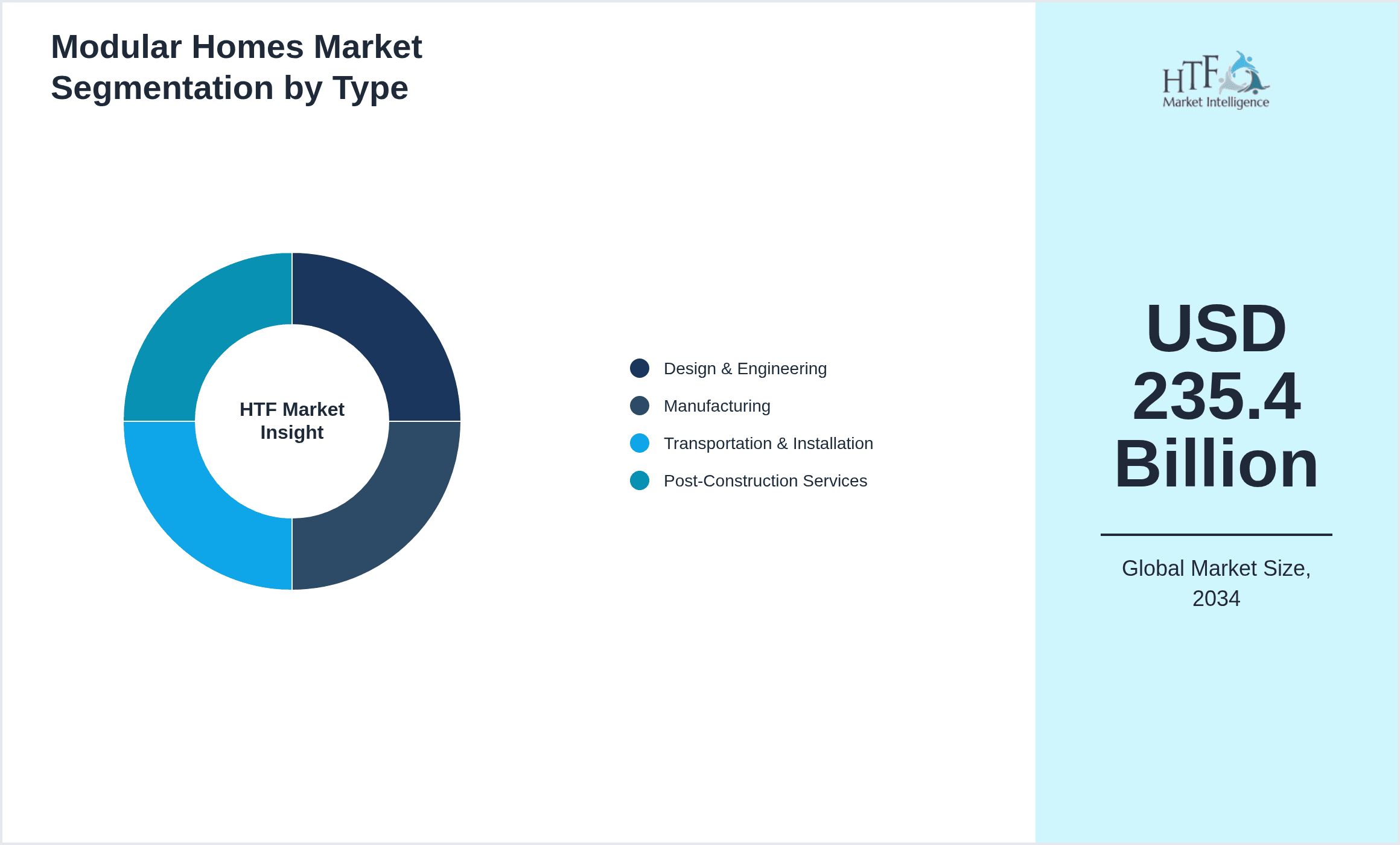
Global Modular Homes Market is segmented by Modular Home Type (Volumetric Modular Homes, Panelized Modular Homes, Hybrid Modular Homes, Modular Components, Pre-fabricated Homes), End-Use Application (Residential, Commercial, Institutional, Industrial, Recreational), Service Type (Design & Engineering, Manufacturing, Transportation & Installation, Post-Construction Services), Deployment Model (On-site Assembly, Off-site Manufacturing, Hybrid Deployment), and Geography (North America, LATAM, West Europe, Central & Eastern Europe, Northern Europe, Southern Europe, East Asia, Southeast Asia, South Asia, Central Asia, Oceania, MEA)
Pricing
Report Overview
Executive Summary
- •The global modular homes market refers to the construction and deployment of prefabricated housing units manufactured in controlled factory environments and assembled onsite. These homes are categorized mainly into volumetric, panelized, hybrid, modular components, and pre-fabricated types that cater to diverse applications including residential, commercial, institutional, industrial, and recreational sectors. The modular homes value chain spans raw material suppliers, manufacturers, logistics providers, construction contractors, and end-users such as homeowners, real estate developers, and public sector organizations. This segment is gaining traction due to its ability to reduce construction timelines, lower costs, minimize waste, and enable high customization with consistent quality. Technological innovations, sustainable building practices, and growing demand for affordable and rapid housing solutions are key market drivers globally. Additionally, modular homes facilitate compliance with stringent building codes and environmental standards, making them a preferred choice in urban and disaster-prone regions. The market's growth is further supported by government incentives, rising awareness of green construction, and expansion of manufacturing capabilities across regions, positioning modular homes as a transformative solution in the global housing industry.
- •Key market highlights include a base market size valued at USD 85.6 Billion in 2025, with projections estimating growth to USD 235.4 Billion by 2034, reflecting a robust CAGR of 11.5%. North America currently dominates the market due to advanced construction technologies and strong demand for sustainable housing, while Asia-Pacific is identified as the fastest growing region, driven by rapid urbanization and infrastructure development. Volumetric modular homes lead the product segment by revenue share, favored for their complete factory-built units and ease of transportation, whereas hybrid modular homes are the fastest growing due to their flexibility and cost-effectiveness. Market growth is underpinned by technological advancements such as Building Information Modeling (BIM) and automation, alongside increasing adoption by commercial and institutional sectors seeking efficiency and scalability.
- •The modular homes market offers significant value propositions through accelerated project delivery, cost savings, and reduced environmental impact. These advantages attract stakeholders ranging from individual homeowners to large-scale developers and governments aiming to address housing shortages and sustainability goals. Strategic importance is heightened by modular construction's ability to improve labor productivity and safety, optimize resource utilization, and support circular economy initiatives. Consequently, modular homes are shaping the future of construction by enabling innovative business models and fostering collaborations across the supply chain, solidifying their role as a vital component within the global residential and non-residential construction sectors.

Competitive Landscape
The global modular homes market is characterized by intense competition among established multinational corporations, regional manufacturers, and innovative startups. Market players are leveraging diverse strategies such as product innovation, strategic partnerships, mergers and acquisitions, and geographic expansion to strengthen their foothold. Competitive dynamics revolve around technology adoption, customization capabilities, cost leadership, and sustainable building solutions. Companies invest heavily in research and development to enhance modular construction techniques, integrate digital tools like BIM, and develop eco-friendly materials to differentiate themselves. Pricing strategies vary by region and application, with premium solutions targeting commercial and institutional sectors, while cost-effective models focus on affordable housing. Distribution channels include direct sales, collaborations with real estate developers, and digital platforms offering design-to-delivery solutions. Barriers to entry such as high capital requirements, regulatory compliance, and customer trust necessitate strong market positioning. Regional competition intensifies as emerging markets in Asia-Pacific, Latin America, and Middle East & Africa adopt modular construction. Future competitive trends suggest increased consolidation, focus on sustainability certifications, and the rise of modular construction-as-a-service business models, reshaping market structure and value creation.
Key Players in Modular Homes Market
- •Clayton Homes (United States)
- •Sekisui House (Japan)
- •CIMC Modular Building Systems (China)
- •Champion Home Builders (United States)
- •Laing O’Rourke (United Kingdom)
- •Skender Construction (United States)
- •Fleetwood Homes (United States)
- •Katerra Inc. (United States)
- •Z Modular (United States)
- •Baufritz (Germany)
- •Modscape (Australia)
- •Lendlease Group (Australia)
- •Dvele (United States)
- •Honomobo (Canada)
- •Guerdon Modular Buildings (United States)
- •Red Sea Housing Services (Saudi Arabia)
- •Broad Sustainable Building (China)
- •Deltec Homes (United States)
- •Kasita (United States)
- •BLOX (Denmark)
- •WeberHaus (Germany)
- •Huf Haus (Germany)
- •CleverHomes (United Kingdom)
- •Vision Modular Systems (Canada)
- •Greenfab (United States)
Market Breakdown
- •By Modular Home Type
- ◦Volumetric Modular Homes
- ◦Panelized Modular Homes
- ◦Hybrid Modular Homes
- ◦Modular Components
- ◦Pre-fabricated Homes
- •By End-Use Application
- ◦Residential
- ◦Commercial
- ◦Institutional
- ◦Industrial
- ◦Recreational
- •By Service Type
- ◦Design & Engineering
- ◦Manufacturing
- ◦Transportation & Installation
- ◦Post-Construction Services
- •By Deployment Model
- ◦On-site Assembly
- ◦Off-site Manufacturing
- ◦Hybrid Deployment
Growth Dynamics
- •Rising urbanization and housing shortages globally are driving demand for modular homes, offering rapid deployment and cost efficiency to address affordable housing needs effectively. For example, governments in Asia-Pacific are increasingly adopting modular solutions to mitigate urban housing deficits.
- •Technological advancements such as Building Information Modeling (BIM), automation in manufacturing, and use of sustainable materials enhance modular homes’ quality and reduce construction time, attracting commercial and institutional developers seeking efficiency.
- •Growing environmental awareness and stringent regulations on construction waste and energy efficiency encourage adoption of modular homes, as these solutions reduce material waste and energy consumption during construction and operation phases.
- •Investment inflows and government incentives supporting prefabricated construction stimulate market growth, enabling manufacturers to expand capabilities and developers to realize faster project completions with better cost controls.
- •Increasing consumer preference for customizable and modern living spaces propels demand in residential modular homes, with digital design tools facilitating tailored solutions that meet diverse lifestyle requirements.
- •Collaborations between technology providers, construction firms, and real estate developers foster innovation in modular home design and delivery, accelerating market adoption across various applications worldwide.
- •Advancements in logistics and transportation infrastructure improve distribution efficiency of modular components, reducing lead times and enabling broader geographic reach, particularly in emerging markets.
Market Trends
- •Increased integration of smart home technologies into modular homes is shaping a trend toward connected, energy-efficient living spaces that appeal to tech-savvy consumers and commercial clients alike.
- •Adoption of sustainable and recycled materials in modular home construction reflects growing commitment to green building standards and circular economy principles within the industry.
- •Modular homes designed for disaster resilience and rapid deployment are gaining traction in regions prone to natural calamities, supported by government programs and humanitarian initiatives.
- •Expansion of modular homes into non-residential sectors such as hotels, schools, and healthcare facilities demonstrates diversification of applications and revenue streams for manufacturers.
- •Increasing use of 3D printing and robotics in manufacturing processes enhances precision, reduces labor costs, and accelerates production cycles for modular construction components.
- •Collaboration platforms and digital marketplaces connecting modular home buyers, designers, and builders streamline customer experience and reduce project timelines.
- •Modular home financing models including lease-to-own and modular mortgages are evolving, improving affordability and accessibility for end consumers globally.

Market Opportunities
- •Emerging economies with rapid urban growth present significant opportunities for modular home manufacturers to address housing demand efficiently and cost-effectively.
- •Rising investment in sustainable infrastructure and green buildings opens avenues for modular solutions that comply with environmental certifications and energy efficiency standards.
- •Technological innovation in modular home design, including modular smart home integration, offers potential for product differentiation and market leadership.
- •Expansion into commercial and institutional sectors such as hotels, healthcare, and educational facilities provides diversification and growth beyond traditional residential markets.
- •Collaborative ventures and strategic partnerships between modular manufacturers, technology providers, and real estate developers can accelerate market penetration and innovation.
- •Government initiatives promoting affordable housing through subsidies and relaxed regulations enhance modular home adoption in both developed and developing regions.
- •Integration of circular economy practices and recycled materials in modular construction can attract eco-conscious consumers and comply with tightening regulatory frameworks worldwide.
Market Challenges
- •High initial capital expenditure for setting up modular manufacturing plants limits entry for smaller players and constrains market expansion in emerging regions.
- •Stringent and varying building codes across countries complicate standardization and cross-border deployment of modular homes, increasing compliance costs for manufacturers.
- •Limited consumer awareness and perceived quality concerns about modular homes, particularly in traditional markets, hamper adoption despite technological advancements.
- •Logistical challenges related to transportation and onsite assembly of large modular units can lead to delays and increased costs, affecting project timelines and profitability.
- •Competition from conventional construction methods with entrenched supply chains presents resistance to modular home market penetration in certain regions.
- •Shortage of skilled labor specialized in modular construction techniques poses operational challenges for manufacturers and contractors.
- •Economic uncertainties and fluctuations in raw material prices affect cost structures and investment decisions within the modular homes market.
Regulatory Framework
- •Between 2020 and 2025, several countries implemented building codes mandating energy efficiency and waste reduction in construction, compelling modular homes to comply with higher sustainability standards, thereby influencing material selection and manufacturing processes.
- •Regulations such as the International Building Code (IBC) updates and ISO standards for prefabricated buildings introduced stricter safety and quality requirements, ensuring modular homes meet uniform criteria across jurisdictions and boosting market credibility.
- •Environmental regulations targeting carbon footprint and construction waste management have driven modular home manufacturers to adopt green technologies and sustainable practices, aligning with global climate goals and attracting government incentives.
- •Region-specific mandates, including the European Union’s Construction Products Regulation (CPR) and North America’s LEED certification frameworks, have shaped modular home design and construction, promoting innovation in energy-efficient and eco-friendly building solutions.
- •Governments worldwide have introduced policies offering subsidies, tax benefits, and streamlined permitting processes for modular home projects to alleviate affordable housing shortages and stimulate adoption of modern construction methods.
Market Intelligence
- •15th January 2025, Clayton Homes announced the launch of its new line of energy-efficient volumetric modular homes designed for rapid deployment in urban residential developments. This product features integrated smart home systems, enhanced insulation materials, and complies with the latest international green building standards, targeting eco-conscious consumers and affordable housing projects. The initiative aligns with Clayton’s strategic focus on sustainability and market expansion in North America and Asia-Pacific regions. The modular homes are manufactured using automation technologies, reducing production time by 30% and lowering construction waste significantly. This launch is expected to strengthen Clayton Homes’ competitive positioning and drive revenue growth in the growing global modular homes sector. Source: Clayton Homes Official Press Release
- •10th March 2025, Sekisui House unveiled its hybrid modular construction platform incorporating advanced BIM integration and robotic assembly lines to deliver customizable commercial and institutional modular buildings. This platform targets rapid construction timelines with minimal onsite disruption, catering to healthcare and educational facilities in Japan and expanding into Europe. The company emphasized its commitment to digital transformation and sustainability through reduced carbon emissions and material reuse. Sekisui House projects a 25% increase in modular construction contracts over the next three years, supported by government incentives for green building adoption. This innovation underscores the growing role of technology in enhancing modular home market competitiveness globally. Source: Sekisui House Corporate News
- •8th May 2025, CIMC Modular Building Systems completed the acquisition of an Australian modular home manufacturer to consolidate its presence in the Asia-Pacific region. This strategic move enhances CIMC’s manufacturing capacity and product portfolio across residential and commercial applications, enabling faster market penetration in emerging economies. The acquisition also facilitates knowledge transfer in sustainable building technologies and expands the service network for transportation and onsite assembly. CIMC aims to leverage this synergy to capitalize on growing urbanization trends and infrastructure development in the region, enhancing its competitive advantage. This transaction reflects the broader industry trend toward consolidation to optimize resources and scale operations globally. Source: CIMC Group Press Release
- •20th July 2025, Katerra Inc. announced a strategic partnership with leading technology firms to develop modular homes equipped with AI-powered energy management systems and IoT-enabled smart appliances. This collaboration aims to accelerate innovation in the modular homes sector, offering predictive maintenance, optimized energy usage, and enhanced occupant comfort. The initiative targets urban residential and commercial markets in North America and Europe, where demand for smart sustainable buildings is surging. Katerra’s move is expected to drive digital transformation within the modular construction value chain and set new industry benchmarks for smart modular living solutions. Source: Katerra Official Announcement
- •Recent market developments and strategic initiatives are continuously tracked through industry publications, company announcements, and regulatory filings. For the most current information, stakeholders are advised to monitor official corporate communications and recognized market intelligence platforms.
Regional Outlook
The North America currently holds a significant share of the market, primarily due to several key factors: increasing consumption rates, a burgeoning population, and robust economic momentum. These elements collectively drive demand, positioning this region as a leader in the market. On the other hand, Asia-Pacific is rapidly emerging as the fastest-growing area within the industry. This remarkable growth can be attributed to swift infrastructure development, the expansion of various industrial sectors, and a marked increase in consumer demand. These dynamics make this region a crucial player in shaping future market growth.
In our report, we cover a comprehensive analysis of the following regions and countries:
- North America
- LATAM
- West Europe
- Central & Eastern Europe
- Northern Europe
- Southern Europe
- East Asia
- Southeast Asia
- South Asia
- Central Asia
- Oceania
- MEA
| Feature | Details |
|---|---|
| Base Year Market Size | USD 85.6 Billion |
| Forecast Year Market Size | USD 235.4 Billion |
| CAGR | 11.5% |
| Forecast Period | 2026 to 2033 |
| YoY Growth | 11.5% |
| Scope of Report | Market is segmented by Modular Home Type (Volumetric Modular Homes, Panelized Modular Homes, Hybrid Modular Homes, Modular Components, Pre-fabricated Homes), End-Use Application (Residential, Commercial, Institutional, Industrial, Recreational), Service Type (Design & Engineering, Manufacturing, Transportation & Installation, Post-Construction Services), Deployment Model (On-site Assembly, Off-site Manufacturing, Hybrid Deployment) |
| Regions Covered | North America, LATAM, West Europe, Central & Eastern Europe, Northern Europe, Southern Europe, East Asia, Southeast Asia, South Asia, Central Asia, Oceania, MEA |
| Key Companies | Clayton Homes (United States), Sekisui House (Japan), CIMC Modular Building Systems (China), Champion Home Builders (United States), Laing O’Rourke (United Kingdom), Skender Construction (United States), Fleetwood Homes (United States), Katerra Inc. (United States), Z Modular (United States), Baufritz (Germany), Modscape (Australia), Lendlease Group (Australia), Dvele (United States), Honomobo (Canada), Guerdon Modular Buildings (United States), Red Sea Housing Services (Saudi Arabia), Broad Sustainable Building (China), Deltec Homes (United States), Kasita (United States), BLOX (Denmark), WeberHaus (Germany), Huf Haus (Germany), CleverHomes (United Kingdom), Vision Modular Systems (Canada), Greenfab (United States) |
Global Modular Homes Market Size, Growth & Revenue 2025-2034 - Table of Contents
Frequently Asked Questions (FAQ):
The Compact Track Loaders market is projected to grow at a CAGR of 6.8% from 2025 to 2030, driven by increasing demand in construction and agricultural sectors.
North America currently leads the market with approximately 45% market share, followed by Europe at 28% and Asia-Pacific at 22%. The remaining regions account for 5% of the global market.
Key growth drivers include increasing construction activities, rising demand for versatile equipment in agriculture, technological advancements in track loader design, and growing preference for compact equipment in urban construction projects.