
Global Premium Motorcycle Helmet Market Size, Growth & Revenue 2024-2034
Global Premium Motorcycle Helmet Market is segmented by Helmet Type (Full-face helmets, Modular helmets, Open-face helmets, Half-face helmets, Dual-sport helmets), Application (Commuting, Racing, Touring, Off-road, Urban Riding), Rider Age Group (18-25 years, 26-40 years, 41-60 years, Above 60 years), Distribution Channel (Online Retail, Specialty Motorcycle Stores, Sports Goods Stores, Direct Manufacturer Sales), and Geography (North America, LATAM, West Europe, Central & Eastern Europe, Northern Europe, Southern Europe, East Asia, Southeast Asia, South Asia, Central Asia, Oceania, MEA)
Pricing
Report Overview
Executive Summary
- •The Global Premium Motorcycle Helmet market is a specialized segment focusing on high-performance protective helmets designed for motorcycle riders worldwide. It includes a variety of helmet types such as full-face, modular, open-face, half-face, and dual-sport variants, each crafted to meet diverse safety standards and rider preferences. The market is driven by increasing awareness about road safety, stringent government regulations mandating helmet use, and growing motorcycle ownership across major regions. Technological innovations like improved ventilation systems, integrated Bluetooth connectivity, and lightweight composite materials have significantly enhanced helmet functionality and rider comfort. The scope also covers applications ranging from daily commuting and touring to professional racing and off-road riding, reflecting the broad usability of premium helmets. This market serves manufacturers, distributors, and end consumers by offering helmets that combine protection with advanced features and premium aesthetics, fostering steady growth and evolving consumer demand globally.
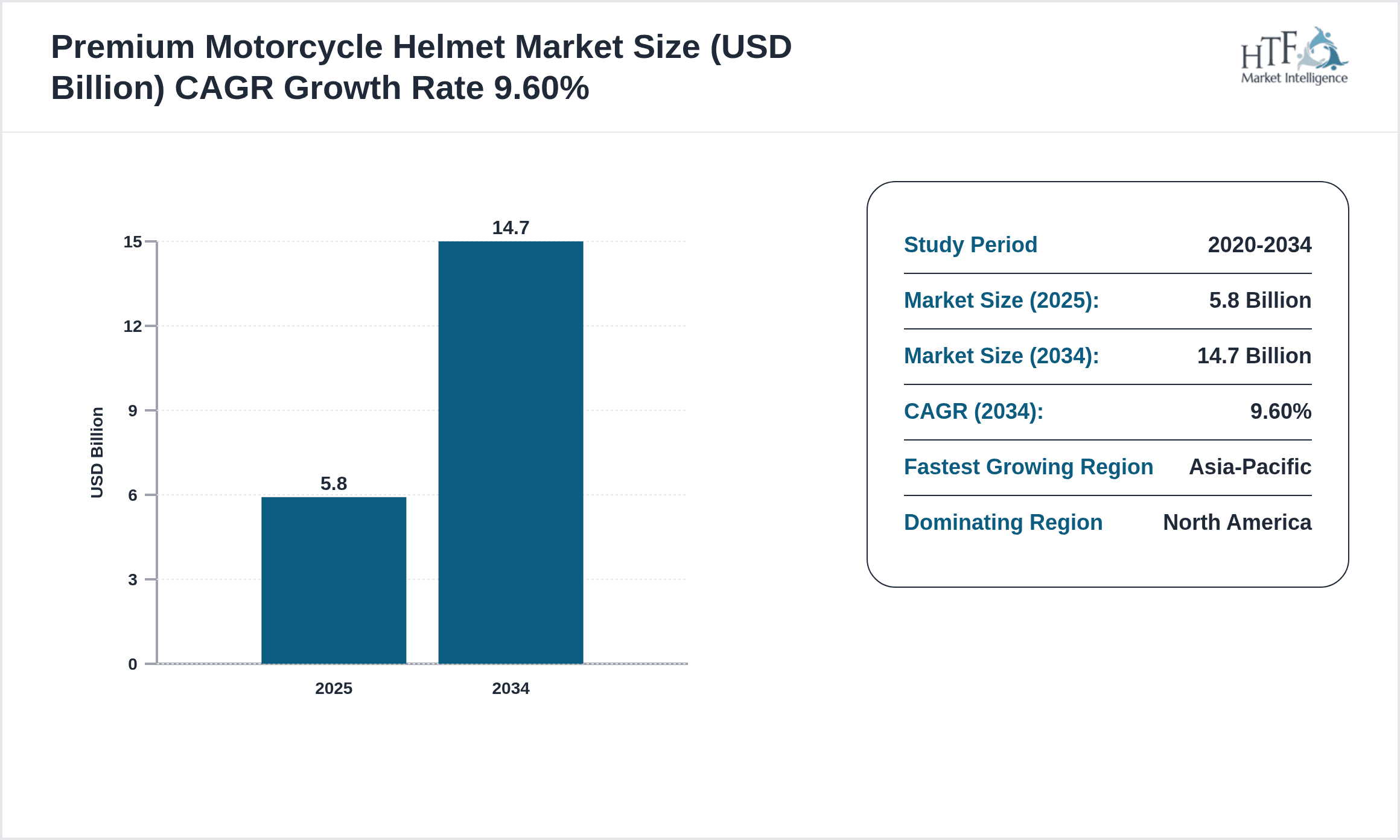
- •Key highlights include a base market size of USD 5.8 billion in 2024 projected to reach USD 14.7 billion by 2034, reflecting a robust CAGR of 9.6%. North America currently dominates due to high safety standards and strong motorcycle culture, while Asia-Pacific is the fastest-growing region fueled by rising disposable incomes and expanding motorcycle penetration. Full-face helmets lead the product segment, favored for their comprehensive protection, with modular helmets witnessing the fastest growth due to their versatility. The market’s expansion is supported by increasing investments in R&D, growing adoption of smart helmets, and rising urbanization driving motorcycle use. These factors collectively highlight significant opportunities for stakeholders to innovate and capture emerging demand across diverse geographies and user segments.
- •The Premium Motorcycle Helmet market offers critical value propositions by enhancing rider safety through cutting-edge technology and superior design. It plays a strategic role in reducing head injuries and fatalities, thus supporting public health and compliance with global traffic safety regulations. Additionally, it caters to lifestyle and performance enthusiasts seeking helmets that offer both protection and style, integrating smart features like heads-up displays and communication systems. The market’s growth potential attracts manufacturers, retailers, and investors aiming to leverage evolving consumer preferences and regulatory mandates. Collectively, the market fosters innovation, safety awareness, and premium product development that benefits riders, industry participants, and regulatory bodies worldwide.
Competitive Landscape
The competitive environment in the Global Premium Motorcycle Helmet market is characterized by intense rivalry among established multinational corporations and emerging specialized brands. Market participants focus on innovation-driven strategies, including advanced material usage, aerodynamic designs, and integration of smart technologies like Bluetooth and augmented reality. Companies leverage strategic partnerships and collaborations with motorcycle manufacturers to enhance brand visibility and product adoption. Pricing strategies vary from premium high-end ranges to mid-tier segments to cater to diverse consumer bases. The presence of stringent safety certifications acts as a barrier to entry, ensuring that only compliant and quality-focused players sustain competitive advantage. Regional competition is vibrant, with North America and Europe hosting several legacy brands, while Asia-Pacific sees rapid growth of domestic manufacturers innovating to meet rising demand. Future trends point toward increased customization, sustainability initiatives, and digital marketing to capture evolving customer preferences and reinforce market positioning.
Leading Companies in Premium Motorcycle Helmet Market
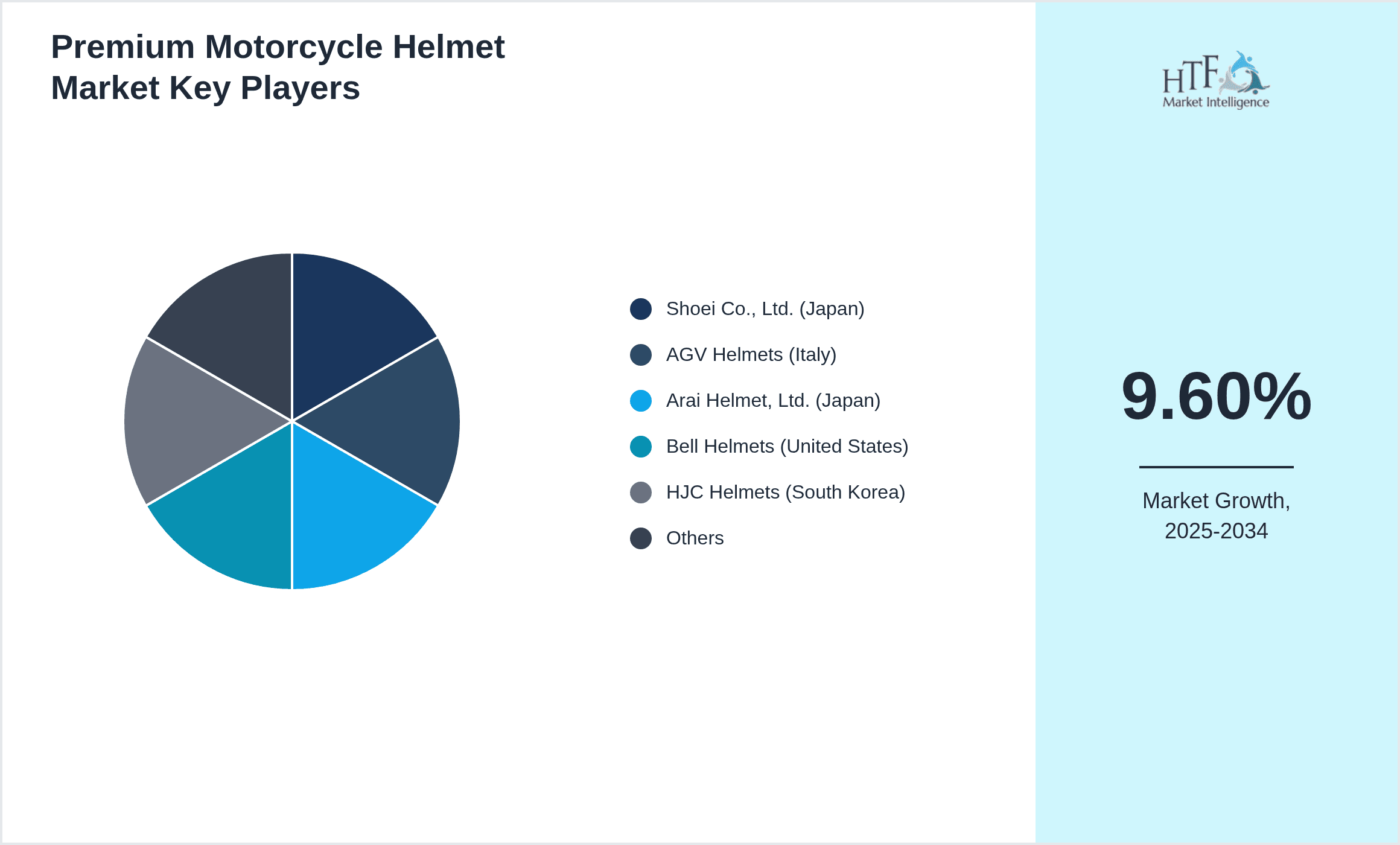
- •Shoei Co., Ltd. (Japan)
- •AGV Helmets (Italy)
- •Arai Helmet, Ltd. (Japan)
- •Bell Helmets (United States)
- •HJC Helmets (South Korea)
- •Schuberth GmbH (Germany)
- •Nolan Helmets (Italy)
- •LS2 Helmets (China)
- •Scorpion Sports (France)
- •Shark Helmets (France)
- •Icon Motorsports (United States)
- •MT Helmets (Spain)
- •Vemar Helmets (Italy)
- •Torc Helmets (United States)
- •Ruroc Ltd. (United Kingdom)
- •Biltwell Inc. (United States)
- •Premier Helmets (Italy)
- •Fly Racing (United States)
- •Shiro Helmets (Spain)
- •KYT Helmets (Indonesia)
- •Suomy Helmets (Italy)
- •Astone Helmets (France)
- •Bell Custom 500 (United States)
- •Nexx Helmets (Portugal)
- •Bieffe Helmets (Italy)
Market Breakdown
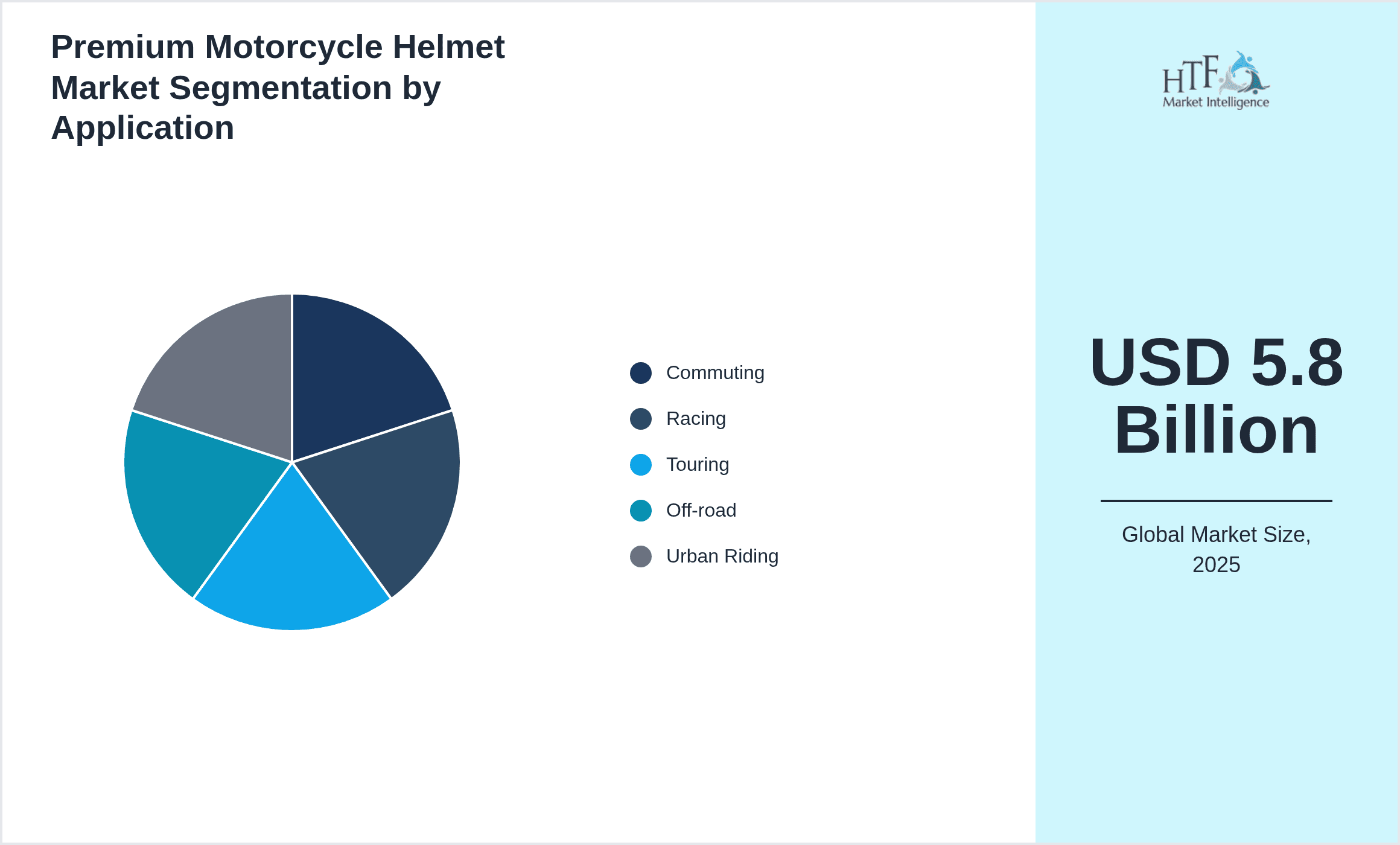
- •By Helmet Type
- ◦Full-face helmets
- ◦Modular helmets
- ◦Open-face helmets
- ◦Half-face helmets
- ◦Dual-sport helmets
- •By Application
- ◦Commuting
- ◦Racing
- ◦Touring
- ◦Off-road
- ◦Urban Riding
- •By Rider Age Group
- ◦18-25 years
- ◦26-40 years
- ◦41-60 years
- ◦Above 60 years
- •By Distribution Channel
- ◦Online Retail
- ◦Specialty Motorcycle Stores
- ◦Sports Goods Stores
- ◦Direct Manufacturer Sales
Growth Dynamics
- •Increasing government regulations mandating helmet use globally have significantly boosted demand for premium motorcycle helmets, ensuring rider safety and compliance. For example, the enforcement of stricter safety standards in North America and Europe has driven sales of helmets with superior impact resistance and advanced features.
- •Technological advancements such as smart helmet integration with Bluetooth communication, GPS navigation, and heads-up display systems are attracting tech-savvy riders and expanding the market scope beyond traditional safety equipment.
- •Rising disposable incomes in emerging economies, particularly in Asia-Pacific, are enabling more consumers to invest in premium helmets that offer enhanced protection and comfort, fueling regional market growth.
- •Growing motorcycle culture and urbanization worldwide have increased the number of riders, further driving demand for high-quality helmets that combine safety with style and convenience.
- •Manufacturers’ strategic focus on product innovation, including lightweight composites and aerodynamic designs, has enhanced user experience and differentiated premium products in a competitive market landscape.
Market Trends
- •The rising popularity of modular helmets is a key trend, driven by their versatility allowing riders to switch between full-face protection and open-face comfort, catering to diverse riding conditions and preferences.
- •Sustainability trends have led manufacturers to explore eco-friendly materials and recyclable components in helmet production, aligning with growing consumer environmental consciousness.
- •Integration of augmented reality (AR) features in helmets is emerging, offering navigational aids and safety alerts, which enhance rider situational awareness and market appeal.
- •Online retail channels have gained prominence as primary sales platforms, providing consumers with wider product access, competitive pricing, and detailed product information.
- •Customization and personalization options, such as custom graphics and fit adjustments, are increasingly influencing purchase decisions among premium helmet buyers seeking unique identity and comfort.
Market Opportunities
- •Expanding into emerging markets with rising motorcycle penetration offers substantial growth potential, particularly in Asia-Pacific and Latin America, where demand for premium safety gear is still developing.
- •Collaborations between helmet manufacturers and motorcycle OEMs to offer bundled safety solutions can enhance brand loyalty and market penetration.
- •Advancements in smart helmet technology create opportunities for innovation-led differentiation, attracting younger and tech-oriented consumer segments.
- •Growth in female motorcycle riders presents a niche market for helmet designs tailored to ergonomics and aesthetics preferred by women.
- •Increasing focus on sustainability can drive adoption of eco-friendly helmets, appealing to environmentally conscious consumers and complying with future regulations.
Market Challenges
- •High production costs of premium helmets due to advanced materials and technologies limit affordability for price-sensitive consumers, especially in developing regions.
- •Complex and varying safety regulations across global markets pose compliance challenges for manufacturers aiming for international expansion.
- •Counterfeit products and low-quality imports undermine brand reputation and consumer trust, impacting market growth and profitability.
- •Limited consumer awareness about the benefits of premium helmets in some regions results in slower adoption rates.
- •Rapid technological changes require continuous investment in R&D, posing financial and operational challenges for smaller manufacturers.
Regulatory Framework
- •Between 2019 and 2024, several countries and regions have updated helmet safety standards, mandating certifications such as DOT, ECE, and Snell to enhance rider protection. These regulations require helmets to meet stringent impact absorption, retention system strength, and field of vision criteria, directly influencing product design and market entry.
- •Enforcement of mandatory helmet laws in emerging markets has increased, with governments initiating awareness campaigns and stricter penalties for non-compliance, thereby expanding the addressable market for premium helmets.
- •Environmental regulations have started impacting helmet manufacturing, encouraging the use of recyclable materials and reducing harmful emissions during production processes to align with global sustainability goals.
- •Regional mandates in Europe and North America have introduced standards for smart helmets incorporating electronic components, ensuring safety without interference or hazards, guiding innovation trajectories.
- •Government incentives and subsidies in select Asia-Pacific countries support domestic production of certified helmets, fostering industry growth and local competitiveness.
Market Intelligence
- •15th January 2025, Shoei Co., Ltd. launched the X-Spirit 4 Carbon helmet featuring cutting-edge carbon fiber construction combined with integrated Bluetooth communication and enhanced aerodynamic design. This product targets racing and touring riders seeking top-tier protection with connectivity, aiming to capture premium market share globally.
- •2nd March 2025, AGV Helmets introduced the Pista GP RR Smart Edition, incorporating augmented reality navigation and crash detection sensors, marking a significant innovation in smart helmet technology. The launch positions AGV as a leader in integrating digital features with traditional safety standards.
- •10th June 2024, Bell Helmets announced a strategic partnership with a leading motorcycle OEM to co-develop helmets optimized for electric motorcycles, focusing on noise reduction and enhanced ventilation. This collaboration aims to align product offerings with the growing electric motorcycle segment.
- •20th November 2024, Schuberth GmbH completed the acquisition of a smart helmet startup specializing in heads-up display technology, expanding its product portfolio and accelerating innovation in connected riding solutions. This move strengthens Schuberth’s competitive position in the premium segment.
- •Source: Official company press releases and verified industry publications
Regional Outlook
The North America currently holds a significant share of the market, primarily due to several key factors: increasing consumption rates, a burgeoning population, and robust economic momentum. These elements collectively drive demand, positioning this region as a leader in the market. On the other hand, Asia-Pacific is rapidly emerging as the fastest-growing area within the industry. This remarkable growth can be attributed to swift infrastructure development, the expansion of various industrial sectors, and a marked increase in consumer demand. These dynamics make this region a crucial player in shaping future market growth.
In our report, we cover a comprehensive analysis of the following regions and countries:
- North America
- LATAM
- West Europe
- Central & Eastern Europe
- Northern Europe
- Southern Europe
- East Asia
- Southeast Asia
- South Asia
- Central Asia
- Oceania
- MEA
| Feature | Details |
|---|---|
| Base Year Market Size | USD 5.8 Billion |
| Forecast Year Market Size | USD 14.7 Billion |
| CAGR | 9.6% |
| Forecast Period | 2026 to 2033 |
| YoY Growth | 9.2% |
| Scope of Report | Market is segmented by Helmet Type (Full-face helmets, Modular helmets, Open-face helmets, Half-face helmets, Dual-sport helmets), Application (Commuting, Racing, Touring, Off-road, Urban Riding), Rider Age Group (18-25 years, 26-40 years, 41-60 years, Above 60 years), Distribution Channel (Online Retail, Specialty Motorcycle Stores, Sports Goods Stores, Direct Manufacturer Sales) |
| Regions Covered | North America, LATAM, West Europe, Central & Eastern Europe, Northern Europe, Southern Europe, East Asia, Southeast Asia, South Asia, Central Asia, Oceania, MEA |
| Key Companies | Shoei Co., Ltd. (Japan), AGV Helmets (Italy), Arai Helmet, Ltd. (Japan), Bell Helmets (United States), HJC Helmets (South Korea), Schuberth GmbH (Germany), Nolan Helmets (Italy), LS2 Helmets (China), Scorpion Sports (France), Shark Helmets (France), Icon Motorsports (United States), MT Helmets (Spain), Vemar Helmets (Italy), Torc Helmets (United States), Ruroc Ltd. (United Kingdom), Biltwell Inc. (United States), Premier Helmets (Italy), Fly Racing (United States), Shiro Helmets (Spain), KYT Helmets (Indonesia), Suomy Helmets (Italy), Astone Helmets (France), Bell Custom 500 (United States), Nexx Helmets (Portugal), Bieffe Helmets (Italy) |
Global Premium Motorcycle Helmet Market Size, Growth & Revenue 2024-2034 - Table of Contents
Frequently Asked Questions (FAQ):
The Compact Track Loaders market is expected to see value worth 5.3 Billion in 2025.
North America currently leads the market with approximately 45% market share, followed by Europe at 28% and Asia-Pacific at 22%. The remaining regions account for 5% of the global market.
Key growth drivers include increasing construction activities, rising demand for versatile equipment in agriculture, technological advancements in track loader design, and growing preference for compact equipment in urban construction projects.