
Global AVoIP Decoder Market - Outlook 2020-2034
Global AVoIP Decoder Market is segmented by Product Type (Hardware Decoder, Software Decoder, Integrated Decoder, Standalone Decoder, Modular Decoder), Application (Broadcasting, Corporate AV, Education, Healthcare, Hospitality), Deployment Model (Cloud-based, On-premise, Hybrid), Service Type (Installation & Integration, Maintenance & Support, Consulting Services, Training & Certification), and Geography (North America, LATAM, West Europe, Central & Eastern Europe, Northern Europe, Southern Europe, East Asia, Southeast Asia, South Asia, Central Asia, Oceania, MEA)
Pricing
Report Overview
Executive Summary
- •The global Audio Video over Internet Protocol (AVoIP) Decoder market is a rapidly evolving sector focused on devices and software that decode AV signals transmitted via IP networks. This market encompasses a broad range of products including hardware decoders, software decoders, integrated systems, standalone units, and modular designs tailored for diverse applications such as broadcasting, corporate audiovisual systems, education, healthcare, and hospitality. The AVoIP decoder ecosystem includes manufacturers, integrators, and software developers who contribute to the value chain by enabling efficient digital AV transmission. The technology supports high scalability, flexibility, and cost-effectiveness, making it an attractive alternative to traditional AV distribution methods. Businesses worldwide are increasingly investing in IP-based AV solutions to accommodate growing demands for high-quality video streaming, remote collaboration, and smart facility management. This report presents a detailed analysis of market dynamics, application segments, technological advancements, and regional performance from 2020 to 2034, highlighting key growth drivers and challenges shaping the market landscape.
- •The market is characterized by a strong CAGR of 12.25% from the base year 2025 to the forecast year 2034, driven by increasing adoption of AVoIP technology across industries. Regions such as North America dominate the market due to advanced infrastructure and strong corporate AV adoption, while Asia-Pacific is identified as the fastest growing region fueled by rapid digitalization and expanding broadcast sectors. Hardware decoders currently lead the product category, but software decoders are gaining traction rapidly due to their flexibility and lower upfront costs. Key market highlights include growing demand for high-resolution video streaming, increased integration of cloud technologies, and expansion of smart campus and healthcare environments. These factors collectively contribute to robust market expansion and innovation.
- •AVoIP decoders provide significant value propositions by enabling seamless, scalable AV content delivery over IP networks, reducing complexity and cost associated with traditional cabling. Their strategic importance spans multiple industries, including broadcasting firms seeking efficient content distribution, corporate sectors enhancing communication infrastructure, educational institutions implementing digital learning environments, healthcare facilities adopting telemedicine, and hospitality venues improving guest experience through advanced AV setups. The market offers stakeholders opportunities to leverage technological innovation and growing demand for IP-based AV solutions, fostering growth and competitive advantage in a digitally connected world.

Competitive Landscape
The global AVoIP Decoder market features a highly competitive environment marked by rapid technological innovation and strategic collaborations. Market players employ diverse competitive strategies including product differentiation through enhanced decoding capabilities, integration of AI and cloud functionalities, and expansion into emerging regional markets. Competitive positioning is influenced by factors such as pricing strategies, after-sales services, and distribution channel robustness. Companies actively pursue mergers and acquisitions to consolidate market presence and acquire advanced technologies, while strategic partnerships and ecosystem development enhance market penetration. Innovation in software decoders and modular hardware solutions is driving differentiation, allowing firms to cater to customized customer requirements. Barriers to entry include high R&D costs and the need for compatibility with multiple AV standards. Regional competition is significant, with North America and Europe representing mature markets, while Asia-Pacific offers high growth potential due to increasing digital infrastructure investments. Looking forward, the competitive landscape is expected to evolve with increased focus on cloud-based AV management, AI-enabled decoding, and seamless integration across platforms, thereby intensifying rivalry and fostering innovation.
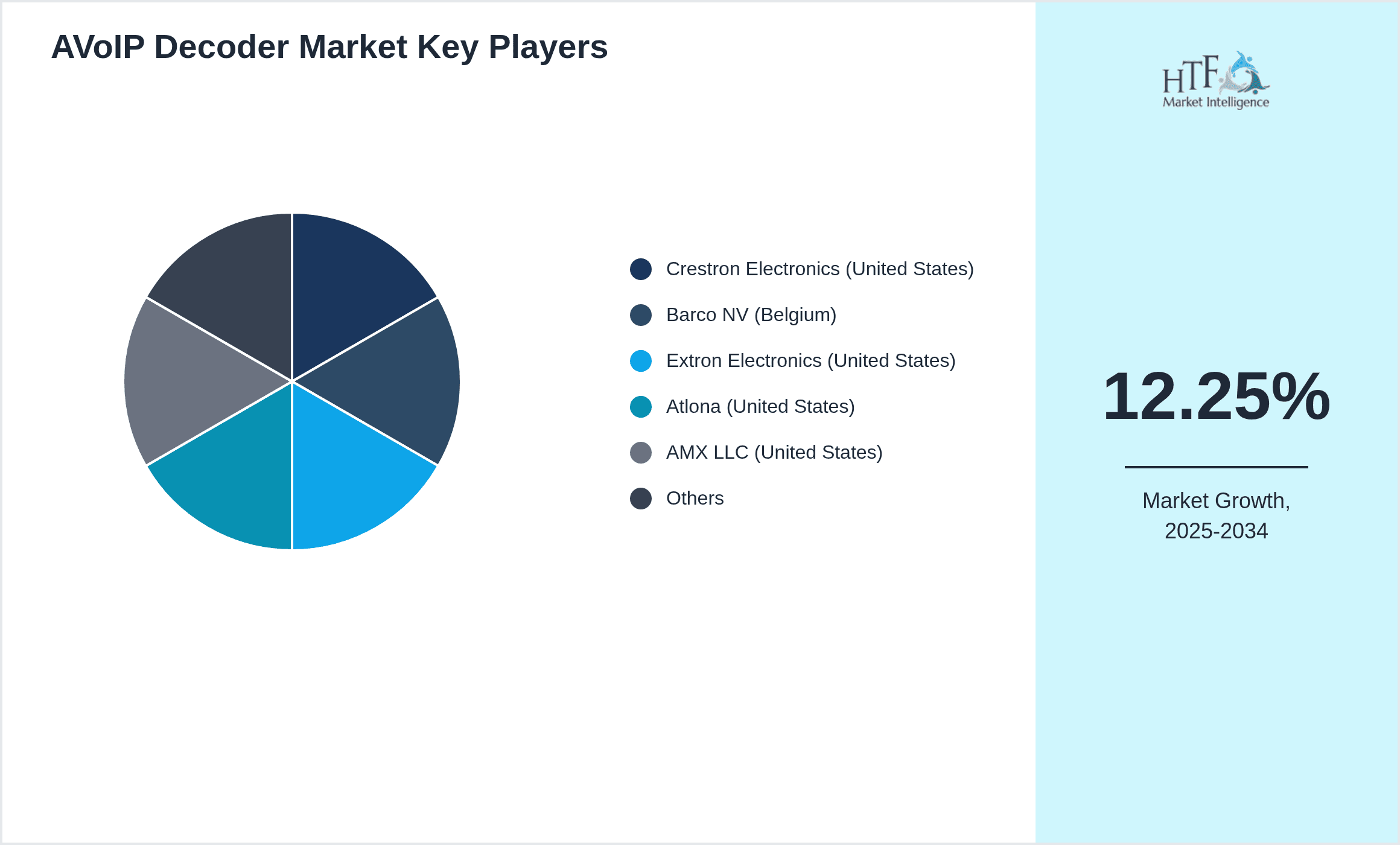
Leading Companies in AVoIP Decoder Market
- •Crestron Electronics (United States)
- •Barco NV (Belgium)
- •Extron Electronics (United States)
- •Atlona (United States)
- •AMX LLC (United States)
- •Cisco Systems, Inc. (United States)
- •Matrox Graphics Inc. (Canada)
- •Hall Research (United States)
- •Gefen, a Nortek Company (United States)
- •Lightware Visual Engineering (Hungary)
- •Aurora Multimedia Corp. (United States)
- •Just Add Power (United States)
- •VITEC (France)
- •Black Box Corporation (United States)
- •Zigen Inc. (United States)
- •Atlona (United States)
- •Gefen, Inc. (United States)
- •Avenview (United States)
- •Blustream (Australia)
- •Dahua Technology (China)
- •Luxul (United States)
- •WyreStorm (United Kingdom)
- •Kramer Electronics (Israel)
- •Zyxel Communications (Taiwan)
- •Biamp Systems (United States)
Market Breakdown
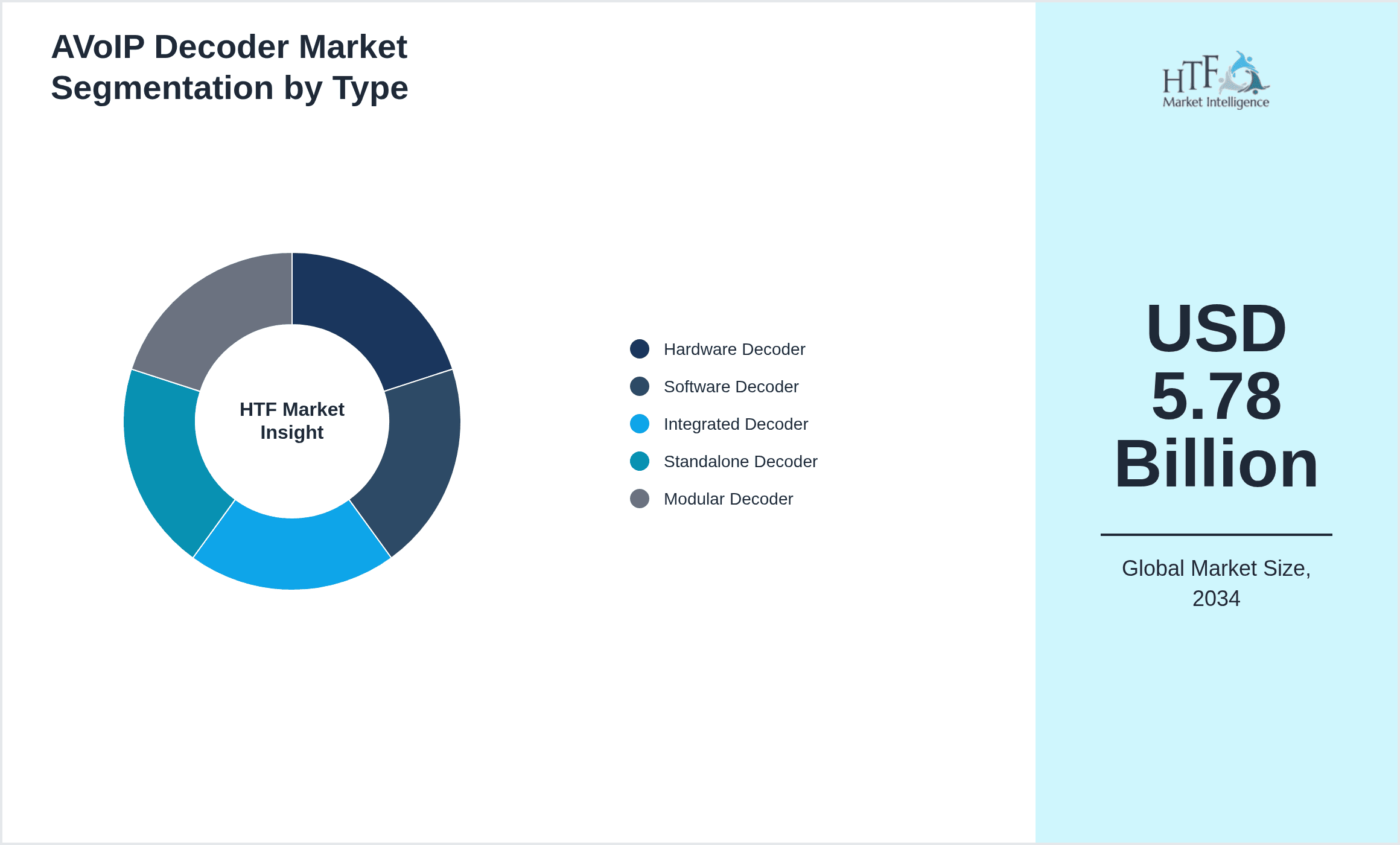
- •By Product Type
- ◦Hardware Decoder
- ◦Software Decoder
- ◦Integrated Decoder
- ◦Standalone Decoder
- ◦Modular Decoder
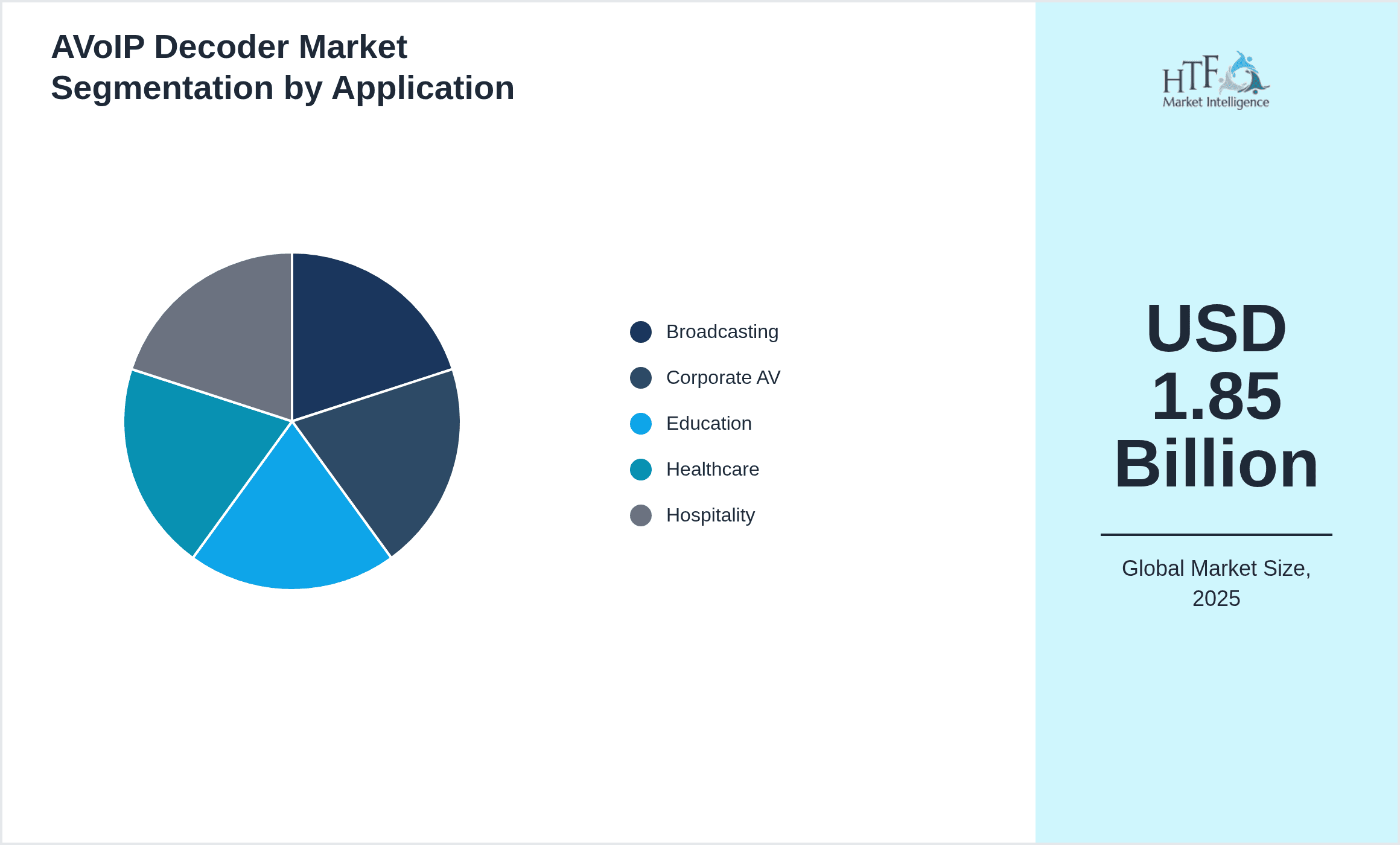
- •By Application
- ◦Broadcasting
- ◦Corporate AV
- ◦Education
- ◦Healthcare
- ◦Hospitality
- •By Deployment Model
- ◦Cloud-based
- ◦On-premise
- ◦Hybrid
- •By Service Type
- ◦Installation & Integration
- ◦Maintenance & Support
- ◦Consulting Services
- ◦Training & Certification
Growth Dynamics
- •The increasing demand for high-quality, scalable AV transmission across industries drives the AVoIP decoder market growth. Organizations are transitioning from traditional AV systems to IP-based infrastructure, enabling flexible and efficient content distribution with reduced cabling and enhanced control. This shift is particularly notable in broadcasting and corporate sectors where seamless video streaming and remote collaboration are critical.
- •Technological advancements such as software-defined decoders and integration of AI-powered features enhance decoding efficiency and user experience. These innovations allow real-time analytics, adaptive streaming, and improved compatibility with diverse AV standards, further accelerating market adoption.
- •Expansion of smart infrastructure including smart campuses, hospitals, and hotels fuels demand for integrated AVoIP solutions. These environments require scalable and interoperable AV systems enabling centralized management, contributing to increased market penetration.
- •Growing investments in cloud-based AV deployment models provide flexibility and reduce upfront costs for end users. Cloud integration supports remote access and management of AV networks, which is particularly beneficial in geographically dispersed organizations.
- •Rising awareness and adoption of IP-based AV technology in emerging regions, especially Asia-Pacific and Latin America, open new growth avenues. Infrastructure development and digital transformation initiatives in these regions support market expansion.
Market Trends
- •Adoption of AI and machine learning in AVoIP decoders is enabling advanced features such as content optimization, security enhancements, and predictive maintenance. Industry leaders are integrating AI to improve user experience and operational efficiency.
- •The rise of hybrid deployment models combining cloud and on-premise solutions offers flexibility, allowing organizations to balance security, control, and scalability according to their specific needs. This trend is gaining traction across corporate and education sectors.
- •Sustainability considerations are influencing product design, with manufacturers developing energy-efficient decoders that reduce power consumption without compromising performance, aligning with growing environmental regulations and corporate responsibility goals.
- •The increasing integration of AVoIP decoders with unified communication platforms and IoT devices is fostering ecosystem development, driving convergence of AV and IT networks, and enabling comprehensive digital workplace solutions.
- •Modular hardware designs offer customization and scalability, allowing users to upgrade or replace components as needed, thereby extending product lifecycle and reducing total cost of ownership.
Market Opportunities
- •Growing need for remote collaboration solutions in corporate and education sectors creates opportunities for advanced AVoIP decoders that support multi-streaming and high-resolution video transmission, enabling enriched communication experiences.
- •Emerging markets in Asia-Pacific and Latin America present significant untapped potential driven by digital transformation initiatives and expanding broadcasting infrastructure, encouraging market entrants to localize offerings and foster partnerships.
- •Integration with cloud services and AI technologies offers avenues for innovation, allowing companies to develop smart decoders capable of real-time analytics, network optimization, and enhanced security, strengthening competitive positioning.
- •The rise in demand for healthcare AV solutions, particularly telemedicine and remote diagnostics, opens niche markets for specialized decoders that ensure low latency and high fidelity video transmission in critical environments.
- •Strategic alliances and acquisitions focusing on complementary technologies can accelerate market penetration and broaden product portfolios, creating synergies and expanding customer base.
Market Challenges
- •High initial investment and complexity associated with deploying AVoIP infrastructure deter small and medium enterprises from adoption, limiting market penetration in cost-sensitive segments.
- •Interoperability issues among different AV protocols and standards pose technical challenges, requiring continuous development and standardization efforts to ensure seamless integration across devices and platforms.
- •Cybersecurity concerns around IP-based AV systems necessitate robust encryption and protection mechanisms, increasing development costs and operational complexities for manufacturers and end users.
- •Limited availability of skilled professionals for installation, maintenance, and management of AVoIP systems creates barriers for rapid adoption, especially in emerging markets.
- •Latency and bandwidth constraints in existing network infrastructures can affect AV quality, requiring significant network upgrades and investments to support high-definition streaming and real-time interactions.
Regulatory Framework
- •Between 2020 and 2025, several regulations have been enacted globally to ensure data privacy and security in IP-based communications, impacting AVoIP decoder design and deployment. For example, GDPR in Europe mandates stringent data handling and encryption protocols, compelling manufacturers to integrate compliant security features.
- •The FCC in the United States has updated network communication standards requiring AVoIP devices to meet specific electromagnetic compatibility and interference criteria, ensuring reliable operation alongside other networked equipment.
- •Environmental regulations such as RoHS and WEEE directives have influenced the production of AVoIP decoders by enforcing restrictions on hazardous substances and mandating proper electronic waste management, promoting ecological sustainability.
- •Country-specific mandates in Asia-Pacific, such as China’s Cybersecurity Law, have introduced compliance requirements for data localization and network security, affecting market entry strategies and device configuration for international companies.
- •Government incentives and standards promoting smart city and digital infrastructure projects have encouraged adoption of IP-based AV technologies, indirectly supporting market growth through supportive policy frameworks and funding programs.
Market Intelligence
- •15th February 2025, Crestron Electronics announced the launch of its new line of software-based AVoIP decoders featuring AI-driven adaptive streaming technology designed to optimize bandwidth usage and enhance video quality in real-time. Targeting corporate and education sectors, this product integrates seamlessly with existing AV networks and supports multi-platform deployment, aiming to reduce latency and improve user experience. The initiative reflects the company’s strategic focus on cloud-based AV solutions and scalability, positioning Crestron at the forefront of innovation in the global AVoIP decoder market. Source: Crestron Electronics official press release.
- •10th June 2025, Barco NV introduced an integrated AVoIP decoder system tailored for healthcare applications, emphasizing ultra-low latency and high-resolution video transmission critical for telemedicine and remote diagnostics. The product includes advanced security features compliant with HIPAA and GDPR, addressing regulatory demands in sensitive environments. Barco’s strategic objective is to expand its footprint in the healthcare AV market by delivering specialized solutions that enhance clinical workflows and patient outcomes. This launch underscores growing demand for industry-specific AVoIP technologies. Source: Barco NV corporate announcement.
- •5th August 2025, Cisco Systems completed its acquisition of a leading AVoIP software startup specializing in cloud-based AV management platforms. The acquisition aims to integrate advanced cloud orchestration and AI analytics into Cisco’s existing AV portfolio, enhancing system scalability and user customization. This strategic move strengthens Cisco’s position in the enterprise AV market and accelerates development of next-generation IP-based AV solutions. The deal is expected to foster innovation and consolidate Cisco’s competitive advantage globally. Source: Cisco Systems official press release.
- •22nd November 2024, VITEC announced a strategic partnership with a major cloud service provider to deliver hybrid deployment models combining on-premise decoders with cloud-based management systems. This collaboration targets broadcasters and large-scale events requiring flexible AV distribution and real-time content delivery with minimal latency. The partnership enhances VITEC’s product portfolio and expands market reach, highlighting the growing trend toward hybrid AV infrastructure solutions. Source: VITEC press release.
Regional Outlook
The North America currently holds a significant share of the market, primarily due to several key factors: increasing consumption rates, a burgeoning population, and robust economic momentum. These elements collectively drive demand, positioning this region as a leader in the market. On the other hand, Asia-Pacific is rapidly emerging as the fastest-growing area within the industry. This remarkable growth can be attributed to swift infrastructure development, the expansion of various industrial sectors, and a marked increase in consumer demand. These dynamics make this region a crucial player in shaping future market growth.
In our report, we cover a comprehensive analysis of the following regions and countries:
- North America
- LATAM
- West Europe
- Central & Eastern Europe
- Northern Europe
- Southern Europe
- East Asia
- Southeast Asia
- South Asia
- Central Asia
- Oceania
- MEA
| Feature | Details |
|---|---|
| Base Year Market Size | USD 1.85 Billion |
| Forecast Year Market Size | USD 5.78 Billion |
| CAGR | 12.25% |
| Forecast Period | 2026 to 2033 |
| YoY Growth | 12.35% |
| Scope of Report | Market is segmented by Product Type (Hardware Decoder, Software Decoder, Integrated Decoder, Standalone Decoder, Modular Decoder), Application (Broadcasting, Corporate AV, Education, Healthcare, Hospitality), Deployment Model (Cloud-based, On-premise, Hybrid), Service Type (Installation & Integration, Maintenance & Support, Consulting Services, Training & Certification) |
| Regions Covered | North America, LATAM, West Europe, Central & Eastern Europe, Northern Europe, Southern Europe, East Asia, Southeast Asia, South Asia, Central Asia, Oceania, MEA |
| Key Companies | Crestron Electronics (United States), Barco NV (Belgium), Extron Electronics (United States), Atlona (United States), AMX LLC (United States), Cisco Systems, Inc. (United States), Matrox Graphics Inc. (Canada), Hall Research (United States), Gefen, a Nortek Company (United States), Lightware Visual Engineering (Hungary), Aurora Multimedia Corp. (United States), Just Add Power (United States), VITEC (France), Black Box Corporation (United States), Zigen Inc. (United States), Atlona (United States), Gefen, Inc. (United States), Avenview (United States), Blustream (Australia), Dahua Technology (China), Luxul (United States), WyreStorm (United Kingdom), Kramer Electronics (Israel), Zyxel Communications (Taiwan), Biamp Systems (United States) |
Global AVoIP Decoder Market - Outlook 2020-2034 - Table of Contents
Frequently Asked Questions (FAQ):
The Compact Track Loaders market is projected to grow at a CAGR of 6.8% from 2025 to 2030, driven by increasing demand in construction and agricultural sectors.
North America currently leads the market with approximately 45% market share, followed by Europe at 28% and Asia-Pacific at 22%. The remaining regions account for 5% of the global market.
Key growth drivers include increasing construction activities, rising demand for versatile equipment in agriculture, technological advancements in track loader design, and growing preference for compact equipment in urban construction projects.