
EMEA Desoldering Tools Market Size, Growth & Revenue 2025-2034
EMEA Desoldering Tools Market is segmented by Desoldering Tool Type (Manual Desoldering Tools, Electric Desoldering Tools, Pneumatic Desoldering Tools, Vacuum Desoldering Tools, Hot Air Desoldering Tools), Application Sector (Electronics Manufacturing, Repair Services, Automotive Industry, Aerospace & Defense, Consumer Electronics), Service Type (Maintenance & Repair Services, Tool Rental Services, After-Sales Support, Training & Certification), Deployment Model (Manual Operation, Semi-Automated Systems, Fully Automated Systems), and Geography (Germany, France, Italy, United Kingdom, Nordics, Rest of Europe, South Africa, Egypt, Turkey, United Arab Emirates, Israel, Saudi Arabia, Rest of EMEA)
Pricing
Report Overview
Executive Summary
- •The EMEA Desoldering Tools market involves a diverse range of equipment designed primarily for the removal of solder from electronic assemblies and components. This market serves a vital role in the electronics manufacturing and repair sectors, facilitating rework and quality control. Key product categories include manual, electric, pneumatic, vacuum, and hot air desoldering tools, each catering to different operational needs and technical specifications. The end-use industries span consumer electronics, automotive, aerospace, and defense, reflecting the region’s broad industrial base. The value chain integrates raw material procurement, manufacturing, distribution, and after-sales services, supported by technological advancements that enhance precision and efficiency. Applications range from small-scale repair workshops to large electronics manufacturing facilities, highlighting the market’s versatility. Growing demand for maintenance and refurbishment of electronics, combined with the rise of complex circuit assemblies, drives innovation and market expansion. Regional dynamics in Europe, Middle East, and Africa present varying growth opportunities influenced by industrial policies, regulatory frameworks, and technological adoption. The market’s strategic importance lies in its contribution to product lifecycle extension, cost savings, and environmental sustainability through reduced electronic waste.
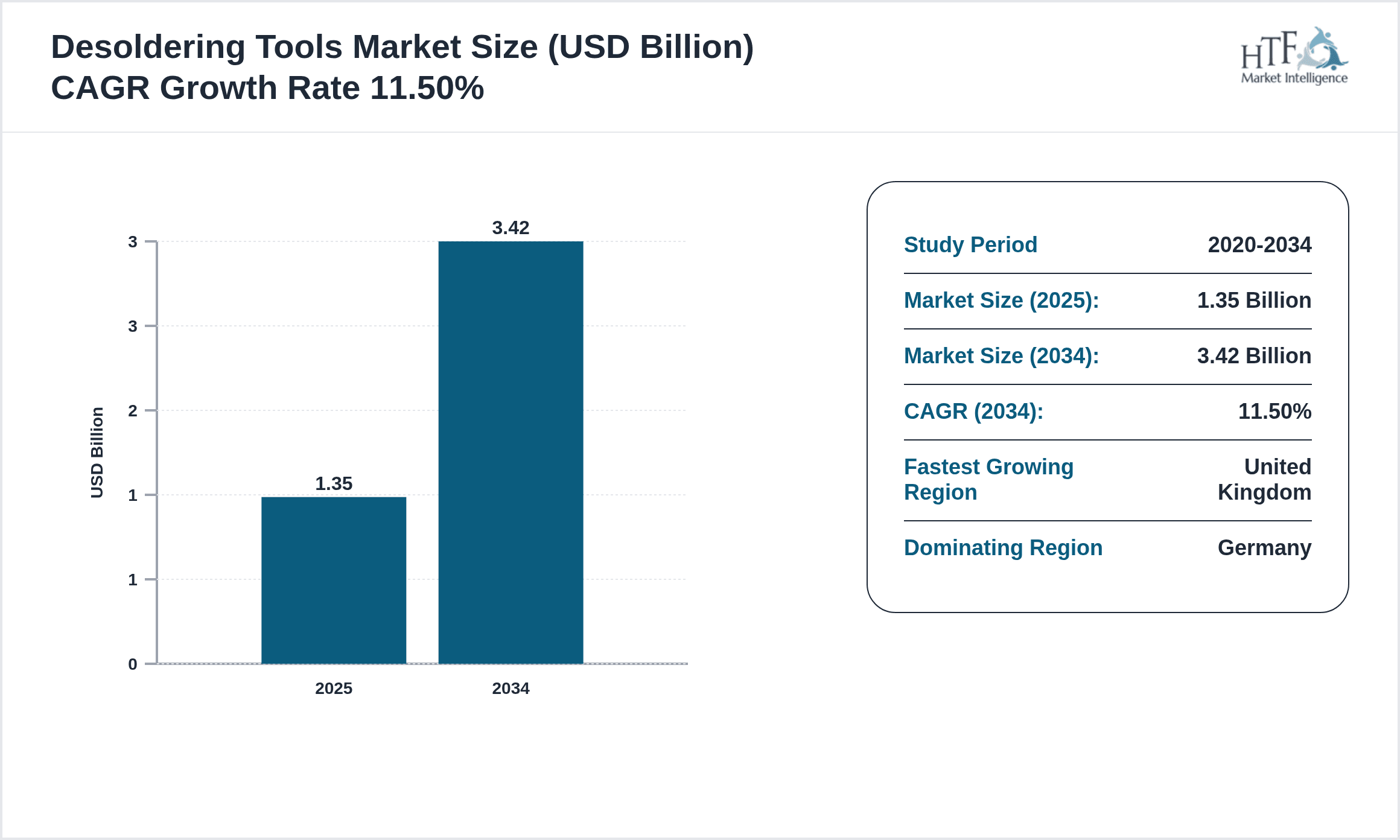
- •Market highlights include a base market size of USD 1.35 Billion in 2025, forecasted to reach USD 3.42 Billion by 2034, reflecting a robust CAGR of 11.5%. The growth trajectory is supported by increasing electronics manufacturing activities and repair services demand, particularly in Germany and the United Kingdom. Electric desoldering tools currently dominate the market due to their efficiency and precision, while vacuum desoldering tools are the fastest-growing segment driven by automation trends. The year-on-year growth rate of approximately 11.0% underscores steady adoption across EMEA industries. Market drivers include technological innovation, rising consumer electronics penetration, and expansion in automotive and aerospace sectors. Challenges such as high initial equipment costs and skilled labor shortages persist but are mitigated by ongoing investments and training programs.
- •The value proposition of the EMEA Desoldering Tools market lies in enabling efficient electronic component repair and manufacturing processes that reduce downtime and improve product quality. This market is strategically important to stakeholders ranging from manufacturers, service providers, and distributors to end-users in automotive, aerospace, and consumer electronics industries. Enhanced tool precision and automation capabilities contribute to sustainability by minimizing waste and energy consumption. Additionally, compliance with stringent European regulatory standards ensures safety and environmental responsibility. The market’s growth facilitates technological advancements and supports the broader electronics ecosystem, reinforcing EMEA’s position as a hub for innovation and industrial excellence.
Competitive Landscape
The EMEA desoldering tools market exhibits a highly competitive environment characterized by a mix of global corporations and regional specialized manufacturers. Competitive strategies focus on innovation, product differentiation, and expanding service portfolios to cater to diverse industrial applications. Leading players invest heavily in R&D to develop tools with enhanced precision, ergonomic design, and automation compatibility. Strategic partnerships and collaborations with electronics manufacturers and repair service providers enable effective market penetration and customer retention. Pricing strategies vary from premium offerings targeting high-end aerospace and automotive sectors to cost-effective solutions for small-scale repair shops. Distribution channels include direct sales, authorized dealers, and e-commerce platforms, enhancing market accessibility. Regional competition is influenced by localized manufacturing capabilities and regulatory compliance, with Germany and the United Kingdom serving as key competitive hubs. Market entry barriers include technology expertise and certification requirements, while mergers and acquisitions facilitate consolidation and portfolio expansion. Future trends indicate increasing adoption of IoT-enabled desoldering tools and integration with Industry 4.0 manufacturing systems, reinforcing the competitive dynamics.
Leading Companies in Desoldering Tools Market
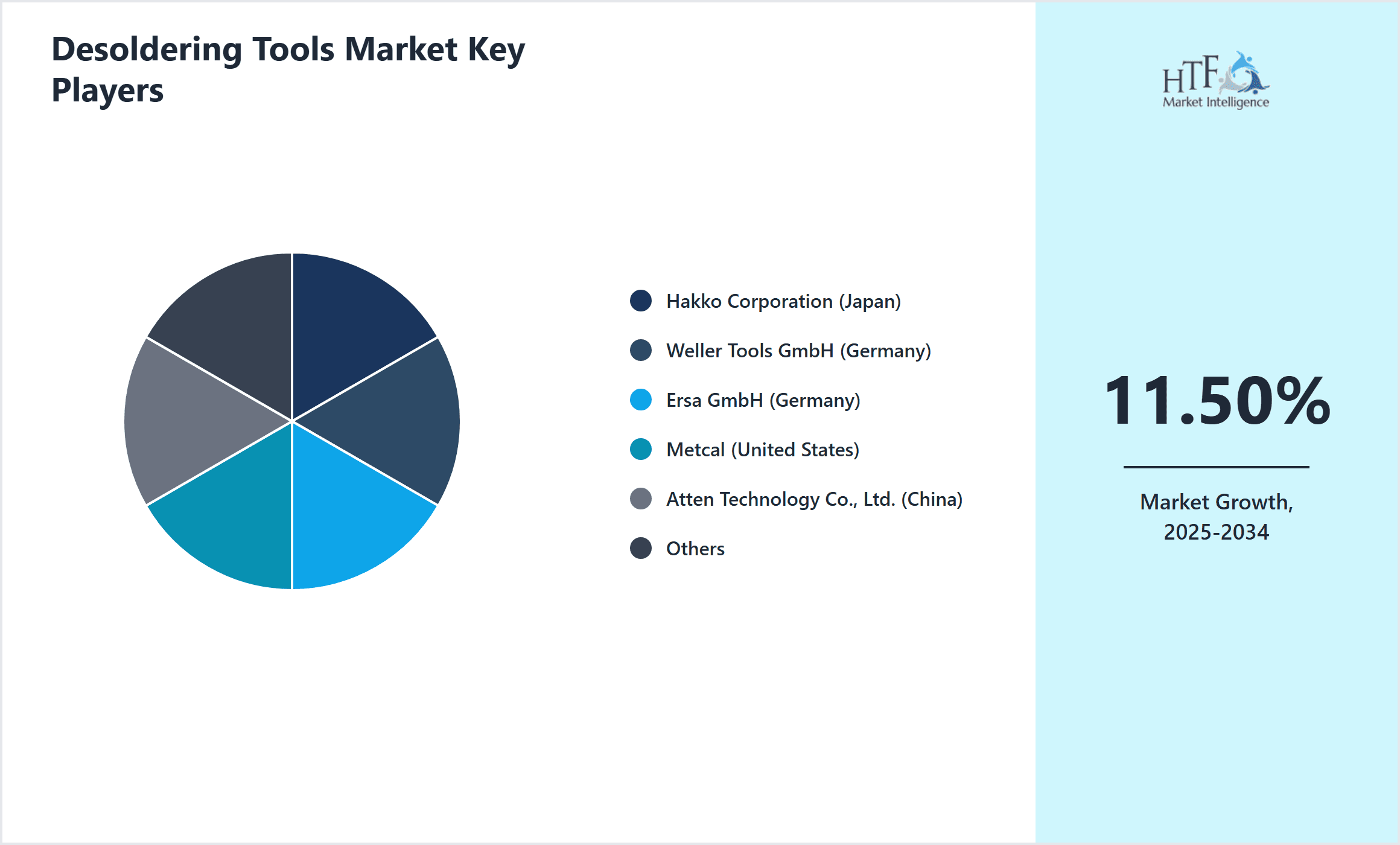
- •Hakko Corporation (Japan)
- •Weller Tools GmbH (Germany)
- •Ersa GmbH (Germany)
- •Metcal (United States)
- •Atten Technology Co., Ltd. (China)
- •PACE Worldwide (United States)
- •JBC Tools (Spain)
- •Soldering Station LLC (Russia)
- •Quick Soldering Products Co., Ltd. (China)
- •SRA Soldering Products (United Kingdom)
- •Techspray (United States)
- •Aoyue (China)
- •Goot Electronics (Japan)
- •Zhaolong Technology Co., Ltd. (China)
- •SolderPro (Germany)
- •Kurtz Ersa (Germany)
- •Quicko (India)
- •Aim-TTi (United Kingdom)
- •Weller Tools GmbH (Germany)
- •Power Probe (United States)
- •Thermaltronics (United States)
- •Velleman (Belgium)
- •BGA Rework Station Co. (China)
- •Atten Technology (China)
- •Ersa GmbH (Germany)
Market Breakdown
- •By Desoldering Tool Type
- ◦Manual Desoldering Tools
- ◦Electric Desoldering Tools
- ◦Pneumatic Desoldering Tools
- ◦Vacuum Desoldering Tools
- ◦Hot Air Desoldering Tools
- •By Application Sector
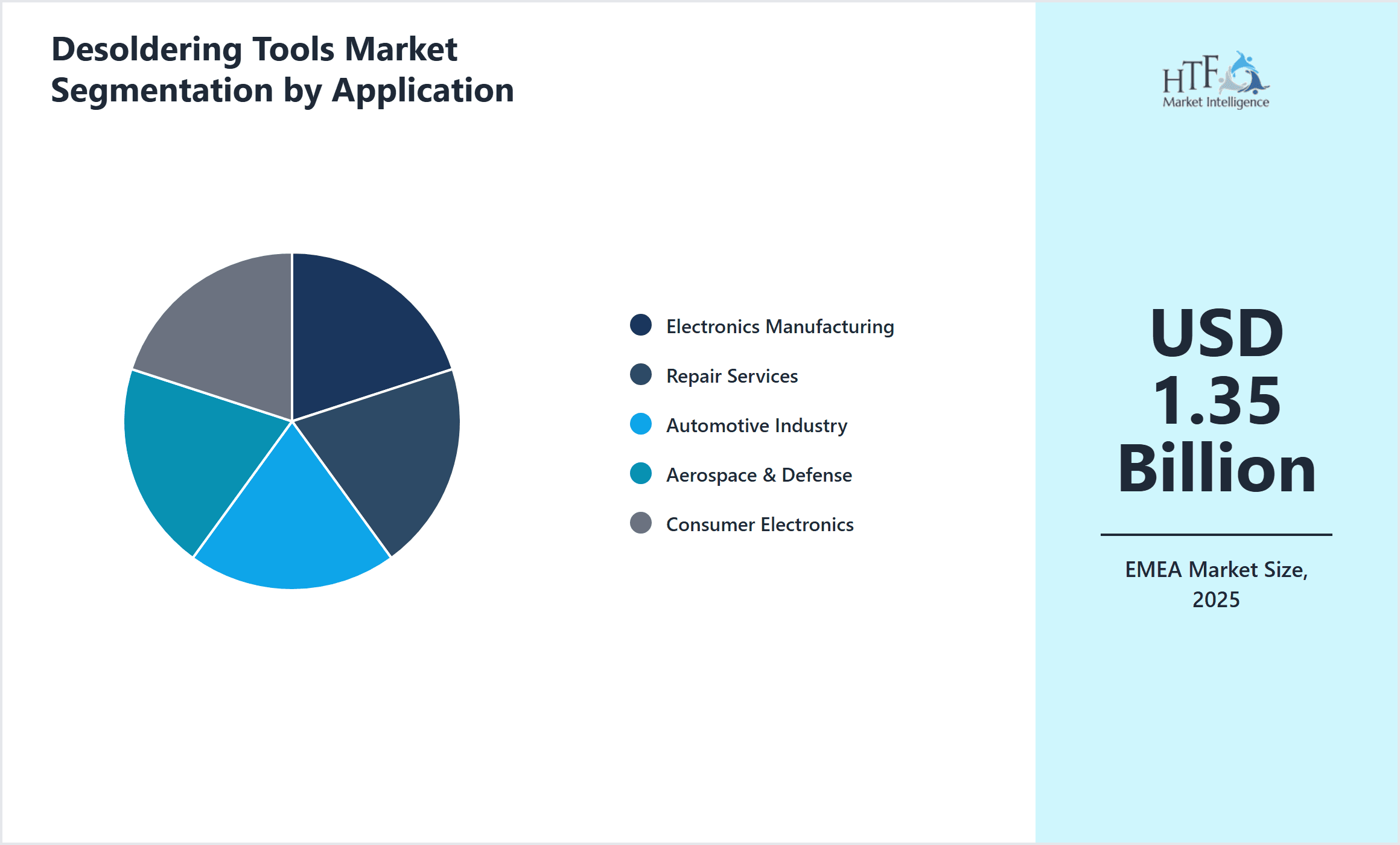
- ◦Electronics Manufacturing
- ◦Repair Services
- ◦Automotive Industry
- ◦Aerospace & Defense
- ◦Consumer Electronics
- •By Service Type
- ◦Maintenance & Repair Services
- ◦Tool Rental Services
- ◦After-Sales Support
- ◦Training & Certification
- •By Deployment Model
- ◦Manual Operation
- ◦Semi-Automated Systems
- ◦Fully Automated Systems
Growth Dynamics
- •Rising demand for consumer electronics in EMEA fuels the need for precise and efficient desoldering tools, especially in repair and refurbishment sectors. Manufacturers prioritize electric and vacuum desoldering tools for enhanced productivity.
- •Technological advancements in automation and smart tool integration enable improved accuracy and reduced operator fatigue, driving adoption across automotive and aerospace industries.
- •Stringent environmental regulations in Europe encourage the use of eco-friendly desoldering processes and tools that minimize waste and hazardous emissions.
- •Growth in electronics manufacturing hubs within Germany, France, and the UK supports steady market expansion, supported by government incentives and skilled workforce availability.
- •Increasing repair and maintenance activities driven by higher electronic device penetration and longer product lifecycles boost demand for reliable desoldering solutions.
- •Investment in R&D for ergonomic and user-friendly tool designs enhances adoption rates, especially in small and medium-sized enterprises across the EMEA region.
- •Emerging trends in Industry 4.0 and IoT integration promote the development of connected desoldering tools, enabling predictive maintenance and process optimization.

Market Trends
- •The shift towards electric and vacuum desoldering tools is prominent due to their precision, speed, and compatibility with automated production lines in EMEA electronics manufacturing.
- •Sustainability trends drive manufacturers to develop energy-efficient tools with recyclable components to meet European Union environmental standards.
- •Collaborations between tool manufacturers and electronics OEMs facilitate tailored solutions, enhancing repair quality and reducing production downtime.
- •Digitalization and IoT-enabled desoldering tools allow real-time monitoring, data analytics, and remote diagnostics, improving operational efficiency and tool lifecycle management.
- •Increasing demand for handheld, portable desoldering tools supports mobile repair services and on-site maintenance, especially in the Middle East and Africa regions.
- •Growth in aftermarket repair services fuels demand for cost-effective and versatile desoldering tools capable of handling diverse electronic components.
- •Adoption of lead-free soldering materials necessitates compatible desoldering tools, influencing product development and market offerings.
Market Opportunities
- •Expansion of electronics manufacturing in emerging EMEA economies offers untapped markets for desoldering tool producers to introduce cost-effective and scalable solutions.
- •Growing demand for repair and refurbishment services, driven by sustainability initiatives and circular economy principles, creates opportunities for advanced desoldering technologies.
- •Integration of IoT and Industry 4.0 technologies in desoldering tools enables new service models such as predictive maintenance and tool-as-a-service offerings.
- •Collaborative partnerships with academic and research institutions can drive innovation in ergonomic and environmentally friendly tool designs tailored to regional needs.
- •Increasing government incentives for electronics recycling and repair support market growth through funding and policy frameworks encouraging technology adoption.
- •Developing training and certification programs enhances skilled labor availability, improving market penetration and customer trust in advanced desoldering solutions.
- •Emerging applications in automotive electronics and aerospace systems provide scope for specialized desoldering tools with high precision and reliability.
Market Challenges
- •High initial investment costs for advanced desoldering tools restrict adoption among small and medium enterprises, limiting market penetration in certain EMEA segments.
- •Skilled labor shortages in specialized electronics repair services hamper market growth and necessitate investment in training and automation.
- •Stringent regulatory compliance and certification requirements increase product development costs and time-to-market for desoldering tool manufacturers.
- •Competition from low-cost imports and counterfeit products affects pricing strategies and brand reputation in some EMEA countries.
- •Rapid technology changes require continuous innovation, posing risks of obsolescence for existing desoldering tool products.
- •Environmental concerns related to hazardous materials in soldering processes demand adherence to strict waste management and disposal protocols.
- •Supply chain disruptions, particularly in raw material sourcing and component availability, impact manufacturing schedules and delivery timelines.
Regulatory Framework
- •The RoHS Directive (Restriction of Hazardous Substances) implemented in 2011 mandates limits on hazardous materials in electronic equipment, significantly impacting desoldering tool design and use in EMEA by enforcing safer materials and processes.
- •WEEE Directive (Waste Electrical and Electronic Equipment) enacted in 2012 requires manufacturers and importers to manage electronic waste responsibly, influencing end-of-life handling of desoldering tools and related equipment.
- •CE Marking regulations ensure that desoldering tools meet European health, safety, and environmental protection standards before market entry, requiring compliance testing and certification.
- •REACH regulation (Registration, Evaluation, Authorization, and Restriction of Chemicals) established in 2007 governs chemical substances used in manufacturing desoldering tools, affecting material selection and supplier compliance.
- •The Machinery Directive 2006/42/EC sets safety requirements for machinery including electric and pneumatic desoldering tools, mandating conformity assessment and risk management procedures to protect users.
Market Intelligence
- •15 March 2025, Weller Tools GmbH launched its latest electric vacuum desoldering station designed for high-precision electronics manufacturing in Europe. The product features enhanced ergonomic design, improved suction power, and compatibility with lead-free solder materials, targeting automotive and aerospace sectors. This launch aligns with increasing demand for efficient repair tools across EMEA and supports sustainability goals through reduced energy consumption. Weller aims to consolidate its market leadership by addressing evolving customer needs with innovative solutions. Source: Weller Official Press Release
- •10 April 2025, Ersa GmbH introduced an Industry 4.0 integrated desoldering tool capable of real-time process monitoring and predictive maintenance. Equipped with IoT sensors and cloud connectivity, the tool enables manufacturers to optimize repair workflows and minimize downtime. This innovation targets large-scale electronics manufacturing facilities in Germany, France, and the UK, enhancing operational efficiency and traceability. Ersa’s initiative reflects broader trends of digital transformation in the EMEA electronics sector, positioning the company as a technological pioneer. Source: Ersa Corporate News
- •28 June 2025, Hakko Corporation announced a strategic partnership with a leading European electronics repair network to supply advanced manual and vacuum desoldering tools. The collaboration focuses on expanding tool availability and providing technical training to repair technicians across EMEA. This initiative supports market growth by improving accessibility to high-quality tools and enhancing workforce expertise, addressing one of the key challenges in the region. Hakko's move strengthens its footprint in the competitive desoldering tools market. Source: Hakko Press Release
- •Market Intelligence: Recent developments and industry insights are being monitored. For the latest updates, stakeholders are advised to consult official company announcements and industry publications regularly.
Regional Outlook
The Germany currently holds a significant share of the market, primarily due to several key factors: increasing consumption rates, a burgeoning population, and robust economic momentum. These elements collectively drive demand, positioning this region as a leader in the market. On the other hand, United Kingdom is rapidly emerging as the fastest-growing area within the industry. This remarkable growth can be attributed to swift infrastructure development, the expansion of various industrial sectors, and a marked increase in consumer demand. These dynamics make this region a crucial player in shaping future market growth.
In our report, we cover a comprehensive analysis of the following regions and countries:
- Germany
- France
- Italy
- United Kingdom
- Nordics
- Rest of Europe
- South Africa
- Egypt
- Turkey
- United Arab Emirates
- Israel
- Saudi Arabia
- Rest of EMEA
| Feature | Details |
|---|---|
| Base Year Market Size | USD 1.35 Billion |
| Forecast Year Market Size | USD 3.42 Billion |
| CAGR | 11.5% |
| Forecast Period | 2026 to 2033 |
| YoY Growth | 11% |
| Scope of Report | Market is segmented by Desoldering Tool Type (Manual Desoldering Tools, Electric Desoldering Tools, Pneumatic Desoldering Tools, Vacuum Desoldering Tools, Hot Air Desoldering Tools), Application Sector (Electronics Manufacturing, Repair Services, Automotive Industry, Aerospace & Defense, Consumer Electronics), Service Type (Maintenance & Repair Services, Tool Rental Services, After-Sales Support, Training & Certification), Deployment Model (Manual Operation, Semi-Automated Systems, Fully Automated Systems) |
| Regions Covered | Germany, France, Italy, United Kingdom, Nordics, Rest of Europe, South Africa, Egypt, Turkey, United Arab Emirates, Israel, Saudi Arabia, Rest of EMEA |
| Key Companies | Hakko Corporation (Japan), Weller Tools GmbH (Germany), Ersa GmbH (Germany), Metcal (United States), Atten Technology Co., Ltd. (China) |
EMEA Desoldering Tools Market Size, Growth & Revenue 2025-2034 - Table of Contents
Research enthusiast focused on transforming data uncovering into actionable insights through data-driven decision-making.
Frequently Asked Questions (FAQ):
The Market market is expected to see significant growth and value in 2025.
North America currently leads the market, followed by Europe and Asia-Pacific.
Key growth drivers include increasing activities, rising demand for innovative solutions, technological advancements, and growing preference for efficient products.