
Global AI Content Creation Market Size, Growth & Revenue 2025-2033
Global AI Content Creation Market is segmented by Application (Marketing, Media & Entertainment, E-commerce, Education), Type (Text Generation, Image Generation, Video Generation, Audio Generation), and Geography (North America, LATAM, West Europe, Central & Eastern Europe, Northern Europe, Southern Europe, East Asia, Southeast Asia, South Asia, Central Asia, Oceania, MEA)
Pricing
Report Overview
AI Content Creation Market Overview
AI Content Creation Market encompasses generative artificial intelligence platforms that automate the production of text, images, videos, and audio content. These solutions leverage large language models, diffusion models, and multimodal architectures to generate marketing materials, creative assets, product descriptions, training content, and social media posts. Enterprises and individual creators adopt AI content tools to enhance productivity, reduce content development costs, and accelerate campaign cycles. The market includes SaaS-based platforms, API-driven engines, and integrated creative software ecosystems. Rapid advancements in generative AI, improved model training techniques, and cloud-based scalability are transforming the creative economy. Multimodal capabilities enabling synchronized text, image, and video outputs represent a significant innovation wave. Despite high growth potential, concerns regarding copyright compliance, misinformation, and ethical AI governance continue to shape regulatory discussions and enterprise adoption policies.
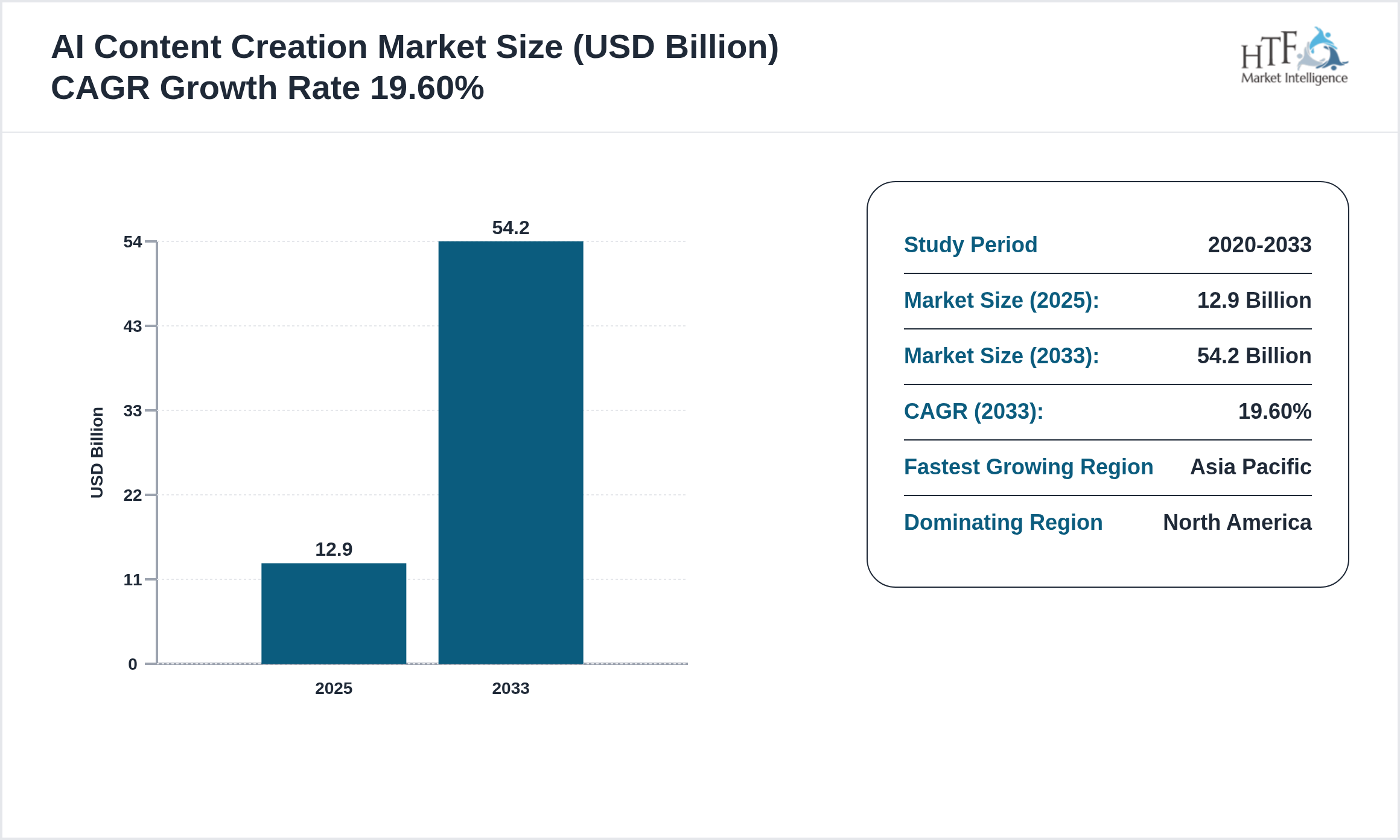
The AI Content Creation market was valued at 12.90 billion in 2025 and is expected to reach 54.20 billion by 2020, growing at a compound annual growth rate (CAGR) of 19.60% over the forecast period. This steady growth is driven by factors such as increasing demand, technological innovations, and rising investments across the industry. Furthermore, expanding applications in various sectors, coupled with an emphasis on sustainability and innovation, are anticipated to further propel market expansion. The projected growth reflects the industry's evolving landscape and emerging opportunities within the AI Content Creation market.
Source: HTF Market Intelligence (HTF MI)
Geographic Analysis of AI Content Creation
The AI Content Creation market exhibits significant regional variation, shaped by different economic conditions and consumer behaviors.
Currently, North America dominates the market due to high consumption, population growth, and sustained economic progress. Meanwhile, Asia Pacific is experiencing the fastest growth, driven by large-scale infrastructure investments, industrial development, and rising consumer demand.
- North America
- LATAM
- West Europe
- Central & Eastern Europe
- Northern Europe
- Southern Europe
- East Asia
- Southeast Asia
- South Asia
- Central Asia
- Oceania
- MEA
Regulatory Landscape
- • Regulated under copyright/IP laws synthetic media disclosure rules content authenticity requirements and AI safety/ethics guidelines. Many regions mandate watermarking provenance tracking and restrictions on generating protected likenesses.
Major Regulatory Bodies Worldwide
- U.S. Food and Drug Administration (FDA): Oversees the approval and regulation of pharmaceuticals, medical devices, and biologics in the U.S., setting high standards for product safety and efficacy.
- European Medicines Agency (EMA): Provides centralized drug approvals in the EU, ensuring uniform safety and efficacy standards across member states.
- Health Canada: and medical devices, maintaining high-quality standards in line with international regulations but adapted to national health needs.
- World Health Organization (WHO): While not a direct regulatory body, WHO sets international health standards that influence North America, LATAM, West Europe, Central & Eastern Europe, Northern Europe, Southern Europe, East Asia, Southeast Asia, South Asia, Central Asia, Oceania, MEA regulations and policies.
- The National Medical Products Administration (NMPA) regulates China's drug and medical device industry, increasingly aligning with North America, LATAM, West Europe, Central & Eastern Europe, Northern Europe, Southern Europe, East Asia, Southeast Asia, South Asia, Central Asia, Oceania, MEA standards to facilitate market access.
SWOT Analysis in the Healthcare Industry
- Strengths: internal advantages such as cutting-edge technology, a skilled workforce, and a strong brand presence (e.g., hospitals with specialized staff and modern equipment).
- Weaknesses: internal challenges, including outdated infrastructure, high operational costs, or inefficiencies in innovation.
- Opportunities: external growth drivers like new medical technologies, expanding markets, and favorable policies.
- Threats: external risks including intensified competition, regulatory changes, and economic fluctuations (e.g., new entrants with disruptive technologies).
Market Segmentation
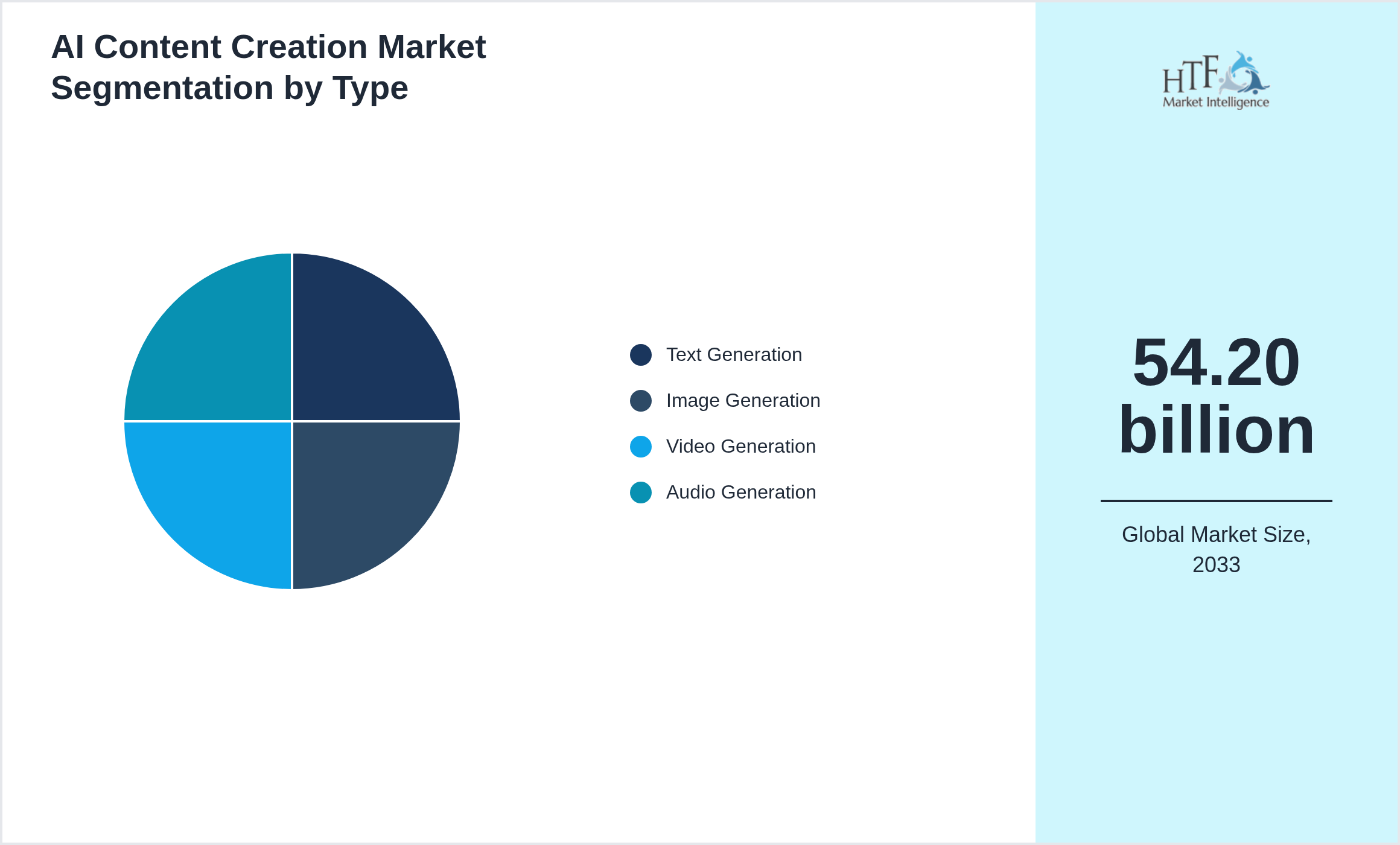
Segmentation by Type
- • Text Generation
- • Image Generation
- • Video Generation
- • Audio Generation
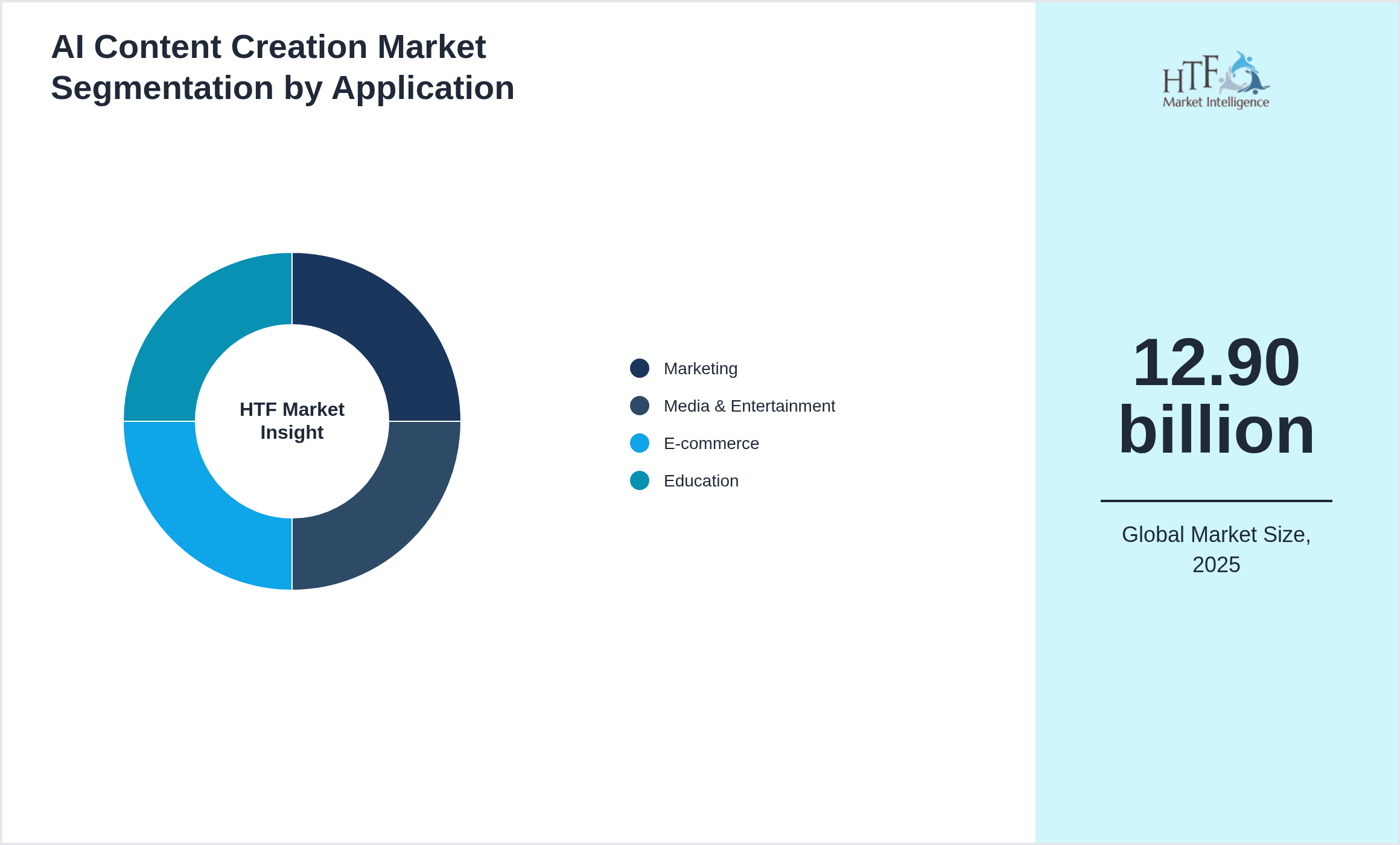
Segmentation by Application
- • Marketing
- • Media & Entertainment
- • E-commerce
- • Education
Primary and Secondary Research
- Primary Research: The research involves direct data collection through methods like surveys, interviews, and clinical trials, providing real-time insights into patient needs, regulatory impacts, and AI Content Creation market demand.
- Secondary Research: Analyzes existing data from sources like industry reports, academic journals, and market studies, offering a broad understanding of AI Content Creation market trends and validating primary research findings. Combining both methods enables healthcare organizations to build data-driven strategies and make well-informed decisions for AI Content Creation Industry.
AI Content Creation Market Dynamics
How are Market Trends Reshaping the AI Content Creation Industry?
- • Generative AI Models
- • Multimodal Content Creation
- • AI Personalization
- • Digital Marketing Expansion
- • Demand for Scalable Content
- • Social Media Growth
- • Intellectual Property Issues
- • Content Authenticity Concerns
- • Regulatory Uncertainty
- • Marketing automation expansion
- • E-learning content generation
- • Regional language localization
- • Gaming asset creation
- • Enterprise knowledge content automation
Important Market Developments and Measurable Industry Impact of AI Content Creation
- • Mar 2026: Generative-content suites released with brand-governance controls and automated multi-format output for marketing teams.
Merger & Acquisition
- • Feb 2026: CreatiGen AI acquired ScriptForge Labs. Oct 2025: MediaSynth purchased ContentBot Systems to expand generative media tools.
Patent Analysis
- • Patents focus on generative architectures content-quality scoring contextual constraint models and editing-automation modules.
Investment and Funding Scenario
- • Strong VC + big-tech investment in generative-AI ecosystems; enterprise adoption accelerates funding into marketing automation stacks.
Competitive Innovation Radar
- • Innovation includes multimodal generation (text-image-video-audio) real-time editing copilots brand-safe generation filters and enterprise governance layers enabling compliant mass-scale content creation.
Market Estimation Process
Optimizing Market Strategy: Leveraging Bottom-Up, Top-Down Approaches & Data Triangulation
- Bottom-Up Approach: Aggregates granular data, such as individual sales or product units, to calculate overall market size, providing detailed insights into specific segments.
- Top-Down Approach: begins with broader market estimates and breaks them into segments, relying on macroeconomic trends and industry data for strategic planning.
- Data Triangulation: Combines multiple data sources (e.g., surveys, reports, expert interviews) to validate findings, ensuring accuracy and reducing bias.
Key components for success include market segmentation, reliable data sources, and continuous data validation to create robust, actionable market insights.
Report Important Highlights
| Report Features | Details |
| Base Year | 2025 |
| Based Year Market Size 2025 | 12.90 billion |
| Historical Period | 2020 to 2025 |
| CAGR 2025 to 2033 | 19.60% |
| Forecast Period | 2026 to 2033 |
| Forecasted Period Market Size 2033 | 54.20 billion |
| Scope of the Report | Type, Application, Deployment Mode, Region |
| Companies Covered | OpenAI, Adobe Inc., Jasper AI, Writesonic, Canva Inc., Grammarly Inc., Synthesia Ltd., Copy.ai, Descript Inc., Runway ML, Meta Platforms Inc., Google LLC, Microsoft Corp., NVIDIA Corp., Shutterstock Inc., Stability AI, Midjourney Inc., HubSpot Inc., Salesforce Inc., ByteDance Ltd. |
| Quantitative Units | Revenue in USD million/billion, volume in kilotons, and CAGR from 2025 to 2033 |
| Customization Scope | 15% Free Customization. Avail Customization
Want to Buy Specific Sections of This Report?
|
| Delivery Format | PDF and Excel through Email |
Research Methodology
The top-down and bottom-up approaches estimate and validate the size of the North America, LATAM, West Europe, Central & Eastern Europe, Northern Europe, Southern Europe, East Asia, Southeast Asia, South Asia, Central Asia, Oceania, MEA AI Content Creation market. To reach an exhaustive list of functional and relevant players, various industry classification standards are closely followed, such as NAICS, ICB, and SIC, to penetrate deep into critical geographies by players, and a thorough validation test is conducted to reach the most relevant players for the survey in the AI Content Creation market. To make a priority list, companies are sorted based on revenue generated in the latest reporting, using paid sources. Finally, the questionnaire is set and specifically designed to address all the necessities for primary data collection after getting a prior appointment. This helps us gather the data for the player's revenue, OPEX, profit margins, product or service growth, etc. Almost 80% of data is collected through primary sources and further validation is done through various secondary sources that include Regulators, World Bank, Associations, Company Websites, SEC filings, white papers, OTC BB, Annual reports, press releases, etc.
Research enthusiast focused on transforming data uncovering into actionable insights through data-driven decision-making.