
Global Water Recirculating Cooling System Market Size, Growth & Revenue 2024-2034
Global Water Recirculating Cooling System Market is segmented by Type (Closed Loop Water Recirculating Cooling Systems, Open Loop Water Recirculating Cooling Systems, Hybrid Water Recirculating Cooling Systems, Modular Water Recirculating Cooling Systems, Custom Water Recirculating Cooling Systems), Application (Power Generation Cooling, Heating, Ventilation, and Air Conditioning (HVAC), Industrial Process Cooling, Data Center Cooling, Chemical Processing Cooling), Deployment Model (On-Premise Systems, Cloud-Enabled Remote Monitoring Systems, Hybrid Deployment Systems), End User Industry (Energy and Utilities, Manufacturing and Heavy Industry, Commercial Buildings, Information Technology, Chemical and Petrochemical), and Geography (North America, LATAM, West Europe, Central & Eastern Europe, Northern Europe, Southern Europe, East Asia, Southeast Asia, South Asia, Central Asia, Oceania, MEA)
Pricing
Report Overview
Executive Summary
- •The global Water Recirculating Cooling System market represents a critical segment of industrial and commercial thermal management solutions, focusing on sustainable water usage and energy efficiency. These systems recycle water to cool equipment and processes across diverse sectors such as power generation, HVAC, data centers, chemical manufacturing, and industrial operations. The market includes various types such as closed loop, open loop, hybrid, modular, and custom configurations, each tailored to specific application needs and environmental constraints. Driven by stringent environmental regulations, rising water scarcity concerns, and the demand for energy-efficient solutions, this market is witnessing rapid innovation in system design and digital integration. The scope of this market extends from manufacturing to installation and maintenance services globally, highlighting its strategic importance in reducing operational costs and environmental footprints across industries. Key use cases include heat dissipation in large-scale utility plants, temperature control in commercial buildings, and industrial process cooling, positioning it as a cornerstone in sustainable infrastructure development worldwide.
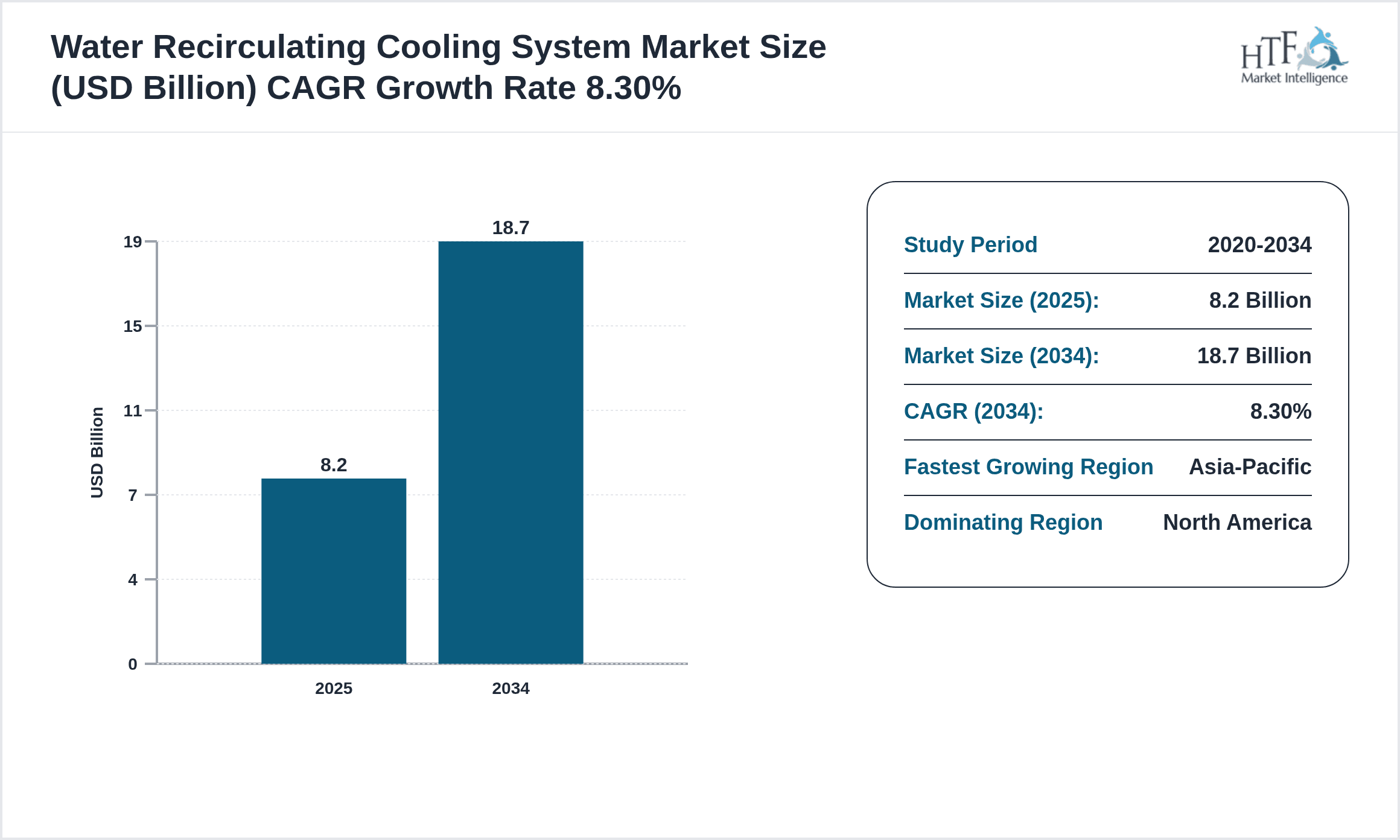
- •Key market highlights include a projected compound annual growth rate (CAGR) of 8.3% from 2024 to 2034, with the market size expected to expand from USD 8.2 billion in 2024 to USD 18.7 billion by 2034. Closed loop systems dominate the product landscape due to their efficiency and water conservation benefits, while hybrid systems are rapidly gaining traction as the fastest growing type. Power generation and HVAC applications lead demand, reflecting ongoing investments in energy infrastructure and commercial real estate development. North America currently holds the largest regional market share, supported by mature infrastructure and strict environmental policies, whereas the Asia-Pacific region is the fastest growing market, fueled by industrial expansion and urbanization.
- •This market offers substantial value propositions to stakeholders by enabling cost-effective and environmentally responsible cooling solutions. For industries, these systems reduce water consumption, lower energy costs, and ensure regulatory compliance, enhancing operational sustainability. Equipment manufacturers and service providers benefit from growing demand for innovative, customizable cooling solutions integrated with IoT and automation technologies. Governments and environmental agencies perceive these systems as vital tools in water resource management and carbon footprint reduction efforts. Consequently, the water recirculating cooling system market is strategically important across multiple sectors, fostering technology advancement and sustainable industrial growth globally.
Competitive Landscape
The global Water Recirculating Cooling System market features intense competition among multinational corporations, mid-sized companies, and emerging innovators. Market players focus on product innovation, energy-efficient designs, and expansion into emerging economies to gain competitive advantage. Strategic partnerships, acquisitions, and collaborations are common to enhance technological capabilities and market reach. Companies emphasize modular and hybrid system offerings to cater to diverse customer requirements and regulatory standards. Pricing strategies often balance cost-effectiveness with advanced feature integration. Market rivalry drives continuous improvement in system durability, water efficiency, and digital controls such as IoT-enabled monitoring. Barriers to entry include high capital investment, stringent certifications, and established customer relationships. Regional competition varies, with North American and European players dominating mature markets, while Asia-Pacific firms leverage cost advantages and local knowledge to capture share in rapidly growing regions.
Leading Companies in Water Recirculating Cooling System Market
- •Johnson Controls International plc (United States)
- •SPX Cooling Technologies, Inc. (United States)
- •Baltimore Aircoil Company (United States)
- •Evapco, Inc. (United States)
- •Daikin Industries, Ltd. (Japan)
- •Guntner GmbH & Co. KG (Germany)
- •Baltimore Aircoil Company Europe (Netherlands)
- •SPX FLOW, Inc. (United States)
- •Thermax Limited (India)
- •Baker Hughes Company (United States)
- •Airedale International Air Conditioning Ltd (United Kingdom)
- •Mitsubishi Electric Corporation (Japan)
- •Arctic Chiller Group (United States)
- •Alfa Laval AB (Sweden)
- •Mitsubishi Heavy Industries, Ltd. (Japan)
- •Lennox International Inc. (United States)
- •Kelvion Holding GmbH (Germany)
- •Trane Technologies plc (Ireland)
- •Baltimore Aircoil Company Asia (Singapore)
- •Carrier Global Corporation (United States)
- •Johnson Controls-Hitachi Air Conditioning (Japan)
- •Gree Electric Appliances Inc. (China)
- •Climaveneta S.p.A. (Italy)
- •Hitachi, Ltd. (Japan)
- •Swegon AB (Sweden)

Market Breakdown
- •By Type
- ◦Closed Loop Water Recirculating Cooling Systems
- ◦Open Loop Water Recirculating Cooling Systems
- ◦Hybrid Water Recirculating Cooling Systems
- ◦Modular Water Recirculating Cooling Systems
- ◦Custom Water Recirculating Cooling Systems
- •By Application
- ◦Power Generation Cooling
- ◦Heating, Ventilation, and Air Conditioning (HVAC)
- ◦Industrial Process Cooling
- ◦Data Center Cooling
- ◦Chemical Processing Cooling
- •By Deployment Model
- ◦On-Premise Systems
- ◦Cloud-Enabled Remote Monitoring Systems
- ◦Hybrid Deployment Systems
- •By End User Industry
- ◦Energy and Utilities
- ◦Manufacturing and Heavy Industry
- ◦Commercial Buildings
- ◦Information Technology
- ◦Chemical and Petrochemical
Growth Dynamics
- •Rising industrialization and urbanization globally are driving demand for efficient water recirculating cooling systems, especially in power generation and manufacturing sectors where heat management is critical. Increasing water scarcity and environmental regulations compel industries to adopt water-saving cooling technologies, fueling market growth.
- •Advancements in hybrid and modular cooling technologies enable flexible, scalable solutions that cater to diverse industrial needs, promoting market adoption. Integration with IoT and automation enhances system efficiency and real-time monitoring, optimizing operational performance and maintenance.
- •Government incentives and policies targeting water conservation and energy efficiency encourage investments in sustainable cooling solutions, expanding market reach. These initiatives also stimulate research and development efforts focused on innovative water recirculating cooling designs.
- •Increasing demand for data center cooling due to rapid digital transformation and cloud computing growth is significantly contributing to the water recirculating cooling system market expansion, especially in North America and Asia-Pacific.
- •The growing trend toward green building certifications and sustainability frameworks in commercial real estate further drives the adoption of water-efficient cooling technologies, supporting market growth globally.

Market Trends
- •Hybrid water recirculating cooling systems combining the benefits of closed and open loop designs are gaining popularity due to their adaptability and enhanced water conservation capabilities. Industry players are increasingly focusing on such innovations to meet stringent environmental standards.
- •Digitalization and integration of smart sensors for predictive maintenance and energy optimization are becoming standard features in new cooling system installations, improving reliability and operational efficiency.
- •Emerging markets in Asia-Pacific are witnessing rapid adoption of advanced cooling systems driven by infrastructure development and increasing industrial output, positioning the region as the fastest growing market.
- •Sustainability initiatives and water reuse policies are pushing industries to retrofit existing facilities with water recirculating cooling systems, expanding the retrofit market segment significantly.
- •Collaborations between cooling system manufacturers and technology firms are fostering the development of integrated solutions combining cooling with renewable energy sources, enhancing market appeal and environmental benefits.

Market Opportunities
- •Expanding industrial infrastructure in emerging economies offers significant opportunities for water recirculating cooling system providers to capture new markets by offering cost-effective and scalable solutions.
- •Growing awareness about water scarcity and environmental sustainability creates demand for advanced cooling technologies that minimize water consumption and carbon footprint, opening avenues for innovation.
- •Integration of IoT and AI-based monitoring systems presents opportunities for service providers to offer value-added solutions, improving system performance and reducing downtime.
- •Collaborations with governments and environmental agencies to support water conservation initiatives can enhance market penetration and drive adoption in regulated industries.
- •Development of modular and hybrid systems tailored for small and medium enterprises enables tapping into previously underserved market segments, expanding customer base.
Market Challenges
- •High capital expenditure and complex installation processes of advanced water recirculating cooling systems can be barriers to adoption, especially for small and medium enterprises.
- •Stringent regulatory compliance and certification requirements vary across regions, complicating market entry and product standardization for manufacturers.
- •Maintenance and operational complexities, including risks of scaling and biofouling, require specialized knowledge, limiting widespread deployment in certain sectors.
- •Competition from alternative cooling technologies such as air-cooled systems and evaporative coolers may restrain market growth in specific applications where water availability is not a concern.
- •Supply chain disruptions and volatile raw material prices can impact manufacturing costs and delivery timelines, affecting market dynamics adversely.
Regulatory Framework
- •Between 2019 and 2024, several regions enacted regulations promoting water conservation in industrial processes, mandating the adoption of water recirculating cooling systems or equivalent technologies. These include the US EPA’s WaterSense program updates and the European Union’s Water Framework Directive enhancements focusing on sustainable water management.
- •New policies in Asia-Pacific countries such as China and India emphasize reducing industrial water usage through incentives for advanced cooling technologies, significantly impacting market demand and compliance strategies.
- •Environmental standards related to discharge water quality and thermal pollution control have tightened, requiring cooling system manufacturers to innovate filtration and heat exchange technologies to meet compliance.
- •North American and European governments have introduced tax benefits and subsidies for companies implementing energy-efficient water cooling solutions, accelerating adoption rates.
- •International organizations and standard bodies are working to harmonize certification processes for water recirculating cooling systems, facilitating smoother cross-border trade and technology transfer.
Market Intelligence
- •15th February 2025, Johnson Controls International plc launched a new hybrid water recirculating cooling system featuring enhanced modular design and IoT-enabled control capabilities. This product aims to reduce water consumption by up to 30% and improve energy efficiency in commercial HVAC applications. The system’s smart monitoring allows real-time diagnostics, predictive maintenance, and remote operation, targeting data centers and large commercial buildings globally. The launch strengthens Johnson Controls’ portfolio and competitive positioning in the sustainable cooling market. Source: Official company press release.
- •10th January 2025, SPX Cooling Technologies, Inc. introduced an advanced closed loop recirculating cooling system optimized for power generation plants. This system incorporates next-generation heat exchangers and corrosion-resistant materials to extend operational lifespan and reduce maintenance costs. Designed to comply with stringent environmental regulations, it offers significant reductions in water usage and thermal discharge. The product launch supports the company’s strategic focus on energy and utility sectors, enhancing market penetration in North America and Asia-Pacific. Source: SPX corporate news.
- •22nd March 2025, Evapco, Inc. announced a strategic partnership with a leading IoT software developer to integrate AI-driven analytics into their water recirculating cooling systems. This collaboration aims to deliver predictive maintenance, optimize resource consumption, and enable automated regulatory compliance reporting. The initiative reflects growing industry trends toward digital transformation and sustainability, positioning Evapco as a technology leader in the cooling market. The partnership is expected to accelerate adoption in industrial and data center applications worldwide. Source: Industry publication.
- •5th April 2025, Daikin Industries, Ltd. completed the acquisition of a mid-sized cooling technology startup specializing in modular water recirculating systems tailored for emerging markets. This acquisition expands Daikin’s product portfolio and enhances its capability to serve small and medium enterprises with cost-effective, scalable cooling solutions. The move aligns with Daikin’s growth strategy focusing on Asia-Pacific and Latin America, regions exhibiting high demand for innovative cooling technologies. Source: Corporate announcement.
Regional Outlook
The North America currently holds a significant share of the market, primarily due to several key factors: increasing consumption rates, a burgeoning population, and robust economic momentum. These elements collectively drive demand, positioning this region as a leader in the market. On the other hand, Asia-Pacific is rapidly emerging as the fastest-growing area within the industry. This remarkable growth can be attributed to swift infrastructure development, the expansion of various industrial sectors, and a marked increase in consumer demand. These dynamics make this region a crucial player in shaping future market growth.
In our report, we cover a comprehensive analysis of the following regions and countries:
- North America
- LATAM
- West Europe
- Central & Eastern Europe
- Northern Europe
- Southern Europe
- East Asia
- Southeast Asia
- South Asia
- Central Asia
- Oceania
- MEA
| Feature | Details |
|---|---|
| Base Year Market Size | USD 8.2 Billion |
| Forecast Year Market Size | USD 18.7 Billion |
| CAGR | 8.3% |
| Forecast Period | 2026 to 2033 |
| YoY Growth | 8% |
| Scope of Report | Market is segmented by Type (Closed Loop Water Recirculating Cooling Systems, Open Loop Water Recirculating Cooling Systems, Hybrid Water Recirculating Cooling Systems, Modular Water Recirculating Cooling Systems, Custom Water Recirculating Cooling Systems), Application (Power Generation Cooling, Heating, Ventilation, and Air Conditioning (HVAC), Industrial Process Cooling, Data Center Cooling, Chemical Processing Cooling), Deployment Model (On-Premise Systems, Cloud-Enabled Remote Monitoring Systems, Hybrid Deployment Systems), End User Industry (Energy and Utilities, Manufacturing and Heavy Industry, Commercial Buildings, Information Technology, Chemical and Petrochemical) |
| Regions Covered | North America, LATAM, West Europe, Central & Eastern Europe, Northern Europe, Southern Europe, East Asia, Southeast Asia, South Asia, Central Asia, Oceania, MEA |
| Key Companies | Johnson Controls International plc (United States), SPX Cooling Technologies, Inc. (United States), Baltimore Aircoil Company (United States), Evapco, Inc. (United States), Daikin Industries, Ltd. (Japan) |
Global Water Recirculating Cooling System Market Size, Growth & Revenue 2024-2034 - Table of Contents
Frequently Asked Questions (FAQ):
The Compact Track Loaders market is projected to grow at a CAGR of 6.8% from 2025 to 2030, driven by increasing demand in construction and agricultural sectors.
North America currently leads the market with approximately 45% market share, followed by Europe at 28% and Asia-Pacific at 22%. The remaining regions account for 5% of the global market.
Key growth drivers include increasing construction activities, rising demand for versatile equipment in agriculture, technological advancements in track loader design, and growing preference for compact equipment in urban construction projects.