
Asia-Pacific Sugar Equipment Market Size, Growth & Revenue 2025-2034
Asia-Pacific Sugar Equipment Market is segmented by Product Type (Crushers, Mills, Clarifiers, Evaporators, Centrifuges), Application (Sugarcane Processing, Beet Sugar Processing, Refining, Packaging, Quality Control), Deployment Model (Fixed Installation, Modular Setup, Mobile Units), Service Type (Installation & Commissioning, Maintenance & Repair, Spare Parts Supply, Consulting & Training), and Geography (Japan, China, Southeast Asia, India, Australia, South Korea, Others)
Pricing
Report Overview
Executive Summary
- •The Asia-Pacific Sugar Equipment market is defined by the manufacturing and supply of specialized machinery that supports the entire sugar production process, including crushing, milling, clarifying, evaporating, centrifuging, refining, and packaging. This market serves critical applications such as processing sugarcane and sugar beet, refining raw sugar, and ensuring quality control in final products. The equipment encompasses crushers, mills, clarifiers, evaporators, centrifuges, and packaging systems, integrating advanced technologies to improve efficiency, reduce energy consumption, and minimize environmental impacts. The market growth is propelled by rising sugar consumption in countries like India and China, expanding sugarcane cultivation, and modernization of existing sugar mills. Government initiatives focused on biofuel production and sustainable agriculture also boost demand for cutting-edge sugar processing equipment. Key challenges include stringent regulatory requirements and the need to upgrade legacy machinery to meet environmental standards. The market is highly competitive with presence of global and regional players investing in R&D to introduce automation and IoT-enabled equipment. Strategic collaborations and infrastructure investments are further expected to shape the market landscape through 2034, making this sector critical for regional agro-industrial development and food security.
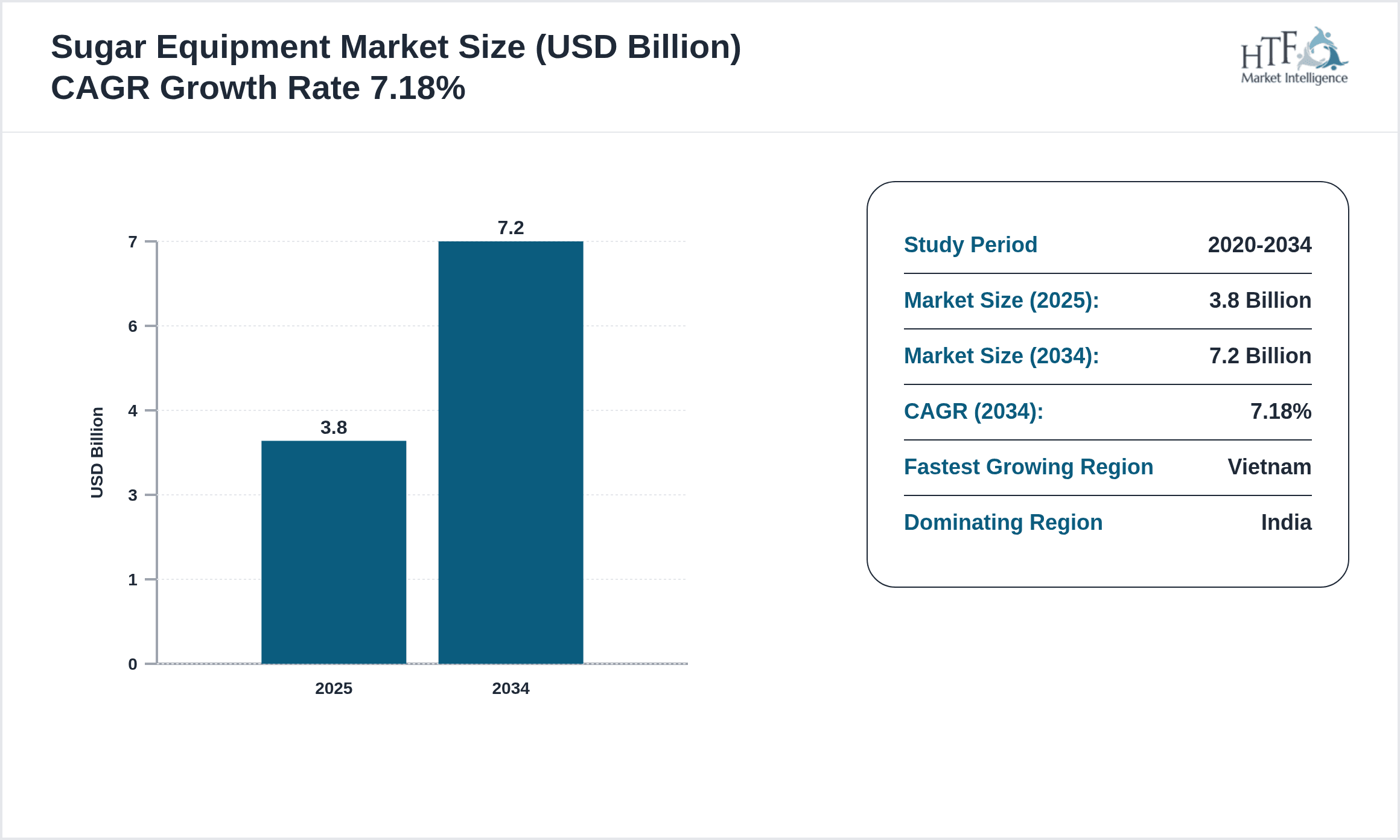
- •Key highlights of the Asia-Pacific Sugar Equipment market include a base market size of USD 3.8 Billion in 2025, forecasted to reach USD 7.2 Billion by 2034. This growth is driven by a robust CAGR of 7.18% and a year-on-year growth rate averaging 7.0%, reflecting strong demand dynamics and technological advancements. India dominates as the largest market within the region due to its extensive sugarcane cultivation and sugar industry infrastructure. Meanwhile, Vietnam is identified as the fastest growing country, benefiting from increased investments in modern sugar processing facilities and export-oriented production. Crushers remain the leading product type, widely adopted for raw material extraction, while clarifiers are the fastest growing segment as producers seek cleaner and more efficient purification processes. The market is characterized by steady modernization, adoption of energy-efficient equipment, and enhanced automation to meet evolving production standards and environmental regulations.
- •The Asia-Pacific Sugar Equipment market holds significant strategic importance for agro-industries, sugar producers, machinery manufacturers, and investors. It underpins the region's sugar production capabilities, enabling higher yields, improved product quality, and reduced operational costs. The evolving regulatory landscape emphasizing sustainability and environmental compliance encourages adoption of advanced equipment. Additionally, the market supports rural economic development by fostering agro-processing industries and generating employment. For stakeholders, this market offers opportunities to leverage technological innovations, expand production capacities, and tap into rising sugar demand driven by population growth and urbanization. The integration of automation and IoT further enhances operational efficiency and predictive maintenance, providing key competitive advantages. As the Asia-Pacific sugar industry evolves, the sugar equipment market remains critical to meeting the dual goals of productivity and sustainability.
Competitive Landscape
The Asia-Pacific Sugar Equipment market is characterized by intense competition among global manufacturers, regional equipment suppliers, and emerging technology innovators. Market players compete on the basis of product reliability, customization capabilities, technological advancements, and after-sales service. Strategic alliances and partnerships are common approaches to expand product portfolios and geographic reach. Companies invest heavily in R&D to introduce automation, energy-efficient systems, and environmentally compliant equipment, responding to evolving industry demands. Price competitiveness and local manufacturing capabilities also influence market positioning, especially in price-sensitive segments. Distribution channels are increasingly digitalized, enhancing customer engagement and service delivery. Mergers and acquisitions play a pivotal role in consolidating market share and integrating complementary capabilities. However, barriers such as high capital requirements, stringent regulatory approvals, and the need for skilled maintenance personnel create challenges for new entrants. Looking forward, innovation in smart equipment and predictive maintenance technologies is expected to be a key competitive differentiator shaping market dynamics through 2034.
Key Participants in Sugar Equipment Market
- •BMA Braunschweigische Maschinenbauanstalt AG (Germany)
- •Alfa Laval AB (Sweden)
- •Fives Group (France)
- •Tate & Lyle PLC (United Kingdom)
- •Massey Ferguson (India)
- •Shandong Longchang Machinery Manufacturing Co., Ltd. (China)
- •Sukup Manufacturing Co. (United States)
- •DuPont (United States)
- •ANDRITZ AG (Austria)
- •John Deere (United States)
- •Sugimat S.A. (Brazil)
- •Krones AG (Germany)
- •Mitsubishi Heavy Industries Ltd. (Japan)
- •Siemens AG (Germany)
- •Kawasaki Heavy Industries (Japan)
- •Tata Projects Limited (India)
- •Bühler Group (Switzerland)
- •FMC Corporation (United States)
- •Suzhou Tongyuan Machinery Manufacturing Co., Ltd. (China)
- •Harbin Sugar Equipment Co., Ltd. (China)
- •Azucarera (Spain)
- •Laxmi Engineering Works (India)
- •Sidel Group (France)
- •Saintyol Machinery (China)
- •Praj Industries Limited (India)
Market Breakdown
- •By Product Type
- ◦Crushers
- ◦Mills
- ◦Clarifiers
- ◦Evaporators
- ◦Centrifuges
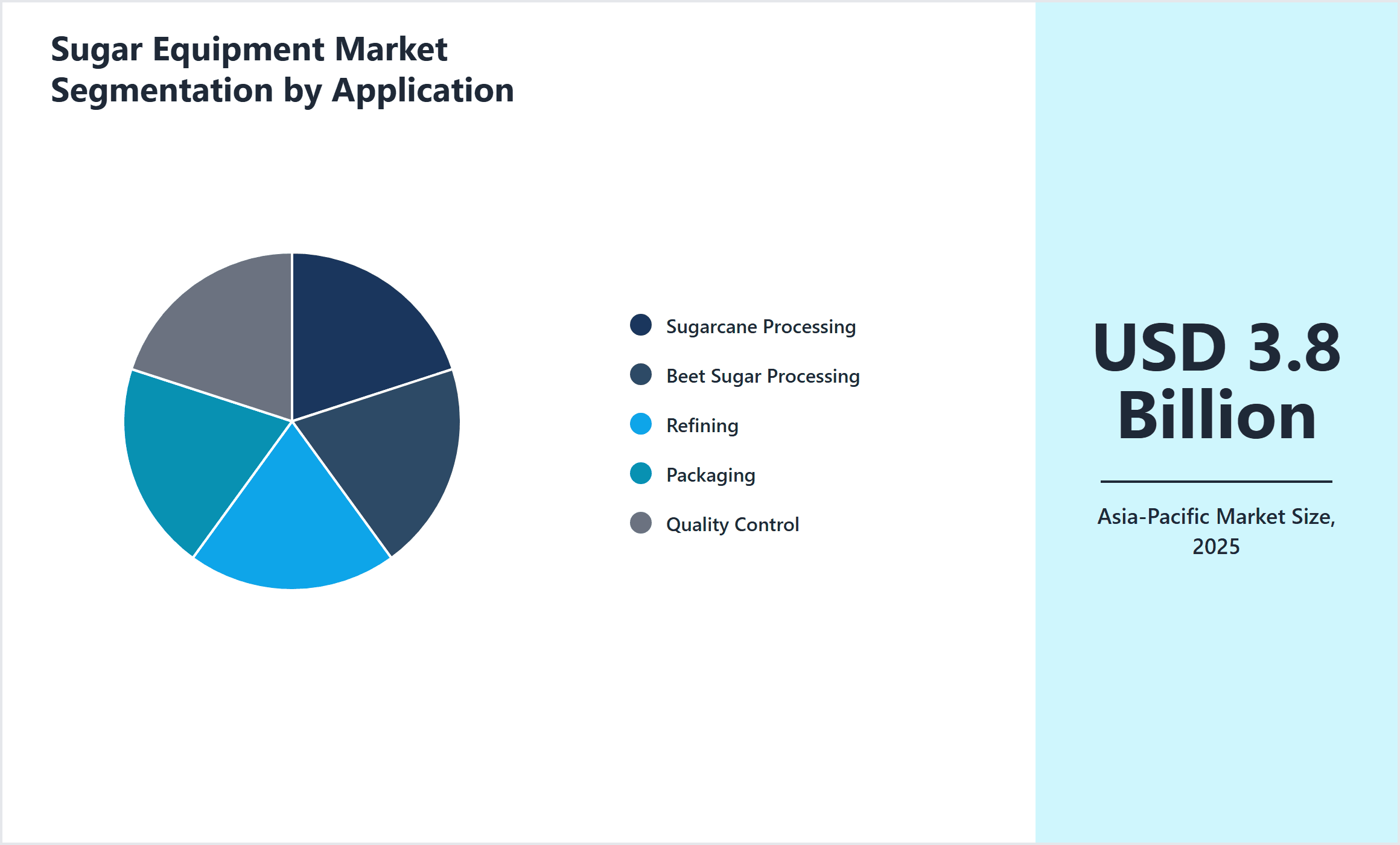
- •By Application
- ◦Sugarcane Processing
- ◦Beet Sugar Processing
- ◦Refining
- ◦Packaging
- ◦Quality Control
- •By Deployment Model
- ◦Fixed Installation
- ◦Modular Setup
- ◦Mobile Units
- •By Service Type
- ◦Installation & Commissioning
- ◦Maintenance & Repair
- ◦Spare Parts Supply
- ◦Consulting & Training
Growth Dynamics
The Asia-Pacific sugar equipment market is experiencing robust growth driven by increasing sugar consumption fueled by population growth and rising disposable incomes across emerging economies such as India and Vietnam. The expansion of sugarcane cultivation, supported by government subsidies and improved farming practices, has led to heightened demand for modern, efficient crushing and milling machinery. Additionally, governments' focus on bioethanol production as an alternative fuel source has intensified the need for advanced sugar processing technologies that enhance extraction efficiency and reduce waste. The trend towards automation and digitization in manufacturing plants is further optimizing operational efficiency and reducing labor costs, thereby stimulating equipment upgrades. Market participants are investing in R&D to develop environmentally compliant solutions that minimize energy consumption and water use, aligning with stricter regulatory requirements. The increasing adoption of IoT-enabled equipment and predictive maintenance systems is enabling real-time monitoring and reducing downtime. Furthermore, rising export opportunities in Southeast Asia are encouraging sugar producers to enhance processing capacities. Collectively, these factors are driving sustained demand and technological innovation in the sugar equipment sector across the Asia-Pacific region.

Market Trends
A significant trend in the Asia-Pacific sugar equipment market is the growing integration of automation and Industry 4.0 technologies, which facilitate enhanced process control, energy efficiency, and predictive maintenance. Manufacturers are increasingly deploying IoT sensors and data analytics platforms to optimize sugar extraction and refining processes, reducing operational costs and improving yield quality. Another emerging trend is the shift towards environmentally sustainable equipment designs that comply with regional emission and effluent standards, reflecting the market's commitment to green manufacturing. Additionally, there is a rising preference for modular and mobile equipment setups that provide flexibility and scalability to sugar mills, especially in smaller or remote locations. Strategic collaborations between equipment manufacturers and technology providers are also on the rise, enabling the development of customized solutions tailored to local processing requirements. These trends collectively underscore the market's evolution towards smarter, cleaner, and more adaptable sugar processing equipment in the Asia-Pacific region.
Market Opportunities
The Asia-Pacific sugar equipment market presents significant opportunities in the modernization of legacy sugar mills and expansion of processing capacities in emerging economies such as Vietnam, Indonesia, and the Philippines. There is growing demand for energy-efficient and eco-friendly equipment aligned with governmental sustainability initiatives, offering manufacturers a chance to innovate and capture market share. Additionally, rising bioethanol production from sugarcane provides new avenues for specialized processing machinery, creating niche markets. The potential for digital transformation through IoT and AI-based solutions opens opportunities for value-added services including predictive maintenance and process optimization. Furthermore, increasing export demand from regional sugar producers encourages capacity scaling and adoption of advanced refining technologies. Strategic partnerships and joint ventures with local players can facilitate market entry and product localization. Overall, the market offers ample growth potential for equipment suppliers focusing on technological innovation, sustainability, and regional customization.
Market Challenges
The Asia-Pacific sugar equipment market faces challenges including the high capital expenditure required for advanced machinery, which can limit adoption among small and medium sugar producers. Regulatory complexities and evolving environmental standards necessitate continuous equipment upgrades, creating compliance risks and operational disruptions. Additionally, the market grapples with the shortage of skilled technicians capable of maintaining sophisticated automated systems, impacting equipment uptime. Fluctuations in global sugar prices and trade policies introduce market uncertainties that affect investment decisions. Furthermore, supply chain disruptions, especially in sourcing critical components, can delay project timelines. Lastly, competition from local low-cost equipment manufacturers poses pricing pressures on global and regional players, challenging profitability and market share retention.
Regulatory Framework
Between 2020 and 2025, Asia-Pacific countries have implemented stringent environmental and safety regulations impacting the sugar equipment market. For instance, India introduced the Sugar Industry (Regulation) Amendment Act 2022, mandating enhanced effluent treatment standards and energy consumption benchmarks for sugar mills, compelling equipment upgrades to meet compliance. China enforced the Green Manufacturing Promotion Policy in 2023, incentivizing adoption of energy-efficient machinery and waste minimization technologies in agro-industries including sugar processing. Japan updated its Industrial Safety Standards in 2021, emphasizing operational safety features in heavy machinery, affecting equipment design and certification. Australia implemented the Renewable Energy Target (RET) policy enhancements in 2024, encouraging bioethanol production from sugarcane, driving demand for specialized processing equipment. Additionally, Southeast Asian countries such as Thailand and Vietnam have aligned their regulatory frameworks with ASEAN environmental protocols, promoting sustainable manufacturing practices and emission controls in sugar refineries. These regulations collectively create a compliance-driven landscape, fostering innovation in cleaner, safer, and more efficient sugar equipment production and deployment.
Market Intelligence
- •15th January 2025, BMA Braunschweigische Maschinenbauanstalt AG announced the launch of its next-generation sugar mill crushers integrated with IoT-enabled sensors to provide real-time performance monitoring and predictive maintenance capabilities. These crushers are designed to reduce energy consumption by up to 15% while enhancing extraction efficiency by 10%. The new product targets large-scale sugar mills in India and Southeast Asia aiming to modernize operations and comply with tightening environmental regulations. BMA's strategic objective includes expanding its footprint in the Asia-Pacific market by leveraging digital transformation and sustainability trends. This launch is expected to set new industry benchmarks and stimulate competitive advancements in sugar processing technologies. Source: BMA Official Press Release
- •22nd March 2025, Tata Projects Limited introduced an automated sugar refining system incorporating AI-based process optimization to significantly reduce water usage and waste generation. Targeted at Indian and Southeast Asian sugar producers, this system enhances product quality consistency and lowers operational costs through advanced analytics and machine learning algorithms. The initiative reflects Tata Projects' commitment to sustainable industrial solutions and aligns with government policies promoting eco-friendly manufacturing. Early adopters have reported improved yield and compliance with environmental standards, positioning Tata Projects as a technology leader in the region's sugar equipment market. Source: Tata Projects Corporate Announcement
- •10th July 2025, Mitsubishi Heavy Industries Ltd. completed a joint venture with a leading Vietnamese sugar processing company to manufacture and supply modular evaporators tailored for Southeast Asian agro-climatic conditions. This collaboration aims to address the demand for scalable and energy-efficient evaporators suited for small to medium-sized sugar mills. The joint venture combines Mitsubishi's engineering expertise with localized market knowledge to accelerate technology adoption and market penetration. The strategic partnership is expected to enhance production capacity and operational sustainability, supporting Vietnam’s growing sugar export ambitions. Source: Mitsubishi Heavy Industries Newsroom
- •30th September 2025, Shandong Longchang Machinery Manufacturing Co., Ltd. unveiled a new clarifier system featuring advanced filtration and automated control technologies designed to improve sugar purification efficiency and reduce chemical usage. This innovation targets the Chinese and broader Asia-Pacific sugar refining sectors, responding to stringent environmental regulations and quality requirements. The clarifier’s modular design allows easy integration into existing plants, facilitating upgrades without significant downtime. Early trials demonstrated a 12% improvement in clarity and a 20% reduction in water consumption, positioning the product as a competitive offering in the region. Source: Shandong Longchang Official Website
Regional Outlook
The India currently holds a significant share of the market, primarily due to several key factors: increasing consumption rates, a burgeoning population, and robust economic momentum. These elements collectively drive demand, positioning this region as a leader in the market. On the other hand, Vietnam is rapidly emerging as the fastest-growing area within the industry. This remarkable growth can be attributed to swift infrastructure development, the expansion of various industrial sectors, and a marked increase in consumer demand. These dynamics make this region a crucial player in shaping future market growth.
In our report, we cover a comprehensive analysis of the following regions and countries:
- Japan
- China
- Southeast Asia
- India
- Australia
- South Korea
- Others
| Feature | Details |
|---|---|
| Base Year Market Size | USD 3.8 Billion |
| Forecast Year Market Size | USD 7.2 Billion |
| CAGR | 7.18% |
| Forecast Period | 2026 to 2033 |
| YoY Growth | 7% |
| Scope of Report | Market is segmented by Product Type (Crushers, Mills, Clarifiers, Evaporators, Centrifuges), Application (Sugarcane Processing, Beet Sugar Processing, Refining, Packaging, Quality Control), Deployment Model (Fixed Installation, Modular Setup, Mobile Units), Service Type (Installation & Commissioning, Maintenance & Repair, Spare Parts Supply, Consulting & Training) |
| Regions Covered | Japan, China, Southeast Asia, India, Australia, South Korea, Others |
| Key Companies | The Asia-Pacific sugar equipment market presents significant opportunities in the modernization of legacy sugar mills and expansion of processing capacities in emerging economies such as Vietnam, Indonesia, and the Philippines. There is growing demand for energy-efficient and eco-friendly equipment aligned with governmental sustainability initiatives, offering manufacturers a chance to innovate and capture market share. Additionally, rising bioethanol production from sugarcane provides new avenues for specialized processing machinery, creating niche markets. The potential for digital transformation through IoT and AI-based solutions opens opportunities for value-added services including predictive maintenance and process optimization. Furthermore, increasing export demand from regional sugar producers encourages capacity scaling and adoption of advanced refining technologies. Strategic partnerships and joint ventures with local players can facilitate market entry and product localization. Overall, the market offers ample growth potential for equipment suppliers focusing on technological innovation, sustainability, and regional customization. |
Asia-Pacific Sugar Equipment Market Size, Growth & Revenue 2025-2034 - Table of Contents
Frequently Asked Questions (FAQ):
The Compact Track Loaders market is expected to see value worth 5.3 Billion in 2025.
North America currently leads the market with approximately 45% market share, followed by Europe at 28% and Asia-Pacific at 22%. The remaining regions account for 5% of the global market.
Key growth drivers include increasing construction activities, rising demand for versatile equipment in agriculture, technological advancements in track loader design, and growing preference for compact equipment in urban construction projects.