
Global Travel Coffee Maker Market - Outlook 2020-2034
Global Travel Coffee Maker Market is segmented by Travel Coffee Maker Type (Manual Travel Coffee Makers, Electric Travel Coffee Makers, Battery Operated Travel Coffee Makers, Capsule-Based Travel Coffee Makers, Portable Espresso Machines), Application Segment (Personal Use, Office Use, Outdoor Activities (Camping, Hiking), Hospitality (Hotels, Resorts), Travel (Airports, Trains, Automobiles)), Power Source (Electric Plug-In, Battery Powered, Manual Operation), Distribution Channel (Online Retail, Specialty Coffee Shops, Supermarkets & Hypermarkets, Direct Manufacturer Sales), and Geography (North America, LATAM, West Europe, Central & Eastern Europe, Northern Europe, Southern Europe, East Asia, Southeast Asia, South Asia, Central Asia, Oceania, MEA)
Pricing
Report Overview
Executive Summary
- •The global travel coffee maker market includes a wide range of portable coffee brewing devices tailored for consumers requiring fresh coffee during travel or outdoor activities. This market covers manual, electric, battery-operated, capsule-based, and portable espresso coffee makers, serving personal, office, hospitality, and outdoor applications. The value chain comprises raw material suppliers, manufacturers, distributors, and retailers, focusing on product innovation, convenience, and user experience. Increasing global travel, urbanization, and rising coffee culture drive demand. Market players focus on enhancing portability, battery life, and brewing efficiency to meet diverse consumer preferences. Regulatory compliance with electrical safety and environmental standards is integral to product development. The market is characterized by rapid technological advancements, growing premiumization, and expanding distribution networks, positioning it as a significant segment in the coffee appliance industry. Consumer trends towards on-the-go lifestyles and premium coffee consumption, combined with expanding retail channels, underpin market growth through 2034.
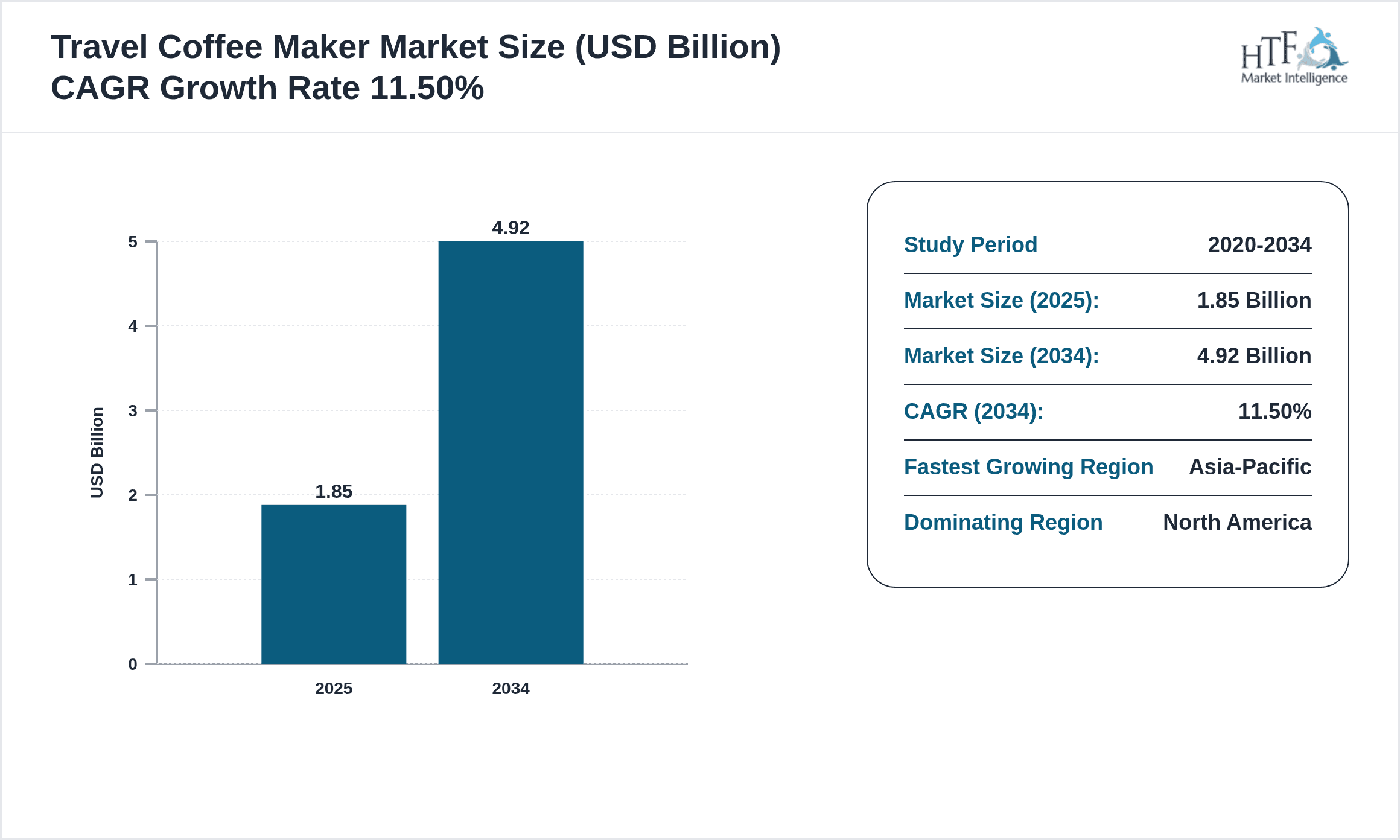
- •Key market highlights include a base market size of USD 1.85 Billion in 2025, with a projected growth to USD 4.92 Billion by 2034, reflecting a robust CAGR of 11.5%. The highest market share is held by electric travel coffee makers, while battery-operated models exhibit the fastest growth due to their convenience and portability. North America dominates in terms of market size, supported by high consumer spending and advanced retail infrastructure, whereas Asia-Pacific is the fastest growing region driven by increasing travel activities and rising urban middle-class populations.
- •The travel coffee maker market holds strategic importance for manufacturers, retailers, and investors by addressing evolving consumer lifestyles and growing demand for mobile coffee solutions. Its value proposition lies in offering convenience, quality coffee brewing, and adaptability across various settings. This market supports innovation in battery technology, compact design, and smart integration, creating opportunities for differentiation and competitive advantage. The sector's growth enhances the broader coffee appliance industry's ecosystem, contributing to economic growth and job creation globally.
Competitive Landscape
The travel coffee maker market is highly competitive with a diverse range of players focusing on innovation, product differentiation, and strategic partnerships. Companies invest significantly in R&D to improve portability, battery efficiency, and brewing technology, which are critical competitive factors. Market leaders adopt multi-channel distribution strategies, including e-commerce and retail partnerships, to enhance global reach and customer accessibility. Pricing strategies vary from premium to affordable segments, targeting different consumer groups. Mergers, acquisitions, and collaborations are common to consolidate market position and expand product portfolios. Regional competition intensifies as emerging markets gain prominence, requiring tailored marketing and localized product features. The industry also faces challenges such as supply chain disruptions and raw material cost fluctuations, impacting profitability. Future competitive trends indicate increased focus on sustainability, smart device integration, and customization options to meet evolving consumer demands.
Leading Companies in Travel Coffee Maker Market
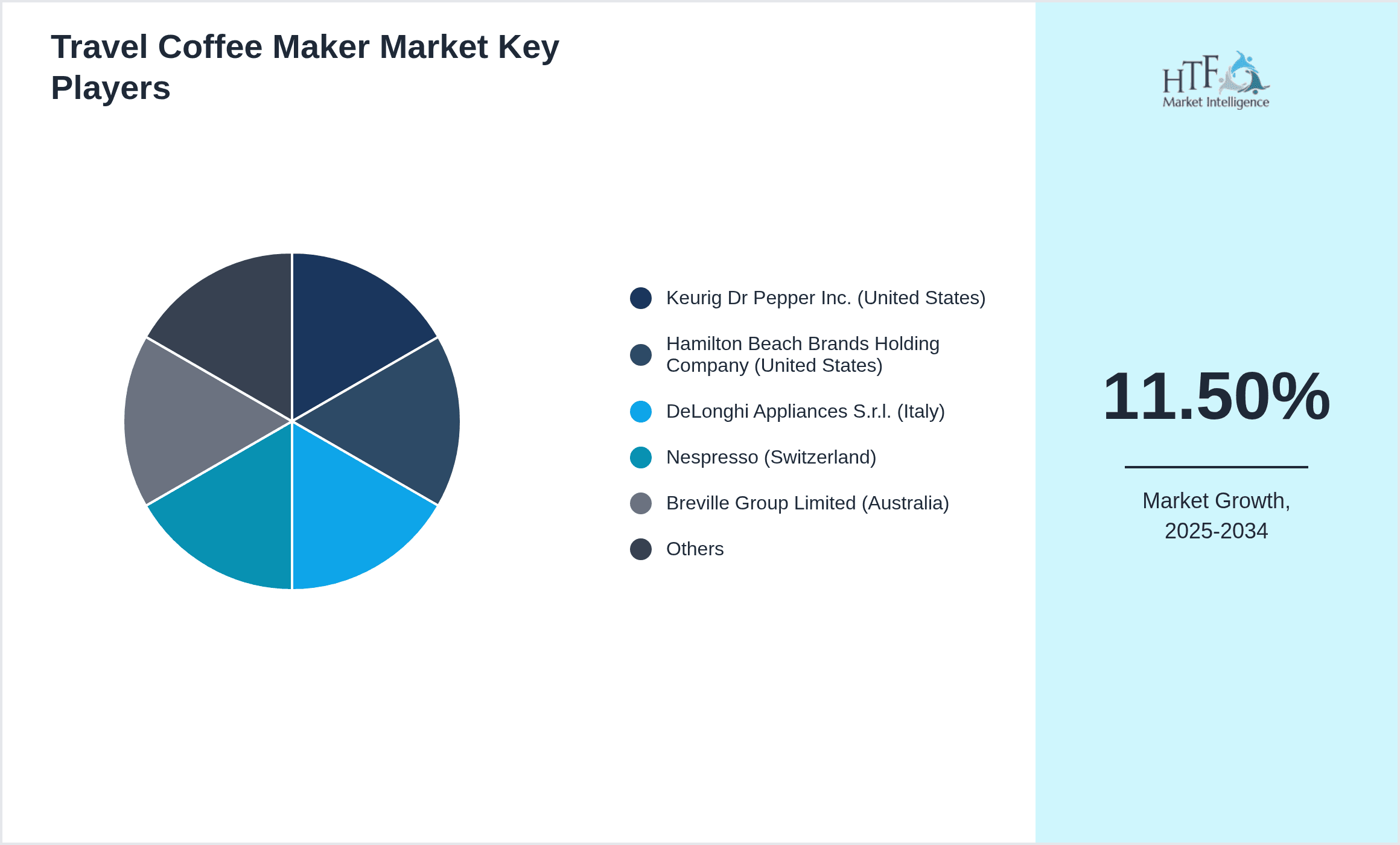
- •Keurig Dr Pepper Inc. (United States)
- •Hamilton Beach Brands Holding Company (United States)
- •DeLonghi Appliances S.r.l. (Italy)
- •Nespresso (Switzerland)
- •Breville Group Limited (Australia)
- •Black+Decker (United States)
- •Bodum AG (Denmark)
- •Cuisinart (United States)
- •GSI Outdoors (United States)
- •Wacaco (China)
- •AeroPress Inc. (United States)
- •Sboly (China)
- •Primula (United States)
- •Coffee Gator (United States)
- •Staresso (China)
- •Fellow Products Inc. (United States)
- •Porlex Co., Ltd. (Japan)
- •Secura (United States)
- •Kona Coffee Gear (United States)
- •Handpresso (France)
- •Minipresso by Wacaco (China)
- •Espresso Parts (United States)
- •Ridge Wallet (United States)
- •Jetboil Inc. (United States)
- •Zojirushi Corporation (Japan)
Market Breakdown
- •By Travel Coffee Maker Type
- ◦Manual Travel Coffee Makers
- ◦Electric Travel Coffee Makers
- ◦Battery Operated Travel Coffee Makers
- ◦Capsule-Based Travel Coffee Makers
- ◦Portable Espresso Machines
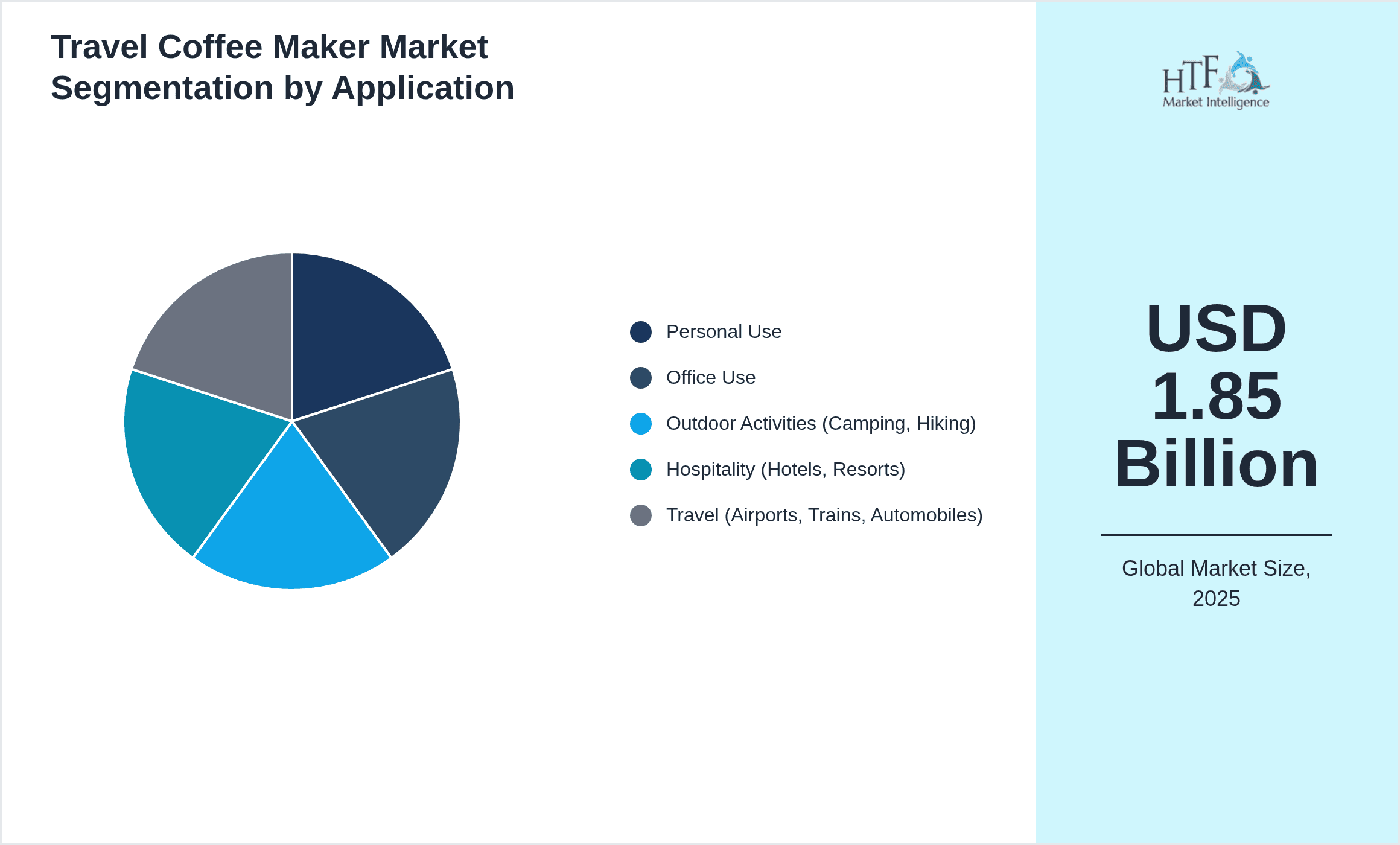
- •By Application Segment
- ◦Personal Use
- ◦Office Use
- ◦Outdoor Activities (Camping, Hiking)
- ◦Hospitality (Hotels, Resorts)
- ◦Travel (Airports, Trains, Automobiles)
- •By Power Source
- ◦Electric Plug-In
- ◦Battery Powered
- ◦Manual Operation
- •By Distribution Channel
- ◦Online Retail
- ◦Specialty Coffee Shops
- ◦Supermarkets & Hypermarkets
- ◦Direct Manufacturer Sales
Growth Dynamics
- •Increasing global travel and outdoor recreational activities have significantly boosted demand for portable travel coffee makers offering convenience and quality brewing anywhere. The rise in adventure tourism and remote work trends further supports this growth trajectory.
- •Technological advancements in battery efficiency and compact design enhance the usability and appeal of battery-operated travel coffee makers, driving consumer adoption and expanding the product portfolio.
- •Rising coffee culture and premiumization globally encourage consumers to seek high-quality coffee experiences even while traveling, fueling demand for advanced portable coffee makers with espresso capabilities.
- •Expanding e-commerce platforms and digital marketing enable manufacturers to reach a broader global audience, increasing product awareness and facilitating easier purchase decisions for travel coffee makers.
- •Growing urbanization and disposable income in emerging markets, especially Asia-Pacific, support rapid adoption of travel coffee makers, contributing substantially to market growth.
- •Sustainability trends push manufacturers to innovate with environmentally friendly materials and energy-efficient designs, aligning with consumer preferences and regulatory standards.
- •Strategic collaborations between coffee machine manufacturers and coffee brands enhance product appeal through integrated solutions and co-branding, driving market penetration.
Market Trends
- •The shift towards smart travel coffee makers embedded with IoT technology allows users to control brewing via mobile apps, enhancing user experience and personalization.
- •Capsule-based portable coffee makers gain traction as they offer convenience, consistent flavor, and minimal cleanup, appealing especially to frequent travelers and office users.
- •Miniaturization and lightweight design trends are prominent, enabling easier portability without compromising brewing quality, which is critical for outdoor enthusiasts and travelers.
- •Sustainability drives the adoption of reusable capsules and eco-friendly materials in travel coffee makers, resonating with environmentally conscious consumers.
- •Increased collaborations with coffee brands and subscription services provide integrated product and coffee supply solutions, enhancing customer loyalty and recurring revenue streams.
- •Customization options such as adjustable brewing strength and temperature control are becoming standard features, catering to diverse consumer preferences.
- •Retailers are expanding experiential marketing initiatives like in-store demos and pop-up events to engage consumers and highlight product portability and performance features.
Market Opportunities
- •Growing interest in outdoor recreational activities presents a significant opportunity for manufacturers to develop rugged, durable travel coffee makers tailored for adventure enthusiasts.
- •Emerging markets in Asia-Pacific and Latin America offer expansion potential due to increasing travel rates and rising disposable incomes, enabling market players to capture new consumer segments.
- •Integration of smart technology and connectivity features in travel coffee makers opens avenues for innovation and differentiation, attracting tech-savvy consumers.
- •Partnerships with hospitality chains and travel service providers can unlock bulk sales opportunities and enhance brand visibility across global travel hubs.
- •Development of eco-friendly and sustainable travel coffee makers aligns with global environmental initiatives, appealing to a growing segment of conscious consumers.
- •Subscription-based models for coffee capsules and accessories linked with travel coffee makers create recurring revenue streams and strengthen customer engagement.
- •Customization and personalization services offer opportunities to cater to niche markets and premium segments, enhancing brand loyalty and market share.
Market Challenges
- •High product costs and premium pricing of advanced travel coffee makers may limit adoption among price-sensitive consumers, especially in developing regions.
- •Battery life limitations in portable electric and battery-operated coffee makers constrain usage duration, impacting consumer satisfaction and repeat purchases.
- •Regulatory compliance with varying electrical safety and environmental standards across regions complicates manufacturing and market entry strategies.
- •Intense competition from established coffee appliance brands and emerging players exerts pressure on margins and necessitates continuous innovation.
- •Supply chain disruptions, including raw material shortages and logistics challenges, affect timely product availability and increase costs.
- •Consumer education on product benefits and usage remains limited in certain markets, restricting market penetration potential.
- •Sustainability concerns regarding disposable capsules and battery disposal pose environmental challenges requiring industry-wide solutions.
Regulatory Framework
- •The IEC 60335 series of international standards for electrical appliances, implemented between 2020 and 2025, sets comprehensive safety requirements for travel coffee makers, mandating compliance on electrical insulation, thermal protection, and mechanical strength, ensuring consumer safety globally.
- •The EU’s Restriction of Hazardous Substances (RoHS) directive, enforced since 2021, restricts use of specific hazardous materials in electrical and electronic equipment, impacting material selection and manufacturing processes for coffee makers marketed in Europe.
- •The U.S. Federal Communications Commission (FCC) regulations on electromagnetic compatibility and radio frequency interference, updated in 2023, require manufacturers of smart travel coffee makers to ensure compliance to avoid interference with other devices.
- •Energy efficiency standards such as the ENERGY STAR program, adopted in major markets since 2022, incentivize manufacturers to develop energy-saving travel coffee makers, influencing product design and consumer purchase decisions.
- •Environmental regulations concerning battery disposal and recycling, including the Battery Directive in the EU and similar frameworks in North America and Asia-Pacific, impose responsibilities on manufacturers for sustainable end-of-life management of battery-operated coffee makers.
Market Intelligence
- •15th January 2025, Keurig Dr Pepper Inc. launched its latest battery-operated travel coffee maker featuring enhanced battery life and integrated app controls targeting on-the-go consumers globally. This product aims to combine convenience with premium coffee brewing quality, positioning the company strongly in the fast-growing portable segment. The device supports multiple brewing options, including espresso and drip coffee, and includes sustainability features such as reusable filters. Keurig's strategic focus on IoT-enabled appliances aligns with increasing consumer demand for smart, connected kitchen devices. This launch is expected to expand the company's global market share in travel coffee makers significantly. Source: Keurig Dr Pepper Official Press Release
- •7th March 2025, DeLonghi Appliances S.r.l. introduced a compact, capsule-based travel coffee maker optimized for battery efficiency and rapid brewing. The new product caters to premium travelers seeking convenience without compromising coffee quality. DeLonghi's innovation integrates recyclable capsules and a modular design for easy maintenance, addressing environmental concerns. The company emphasized its commitment to sustainability and portability during the launch event, highlighting plans for global distribution expansion. This product is anticipated to strengthen DeLonghi's competitive positioning in Europe and Asia-Pacific markets, given rising travel trends and premium coffee consumption. Source: DeLonghi Corporate Website
- •22nd June 2025, Hamilton Beach Brands Holding Company announced a strategic partnership with a leading outdoor gear retailer to co-market a rugged manual travel coffee maker designed for adventure enthusiasts. The collaboration aims to leverage the retailer's wide distribution network and customer base in North America and Europe. The product features durable materials, easy operation, and compatibility with various coffee grounds. This partnership is expected to increase brand visibility and drive sales in the growing outdoor activities segment. Hamilton Beach also plans to introduce complementary accessories to enhance user experience. Source: Hamilton Beach Investor Relations
- •5th September 2025, Breville Group Limited completed the acquisition of a smart coffee appliance startup specializing in IoT-enabled travel coffee makers. The acquisition enhances Breville’s product innovation pipeline with advanced connectivity features and data analytics capabilities. The startup’s technology enables personalized brewing profiles and remote operation via smartphones. This strategic move aims to accelerate Breville's penetration into the smart appliance market and capitalize on rising consumer preference for integrated kitchen technology. The acquisition is expected to drive revenue growth and expand Breville's footprint in the Asia-Pacific and North American regions. Source: Breville Group Official Announcement
Regional Outlook
The North America currently holds a significant share of the market, primarily due to several key factors: increasing consumption rates, a burgeoning population, and robust economic momentum. These elements collectively drive demand, positioning this region as a leader in the market. On the other hand, Asia-Pacific is rapidly emerging as the fastest-growing area within the industry. This remarkable growth can be attributed to swift infrastructure development, the expansion of various industrial sectors, and a marked increase in consumer demand. These dynamics make this region a crucial player in shaping future market growth.
In our report, we cover a comprehensive analysis of the following regions and countries:
- North America
- LATAM
- West Europe
- Central & Eastern Europe
- Northern Europe
- Southern Europe
- East Asia
- Southeast Asia
- South Asia
- Central Asia
- Oceania
- MEA
| Feature | Details |
|---|---|
| Base Year Market Size | USD 1.85 Billion |
| Forecast Year Market Size | USD 4.92 Billion |
| CAGR | 11.5% |
| Forecast Period | 2026 to 2033 |
| YoY Growth | 11% |
| Scope of Report | Market is segmented by Travel Coffee Maker Type (Manual Travel Coffee Makers, Electric Travel Coffee Makers, Battery Operated Travel Coffee Makers, Capsule-Based Travel Coffee Makers, Portable Espresso Machines), Application Segment (Personal Use, Office Use, Outdoor Activities (Camping, Hiking), Hospitality (Hotels, Resorts), Travel (Airports, Trains, Automobiles)), Power Source (Electric Plug-In, Battery Powered, Manual Operation), Distribution Channel (Online Retail, Specialty Coffee Shops, Supermarkets & Hypermarkets, Direct Manufacturer Sales) |
| Regions Covered | North America, LATAM, West Europe, Central & Eastern Europe, Northern Europe, Southern Europe, East Asia, Southeast Asia, South Asia, Central Asia, Oceania, MEA |
| Key Companies | Keurig Dr Pepper Inc. (United States), Hamilton Beach Brands Holding Company (United States), DeLonghi Appliances S.r.l. (Italy), Nespresso (Switzerland), Breville Group Limited (Australia) |
Global Travel Coffee Maker Market - Outlook 2020-2034 - Table of Contents
Multidisciplinary researcher with 10+ years of experience uncovering insights across diverse domains focused on uncovering insights that drive informed decisions.
Frequently Asked Questions (FAQ):
The Compact Track Loaders market is projected to grow at a CAGR of 6.8% from 2025 to 2030, driven by increasing demand in construction and agricultural sectors.
North America currently leads the market with approximately 45% market share, followed by Europe at 28% and Asia-Pacific at 22%. The remaining regions account for 5% of the global market.
Key growth drivers include increasing construction activities, rising demand for versatile equipment in agriculture, technological advancements in track loader design, and growing preference for compact equipment in urban construction projects.