
Content Writing Tools Market - Global Size & Outlook 2020-2033
Global Content Writing Tools Market is segmented by Application (Digital Marketing Content, Blogging and Publishing, Academic Writing, Corporate Communications), Type (AI Writing Assistants, SEO Content Tools, Grammar Correction Tools, Copywriting Automation Tools), and Geography (North America, LATAM, West Europe, Central & Eastern Europe, Northern Europe, Southern Europe, East Asia, Southeast Asia, South Asia, Central Asia, Oceania, MEA)
Pricing
Report Overview
Key Aspects of the Market Report
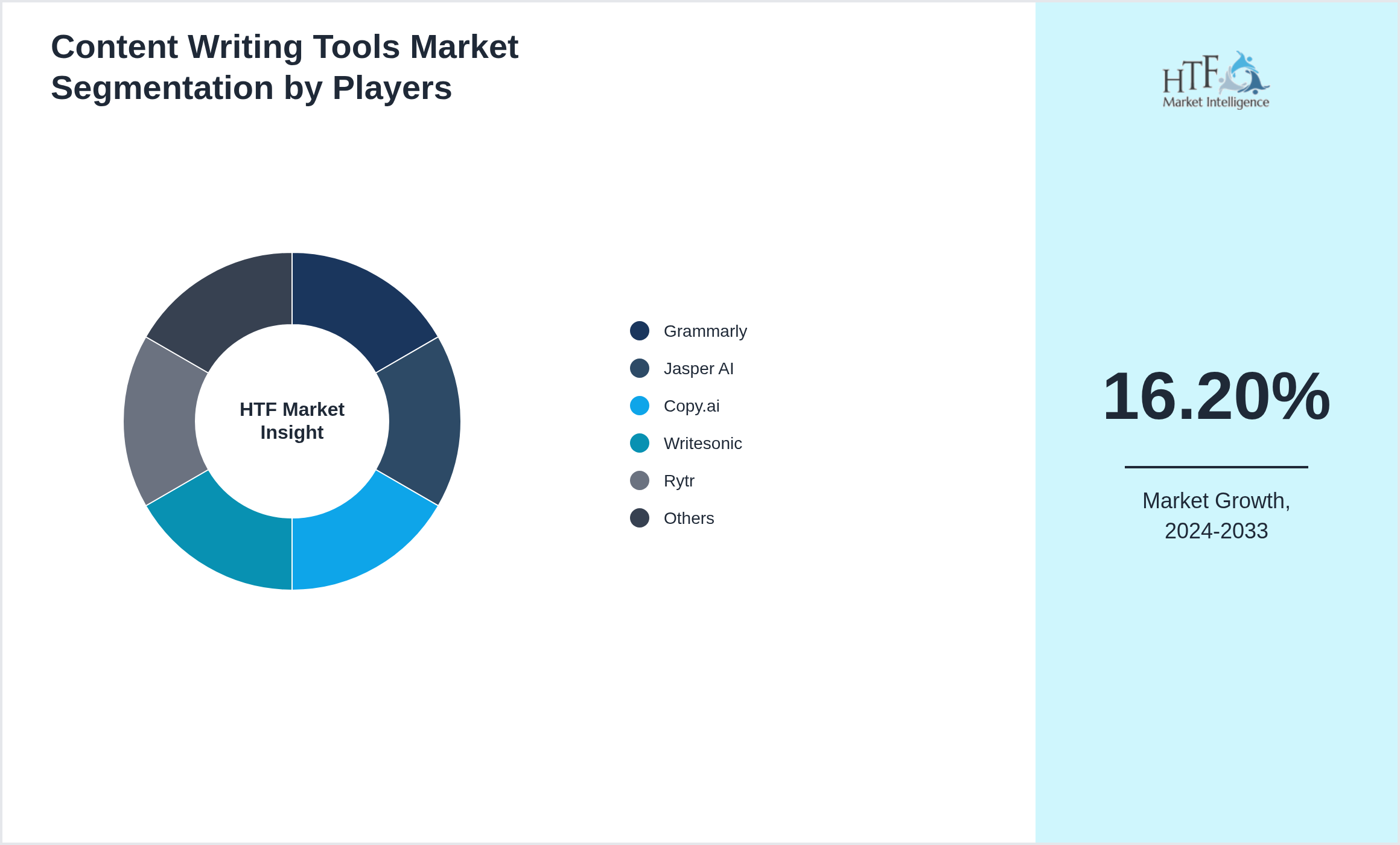
The Content Writing Tools is growing at 16.20% and is expected to reach 12.60 billion by 2033. Below are some of the dynamics shaping the Content Writing Tools.
AI-powered content-writing tools generate SEO-friendly blogs, ad copy, and product descriptions using transformer models fine-tuned on marketing corpora. Users enter keywords; the platform outputs multi-heading drafts with readability scoring and plagiarism checks (Copyscape API). Tone sliders modulate voice from formal to playful, while SERP analytics suggest citations for E-E-A-T compliance. Enterprise SaaS tiers offer brand-style guides enforced through custom embeddings. Data-governance features guarantee that proprietary prompts aren’t retained for model re-training, addressing IP concerns post ChatGPT era.
Source: HTF Market Intelligence (HTF MI)
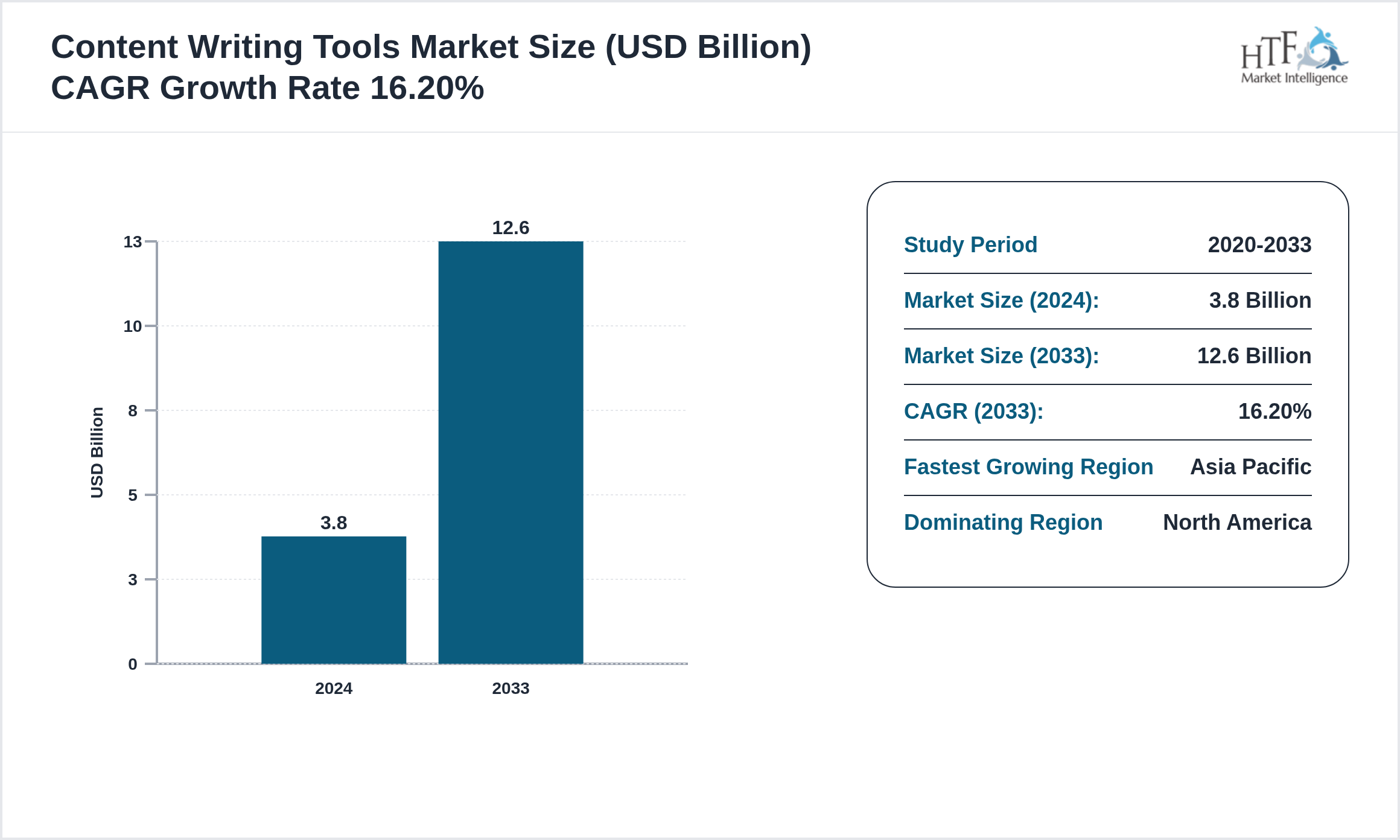
A Content Writing Tools market research report effectively communicates vital insights through several key aspects. It begins with an executive summary that concisely outlines the findings, conclusions, and actionable recommendations, allowing stakeholders to quickly grasp essential information. Clearly stating the research objectives ensures the purpose and specific questions being addressed are understood. The methodology section describes the research methods employed, such as surveys or focus groups, and provides a rationale for their selection to establish credibility. A market overview presents the industry landscape, including market size, growth trends, and key drivers.
Additionally, the segmentation analysis examines distinct market segments to identify varied customer needs. The competitive analysis offers insights into major competitors, highlighting their strengths and weaknesses. Finally, the report concludes with key findings and insights, followed by conclusions and recommendations that provide actionable strategies to guide future business decisions.
Geographic Analysis of Content Writing Tools
The Content Writing Tools market exhibits significant regional variation, shaped by different economic conditions and consumer behaviors.
Currently, North America dominates the market due to high consumption, population growth, and sustained economic progress. Meanwhile, Asia Pacific is experiencing the fastest growth, driven by large-scale infrastructure investments, industrial development, and rising consumer demand.
- North America
- LATAM
- West Europe
- Central & Eastern Europe
- Northern Europe
- Southern Europe
- East Asia
- Southeast Asia
- South Asia
- Central Asia
- Oceania
- MEA
Content Writing Tools Market Dynamics
Influencing Trend:
- • AI-powered writing assistants
- • Grammar and SEO optimization tools
- • Plagiarism detection integration
- • Subscription SaaS models
- • Multilingual content support
Market Growth Drivers:
- • Digital marketing expansion
- • SEO demand growth
- • E-commerce content needs
- • Remote workforce increase
- • AI content generation
Challenges:
- • AI content quality concerns
- • Copyright issues
- • Subscription churn
- • Competition saturation
- • Data privacy
Opportunities:
- • SME marketing automation
- • Blogger monetization tools
- • Enterprise content platforms
- • Educational content creation
- • Global digital markets
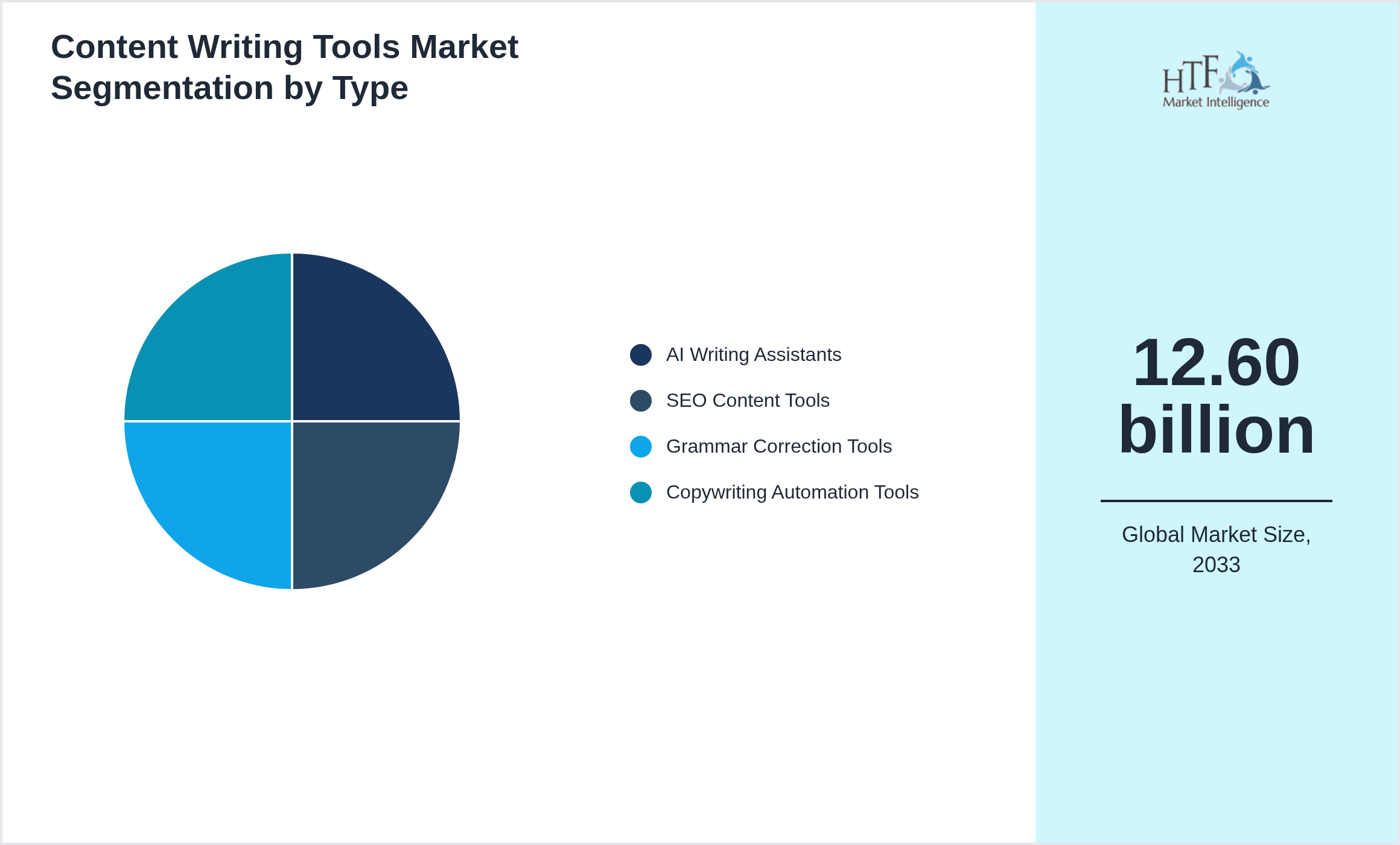
Segmentation by Type
- • AI Writing Assistants
- • SEO Content Tools
- • Grammar Correction Tools
- • Copywriting Automation Tools
Segmentation by Application
- • Digital Marketing Content
- • Blogging and Publishing
- • Academic Writing
- • Corporate Communications
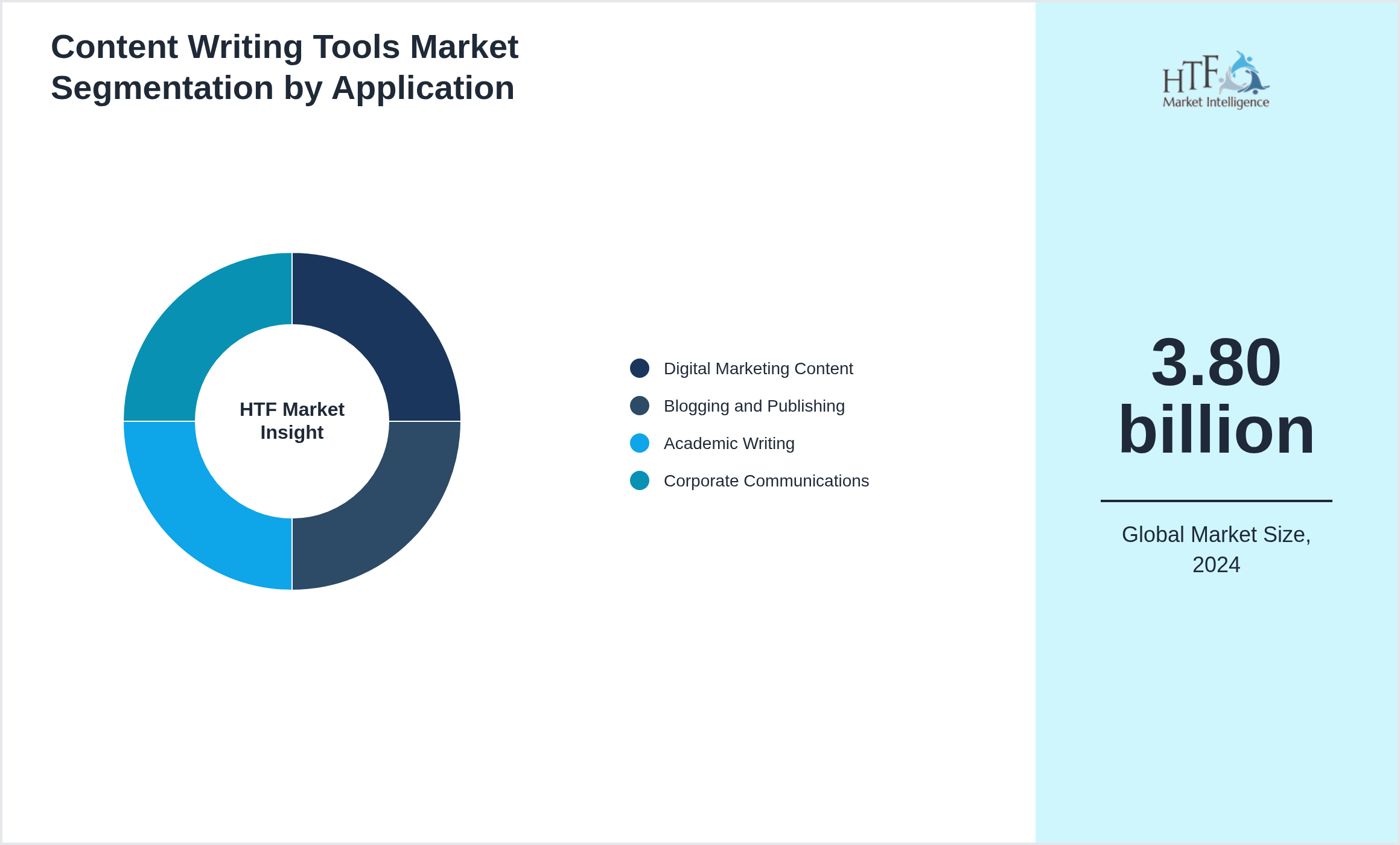
Key Players
The companies highlighted in this profile were selected based on insights from primary experts and an evaluation of their market penetration, product offerings, and geographical reach:
- • Grammarly
- • Jasper AI
- • Copy.ai
- • Writesonic
- • Rytr
- • QuillBot
- • Frase.io
- • Surfer SEO
- • Wordtune
- • ProWritingAid
- • Hemingway Editor
- • Pepper Content
- • MarketMuse
- • Ink Editor
- • ClosersCopy
- • ContentBot
- • Writer.com
- • Anyword
- • Simplified AI
- • Hypotenuse AI
Regional Outlook
The Asia Pacific is the fastest-growing region due to its rapidly increasing population and expanding economic activities across various industries. This growth is further fueled by rising urbanization, improving infrastructure, and government initiatives aimed at fostering industrial development. Additionally, the region's young and dynamic workforce, along with an increase in consumer spending, contributes significantly to its accelerated growth rate. The North America is the dominating region and is going to maintain its dominance during the forecasted period.
- North America
- LATAM
- West Europe
- Central & Eastern Europe
- Northern Europe
- Southern Europe
- East Asia
- Southeast Asia
- South Asia
- Central Asia
- Oceania
- MEA
Among the major investors, Johnson & Johnson is a prominent player. The company consistently allocates significant resources to expand its research capabilities, develop new medical technologies, and enhance its pharmaceutical portfolio. Johnson & Johnson's investments in R&D, coupled with strategic acquisitions and partnerships, reinforce its position as a major contributor to advancements in healthcare. This focus on innovation and market expansion underscores the critical importance of the North American region in the global healthcare landscape.
Source: HTF Market Intelligence (HTF MI)
For the complete company list, please ask for sample pages.
Competitive Landscape
The competitive landscape of the market provides a comprehensive analysis of the key players and their market positioning. It identifies the leading companies, including both established firms and emerging competitors, outlining their strengths such as innovation, strong brand presence, and extensive customer base, as well as weaknesses like limited product range or geographic reach. This section also delves into how these competitors position themselves in the market, whether they target premium, mid-tier, or budget segments, and how they differentiate from others through pricing, product innovation, or customer service.
Additionally, it highlights significant strategic moves, such as mergers, acquisitions, or product launches, that have impacted their competitive standing. The role of technology and innovation is another key factor, with companies investing in research and development to stay ahead. By understanding this competitive landscape, businesses can better identify market opportunities, anticipate competitor strategies, and adjust their approaches to gain a stronger foothold.
Research Methodology & Data Triangulation
Data triangulation is a robust research method that enhances the credibility and validity of findings by combining multiple data sources, methodologies, or perspectives. This approach involves three primary types: data source triangulation, where information is gathered from different sources such as surveys, interviews, and secondary data; methodological triangulation, which integrates various research methods, such as qualitative and quantitative techniques, to enrich the analysis; and investigator triangulation, where multiple researchers collaborate to interpret data, minimizing individual bias.
By employing data triangulation, businesses can gain a more comprehensive understanding of market dynamics and consumer behavior. This method helps validate findings by cross-referencing information, ensuring that conclusions are not based on a single data point. Consequently, triangulation enhances decision-making processes, as organizations can rely on more accurate and reliable insights. Ultimately, this approach fosters confidence in strategic planning and contributes to more effective risk management and resource allocation.
Key Development Activities
Market Entropy
- • Jan 2026 GenerativeAI content suite rolled out with brandstyle guardrails and multilingual SEO optimization.
- • Jan 2026 – WriteAI Technologies acquired ContentForge Labs to expand AIdriven writing automation. Sep 2025 – DigitalCreator Group merged with SmartDraft Solutions to strengthen SaaS subscription base.
- • Patent activity focuses on natural language processing algorithms automated content generation engines and AIdriven grammar and semantic analysis systems used to improve writing quality and productivity.
- • Investment is strong in AI software startups developing content automation platforms and marketing technology solutions that assist businesses in scaling digital content production.
Market Estimation Process
Report Details
| Report Features | Details |
| Base Year | 2024 |
| Based Year Market Size (2024) | 3.80 billion |
| Historical Period | 2020 to 2024 |
| CAGR (2024 to 2033) | 16.20% |
| Forecast Period | 2026 to 2033 |
| Forecasted Period Market Size (2033) | 12.60 billion |
| Scope of the Report | AI Writing Assistants, SEO Content Tools, Grammar Correction Tools, Copywriting Automation Tools, Digital Marketing Content, Blogging and Publishing, Academic Writing, Corporate Communications |
| Regions Covered | North America, LATAM, West Europe, Central & Eastern Europe, Northern Europe, Southern Europe, East Asia, Southeast Asia, South Asia, Central Asia, Oceania, MEA |
| Companies Covered | Grammarly, Jasper AI, Copy.ai, Writesonic, Rytr, QuillBot, Frase.io, Surfer SEO, Wordtune, ProWritingAid, Hemingway Editor, Pepper Content, MarketMuse, Ink Editor, ClosersCopy, ContentBot, Writer.com, Anyword, Simplified AI, Hypotenuse AI |
| Customization Scope | 15% Free Customization |
| Delivery Format | PDF and Excel through Email |
Limitation & Assumptions
Limitations and assumptions in a market research report are critical for framing the context and reliability of the findings. Limitations refer to potential weaknesses or constraints that may impact the research outcomes. These can include a limited sample size, which may not represent the broader population, or reliance on self-reported data, which can introduce bias. Other limitations may involve geographical constraints, where findings may not be applicable outside the studied regions, or temporal factors, such as rapidly changing market conditions, that can render results less relevant over time.
Assumptions are foundational beliefs taken for granted in the research process. For instance, it may be assumed that respondents provided honest and accurate information or that market conditions remained stable during the research period. Acknowledging these limitations and assumptions helps stakeholders critically evaluate the validity of the report's conclusions and guides strategic decisions based on the inherent uncertainties of the research.