
Automated Irrigation Scheduling Market - Global Size & Outlook 2020-2033
Global Automated Irrigation Scheduling Market is segmented by Application (Precision Irrigation Management, Water Resource Optimization, Crop Yield Enhancement, Smart Farming), Type (AI Irrigation Scheduling Platforms, Sensor Based Irrigation Systems, IoT Irrigation Controllers, Cloud Irrigation Analytics), and Geography (North America, LATAM, West Europe, Central & Eastern Europe, Northern Europe, Southern Europe, East Asia, Southeast Asia, South Asia, Central Asia, Oceania, MEA)
Pricing
Report Overview
Industry Overview
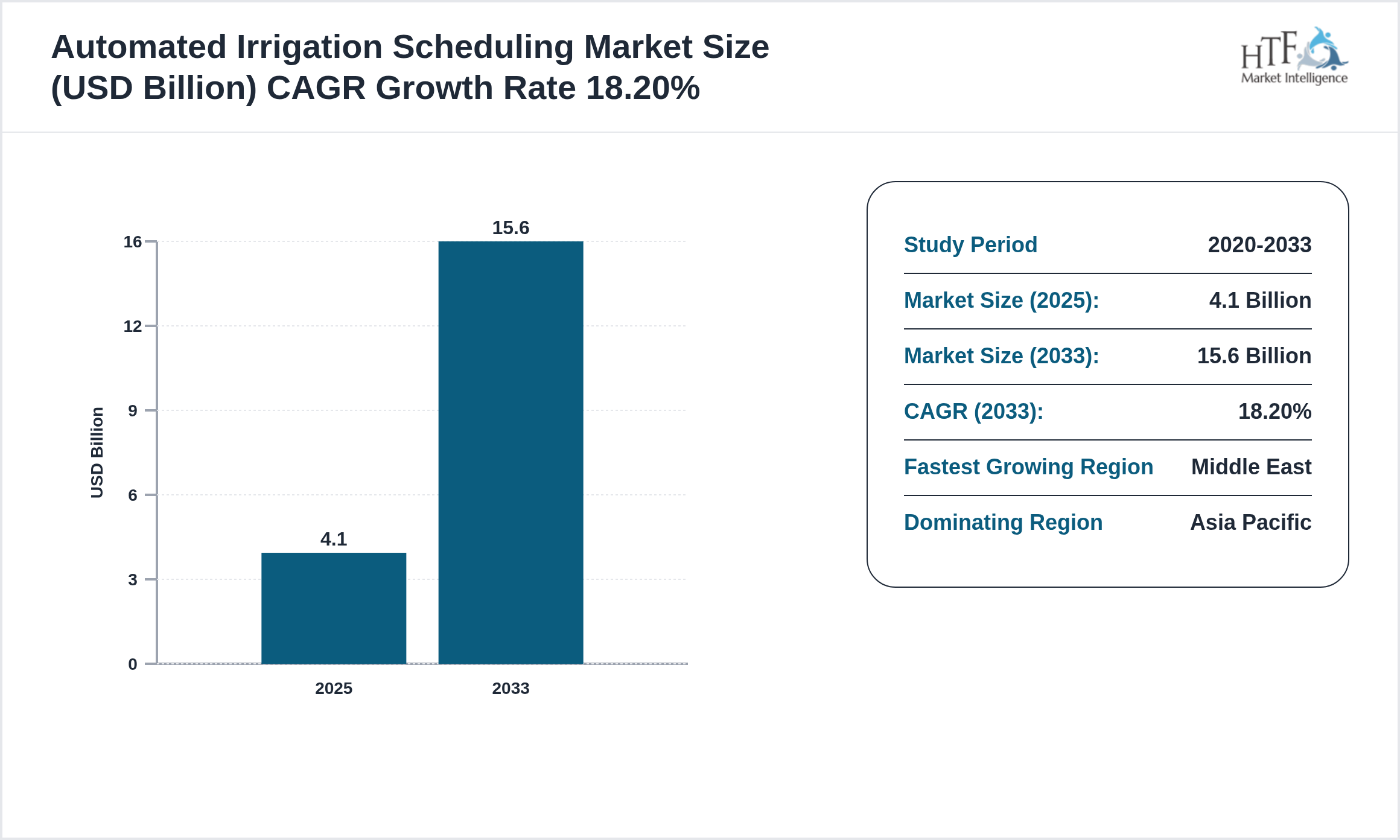
The North America, LATAM, West Europe, Central & Eastern Europe, Northern Europe, Southern Europe, East Asia, Southeast Asia, South Asia, Central Asia, Oceania, MEA Automated Irrigation Scheduling market was valued at 4.10 billion in 2025 and is expected to reach 15.60 billion by 2020, growing at a compound annual growth rate (CAGR) of 18.20% over the forecast period.
Automated scheduling platforms combine soil-moisture sensors, ET models, and AI forecasts to trigger pumps. Controllers from Rain Bird support LoRa networks. Field trials save 25 % water while maintaining yields, crucial for drought resilience.
Source: HTF Market Intelligence (HTF MI)
Key Highlights
• The Automated Irrigation Scheduling is growing at a CAGR of 18.20% during the forecasted period of 2025 to 2033
• Year-on-year growth for the market is {YOY_GROWTH}.
• Asia Pacific dominated the market share in 2025
• Based on type, the market is bifurcated into AI Irrigation Scheduling Platforms, Sensor Based Irrigation Systems, IoT Irrigation Controllers, Cloud Irrigation Analytics segment, which dominated the market share during the forecasted period
• Based on application, the market is segmented into Application Precision Irrigation Management, Water Resource Optimization, Crop Yield Enhancement, Smart Farming, which is the fastest-growing segment.
• {REGION_NAME} import/export in terms of K tons, K units, and metric tons will be provided if applicable based on industry best practice.
The research study Automated Irrigation Scheduling Market provides readers with details on strategic planning and tactical business decisions that influence and stabilize growth prognosis in the Automated Irrigation Scheduling market. A few disruptive trends, however, will have opposing and strong influences on the development of the global biometric lockers market and the distribution across players. This section aims to clarify why specific trends in the Automated Irrigation Scheduling market significantly impact the market trajectory and how they should be considered in the strategic planning of industry players.
Market Dynamics
Market Driver
- • Water scarcity laws
- • Energy pumping costs
- • Crop stress prevention
- • IoT sensor affordability
- • Government smart-water grants
- • AI evapotranspiration models
- • Satellite moisture fusion
- • Mobile valve control
- • Cloud forecast integration
- • SMS pump alerts
- • Subscription advisory SaaS
- • OEM bundling with pivots
- • Export to orchards
- • Carbon water credits
- • Utility rebate programs
- • Sensor network maintenance
- • Connectivity gaps
- • Farmer habit change
- • Power outages
- • ROI for low-value crops
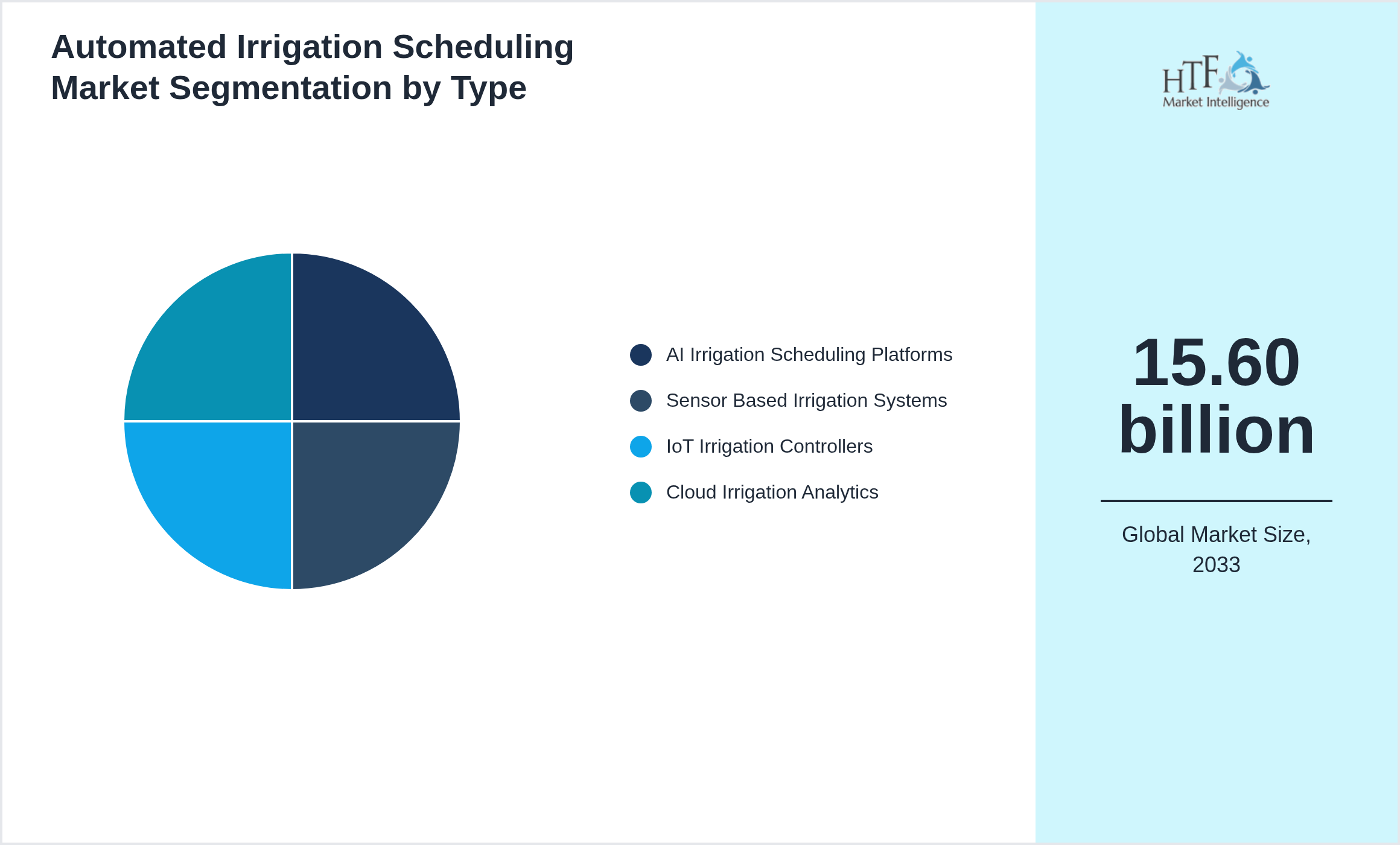
Segmentation by Type
- • AI Irrigation Scheduling Platforms
- • Sensor Based Irrigation Systems
- • IoT Irrigation Controllers
- • Cloud Irrigation Analytics
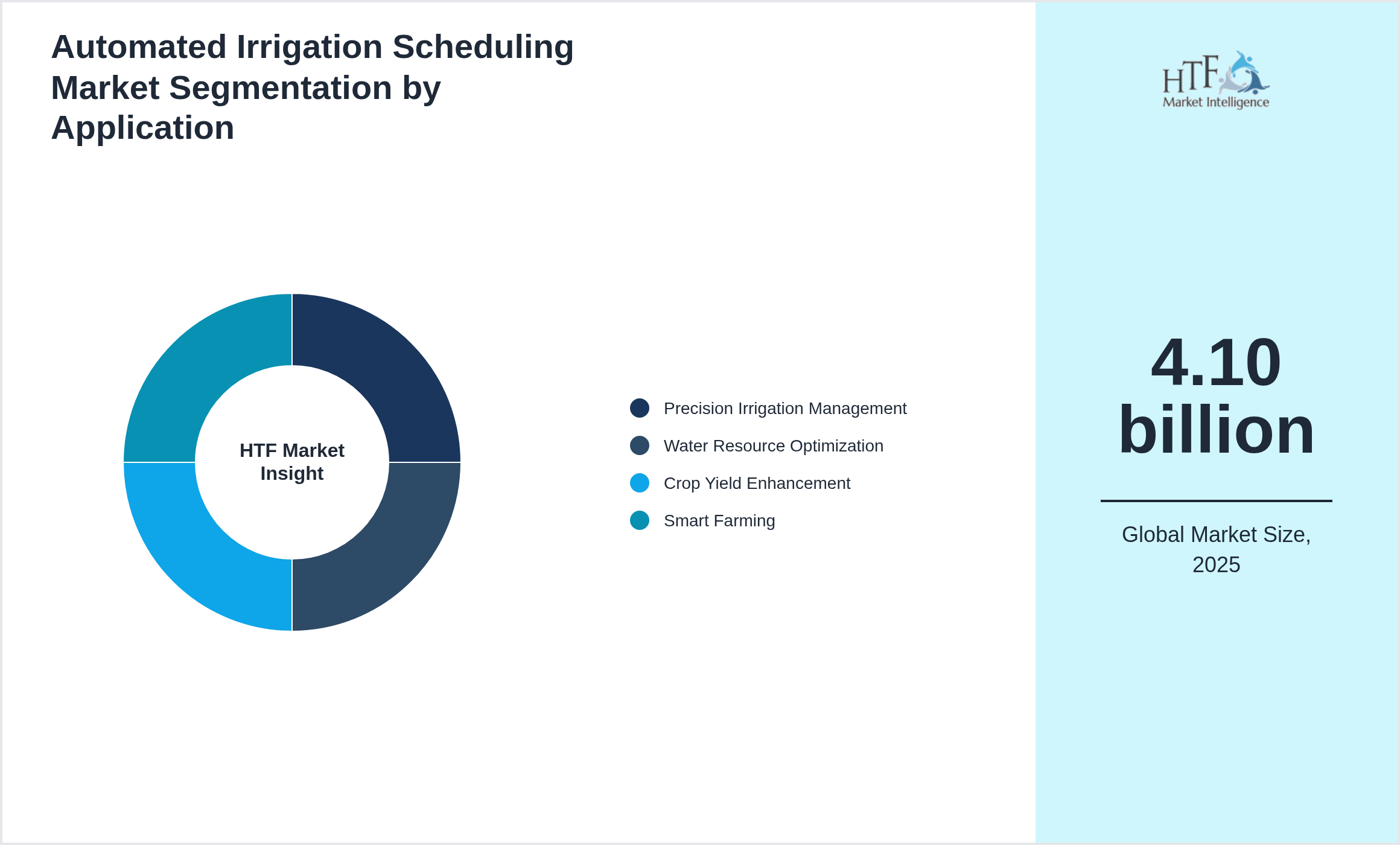
Segmentation by Application
- • Precision Irrigation Management
- • Water Resource Optimization
- • Crop Yield Enhancement
- • Smart Farming
Key Players
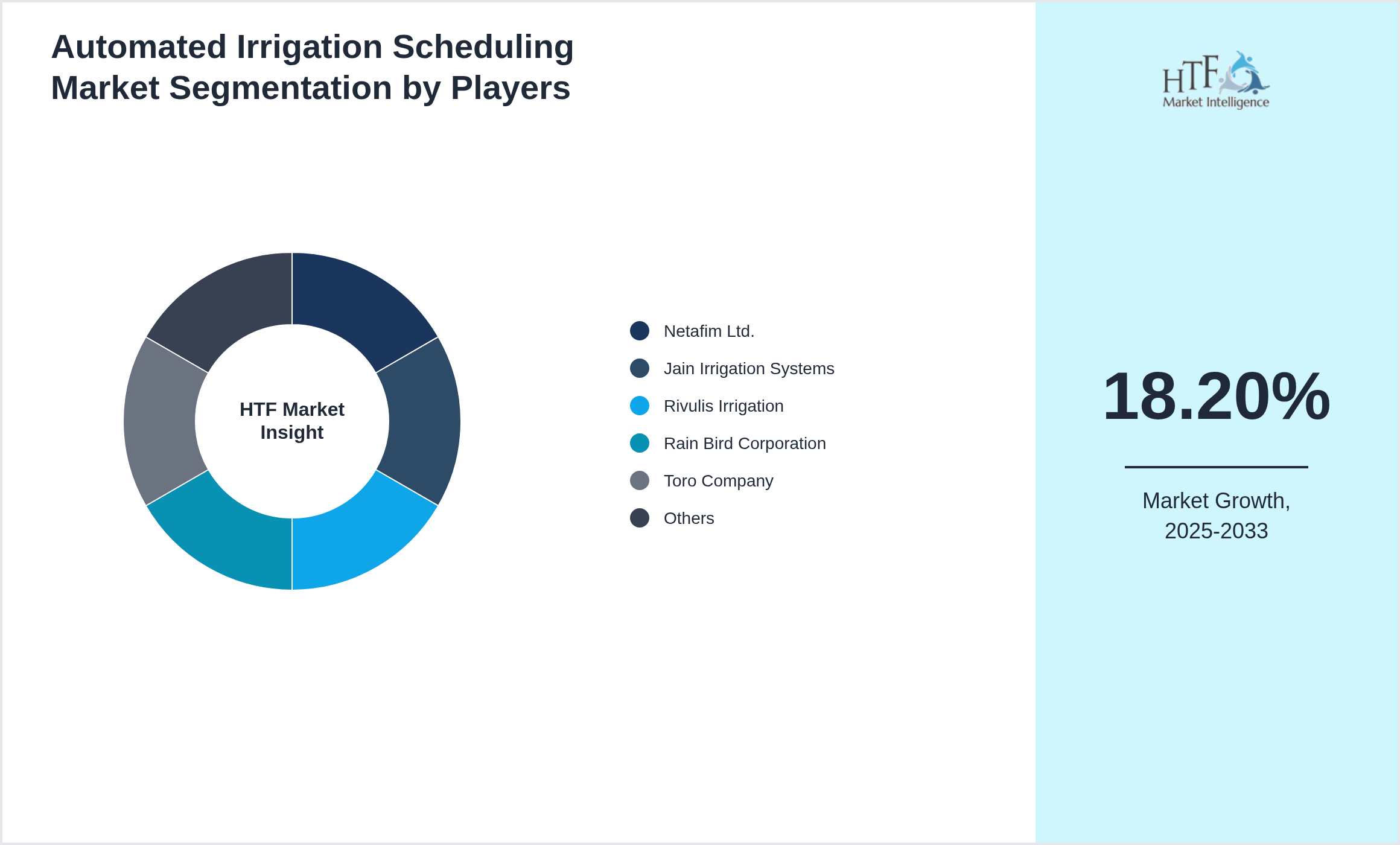
Several key players in the Automated Irrigation Scheduling market are strategically focusing on expanding their operations in developing regions to capture a larger market share, particularly as the year-on-year growth rate for the market stands at 8.70%. The companies featured in this profile were selected based on insights from primary experts, evaluating their market penetration, product offerings, and geographical reach. By targeting emerging markets, these companies aim to leverage new opportunities, enhance their competitive advantage, and drive revenue growth. This approach not only aligns with their overall business objectives but also positions them to respond effectively to the evolving demands of consumers in these regions.
- • Netafim Ltd.
- • Jain Irrigation Systems
- • Rivulis Irrigation
- • Rain Bird Corporation
- • Toro Company
- • Valmont Industries
- • Lindsay Corporation
- • Trimble Agriculture
- • Topcon Agriculture
- • CropX Technologies
- • Hortau Irrigation
- • Sentek Technologies
- • Arable Labs
- • Pessl Instruments
- • Davis Instruments
- • Bosch Smart Agriculture
- • Hexagon Agriculture
- • Smart Irrigation Systems
- • Aquaspy Sensors
- • Hydropoint Data Systems
For the complete company list, please ask for sample pages.
Merger & Acquisition
- • Jan 2026 – AquaLogic Systems acquired IrrigateAI Technologies to expand predictive irrigation software. Oct 2025 – GlobalAgroTech merged with SmartWater Schedulers to strengthen subscription growth.
Patent Analysis
- • Patent activity focuses on soil moisture sensors automated irrigation controllers and AI-based irrigation optimization algorithms used in precision agriculture systems.
Investment and Funding Scenario
- • Investment flows into agritech startups and irrigation technology companies developing automated irrigation management platforms.
Regional Insight
The Automated Irrigation Scheduling vary widely by region, reflecting diverse economic conditions and consumer preferences. In North America, the focus is on convenience and premium products, driven by high disposable incomes and a strong e-commerce sector. Europe’s market is fragmented, with Western countries emphasizing luxury and organic goods, while Eastern Europe sees rapid growth. Asia-Pacific is a fast-growing region with high demand for high-tech and affordable products, driven by urbanization and rising middle-class incomes. Latin America prioritizes affordability amidst economic fluctuations, with Brazil and Mexico leading in market growth. In the Middle East and Africa, market trends are influenced by cultural preferences, with luxury goods prominent in the Gulf States and gradual growth in sub-Saharan Africa. Global trends like sustainability and digital transformation are impacting all regions.
The Asia Pacific dominant region currently dominates the market share, fueled by increasing consumption, population growth, and sustained economic progress, which collectively enhance market demand. Conversely, the Middle East is growing rapidly, driven by significant infrastructure investments, industrial expansion, and rising consumer demand.
- North America
- LATAM
- West Europe
- Central & Eastern Europe
- Northern Europe
- Southern Europe
- East Asia
- Southeast Asia
- South Asia
- Central Asia
- Oceania
- MEA
The Top-Down and Bottom-Up Approaches
The top-down approach begins with a broad theory or hypothesis and breaks it down into specific components for testing. This structured, deductive process involves developing a theory, creating hypotheses, collecting and analyzing data, and drawing conclusions. It is particularly useful when there is substantial theoretical knowledge, but it can be rigid and may overlook new phenomena.
Conversely, the bottom-up approach starts with specific data or observations, from which broader generalizations and theories are developed. This inductive process involves collecting detailed data, analyzing it for patterns, developing hypotheses, formulating theories, and validating them with additional data. While this approach is flexible and encourages the discovery of new phenomena, it can be time-consuming and less structured.
Regulatory Framework
The healthcare sector is overseen by various regulatory bodies that ensure the safety, quality, and efficacy of health services and products. In the United States, the U.S. Department of Health and Human Services (HHS) plays a crucial role in protecting public health and providing essential human services. Within HHS, the Food and Drug Administration (FDA) regulates food, drugs, and medical devices, ensuring they meet safety and efficacy standards. The Centers for Disease Control and Prevention (CDC) focuses on disease control and prevention, conducting research, and providing health information to protect public health.
In the United Kingdom, the General Medical Council (GMC) regulates doctors, ensuring they adhere to professional standards. Other important bodies include the General Pharmaceutical Council (GPhC), which oversees pharmacists, and the Nursing and Midwifery Council (NMC), which regulates nurses and midwives. These organizations work to maintain high standards of care and protect patients.
Internationally, the European Medicines Agency (EMA) regulates medicines within the European Union, while the World Health Organization (WHO) provides global leadership on public health issues. Each of these regulatory bodies plays a vital role in ensuring that health care systems operate effectively and safely, ultimately safeguarding public health across different regions.
- • Automated irrigation scheduling systems operate under agricultural water management regulations and environmental policies promoting efficient water use in farming. Governments encourage smart irrigation technologies to reduce water consumption and improve agricultural sustainability.
Report Infographics
| Report Features | Details |
| Base Year | 2025 |
| Based Year Market Size (2025) | 4.10 billion |
| Historical Period | 2020 to 2025 |
| CAGR (2025 to 2033) | 18.20% |
| Forecast Period | 2026 to 2033 |
| Forecasted Period Market Size (2033) | 15.60 billion |
| Scope of the Report | AI Irrigation Scheduling Platforms, Sensor Based Irrigation Systems, IoT Irrigation Controllers, Cloud Irrigation Analytics, Precision Irrigation Management, Water Resource Optimization, Crop Yield Enhancement, Smart Farming |
| Regions Covered | North America, LATAM, West Europe, Central & Eastern Europe, Northern Europe, Southern Europe, East Asia, Southeast Asia, South Asia, Central Asia, Oceania, MEA |
| Companies Covered | Netafim Ltd., Jain Irrigation Systems, Rivulis Irrigation, Rain Bird Corporation, Toro Company, Valmont Industries, Lindsay Corporation, Trimble Agriculture, Topcon Agriculture, CropX Technologies, Hortau Irrigation, Sentek Technologies, Arable Labs, Pessl Instruments, Davis Instruments, Bosch Smart Agriculture, Hexagon Agriculture, Smart Irrigation Systems, Aquaspy Sensors, Hydropoint Data Systems |
| Customization Scope | 15% Free Customization |
| Delivery Format | PDF and Excel through Email |