
Global E-commerce Inventory Management Software Market Size, Growth & Revenue 2025-2034
Global E-commerce Inventory Management Software Market is segmented by Product Type (Cloud-Based Inventory Management Software, On-Premise Inventory Management Software, Hybrid Inventory Management Software, AI-Enabled Inventory Management Software, Mobile-Integrated Inventory Management Software), Application (Online Retail, Wholesale Distribution, Third-Party Logistics, Direct-to-Consumer, Marketplaces), Deployment Model (Cloud-Based, On-Premise, Hybrid), Service Type (Inventory Tracking, Demand Forecasting, Order Management, Supplier Integration), and Geography (North America, LATAM, West Europe, Central & Eastern Europe, Northern Europe, Southern Europe, East Asia, Southeast Asia, South Asia, Central Asia, Oceania, MEA)
Pricing
Report Overview
Executive Summary
- •The global E-commerce Inventory Management Software market delivers critical software solutions aimed at optimizing inventory processes for online and hybrid retail businesses worldwide. These solutions enable real-time inventory tracking, demand forecasting, order processing, and supply chain integration, supporting businesses across various e-commerce models such as online retail, wholesale distribution, third-party logistics, direct-to-consumer sales, and marketplaces. The market comprises multiple software types including cloud-based, on-premise, hybrid, AI-enabled, and mobile-integrated platforms, each offering unique capabilities relevant to diverse business needs. With the rapid digital transformation of retail and the exponential growth of e-commerce, companies require sophisticated inventory management to reduce costs, minimize stockouts, and enhance customer satisfaction. The integration of artificial intelligence and machine learning further empowers these platforms to provide predictive analytics and automated replenishment, enabling proactive inventory control. This market is witnessing robust expansion driven by increasing online consumer demand, globalization of supply chains, and the necessity for scalable and flexible software systems that facilitate omnichannel presence and seamless logistics coordination. The software’s ability to connect multiple sales channels, warehouses, and suppliers in a unified platform is pivotal to reducing operational complexities and enhancing efficiency. Furthermore, advancements in cloud technology and mobile applications are making inventory management more accessible and responsive, especially for small and medium-sized enterprises. Overall, the market’s growth is fueled by digital innovation, evolving retail paradigms, and the imperative for agile inventory solutions that align with dynamic e-commerce ecosystems.
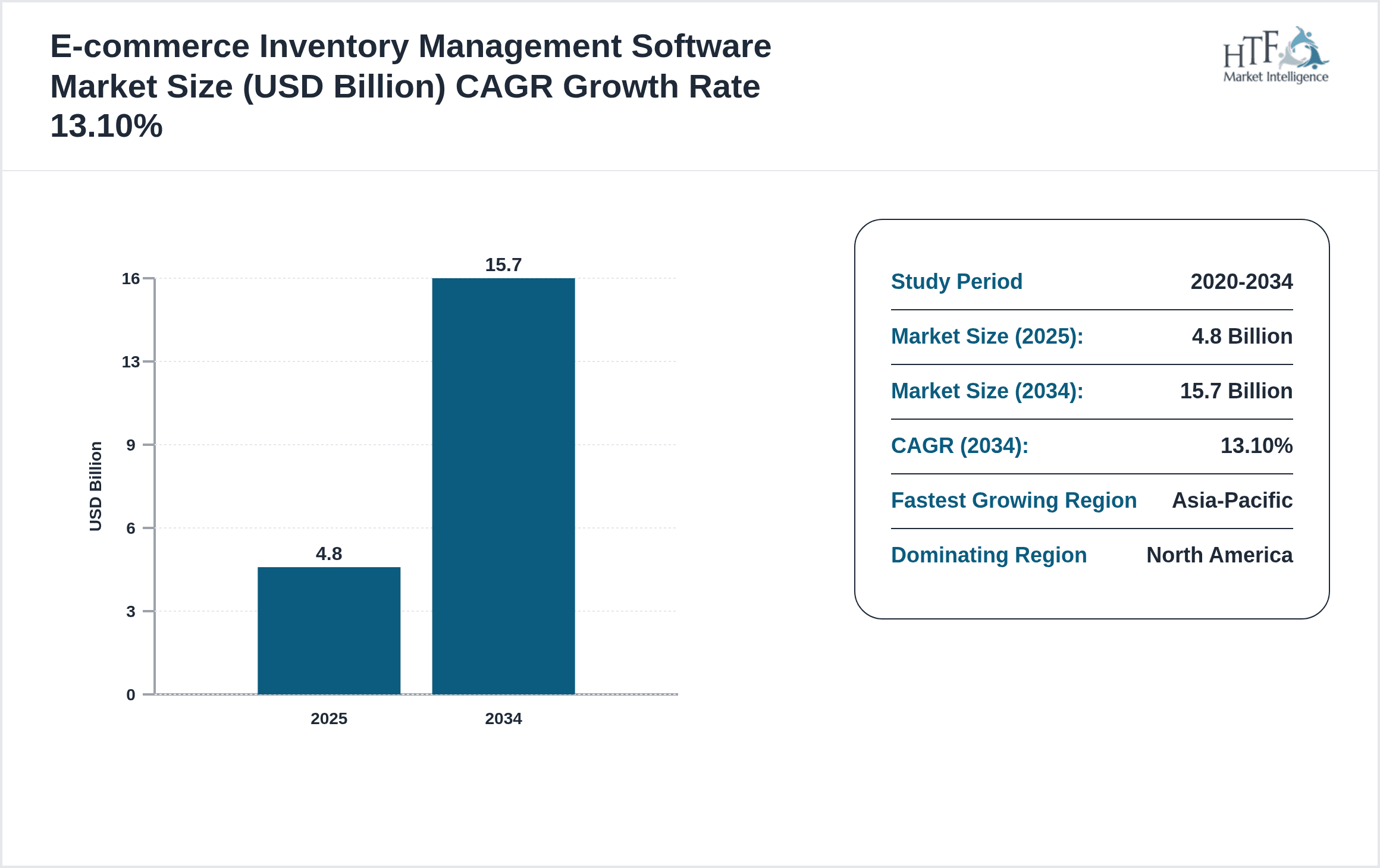
- •Key market highlights indicate a substantial growth trajectory with the global market valued at USD 4.8 Billion in 2025 and projected to reach USD 15.7 Billion by 2034, reflecting a CAGR of 13.1%. The cloud-based segment dominates the product landscape due to its scalability and cost-effectiveness, while AI-enabled software is the fastest growing driven by enhanced predictive capabilities and automation. North America remains the dominant region owing to early digital adoption and advanced e-commerce infrastructure, whereas Asia-Pacific shows the fastest growth propelled by increasing internet penetration and expanding online retail sectors. The market benefits from continuous technological advancements, growing investment in supply chain digitization, and rising awareness about the importance of inventory optimization among e-commerce enterprises.
- •E-commerce Inventory Management Software provides strategic value across multiple industries, including retail, logistics, and manufacturing, by enabling efficient stock control, reducing operational costs, and improving customer experience through timely product availability. For investors and stakeholders, the market offers promising opportunities driven by ongoing digitalization trends, evolving consumer preferences toward online shopping, and the increasing complexity of global supply chains. The software's capability to integrate with diverse platforms and technologies positions it as a critical enabler for omnichannel commerce and smart logistics operations, making it an indispensable tool for businesses aiming to maintain competitive advantage in the rapidly evolving e-commerce landscape.
Competitive Landscape
The global E-commerce Inventory Management Software market features a highly competitive environment characterized by rapid technological innovation, strategic partnerships, and aggressive market penetration strategies. Leading players focus on differentiating their offerings through integration of AI and machine learning for enhanced predictive analytics and automation capabilities. Competitive strategies include continuous product development, expansion into emerging markets, and acquisitions to broaden service portfolios and customer base. Pricing models vary from subscription-based cloud services to customized enterprise solutions, enabling flexibility and scalability for clients of different sizes. Market entrants face significant barriers including technological complexity, high capital requirements for R&D, and the necessity for robust cybersecurity measures to protect sensitive inventory and transaction data. Distribution channels encompass direct sales, channel partners, and digital marketplaces, facilitating wide-reaching market access. Regional competition varies, with North America and Europe driven by innovation and regulatory compliance, while Asia-Pacific emphasizes cost-effective and localized solutions. Future competitive trends indicate a shift towards fully integrated omni-platform inventory ecosystems, increased adoption of mobile and IoT-enabled interfaces, and deeper analytics for supply chain optimization. Companies are expected to leverage big data and blockchain technologies to enhance transparency, traceability, and operational efficiency. Overall, the competitive landscape is dynamic, with continuous evolution shaped by technological advancements and changing customer expectations.
Leading Companies in E-commerce Inventory Management Software Market
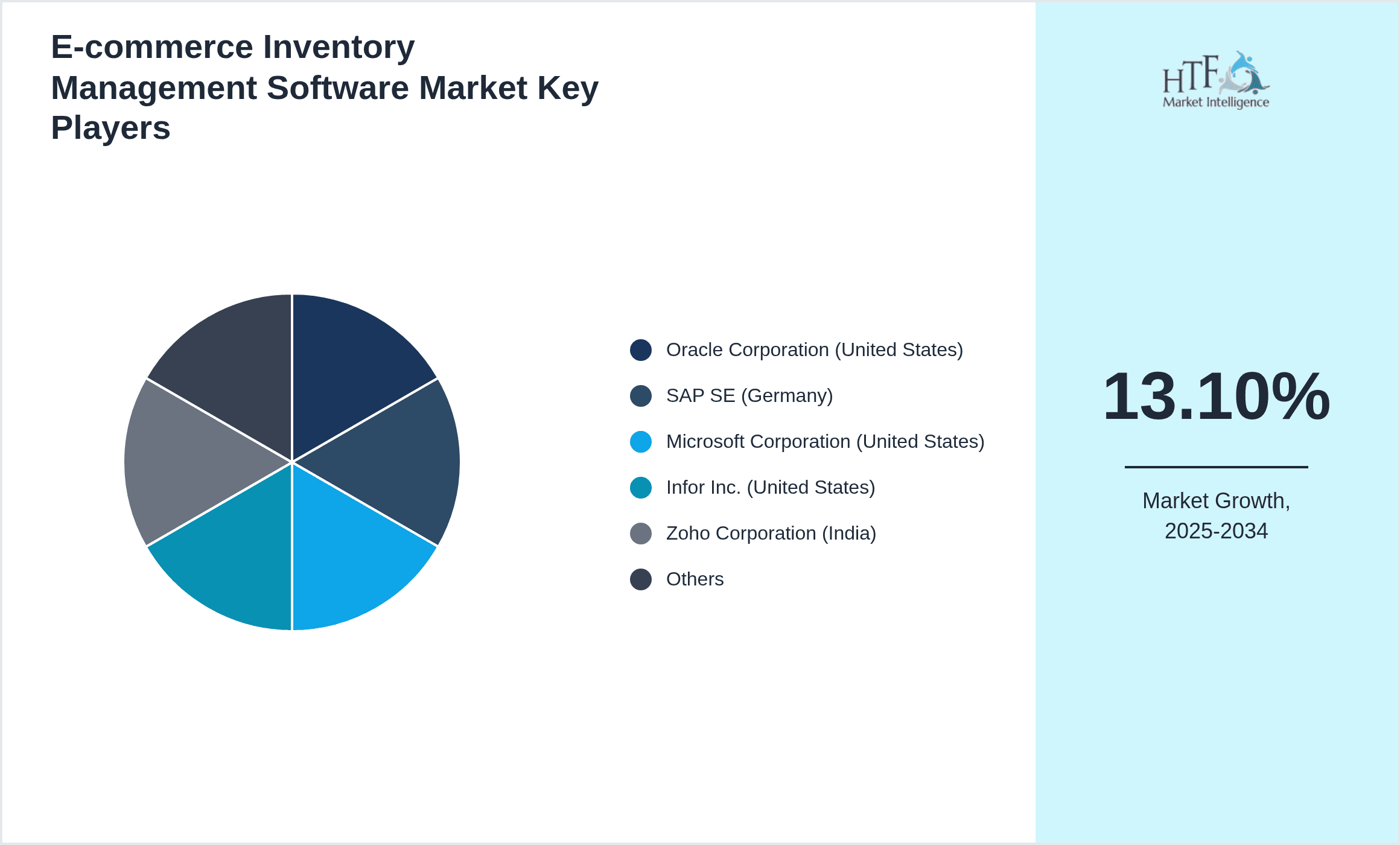
- •Oracle Corporation (United States)
- •SAP SE (Germany)
- •Microsoft Corporation (United States)
- •Infor Inc. (United States)
- •Zoho Corporation (India)
- •IBM Corporation (United States)
- •NetSuite Inc. (United States)
- •TradeGecko (Singapore)
- •Cin7 (New Zealand)
- •Brightpearl (United Kingdom)
- •DEAR Systems (Australia)
- •Fishbowl Inventory (United States)
- •Sage Group plc (United Kingdom)
- •Epicor Software Corporation (United States)
- •Veeqo (United Kingdom)
- •SkuVault (United States)
- •Unleashed Software (New Zealand)
- •Orderhive (India)
- •QuickBooks Commerce (United States)
- •Tradevine (New Zealand)
- •Megaventory (United States)
- •Stitch Labs (United States)
- •SkuNexus (United States)
- •Katana MRP (Hungary)
- •Zoho Inventory (India)

Market Breakdown
- •By Product Type
- ◦Cloud-Based Inventory Management Software
- ◦On-Premise Inventory Management Software
- ◦Hybrid Inventory Management Software
- ◦AI-Enabled Inventory Management Software
- ◦Mobile-Integrated Inventory Management Software
- •By Application
- ◦Online Retail
- ◦Wholesale Distribution
- ◦Third-Party Logistics
- ◦Direct-to-Consumer
- ◦Marketplaces
- •By Deployment Model
- ◦Cloud-Based
- ◦On-Premise
- ◦Hybrid
- •By Service Type
- ◦Inventory Tracking
- ◦Demand Forecasting
- ◦Order Management
- ◦Supplier Integration
Growth Dynamics
The global E-commerce Inventory Management Software market is primarily driven by the exponential growth of online retail and the increasing complexity of supply chains, which necessitate efficient inventory control systems. Businesses are adopting advanced software solutions to automate stock management, reduce operational costs, and enhance customer satisfaction through improved product availability. Cloud computing adoption facilitates scalability and real-time data access, empowering enterprises to respond swiftly to market fluctuations and consumer demand changes. Furthermore, the integration of artificial intelligence and machine learning enhances predictive analytics, enabling proactive inventory replenishment and minimizing stockouts or overstock situations. The surge in omnichannel retailing compels companies to deploy unified inventory management platforms that synchronize stock across multiple sales channels and warehouses, ensuring seamless order fulfillment and logistics coordination. Additionally, rising e-commerce penetration in emerging economies fuels demand for affordable, flexible inventory software solutions tailored for small and medium-sized businesses. Strategic investments in digital transformation and government initiatives promoting technological innovation further propel market expansion. The COVID-19 pandemic accelerated the adoption of e-commerce and digitized supply chains, underscoring the critical role of inventory management software in business continuity and resilience. Collectively, these factors contribute to robust market growth and ongoing technology-driven evolution in inventory management practices.

Market Trends
Key trends shaping the E-commerce Inventory Management Software market include the widespread adoption of cloud-based platforms that offer enhanced scalability, accessibility, and lower upfront costs compared to traditional on-premise solutions. The integration of AI and machine learning technologies is becoming increasingly prevalent, enabling intelligent demand forecasting, automated replenishment, and anomaly detection to optimize inventory levels. Mobile integration is gaining traction, facilitating real-time inventory monitoring and management on-the-go, which is particularly beneficial for small businesses and field operations. Additionally, the rise of omnichannel retail strategies promotes the deployment of unified inventory systems that provide centralized visibility across online stores, physical outlets, and warehouses. Sustainability considerations are influencing software capabilities, with features aimed at reducing waste and supporting circular economy initiatives. The market also witnesses growth in API-based integrations allowing seamless connectivity with e-commerce platforms, ERP systems, and third-party logistics providers. These trends collectively enhance operational efficiency, customer experience, and supply chain resilience, driving broader adoption of advanced inventory management solutions globally.
Market Opportunities
The global E-commerce Inventory Management Software market presents significant growth opportunities driven by expanding e-commerce penetration in emerging economies such as Asia-Pacific and Latin America. Increasing smartphone adoption and internet connectivity in these regions create demand for mobile-integrated and cloud-based inventory solutions tailored to local business needs. The rise of AI-enabled inventory management offers avenues for product innovation, enabling companies to differentiate through advanced analytics and automation features. Furthermore, the growing trend of omnichannel retailing necessitates unified inventory platforms capable of synchronizing stock across multiple channels, providing a lucrative target segment. Small and medium-sized enterprises represent an underserved market segment with increasing digital adoption, offering potential for scalable and cost-effective software solutions. Additionally, sustainability-focused features that help reduce inventory waste and optimize resource utilization align with global environmental priorities, opening new avenues for growth. Partnerships with e-commerce platforms, logistics providers, and ERP vendors can drive market expansion through integrated offerings and enhanced customer value. Overall, innovation in AI, mobile technology, and cloud services combined with geographic expansion and strategic collaborations constitutes a promising opportunity landscape.
Market Challenges
Despite strong growth prospects, the E-commerce Inventory Management Software market faces several challenges that could impede rapid adoption and scaling. High initial implementation costs and complexity can deter small and medium-sized enterprises, especially in developing regions with limited technological infrastructure. Data security and privacy concerns remain paramount as inventory management solutions handle sensitive business and customer data, requiring robust cybersecurity measures and compliance with diverse regional regulations. Integration difficulties with existing legacy systems and varied e-commerce platforms can create operational inefficiencies and increase deployment timelines. Additionally, the lack of standardized processes and varying requirements across industries complicate the development of universally applicable software solutions. Market fragmentation with numerous providers offering overlapping functionalities intensifies competition and pricing pressures, potentially impacting profit margins. Furthermore, rapid technological changes demand continuous innovation and investment, which may be challenging for smaller vendors. Lastly, supply chain disruptions and fluctuating global trade conditions can affect inventory data accuracy and forecasting reliability, posing operational risks. Addressing these challenges requires strategic investments in technology, partnerships, and customer education.
Regulatory Framework
Between 2020 and 2025, regulatory developments impacting the E-commerce Inventory Management Software market have focused on data protection, cybersecurity, and digital commerce compliance across major regions. The European Union’s General Data Protection Regulation (GDPR), enacted prior to 2020 but with ongoing enforcement, imposes stringent requirements on data privacy and security, compelling inventory software providers to implement robust data handling and user consent mechanisms. In North America, regulations such as the California Consumer Privacy Act (CCPA) have further reinforced data protection standards, influencing software design and deployment. Additionally, the rise of e-commerce taxation policies globally requires inventory systems to incorporate tax compliance features adaptable to multiple jurisdictions. Governments in Asia-Pacific and Latin America have introduced cybersecurity frameworks mandating regular audits and breach notifications to safeguard e-commerce platforms. Intellectual property laws also govern software licensing and usage rights, necessitating compliance to avoid litigation risks. Furthermore, environmental regulations encouraging sustainable business practices are prompting software vendors to integrate features that support waste reduction and resource optimization. Regulatory bodies have increased scrutiny on cloud service providers regarding data sovereignty and cross-border data flows, influencing deployment choices between cloud and on-premise systems. Overall, evolving regulatory landscapes demand continuous adaptation by inventory management software vendors to ensure compliance, security, and market access.
Market Intelligence
- •15th January 2025, Oracle Corporation announced the launch of its next-generation cloud-based E-commerce Inventory Management Software designed to leverage AI-driven analytics and automation. The new platform integrates seamlessly with multiple e-commerce and ERP systems, offering real-time inventory visibility, predictive demand forecasting, and automated replenishment workflows. Oracle’s solution targets large enterprises and mid-market firms seeking scalable, flexible inventory control across omnichannel sales networks. This launch positions Oracle to expand its market share by addressing the growing demand for intelligent inventory solutions that enhance operational efficiency and customer satisfaction globally. The platform also incorporates advanced security features ensuring compliance with international data protection regulations. Source: Oracle Official Press Release
- •10th March 2025, SAP SE introduced enhancements to its AI-enabled inventory management module within SAP S/4HANA Cloud. The update focuses on improved machine learning algorithms for dynamic stock optimization and integrates IoT sensor data for real-time warehouse monitoring. SAP’s innovation aims to reduce inventory carrying costs and prevent stockouts while supporting sustainability goals by minimizing waste. The enhanced module targets retail, wholesale, and logistics sectors embracing digital transformation and sustainability mandates. SAP’s strategic investment in AI and IoT integration underscores its commitment to delivering comprehensive, future-ready inventory management solutions that cater to evolving market demands. Source: SAP Corporate News
- •22nd May 2025, Microsoft Corporation announced a strategic partnership with leading e-commerce platform Shopify to develop a unified inventory management solution. The collaboration combines Microsoft’s cloud computing and AI capabilities with Shopify’s extensive merchant network, aiming to provide small and medium-sized businesses with affordable, scalable inventory software. The solution offers seamless integration with Shopify stores, real-time inventory tracking, and AI-powered demand forecasting. This initiative seeks to empower merchants to optimize stock levels, improve order fulfillment rates, and enhance customer experience, fueling growth in the e-commerce sector globally. The partnership signifies growing collaboration trends between software providers and e-commerce platforms to deliver integrated solutions. Source: Microsoft and Shopify Joint Announcement
- •18th September 2024, IBM Corporation completed the acquisition of a specialized AI startup focused on predictive inventory analytics to enhance its Watson Supply Chain portfolio. This acquisition strengthens IBM’s capabilities in offering advanced inventory management solutions equipped with machine learning models that forecast demand patterns and supply chain disruptions. IBM plans to integrate these technologies into its existing cloud-based inventory software to provide clients with actionable insights and automated decision-making tools. The move reflects IBM’s strategic focus on expanding its AI-driven supply chain solutions to meet growing market requirements for intelligent, data-driven inventory control. Source: IBM Official Press Release
- •Recent market developments and strategic initiatives are continuously tracked through industry publications, company announcements, and regulatory filings. For the most current information, stakeholders are advised to monitor official corporate communications and recognized market intelligence platforms.
Regional Outlook
The North America currently holds a significant share of the market, primarily due to several key factors: increasing consumption rates, a burgeoning population, and robust economic momentum. These elements collectively drive demand, positioning this region as a leader in the market. On the other hand, Asia-Pacific is rapidly emerging as the fastest-growing area within the industry. This remarkable growth can be attributed to swift infrastructure development, the expansion of various industrial sectors, and a marked increase in consumer demand. These dynamics make this region a crucial player in shaping future market growth.
In our report, we cover a comprehensive analysis of the following regions and countries:
- North America
- LATAM
- West Europe
- Central & Eastern Europe
- Northern Europe
- Southern Europe
- East Asia
- Southeast Asia
- South Asia
- Central Asia
- Oceania
- MEA
| Feature | Details |
|---|---|
| Base Year Market Size | USD 4.8 Billion |
| Forecast Year Market Size | USD 15.7 Billion |
| CAGR | 13.1% |
| Forecast Period | 2026 to 2033 |
| YoY Growth | 12.4% |
| Scope of Report | Market is segmented by Product Type (Cloud-Based Inventory Management Software, On-Premise Inventory Management Software, Hybrid Inventory Management Software, AI-Enabled Inventory Management Software, Mobile-Integrated Inventory Management Software), Application (Online Retail, Wholesale Distribution, Third-Party Logistics, Direct-to-Consumer, Marketplaces), Deployment Model (Cloud-Based, On-Premise, Hybrid), Service Type (Inventory Tracking, Demand Forecasting, Order Management, Supplier Integration) |
| Regions Covered | North America, LATAM, West Europe, Central & Eastern Europe, Northern Europe, Southern Europe, East Asia, Southeast Asia, South Asia, Central Asia, Oceania, MEA |
| Key Companies | Oracle Corporation (United States), SAP SE (Germany), Microsoft Corporation (United States), Infor Inc. (United States), Zoho Corporation (India) |
Global E-commerce Inventory Management Software Market Size, Growth & Revenue 2025-2034 - Table of Contents
Frequently Asked Questions (FAQ):
The Compact Track Loaders market is expected to see value worth 5.3 Billion in 2025.
North America currently leads the market with approximately 45% market share, followed by Europe at 28% and Asia-Pacific at 22%. The remaining regions account for 5% of the global market.
Key growth drivers include increasing construction activities, rising demand for versatile equipment in agriculture, technological advancements in track loader design, and growing preference for compact equipment in urban construction projects.