
North America GPS Anti-Jamming Market Size, Growth & Revenue 2024-2034
North America GPS Anti-Jamming Market is segmented by Product Type (Software-based Anti-Jamming Solutions, Hardware-based Anti-Jamming Devices, Hybrid Anti-Jamming Systems, Signal Processing Techniques, Directional Antennas), Application (Military & Defense, Aviation, Maritime, Transportation & Logistics, Telecommunications), Deployment Model (On-Premise Systems, Embedded Systems, Cloud-Enabled Solutions), End User (Government & Defense Agencies, Commercial Aviation Operators, Maritime Navigation Companies, Logistics & Transportation Firms, Telecom Service Providers), and Geography (United States, Canada, Mexico)
Pricing
Report Overview
Executive Summary
- •The North America GPS Anti-Jamming Market is a critical segment focused on developing and deploying technologies to protect GPS signals from jamming and interference threats. This market covers a wide range of products, including hardware-based jamming detectors, software solutions for signal processing, hybrid anti-jamming systems, and directional antennas. Its applications span military and defense operations, commercial and civil aviation, maritime navigation, transportation logistics, and telecommunications networks, where reliable positioning and timing are imperative. The market also addresses the growing complexity of GPS signal attacks, including spoofing and high-power jamming, necessitating advanced adaptive and resilient countermeasures. The scope includes standalone anti-jamming devices as well as integrated solutions embedded in larger systems, supporting critical infrastructure and national security. Increasing reliance on GPS across sectors in North America, combined with rising threats of signal disruption, drives sustained innovation and investment in anti-jamming technologies. This market plays a strategic role in enhancing situational awareness, navigation safety, and operational continuity across multiple industries.
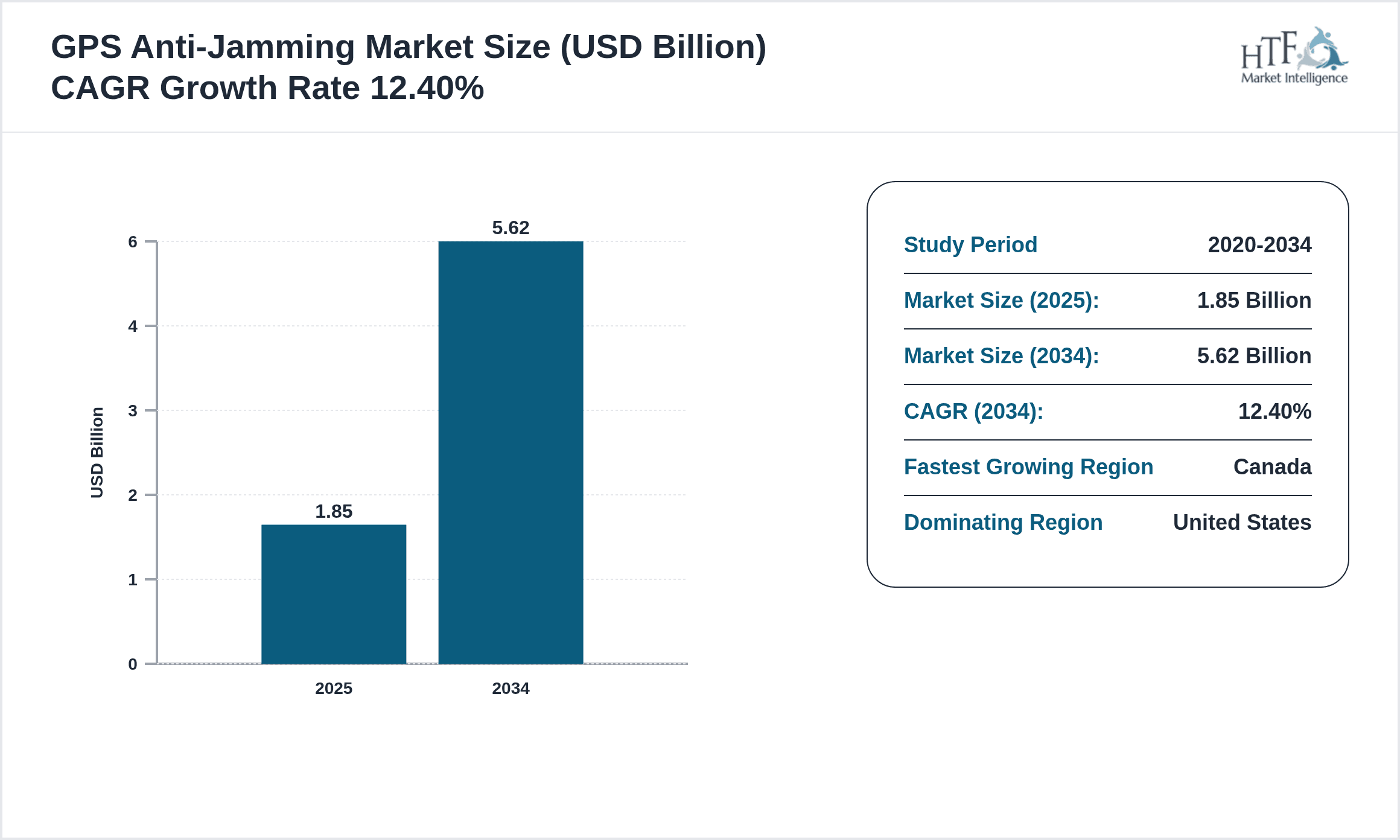
- •Key highlights of the North America GPS Anti-Jamming Market include a robust CAGR of 12.4% forecasted from 2025 to 2034, with the market size expected to grow from USD 1.85 Billion in 2025 to USD 5.62 Billion by 2034. The United States dominates the market due to its advanced defense infrastructure and extensive use in aviation and maritime sectors, while Canada is emerging as the fastest-growing country driven by increased investment in secure navigation solutions. Hardware-based anti-jamming products currently lead the market, but hybrid systems integrating both software and hardware elements are gaining rapid traction. Military and defense remain the largest application segment, reflecting the strategic importance of GPS signal protection in national security. The market is characterized by continuous technological advancements, strategic partnerships, and rising adoption across civilian domains, supported by regulatory frameworks emphasizing GPS security.
- •The North America GPS Anti-Jamming Market offers significant value propositions by ensuring uninterrupted GPS signal availability, which is essential for navigation accuracy, communication synchronization, and operational safety. Its strategic importance is underscored in defense applications where anti-jamming ensures mission-critical capabilities against adversarial electronic warfare. In commercial aviation and maritime industries, these solutions mitigate risks associated with GPS signal disruptions that can compromise safety and efficiency. Telecommunications networks rely on GPS timing for synchronization; thus, anti-jamming technologies support network integrity. Stakeholders including government agencies, defense contractors, aviation authorities, and telecom operators benefit from enhanced security, compliance with regulations, and improved system resilience. The market’s growth is also propelled by increasing awareness of GPS vulnerabilities, technological innovation, and cross-sector collaboration to address emerging threats, making it a pivotal component of North America’s critical infrastructure landscape.
Competitive Landscape
The competitive environment in the North America GPS Anti-Jamming Market is marked by intense rivalry among established defense contractors, specialized technology firms, and emerging innovators. Companies compete through continuous investment in research and development to enhance the sophistication of anti-jamming solutions, integrating advanced signal processing algorithms, AI-driven detection, and adaptive hardware architectures. Market positioning is heavily influenced by the ability to deliver high-reliability systems tailored to military and critical infrastructure needs, alongside expanding presence in commercial aviation and maritime sectors. Strategic partnerships and collaborations with government agencies and system integrators are common to secure long-term contracts and access emerging application areas. Pricing strategies focus on value-added features and customization, while companies also leverage extensive distribution networks and service capabilities. Market entry barriers include stringent regulatory requirements, high R&D costs, and the need for specialized technical expertise. The evolving threat landscape drives continuous innovation, with companies prioritizing product differentiation through enhanced resilience, interoperability, and ease of integration. Future competitive trends will likely emphasize software-defined anti-jamming solutions, modular designs, and ecosystem partnerships to address expanding market demands.
Leading Companies in GPS Anti-Jamming Market
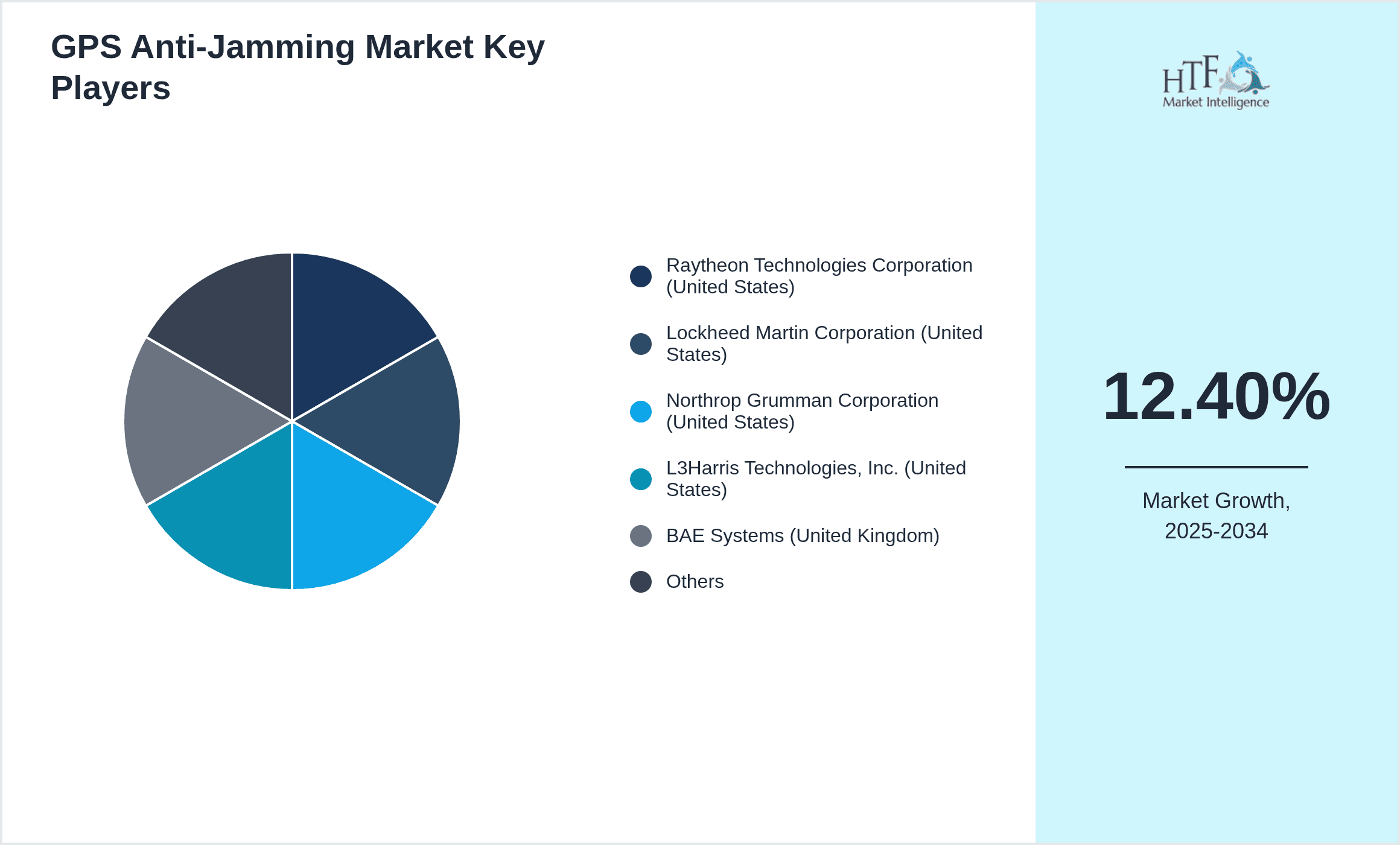
- •Raytheon Technologies Corporation (United States)
- •Lockheed Martin Corporation (United States)
- •Northrop Grumman Corporation (United States)
- •L3Harris Technologies, Inc. (United States)
- •BAE Systems (United Kingdom)
- •Thales Group (France)
- •Honeywell International Inc. (United States)
- •FLIR Systems, Inc. (United States)
- •Leonardo S.p.A. (Italy)
- •Ultra Electronics Holdings plc (United Kingdom)
- •Rohde & Schwarz GmbH & Co KG (Germany)
- •NovAtel Inc. (Canada)
- •Spirent Communications plc (United Kingdom)
- •Comtech Telecommunications Corp. (United States)
- •Genasys Inc. (United States)
- •Hexagon AB (Sweden)
- •Cobham plc (United Kingdom)
- •Viasat, Inc. (United States)
- •Saab AB (Sweden)
- •Garmin Ltd. (United States)
Market Breakdown
- •By Product Type
- ◦Software-based Anti-Jamming Solutions
- ◦Hardware-based Anti-Jamming Devices
- ◦Hybrid Anti-Jamming Systems
- ◦Signal Processing Techniques
- ◦Directional Antennas
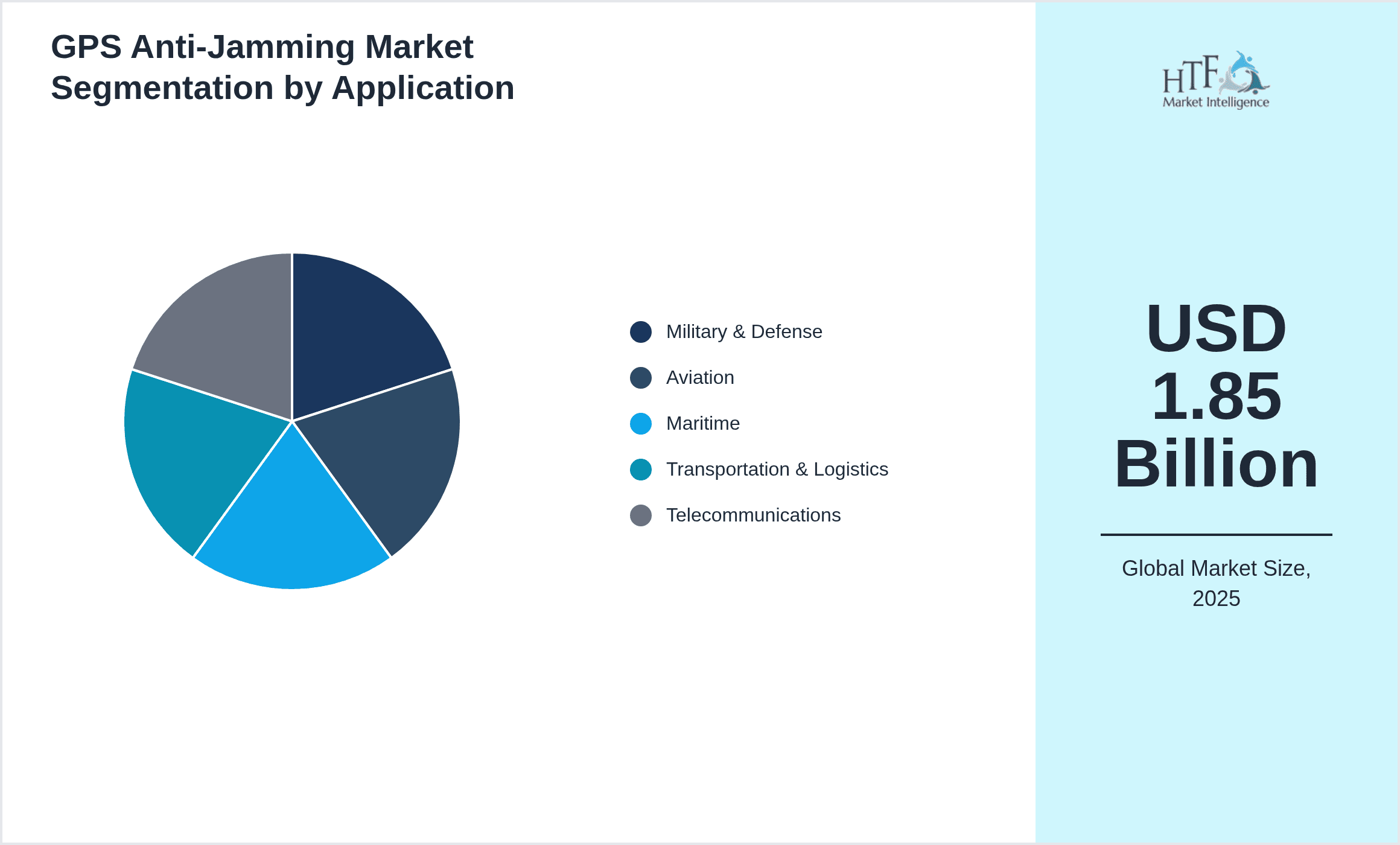
- •By Application
- ◦Military & Defense
- ◦Aviation
- ◦Maritime
- ◦Transportation & Logistics
- ◦Telecommunications
- •By Deployment Model
- ◦On-Premise Systems
- ◦Embedded Systems
- ◦Cloud-Enabled Solutions
- •By End User
- ◦Government & Defense Agencies
- ◦Commercial Aviation Operators
- ◦Maritime Navigation Companies
- ◦Logistics & Transportation Firms
- ◦Telecom Service Providers
Growth Dynamics
The North America GPS Anti-Jamming Market growth is driven primarily by escalating security concerns within military and defense sectors, where safeguarding GPS signals against jamming is critical for operational effectiveness. Increasing adoption of unmanned aerial vehicles and advanced defense systems necessitates robust anti-jamming capabilities. Additionally, the expansion of commercial aviation and maritime industries demands enhanced GPS signal integrity to ensure safety and regulatory compliance. Technological innovations focusing on hybrid anti-jamming solutions that combine software and hardware elements provide differentiated offerings, accelerating market uptake. Government initiatives and increased defense budgets further support market expansion by funding research and procurement of advanced anti-jamming systems. The rising prevalence of GPS spoofing and interference incidents highlights the urgent need for resilient anti-jamming technologies, reinforcing market demand. Partnerships between technology providers and end-users facilitate tailored solutions, enhancing market penetration. These factors collectively contribute to a projected CAGR of 12.4% over the forecast period, positioning North America as a pivotal region for GPS anti-jamming advancements.

Market Trends
Emerging trends in the North America GPS Anti-Jamming Market include increasing integration of artificial intelligence and machine learning algorithms for real-time detection and mitigation of jamming threats. The shift toward software-defined anti-jamming systems offers enhanced flexibility and scalability, enabling rapid updates to counter evolving threats. There is growing adoption of hybrid systems that synergize hardware robustness with software agility to provide comprehensive protection. Vendors are increasingly focusing on miniaturization and modularity to support diverse platforms such as drones and mobile devices. Collaboration between defense agencies and commercial enterprises fosters innovation and cross-sector technology transfer, expanding application scope. Additionally, regulatory emphasis on GPS security compliance drives adoption of certified anti-jamming technologies. These trends reflect a market evolving toward adaptive, intelligent, and integrated solutions, ensuring resilience against sophisticated jamming and spoofing techniques.
Market Opportunities
North America presents significant opportunities in the GPS Anti-Jamming Market through expanding applications in civilian sectors such as autonomous vehicles, smart transportation systems, and critical infrastructure protection. Increasing investments in 5G networks create demand for precise timing and synchronization safeguarded by anti-jamming solutions. Growing awareness of GPS vulnerabilities among commercial aviation and maritime operators opens new customer segments. Technological advancements enable development of cost-effective, scalable hybrid systems suitable for small and medium enterprises. Furthermore, government funding for research into next-generation anti-jamming technologies presents collaboration and innovation prospects. Expansion into adjacent markets such as GPS spoofing detection and cyber-physical security further broadens growth avenues. Strategic partnerships and acquisitions facilitate market penetration and product portfolio diversification. These factors collectively offer robust pathways for sustained revenue growth and technological leadership in North America.
Market Challenges
Despite promising growth, the North America GPS Anti-Jamming Market faces challenges including high development costs and complexity associated with integrating advanced anti-jamming technologies into existing systems. Regulatory hurdles and certification processes can delay product deployment and increase compliance expenses. Market fragmentation with multiple competing technologies complicates standardization and interoperability efforts. The rapid evolution of jamming and spoofing techniques demands continuous innovation, imposing resource burdens on manufacturers. Limited awareness among certain commercial segments restricts immediate adoption rates. Additionally, supply chain disruptions and component shortages impact production timelines and scalability. These challenges necessitate strategic investment, collaborative R&D, and regulatory engagement to ensure timely market access and sustained competitive advantage.
Regulatory Framework
Between 2020 and 2025, the North America GPS Anti-Jamming Market has been shaped by stringent regulatory standards aimed at enhancing national security and critical infrastructure resilience. The Federal Communications Commission (FCC) has implemented policies restricting unauthorized transmission near GPS frequencies to reduce interference risks. The Department of Defense mandates compliance with MIL-STD requirements for anti-jamming capabilities in defense systems, ensuring robust performance under electronic warfare conditions. The Federal Aviation Administration (FAA) has introduced guidelines for GPS integrity and anti-jamming measures in commercial aviation, promoting safety and reliability. Additionally, the National Institute of Standards and Technology (NIST) has advanced standards for timing and synchronization security in telecommunications, indirectly driving anti-jamming adoption. These regulations necessitate rigorous testing, certification, and adherence protocols, influencing product design and market entry strategies. Government initiatives also provide incentives for innovation in resilient navigation technologies, fostering industry growth within the regulatory framework.
Market Intelligence
- •15th February 2025, Raytheon Technologies Corporation launched an advanced hybrid GPS anti-jamming system integrating AI-powered signal detection with hardware-based directional antennas. This product targets military and aviation sectors, providing enhanced resilience against sophisticated jamming attacks while minimizing system weight and power consumption. The launch aligns with increased defense budgets and rising demand for adaptive navigation security solutions in North America. The system's modular design facilitates integration into existing platforms, supporting rapid deployment and scalability. Strategic objectives include strengthening Raytheon's competitive positioning through innovation and expanding market share among government and commercial customers. Source: Raytheon Technologies Official Release
- •10th November 2024, NovAtel Inc. introduced a cloud-enabled GPS anti-jamming service offering real-time threat analysis and mitigation for telecommunications and transportation industries. The service leverages machine learning algorithms to adaptively counteract jamming and spoofing attempts, enhancing signal integrity across distributed networks. This innovation supports growing 5G infrastructure needs by ensuring precise timing and positioning critical for network synchronization. NovAtel aims to capitalize on emerging civilian market opportunities by providing scalable, subscription-based solutions that reduce upfront hardware investment. The launch reflects a strategic shift toward software-centric models and expanded customer engagement. Source: NovAtel Press Announcement
- •28th July 2025, Lockheed Martin Corporation announced a strategic partnership with a leading AI startup to co-develop next-generation GPS anti-jamming technologies. This collaboration focuses on integrating advanced neural network-based detection algorithms with Lockheed Martin's existing hardware platforms to enhance adaptability against evolving electronic threats. The initiative supports U.S. Department of Defense modernization programs and aims to accelerate deployment timelines. By combining expertise, both companies expect to deliver superior anti-jamming solutions with improved accuracy and reduced false alarms. The partnership exemplifies growing industry trends toward synergistic innovation and cross-sector collaboration. Source: Lockheed Martin Corporate News
- •5th May 2025, L3Harris Technologies, Inc. completed the acquisition of a specialized anti-jamming software firm to expand its portfolio in resilient navigation systems. This acquisition enhances L3Harris's capabilities in developing integrated hardware-software solutions tailored for military and commercial aviation markets. The strategic move strengthens the company’s position in North America’s competitive landscape by broadening technology offerings and accelerating product development cycles. The deal also provides access to emerging intellectual property and skilled talent, facilitating innovation in GPS signal protection against complex jamming scenarios. L3Harris intends to leverage this acquisition to meet growing customer demand and regulatory requirements. Source: L3Harris Investor Relations
Regional Outlook
The United States currently holds a significant share of the market, primarily due to several key factors: increasing consumption rates, a burgeoning population, and robust economic momentum. These elements collectively drive demand, positioning this region as a leader in the market. On the other hand, Canada is rapidly emerging as the fastest-growing area within the industry. This remarkable growth can be attributed to swift infrastructure development, the expansion of various industrial sectors, and a marked increase in consumer demand. These dynamics make this region a crucial player in shaping future market growth.
In our report, we cover a comprehensive analysis of the following regions and countries:
- United States
- Canada
- Mexico
| Feature | Details |
|---|---|
| Base Year Market Size | USD 1.85 Billion |
| Forecast Year Market Size | USD 5.62 Billion |
| CAGR | 12.4% |
| Forecast Period | 2026 to 2033 |
| YoY Growth | 12% |
| Scope of Report | Market is segmented by Product Type (Software-based Anti-Jamming Solutions, Hardware-based Anti-Jamming Devices, Hybrid Anti-Jamming Systems, Signal Processing Techniques, Directional Antennas), Application (Military & Defense, Aviation, Maritime, Transportation & Logistics, Telecommunications), Deployment Model (On-Premise Systems, Embedded Systems, Cloud-Enabled Solutions), End User (Government & Defense Agencies, Commercial Aviation Operators, Maritime Navigation Companies, Logistics & Transportation Firms, Telecom Service Providers) |
| Regions Covered | United States, Canada, Mexico |
| Key Companies | Raytheon Technologies Corporation (United States), Lockheed Martin Corporation (United States), Northrop Grumman Corporation (United States), L3Harris Technologies, Inc. (United States), BAE Systems (United Kingdom), Thales Group (France), Honeywell International Inc. (United States), FLIR Systems, Inc. (United States), Leonardo S.p.A. (Italy), Ultra Electronics Holdings plc (United Kingdom), Rohde & Schwarz GmbH & Co KG (Germany), NovAtel Inc. (Canada), Spirent Communications plc (United Kingdom), Comtech Telecommunications Corp. (United States), Genasys Inc. (United States), Hexagon AB (Sweden), Cobham plc (United Kingdom), Viasat, Inc. (United States), Saab AB (Sweden), Garmin Ltd. (United States) |
North America GPS Anti-Jamming Market Size, Growth & Revenue 2024-2034 - Table of Contents
Multidisciplinary researcher with 10+ years of experience uncovering insights across diverse domains focused on uncovering insights that drive informed decisions.
Frequently Asked Questions (FAQ):
The Compact Track Loaders market is projected to grow at a CAGR of 6.8% from 2025 to 2030, driven by increasing demand in construction and agricultural sectors.
North America currently leads the market with approximately 45% market share, followed by Europe at 28% and Asia-Pacific at 22%. The remaining regions account for 5% of the global market.
Key growth drivers include increasing construction activities, rising demand for versatile equipment in agriculture, technological advancements in track loader design, and growing preference for compact equipment in urban construction projects.