
Global Contactless EMV Cards Market Size, Growth & Revenue 2025-2034
Global Contactless EMV Cards Market is segmented by Type (Dual Interface Cards, Contactless-only Cards, Wearable Payment Devices, Mobile EMV Solutions, Virtual Cards), Application (Retail Payments, Transportation, Hospitality, Healthcare, Government Services), Security Feature (Biometric Authentication, Tokenization, Encryption, Dynamic CVV), Deployment Model (Cloud-based, On-premise, Hybrid), and Geography (North America, LATAM, West Europe, Central & Eastern Europe, Northern Europe, Southern Europe, East Asia, Southeast Asia, South Asia, Central Asia, Oceania, MEA)
Pricing
Report Overview
Executive Summary
- •The Global Contactless EMV Cards market consists of advanced payment cards enabling secure contactless transactions through embedded chip technology compliant with EMV standards. These cards facilitate fast, convenient, and fraud-resistant financial interactions supported by Near Field Communication technology. The market covers a broad spectrum of card types including dual interface cards, contactless-only cards, wearable payment devices, mobile EMV platforms, and virtual cards integrated within digital wallets. Applications span retail payments, public transportation, hospitality, healthcare identification, and government services, reflecting the growing demand for seamless and hygienic payment solutions worldwide. Increasing adoption is driven by rising consumer preference for contactless payments, enhanced security features reducing fraud, and supportive regulatory frameworks encouraging EMV migration. This market plays a critical role in the evolution of payment ecosystems globally, ensuring interoperability, efficiency, and compliance with international security standards. The integration of emerging technologies such as biometric authentication and tokenization further expands the scope and utility of contactless EMV cards.
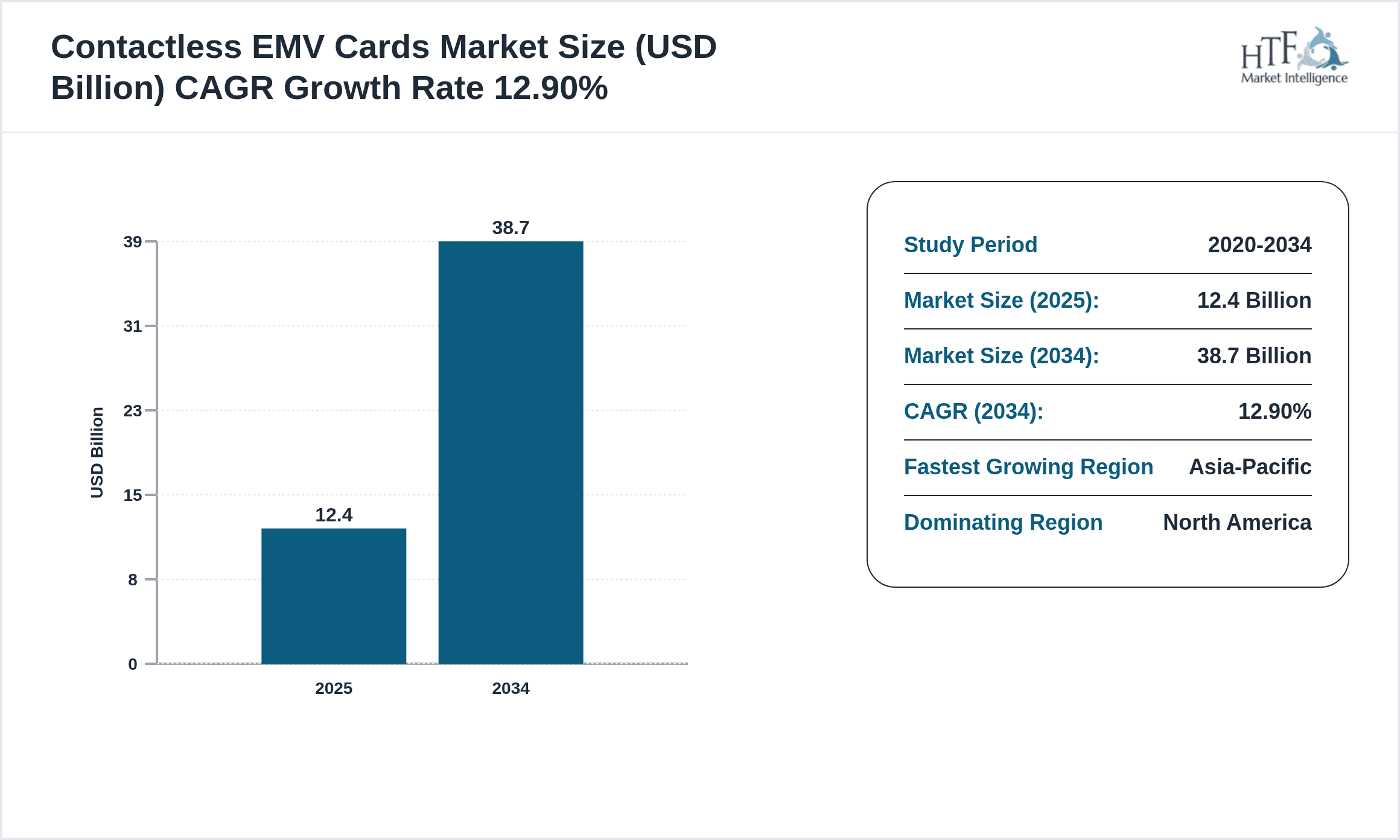
- •The market recorded a base size of USD 12.4 Billion in 2025 and is forecasted to reach USD 38.7 Billion by 2034, growing at a CAGR of 12.9%. North America dominates the market due to robust financial infrastructure and early adoption of contactless payments, while Asia-Pacific exhibits the highest growth trajectory fueled by rapid urbanization and digital payment adoption. Dual interface cards hold the largest market share given their versatility, with wearable payment devices identified as the fastest-growing segment supported by rising consumer interest in convenience and technology integration. Key players focus on innovation, strategic partnerships, and expanding product portfolios to capture increasing demand across diverse applications. The market also benefits from supportive government initiatives and evolving consumer behaviors favoring contactless transactions post-pandemic.
- •Contactless EMV cards deliver significant value to stakeholders by enhancing transaction speed, security, and user convenience, thereby improving customer satisfaction and operational efficiency. Financial institutions leverage these technologies to reduce fraud losses and compliance risks, while merchants benefit from faster checkout times and increased throughput. The strategic importance extends to transportation and government sectors where secure, contactless identity verification and fare collection streamline operations. Increasing integration with mobile payment ecosystems and wearable devices unlock new revenue streams and user engagement opportunities. The market’s dynamic growth underlines its critical role in the global transition to cashless economies, digital finance inclusion, and innovative payment experiences.
Competitive Landscape
Companies operating in the Global Contactless EMV Cards market employ multifaceted strategies including continuous product innovation, strategic alliances, and geographic expansion to enhance market presence. Innovation focuses on integrating biometric authentication, enhanced encryption, and multi-factor security features to differentiate offerings. Collaborations with payment networks, fintech startups, and technology providers accelerate go-to-market timelines and broaden solution portfolios. Global expansion targets emerging economies where digital payment adoption accelerates, supported by local partnerships and compliance adherence. Mergers and acquisitions allow consolidation of technology capabilities and market share, enabling competitive positioning against established players. Pricing strategies balance cost competitiveness with value-added features to cater to diverse customer segments. Distribution channels leverage both direct sales and partnerships with financial institutions and merchants to maximize reach. Technology adoption emphasizes compliance with evolving EMV standards, contactless protocols, and integration with mobile wallets, ensuring interoperability and future-readiness. These strategies collectively sustain growth momentum and reinforce competitive advantages in a rapidly evolving market.
Leading Companies in Contactless EMV Cards Market
- •Gemalto (Netherlands)
- •Thales Group (France)
- •IDEMIA (France)
- •Giesecke+Devrient (Germany)
- •NXP Semiconductors (Netherlands)
- •Infineon Technologies AG (Germany)
- •Eastcompeace Technology (China)
- •Watchdata Technologies (China)
- •CardLogix Corporation (United States)
- •HID Global (United States)
- •Smartmetric (Singapore)
- •Mühlbauer Group (Germany)
- •Entrust Corporation (United States)
- •VeriFone Systems (United States)
- •Oberthur Technologies (France)
- •Egis Technology (Hungary)
- •Xerox Corporation (United States)
- •HID Global (United States)
- •STMicroelectronics (Switzerland)
- •Syniverse Technologies (United States)

Market Breakdown
- •By Type
- ◦Dual Interface Cards
- ◦Contactless-only Cards
- ◦Wearable Payment Devices
- ◦Mobile EMV Solutions
- ◦Virtual Cards
- •By Application
- ◦Retail Payments
- ◦Transportation
- ◦Hospitality
- ◦Healthcare
- ◦Government Services
- •By Security Feature
- ◦Biometric Authentication
- ◦Tokenization
- ◦Encryption
- ◦Dynamic CVV
- •By Deployment Model
- ◦Cloud-based
- ◦On-premise
- ◦Hybrid
Growth Dynamics
Rapid urbanization and increasing smartphone penetration globally have fueled faster adoption of contactless EMV cards by enabling seamless integration with mobile wallets and wearables. The growing demand for hygienic payment options post-pandemic has accelerated consumer preference toward contactless transactions, driving market expansion. Governments and financial institutions worldwide are enforcing EMV migration to reduce fraud and comply with security standards, supporting market growth. Recent collaborations between major card manufacturers and fintech firms have introduced advanced biometric authentication features, enhancing security and user convenience. Additionally, expanding transportation and retail sectors across Asia-Pacific and Latin America are adopting contactless payment solutions, opening new revenue streams. Strategic investments in contactless infrastructure by key players further propel market penetration and user acceptance. These dynamics collectively contribute to the robust CAGR observed with increasing transaction volumes and user base globally.

Market Trends
The contactless EMV cards market is evolving with emerging trends such as integration of biometric authentication technologies including fingerprint and facial recognition to enhance transaction security. Advancements in wearable payment devices such as smartwatches and fitness bands expand usage beyond traditional cards, catering to convenience-driven consumers. Virtual EMV cards embedded in mobile wallets provide flexible payment options without physical cards, gaining traction among tech-savvy users. Increasing adoption of tokenization and dynamic CVV technology mitigates fraud risks and strengthens consumer trust. Strategic partnerships between card manufacturers and digital payment platforms are becoming prevalent to deliver seamless omni-channel payment experiences. Furthermore, sustainability initiatives encourage development of eco-friendly card materials and manufacturing processes. These trends reflect a shift toward more secure, versatile, and environmentally responsible payment solutions, positioning the market for sustained innovation and growth.

Market Opportunities
Expanding digital payment adoption in emerging economies presents significant growth opportunities for contactless EMV cards, especially in Asia-Pacific and Latin America where cashless transactions are rapidly increasing. Integration with mobile-based EMV solutions and wearable devices offers avenues to capture younger, tech-savvy demographics seeking convenience and speed. The rise of smart cities and IoT ecosystems enables deployment of contactless cards in transportation and government services to enhance urban mobility and public service delivery. Innovation in biometric-enabled cards and multi-factor authentication creates differentiation opportunities for manufacturers to address security-conscious consumers. Additionally, increasing cross-border travel and international commerce drive demand for globally interoperable contactless payment solutions. Collaborations with fintech startups and telecom operators facilitate rapid market penetration and tailored products for regional preferences. These opportunities, supported by evolving regulatory frameworks and consumer behavior shifts, position the market for accelerated expansion and technological advancement.
Market Challenges
High initial infrastructure costs and complexity of upgrading legacy payment systems pose significant challenges for widespread adoption of contactless EMV cards in developing regions. Security concerns related to wireless transaction vulnerabilities and data breaches require continuous innovation and investment in advanced encryption and authentication technologies. Fragmented regulatory environments across countries complicate compliance efforts for global players, increasing operational risks and costs. Consumer apprehension regarding privacy and misuse of biometric data affects acceptance rates despite technological benefits. Additionally, counterfeit card production and sophisticated fraud techniques necessitate robust anti-fraud measures, creating ongoing challenges for manufacturers and financial institutions. Recent incidents of card skimming and relay attacks reported in certain regions highlight vulnerabilities impacting consumer trust. Market players must navigate these hurdles through strategic partnerships, regulatory engagement, and continuous product enhancements to sustain growth.
Regulatory Framework
Over the last five years, global regulatory bodies have intensified mandates on EMV compliance to enhance payment security and reduce fraud. The Payment Card Industry Security Standards Council updated its PCI DSS guidelines emphasizing encryption, tokenization, and multi-factor authentication for contactless transactions. The European Union implemented the second Payment Services Directive enforcing Strong Customer Authentication for electronic payments, influencing contactless card issuance and usage. In North America, regulatory agencies such as the Federal Reserve promote EMV adoption and standardization to ensure interoperability and consumer protection. Asia-Pacific countries have introduced region-specific EMV migration timelines and security protocols aligned with international standards. These regulations drive innovation in card technology and require manufacturers and issuers to maintain stringent compliance, significantly impacting market strategies and product development.
Recent Industry Insights
Recent market developments and strategic initiatives are continuously tracked through industry publications, company announcements, and regulatory filings. For the most current information, stakeholders are advised to monitor official corporate communications and recognized market intelligence platforms.
Recent Merger and Acquisition
Recent market developments and strategic initiatives are continuously tracked through industry publications, company announcements, and regulatory filings. For the most current information, stakeholders are advised to monitor official corporate communications and recognized market intelligence platforms.
Regional Outlook
The North America currently holds a significant share of the market, primarily due to several key factors: increasing consumption rates, a burgeoning population, and robust economic momentum. These elements collectively drive demand, positioning this region as a leader in the market. On the other hand, Asia-Pacific is rapidly emerging as the fastest-growing area within the industry. This remarkable growth can be attributed to swift infrastructure development, the expansion of various industrial sectors, and a marked increase in consumer demand. These dynamics make this region a crucial player in shaping future market growth.
In our report, we cover a comprehensive analysis of the following regions and countries:
- North America
- LATAM
- West Europe
- Central & Eastern Europe
- Northern Europe
- Southern Europe
- East Asia
- Southeast Asia
- South Asia
- Central Asia
- Oceania
- MEA
| Feature | Details |
|---|---|
| Base Year Market Size | USD 12.4 Billion |
| Forecast Year Market Size | USD 38.7 Billion |
| CAGR | 12.9% |
| Forecast Period | 2026 to 2033 |
| YoY Growth | 12.2% |
| Scope of Report | Market is segmented by Type (Dual Interface Cards, Contactless-only Cards, Wearable Payment Devices, Mobile EMV Solutions, Virtual Cards), Application (Retail Payments, Transportation, Hospitality, Healthcare, Government Services), Security Feature (Biometric Authentication, Tokenization, Encryption, Dynamic CVV), Deployment Model (Cloud-based, On-premise, Hybrid) |
| Regions Covered | North America, LATAM, West Europe, Central & Eastern Europe, Northern Europe, Southern Europe, East Asia, Southeast Asia, South Asia, Central Asia, Oceania, MEA |
| Key Companies | Gemalto (Netherlands), Thales Group (France), IDEMIA (France), Giesecke+Devrient (Germany), NXP Semiconductors (Netherlands), Infineon Technologies AG (Germany), Eastcompeace Technology (China), Watchdata Technologies (China), CardLogix Corporation (United States), HID Global (United States), Smartmetric (Singapore), Mühlbauer Group (Germany), Entrust Corporation (United States), VeriFone Systems (United States), Oberthur Technologies (France), Egis Technology (Hungary), Xerox Corporation (United States), HID Global (United States), STMicroelectronics (Switzerland), Syniverse Technologies (United States) |
Global Contactless EMV Cards Market Size, Growth & Revenue 2025-2034 - Table of Contents
Frequently Asked Questions (FAQ):
The Compact Track Loaders market is projected to grow at a CAGR of 6.8% from 2025 to 2030, driven by increasing demand in construction and agricultural sectors.
North America currently leads the market with approximately 45% market share, followed by Europe at 28% and Asia-Pacific at 22%. The remaining regions account for 5% of the global market.
Key growth drivers include increasing construction activities, rising demand for versatile equipment in agriculture, technological advancements in track loader design, and growing preference for compact equipment in urban construction projects.