
Global Virtual VoIP Softwares Market Size, Growth & Revenue 2024-2034
Global Virtual VoIP Softwares Market is segmented by Product Type (Hosted VoIP, On-Premise VoIP, Mobile VoIP, SIP Trunking, Virtual PBX), Application (Enterprise Communication, Customer Support, Unified Communications, Collaboration Tools, Cloud Telephony), Deployment Model (Cloud-Based, On-Premise, Hybrid), End User Industry (IT & Telecom, Healthcare, Retail, BFSI, Education), and Geography (North America, LATAM, West Europe, Central & Eastern Europe, Northern Europe, Southern Europe, East Asia, Southeast Asia, South Asia, Central Asia, Oceania, MEA)
Pricing
Report Overview
Executive Summary
- •The Global Virtual VoIP Softwares market represents a transformative segment in telecommunications, offering voice communication solutions via internet protocols. This market includes hosted and on-premise VoIP systems, SIP trunking, mobile VoIP, and virtual PBX software facilitating enterprise communications, customer support, and cloud telephony. It serves diverse applications such as unified communications, collaboration tools, and cloud-based telephony, enabling organizations to reduce costs and improve communication efficiency. The market's scope extends across industries including IT, healthcare, retail, and finance, reflecting the increasing adoption of digital communication technologies worldwide. Driven by rising demand for remote communication, cloud infrastructure growth, and integration with AI and analytics, the market is poised for substantial expansion. The proliferation of smartphones and mobile applications further accelerates mobile VoIP usage, supporting flexible and scalable communication solutions globally. This comprehensive analysis covers segmentation, competitive landscape, key trends, regulatory overview, and strategic growth dynamics shaping the market through 2034.
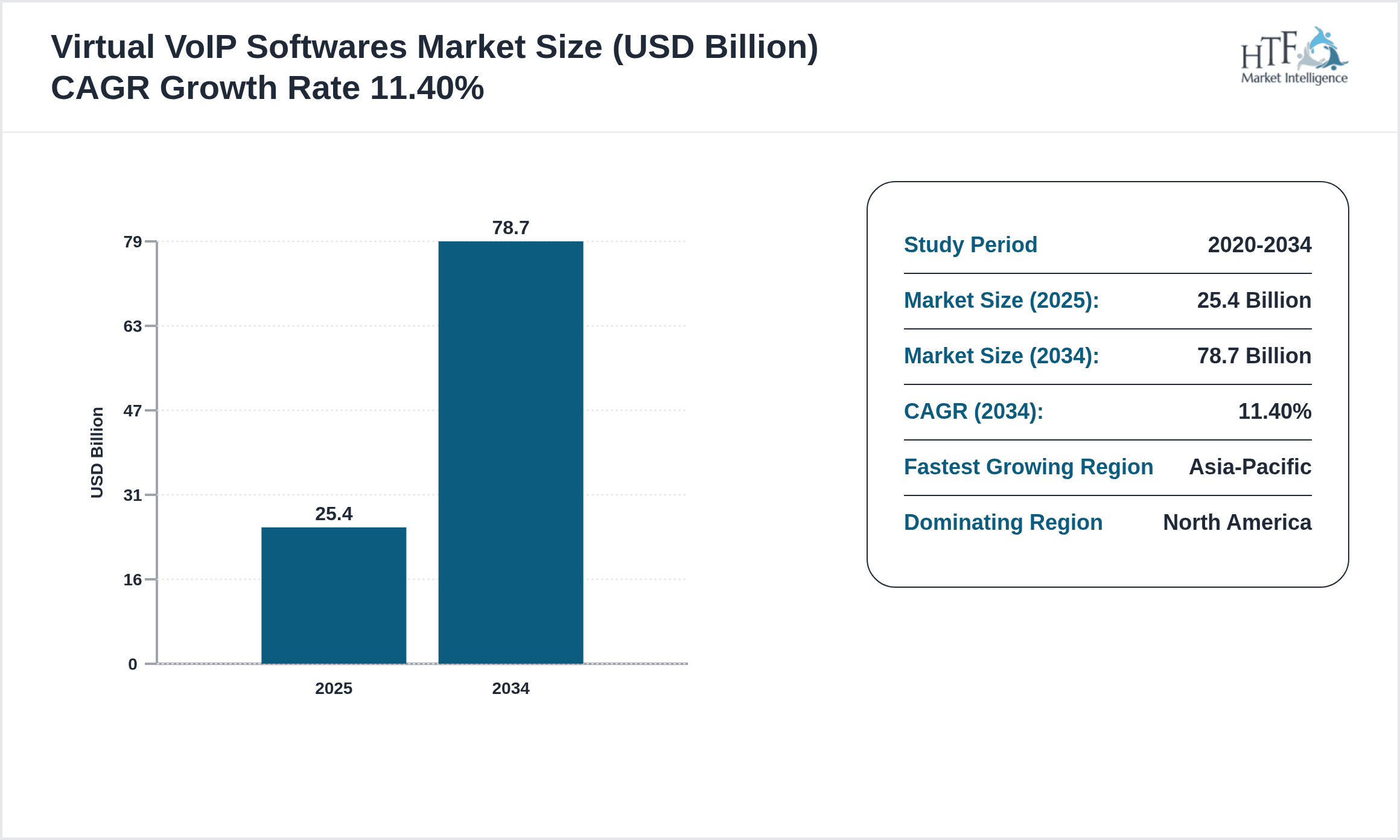
- •Key market highlights include a base market size of USD 25.4 Billion in 2024, forecasted to reach USD 78.7 Billion by 2034, representing a robust CAGR of 11.4%. Hosted VoIP dominates product types owing to scalability and cloud integration, while mobile VoIP is the fastest growing segment propelled by smartphone penetration. Enterprise communication leads applications, supported by unified communications and cloud telephony growth. North America holds the largest market share due to advanced infrastructure and early adoption, with Asia-Pacific identified as the fastest-growing region, driven by digital transformation and growing telecom investments. Year-over-year growth is consistent at approximately 11.4%, reflecting strong demand and technological advancements across industries.
- •The value proposition of virtual VoIP software lies in cost efficiency, enhanced scalability, and seamless integration with business workflows, making it strategically important for enterprises seeking digital transformation. It enables remote work, improves customer engagement, and supports multi-channel communication, thus empowering industries to enhance operational agility. Stakeholders including telecom providers, software vendors, and enterprises benefit from ongoing innovations such as AI-powered voice analytics and cloud-hosted platforms. The evolving regulatory landscape also shapes market strategies, emphasizing data security and compliance. Overall, virtual VoIP software is a critical enabler in the modern digital economy, driving connectivity and collaboration on a global scale.
Competitive Landscape
The Global Virtual VoIP Softwares market is characterized by intense competition driven by innovation, rapid technological advancements, and strategic partnerships. Market players focus on enhancing product features such as AI integration, security protocols, and cloud scalability to differentiate their offerings. Competitive strategies include mergers and acquisitions to consolidate market position, geographic expansion, and investment in R&D. Pricing strategies vary from subscription-based models to tiered service offerings, catering to diverse customer segments ranging from SMEs to large enterprises. Distribution channels include direct sales, channel partners, and cloud marketplaces, expanding reach and customer engagement. Market entry barriers include technological complexity and compliance with international telecom regulations. Regional competition is notable with North America leading in innovation, Asia-Pacific emerging rapidly due to digital adoption, and Europe emphasizing data privacy compliance. Future trends point toward increased convergence of communication platforms, driving further competitive dynamics.
Leading Companies in Virtual VoIP Softwares Market
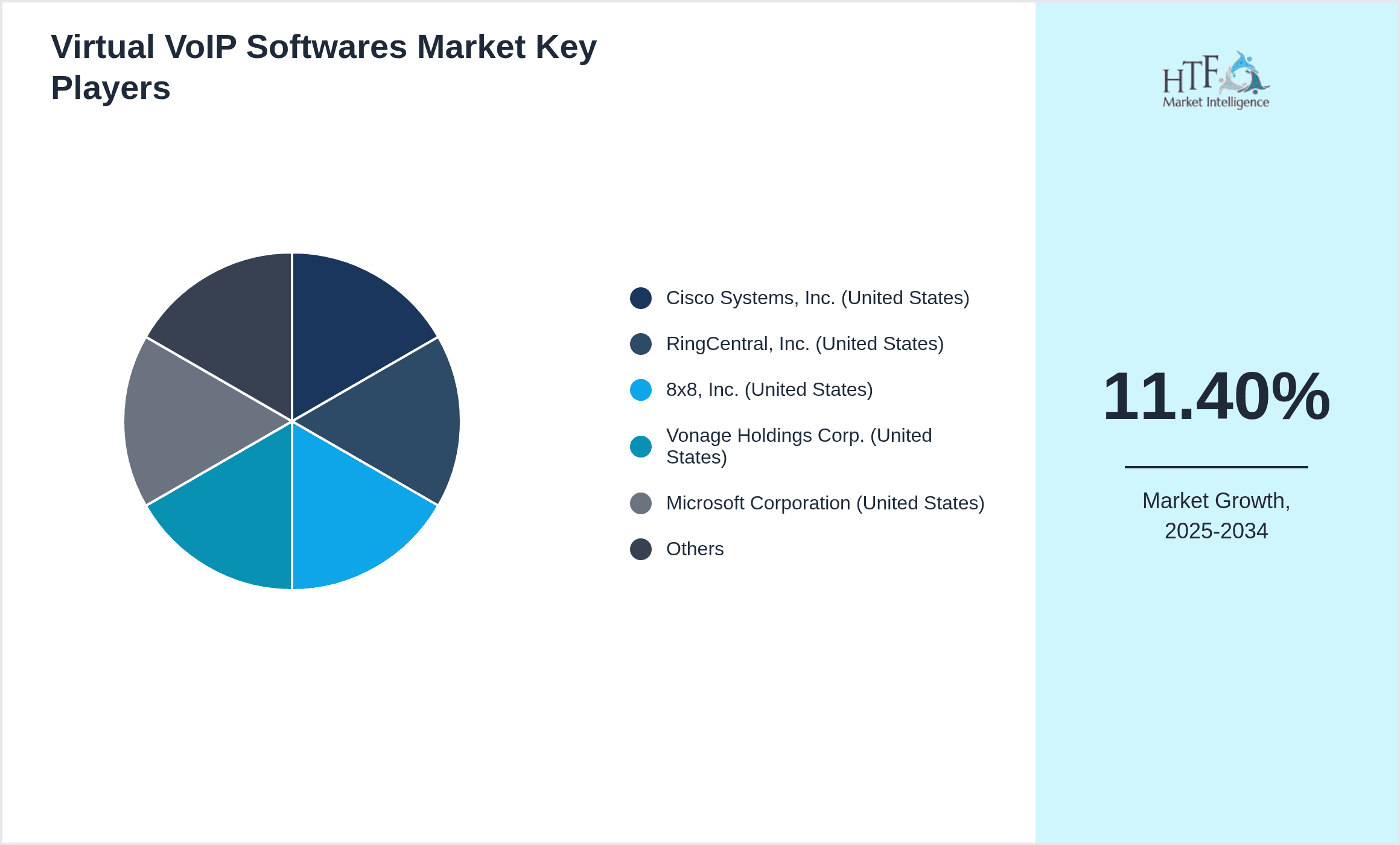
- •Cisco Systems, Inc. (United States)
- •RingCentral, Inc. (United States)
- •8x8, Inc. (United States)
- •Vonage Holdings Corp. (United States)
- •Microsoft Corporation (United States)
- •Zoom Video Communications, Inc. (United States)
- •Avaya Holdings Corp. (United States)
- •NEC Corporation (Japan)
- •Mitel Networks Corporation (Canada)
- •Alcatel-Lucent Enterprise (France)
- •Nextiva, Inc. (United States)
- •Twilio Inc. (United States)
- •LogMeIn, Inc. (United States)
- •BroadSoft, Inc. (United States)
- •GoTo (United States)
- •Freshworks Inc. (United States)
- •Genesys Telecommunications Laboratories, Inc. (United States)
- •Dialpad, Inc. (United States)
- •Grasshopper Group, Inc. (United States)
- •Vonage Business (United States)
- •RingOver (France)
- •Vodafone Group Plc (United Kingdom)
- •Talkdesk, Inc. (United States)
- •Star2Star Communications (United States)
- •Zoom Phone (United States)

Market Breakdown
- •By Product Type
- ◦Hosted VoIP
- ◦On-Premise VoIP
- ◦Mobile VoIP
- ◦SIP Trunking
- ◦Virtual PBX
- •By Application
- ◦Enterprise Communication
- ◦Customer Support
- ◦Unified Communications
- ◦Collaboration Tools
- ◦Cloud Telephony
- •By Deployment Model
- ◦Cloud-Based
- ◦On-Premise
- ◦Hybrid
- •By End User Industry
- ◦IT & Telecom
- ◦Healthcare
- ◦Retail
- ◦BFSI
- ◦Education
Growth Dynamics
- •Increasing adoption of cloud computing and digital transformation initiatives worldwide drives demand for scalable and cost-efficient virtual VoIP software solutions in enterprises, enhancing communication agility and reducing operational costs.
- •The rise of remote work culture accelerated by global events has amplified the need for reliable, mobile-friendly VoIP platforms, boosting mobile VoIP adoption and fueling market growth across regions with expanding internet penetration.
- •Integration of artificial intelligence and machine learning in VoIP software enables advanced analytics, voice recognition, and automated customer interactions, providing a competitive edge and stimulating market expansion.
- •Favorable government initiatives promoting digital infrastructure and supportive telecom regulations facilitate market penetration, particularly in emerging economies within Asia-Pacific and Latin America.
- •Growing demand from SMEs for affordable communication solutions with flexible deployment models, including cloud and hybrid options, creates significant opportunities for market players to diversify offerings and expand customer base.

Market Trends
- •The shift towards unified communication as a service (UCaaS) is gaining momentum, with enterprises preferring integrated platforms combining voice, video, and messaging to streamline workflows and enhance collaboration.
- •Emerging trends include the incorporation of 5G technology, which promises higher bandwidth and lower latency, improving VoIP call quality and enabling new applications in IoT and smart offices.
- •Subscription-based and pay-as-you-go pricing models are becoming prevalent, allowing businesses to scale usage according to needs while optimizing costs, thus increasing market accessibility for smaller organizations.
- •Sustainability and energy efficiency in data centers hosting VoIP services are gaining focus, with providers investing in green technologies to reduce carbon footprint and comply with environmental regulations.
- •Collaborations and strategic partnerships among VoIP providers, cloud platforms, and telecom operators are fostering ecosystem development and enhancing service integration capabilities.
Market Opportunities
- •Expanding digital infrastructure in developing regions offers untapped markets for virtual VoIP software providers to introduce affordable, localized communication solutions tailored to regional needs.
- •The integration of AI-driven features such as voice biometrics, sentiment analysis, and predictive dialing presents innovation opportunities to enhance user experience and operational efficiency.
- •Demand for enhanced security and compliance solutions amid rising cyber threats opens avenues for providers specializing in encrypted and GDPR-compliant VoIP services.
- •Growth in hybrid work models encourages development of interoperable VoIP platforms that seamlessly connect on-premise systems with cloud services, expanding market reach.
- •Emerging use cases in sectors like telehealth, online education, and virtual events stimulate demand for specialized VoIP features, enabling providers to customize offerings accordingly.
Market Challenges
- •High dependency on stable internet connectivity limits VoIP adoption in regions with inadequate broadband infrastructure, posing significant challenges to market penetration in certain developing areas.
- •Security concerns including data breaches and call interception require continuous investment in advanced encryption and compliance, increasing operational costs for providers.
- •Intense competition and price sensitivity among customers pressure providers to innovate while maintaining profitability, complicating market strategies.
- •Complex regulatory environments across different countries, including telecom licensing and data privacy laws, create barriers to seamless international operations.
- •Integration challenges with legacy telephony systems in enterprises hinder smooth transition to fully virtual VoIP solutions, requiring additional customization and support.
Regulatory Framework
- •Between 2019 and 2024, global telecom regulatory bodies have introduced stringent data privacy and protection regulations, including GDPR in Europe and similar frameworks in North America and Asia-Pacific, mandating enhanced security protocols for VoIP providers.
- •Emerging mandates require interoperability standards for VoIP systems to ensure seamless communication across networks, promoting industry-wide collaboration and consumer protection.
- •Countries have updated licensing requirements for VoIP operators, focusing on lawful interception capabilities and service quality benchmarks to safeguard national security and user experience.
- •Regulators have emphasized compliance with emergency calling features and number portability, obligating providers to integrate these functionalities into virtual VoIP software solutions.
- •Government incentives encouraging adoption of cloud-based communications and digital infrastructure investments have positively impacted market growth, especially in Asia-Pacific and Latin America.
Market Intelligence
- •15th January 2025, Cisco Systems, Inc. launched its latest cloud-based Virtual PBX solution, designed to enhance enterprise communication by integrating AI-driven call routing and analytics. The new platform targets SMEs seeking scalable and cost-effective communication systems, featuring enhanced security and seamless integration with existing IT infrastructure. This launch positions Cisco to strengthen its leadership in the hosted VoIP segment amid growing demand for cloud telephony. Strategic objectives include expanding market share in Asia-Pacific and Latin America through localized offerings and partnerships with regional telecom providers, aligning with global digital transformation trends. Source: Cisco Official Press Release
- •8th March 2025, RingCentral, Inc. introduced a unified communications platform incorporating 5G technology to deliver ultra-low latency voice and video services. The innovation focuses on enhancing mobile VoIP experiences for remote workers and enterprises requiring high reliability and responsiveness. Positioned as a next-generation solution, it aims to capture market segments in North America and Europe where 5G infrastructure rollout is accelerating. The platform supports extensive API integration, enabling customization and third-party app connectivity, thereby improving operational efficiency and collaboration. Source: RingCentral Corporate Announcement
- •20th February 2024, Zoom Video Communications, Inc. completed the acquisition of a cloud telephony startup to expand its portfolio into virtual VoIP software solutions. This strategic move aims to integrate Zoom's video conferencing capabilities with advanced voice communication services, offering enterprises a comprehensive unified communication suite. The acquisition is expected to enhance Zoom's competitive positioning against traditional VoIP providers and capitalize on hybrid work trends. Financial terms were undisclosed, but the deal underscores the increasing convergence of communication platforms in the market. Source: Industry Publication
- •5th May 2025, Twilio Inc. announced a strategic partnership with a leading telecom operator to deliver global SIP trunking services optimized for cloud applications. This collaboration expands Twilio's VoIP service footprint, enhancing global connectivity and service reliability for developers and enterprises. The partnership supports multi-region deployment, regulatory compliance, and improved call quality, addressing critical market demands. Twilio aims to leverage this to accelerate growth in emerging markets, particularly in Asia-Pacific and Latin America. Source: Twilio Official Press Release
Regional Outlook
The North America currently holds a significant share of the market, primarily due to several key factors: increasing consumption rates, a burgeoning population, and robust economic momentum. These elements collectively drive demand, positioning this region as a leader in the market. On the other hand, Asia-Pacific is rapidly emerging as the fastest-growing area within the industry. This remarkable growth can be attributed to swift infrastructure development, the expansion of various industrial sectors, and a marked increase in consumer demand. These dynamics make this region a crucial player in shaping future market growth.
In our report, we cover a comprehensive analysis of the following regions and countries:
- North America
- LATAM
- West Europe
- Central & Eastern Europe
- Northern Europe
- Southern Europe
- East Asia
- Southeast Asia
- South Asia
- Central Asia
- Oceania
- MEA
| Feature | Details |
|---|---|
| Base Year Market Size | USD 25.4 Billion |
| Forecast Year Market Size | USD 78.7 Billion |
| CAGR | 11.4% |
| Forecast Period | 2026 to 2033 |
| YoY Growth | 11.4% |
| Scope of Report | Market is segmented by Product Type (Hosted VoIP, On-Premise VoIP, Mobile VoIP, SIP Trunking, Virtual PBX), Application (Enterprise Communication, Customer Support, Unified Communications, Collaboration Tools, Cloud Telephony), Deployment Model (Cloud-Based, On-Premise, Hybrid), End User Industry (IT & Telecom, Healthcare, Retail, BFSI, Education) |
| Regions Covered | North America, LATAM, West Europe, Central & Eastern Europe, Northern Europe, Southern Europe, East Asia, Southeast Asia, South Asia, Central Asia, Oceania, MEA |
| Key Companies | Cisco Systems, Inc. (United States), RingCentral, Inc. (United States), 8x8, Inc. (United States), Vonage Holdings Corp. (United States), Microsoft Corporation (United States), Zoom Video Communications, Inc. (United States), Avaya Holdings Corp. (United States), NEC Corporation (Japan), Mitel Networks Corporation (Canada), Alcatel-Lucent Enterprise (France), Nextiva, Inc. (United States), Twilio Inc. (United States), LogMeIn, Inc. (United States), BroadSoft, Inc. (United States), GoTo (United States), Freshworks Inc. (United States), Genesys Telecommunications Laboratories, Inc. (United States), Dialpad, Inc. (United States), Grasshopper Group, Inc. (United States), Vonage Business (United States), RingOver (France), Vodafone Group Plc (United Kingdom), Talkdesk, Inc. (United States), Star2Star Communications (United States), Zoom Phone (United States) |
Global Virtual VoIP Softwares Market Size, Growth & Revenue 2024-2034 - Table of Contents
Frequently Asked Questions (FAQ):
The Compact Track Loaders market is expected to see value worth 5.3 Billion in 2025.
North America currently leads the market with approximately 45% market share, followed by Europe at 28% and Asia-Pacific at 22%. The remaining regions account for 5% of the global market.
Key growth drivers include increasing construction activities, rising demand for versatile equipment in agriculture, technological advancements in track loader design, and growing preference for compact equipment in urban construction projects.