
Global Sliding Bearing Market Size, Growth & Revenue 2024-2034
Global Sliding Bearing Market is segmented by Type (Plain Bearings, Composite Bearings, PTFE Bearings, Metal-Polymer Bearings, Hydrodynamic Bearings), Application (Automotive, Construction Machinery, Aerospace, Industrial Equipment, Marine), End User Industry (Automotive Manufacturing, Heavy Machinery, Aerospace & Defense, Marine Engineering, General Industry), Distribution Channel (Direct Sales, Distributors & Dealers, Online Sales), and Geography (North America, LATAM, West Europe, Central & Eastern Europe, Northern Europe, Southern Europe, East Asia, Southeast Asia, South Asia, Central Asia, Oceania, MEA)
Pricing
Report Overview
Executive Summary
- •The Global Sliding Bearing Market encompasses a wide array of bearing types designed to facilitate smooth motion between components by minimizing friction through sliding interfaces. This market covers bearings used across multiple industrial sectors including automotive, aerospace, construction machinery, industrial equipment, and marine vessels, highlighting its extensive applicability. Sliding bearings include plain bearings, composite bearings, PTFE bearings, metal-polymer bearings, and hydrodynamic types, each tailored to specific load, speed, and environmental conditions. The market scope includes raw material suppliers, bearing manufacturers, and end users worldwide, with continuous advancements in materials engineering and manufacturing processes driving innovation. The market’s growth is propelled by rising demand for durable, maintenance-free, and efficient bearing solutions to enhance equipment lifespan and performance in increasingly complex and demanding operational environments. Technological advances combined with growing industrialization and infrastructure development globally underpin the expanding market potential. The sliding bearing market’s strategic importance is evident as it supports critical mechanical operations across diverse sectors, ensuring reliability and operational efficiency.
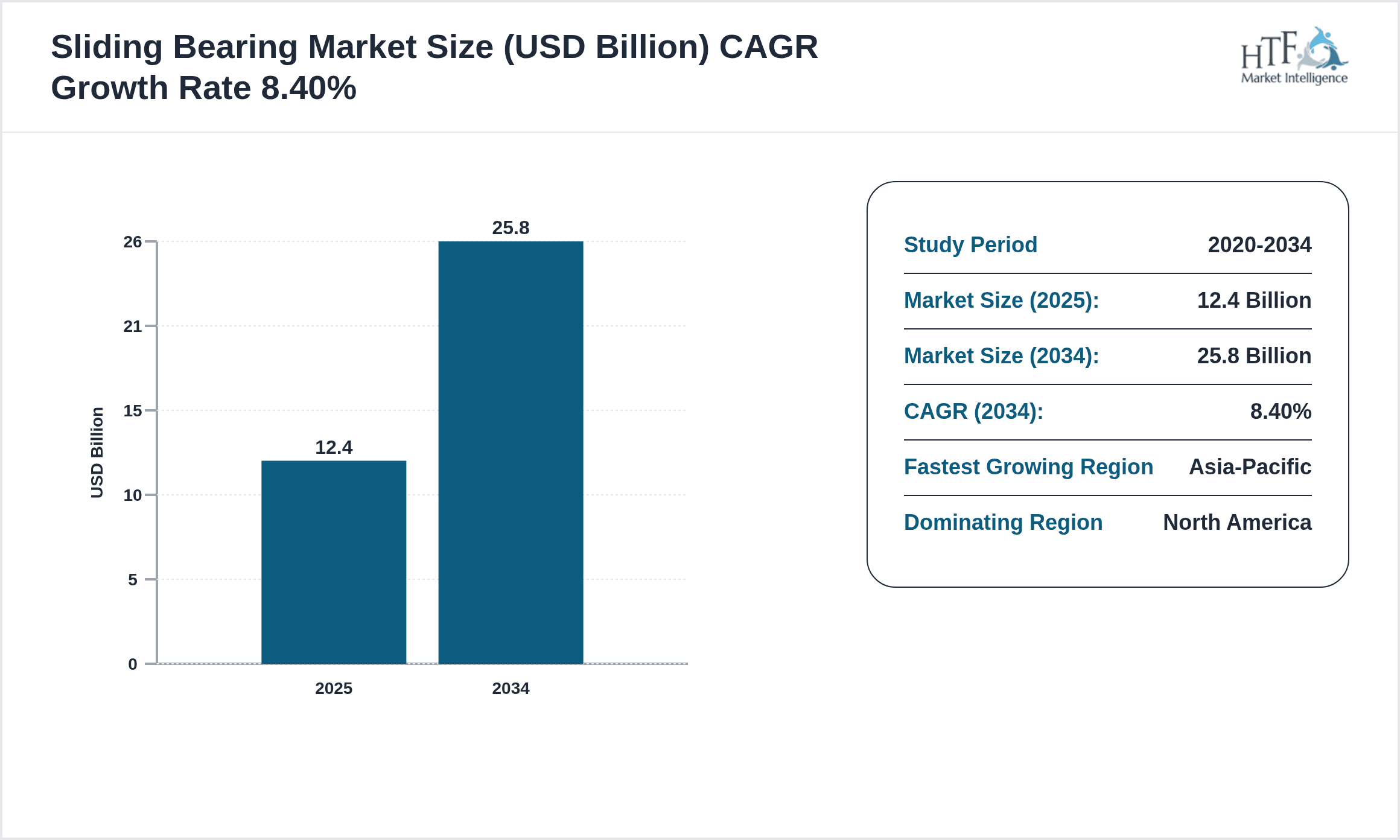
- •Key market highlights indicate a robust CAGR of 8.4% from the base year 2025 through the forecast period ending 2034, with the global market size expected to more than double from USD 12.4 Billion in 2025 to USD 25.8 Billion by 2034. North America currently dominates the market, driven by advanced manufacturing and automotive industries, while the Asia-Pacific region is poised as the fastest growing due to rapid industrialization and infrastructure investments. Plain bearings lead the product segment with widespread usage, whereas composite bearings exhibit the highest growth potential fueled by technological innovation and demand for lightweight materials. Applications in automotive and construction machinery represent the largest market shares, supported by expanding vehicle production and infrastructure projects worldwide. Market dynamics highlight expanding end-user industries and continuous product innovation as critical growth factors.
- •The sliding bearing market presents significant value propositions by enhancing machinery reliability, reducing maintenance costs, and enabling high load and speed applications. Its strategic importance spans across automotive manufacturers seeking durable components, aerospace industries demanding precision and reliability, and construction sectors focusing on robust equipment performance. Investors and stakeholders benefit from the market’s sustained growth driven by technological advancements, expanding industrial applications, and increasing demand for sustainable, high-performance materials. The market also offers opportunities in emerging regions, particularly Asia-Pacific, where infrastructure development and manufacturing expansion are accelerating. Overall, the sliding bearing market plays a pivotal role in enabling industrial efficiency and innovation, making it a critical component in the global manufacturing ecosystem.
Competitive Landscape
The global sliding bearing market is characterized by intense competition among established multinational manufacturers and emerging regional players. Market leaders pursue strategic initiatives such as continuous product innovation, adoption of advanced materials like composites and polymers, and expansion into emerging markets to strengthen their competitive position. Companies focus on differentiating their offerings through enhanced durability, load capacity, and customization for specific applications. Innovation approaches include integrating sustainable materials and advancing manufacturing technologies to reduce costs and improve performance. Rivalry is intensified by the presence of numerous players competing on price, quality, and technological superiority. Strategic partnerships, mergers, and acquisitions further consolidate market share and expand geographic footprints. Distribution channels are diversified to ensure wide availability, while competitive pricing and after-sales support remain critical to customer retention. Future trends indicate an increasing emphasis on digitalization and smart bearing technologies, which will shape competitive dynamics and create new entry barriers.
Leading Companies in Sliding Bearing Market
- •SKF AB (Sweden)
- •NSK Ltd. (Japan)
- •Timken Company (United States)
- •JTEKT Corporation (Japan)
- •Schaeffler Technologies AG & Co. KG (Germany)
- •FAG Bearings (Germany)
- •Boca Bearings (United States)
- •Bronze Alloy Manufacturing Co. (India)
- •Thomson Industries (United States)
- •CBC Group (Italy)
- •IKO International (Japan)
- •NTN Corporation (Japan)
- •GGB Bearing Technology (United States)
- •Rodriguez Group (Spain)
- •RBC Bearings Incorporated (United States)
- •Koyo Bearings (Japan)
- •Federal-Mogul Bearings (United States)
- •Trelleborg AB (Sweden)
- •Ameridrives Couplings (United States)
- •ZKL Bearings (Czech Republic)

Market Breakdown
- •By Type
- ◦Plain Bearings
- ◦Composite Bearings
- ◦PTFE Bearings
- ◦Metal-Polymer Bearings
- ◦Hydrodynamic Bearings
- •By Application
- ◦Automotive
- ◦Construction Machinery
- ◦Aerospace
- ◦Industrial Equipment
- ◦Marine
- •By End User Industry
- ◦Automotive Manufacturing
- ◦Heavy Machinery
- ◦Aerospace & Defense
- ◦Marine Engineering
- ◦General Industry
- •By Distribution Channel
- ◦Direct Sales
- ◦Distributors & Dealers
- ◦Online Sales
Growth Dynamics
The global sliding bearing market is driven by rapid industrialization across emerging economies, increasing demand for automotive and construction machinery, and the growing need for durable, low-maintenance bearing solutions. Enhanced performance requirements in aerospace and marine sectors also contribute substantially. Technological advancements in composite and polymer materials improve wear resistance and load capacity, thereby expanding application scopes. Additionally, rising infrastructure spending worldwide fuels equipment demand, directly benefiting sliding bearing manufacturers. Environmental regulations encouraging sustainable materials further stimulate innovation and adoption of eco-friendly bearings. The integration of advanced manufacturing techniques such as precision casting and additive manufacturing enables cost-effective production and customization, accelerating market growth. Finally, increased automation and mechanization in various industries necessitate reliable sliding bearing solutions, reinforcing the market’s upward trajectory.

Market Trends
Current market trends emphasize the adoption of composite and polymer-based sliding bearings due to their superior wear resistance, lightweight properties, and reduced lubrication needs. Leading manufacturers are investing heavily in R&D to develop next-generation materials that enhance bearing lifespan under extreme conditions. Digitalization and smart bearing technologies incorporating sensors for real-time condition monitoring are gaining traction, enhancing predictive maintenance capabilities. Moreover, sustainability trends push the market towards environmentally friendly materials and manufacturing processes. Regional diversification is also evident, with increasing production capacities in Asia-Pacific to meet growing local demand. Strategic collaborations between material science startups and established bearing manufacturers foster innovation and accelerate product commercialization. These trends collectively shape a dynamic market landscape focused on performance, sustainability, and technological integration.

Market Opportunities
Significant opportunities exist in expanding into emerging markets within Asia-Pacific and Latin America, where industrial growth and infrastructure development are accelerating. The increasing adoption of electric and autonomous vehicles presents new application areas for sliding bearings optimized for lightweight and high-performance requirements. Innovations in composite materials and self-lubricating bearings open avenues for product differentiation and premium pricing. Moreover, integration of IoT-enabled smart bearings offers prospects for value-added services such as predictive maintenance and remote monitoring. Strategic partnerships with OEMs and infrastructure developers can enhance market penetration. Additionally, growing environmental regulations compel manufacturers to develop sustainable products, presenting opportunities to capture eco-conscious segments. These factors collectively create a fertile environment for market expansion and innovation-led growth.
Market Challenges
The sliding bearing market faces challenges including volatile raw material prices, particularly for advanced composites and specialty polymers, which can impact production costs and profitability. High initial investment requirements for R&D and precision manufacturing technologies may limit entry and expansion for smaller players. Competition from alternative bearing technologies such as rolling element bearings poses a constant threat. Furthermore, stringent regulatory compliance across regions increases operational complexities and costs. Supply chain disruptions, exacerbated by global events, affect timely material procurement and delivery schedules. Market fragmentation with numerous regional players creates pricing pressures and reduces bargaining power. Lastly, the need to continually innovate while managing cost competitiveness remains a persistent challenge for market participants.
Regulatory Framework
Between 2019 and 2025, the sliding bearing market has been influenced by several regulatory updates aimed at improving environmental sustainability and workplace safety. Key regulations include the EU’s REACH regulation on chemical substances, mandating the use of safer materials and restricting hazardous chemicals in bearing components. The US Environmental Protection Agency (EPA) has enforced stricter emissions and waste management standards impacting manufacturing processes. Additionally, ISO standards related to bearing quality and testing have been updated to ensure product reliability and safety. Regional mandates in Asia-Pacific focus on promoting green manufacturing and sustainable supply chains. Governments worldwide are encouraging the use of eco-friendly materials and energy-efficient production methods to reduce carbon footprints. These regulations require manufacturers to adapt material sourcing, production techniques, and product designs to comply, thereby shaping market innovation and competitiveness.
Market Intelligence
- •15th January 2025, SKF AB launched an innovative composite sliding bearing designed for high-load automotive applications featuring enhanced wear resistance and reduced maintenance requirements. This product integrates advanced polymer materials and precision manufacturing to improve durability and efficiency. Targeting electric vehicle manufacturers, the bearing supports lightweight designs and sustainability goals. SKF’s strategic objective is to strengthen its presence in emerging automotive segments globally and capitalize on the growing demand for performance-optimized components. This launch demonstrates the company’s commitment to material innovation and sustainability, positioning it competitively in the evolving sliding bearing market. Source: SKF Official Press Release
- •10th March 2025, Timken Company introduced a new series of hydrodynamic sliding bearings for aerospace applications, combining advanced lubrication technology with lightweight metal alloys. The product aims at improving fuel efficiency and reducing operational costs for aircraft manufacturers. Timken’s innovation reflects the increasing demand for high-performance, reliable components in aerospace, supporting extended maintenance intervals and enhanced safety features. The new bearings are expected to capture significant market share, particularly in commercial and defense aviation sectors. This initiative aligns with Timken’s strategic focus on expanding its aerospace portfolio through technological advancements. Source: Timken Company Corporate Announcement
- •20th May 2025, NSK Ltd. announced a strategic partnership with a leading construction equipment manufacturer to co-develop customized sliding bearings optimized for heavy machinery under extreme conditions. This collaboration leverages NSK’s material science expertise and the manufacturer’s field experience to enhance product durability and performance. The partnership is anticipated to accelerate product development cycles and expand market reach in infrastructure and mining sectors. NSK aims to strengthen its competitive position by offering application-specific solutions tailored to client needs. This alliance reflects growing industry trends toward collaborative innovation for specialized bearing applications. Source: NSK Corporate News
- •5th August 2025, Schaeffler Technologies AG & Co. KG expanded its manufacturing capacity for PTFE sliding bearings in Asia-Pacific to meet rising regional demand driven by industrial growth and automotive production. The expansion includes investment in advanced automation and quality control systems to enhance productivity and reduce lead times. Schaeffler’s move aims to capitalize on the fastest-growing regional market, providing localized solutions and improved supply chain responsiveness. This strategic investment positions the company to better serve emerging markets while maintaining global competitiveness. It underscores the importance of regional manufacturing footprints in the global sliding bearing industry. Source: Schaeffler Annual Report
Regional Outlook
The North America currently holds a significant share of the market, primarily due to several key factors: increasing consumption rates, a burgeoning population, and robust economic momentum. These elements collectively drive demand, positioning this region as a leader in the market. On the other hand, Asia-Pacific is rapidly emerging as the fastest-growing area within the industry. This remarkable growth can be attributed to swift infrastructure development, the expansion of various industrial sectors, and a marked increase in consumer demand. These dynamics make this region a crucial player in shaping future market growth.
In our report, we cover a comprehensive analysis of the following regions and countries:
- North America
- LATAM
- West Europe
- Central & Eastern Europe
- Northern Europe
- Southern Europe
- East Asia
- Southeast Asia
- South Asia
- Central Asia
- Oceania
- MEA
| Feature | Details |
|---|---|
| Base Year Market Size | USD 12.4 Billion |
| Forecast Year Market Size | USD 25.8 Billion |
| CAGR | 8.4% |
| Forecast Period | 2026 to 2033 |
| YoY Growth | 7.9% |
| Scope of Report | Market is segmented by Type (Plain Bearings, Composite Bearings, PTFE Bearings, Metal-Polymer Bearings, Hydrodynamic Bearings), Application (Automotive, Construction Machinery, Aerospace, Industrial Equipment, Marine), End User Industry (Automotive Manufacturing, Heavy Machinery, Aerospace & Defense, Marine Engineering, General Industry), Distribution Channel (Direct Sales, Distributors & Dealers, Online Sales) |
| Regions Covered | North America, LATAM, West Europe, Central & Eastern Europe, Northern Europe, Southern Europe, East Asia, Southeast Asia, South Asia, Central Asia, Oceania, MEA |
| Key Companies | SKF AB (Sweden), NSK Ltd. (Japan), Timken Company (United States), JTEKT Corporation (Japan), Schaeffler Technologies AG & Co. KG (Germany) |
Global Sliding Bearing Market Size, Growth & Revenue 2024-2034 - Table of Contents
Frequently Asked Questions (FAQ):
The Compact Track Loaders market is projected to grow at a CAGR of 6.8% from 2025 to 2030, driven by increasing demand in construction and agricultural sectors.
North America currently leads the market with approximately 45% market share, followed by Europe at 28% and Asia-Pacific at 22%. The remaining regions account for 5% of the global market.
Key growth drivers include increasing construction activities, rising demand for versatile equipment in agriculture, technological advancements in track loader design, and growing preference for compact equipment in urban construction projects.