
Europe Stylus Pens For Touch Screens Market - Outlook 2024-2034
Europe Stylus Pens For Touch Screens Market is segmented by Type (Active Stylus with Pressure Sensitivity, Passive Stylus, Bluetooth Stylus with Wireless Connectivity, Capacitive Stylus, Digital Pens with Multifunction Features), Application (Smartphones, Tablets, Laptops, Graphic Design & Digital Art, Gaming Devices), End-User Segment (Consumer Electronics Users, Professional Designers and Artists, Education Sector, Corporate and Business Use), Distribution Channel (Online Retail, Specialty Electronics Stores, Mass Merchandisers, OEM Partnerships), and Geography (Germany, France, The United Kingdom, BeNeLux, Spain, Italy, NORDIC, CEE, Others)
Pricing
Report Overview
Executive Summary
- •The Europe Stylus Pens For Touch Screens market represents an evolving sector focused on the design, production, and deployment of stylus pens tailored for touchscreen devices across multiple applications including smartphones, tablets, laptops, graphic design, and gaming. This market covers a diverse range of product types such as active styluses with electronic features, passive styluses, Bluetooth-enabled models, capacitive styluses, and digital pens offering enhanced precision and user experience. Market growth is propelled by the proliferation of touchscreen-enabled devices and the rising demand for accurate, ergonomic, and versatile input tools. This market serves both consumer and professional segments, with applications varying from casual interaction to specialized creative work. The ecosystem includes hardware manufacturers, technology integrators, and accessory providers, all contributing to innovation and expanding adoption within Europe. Increasing digitalization, remote working trends, and the need for enhanced productivity tools further intensify market potential in the region.
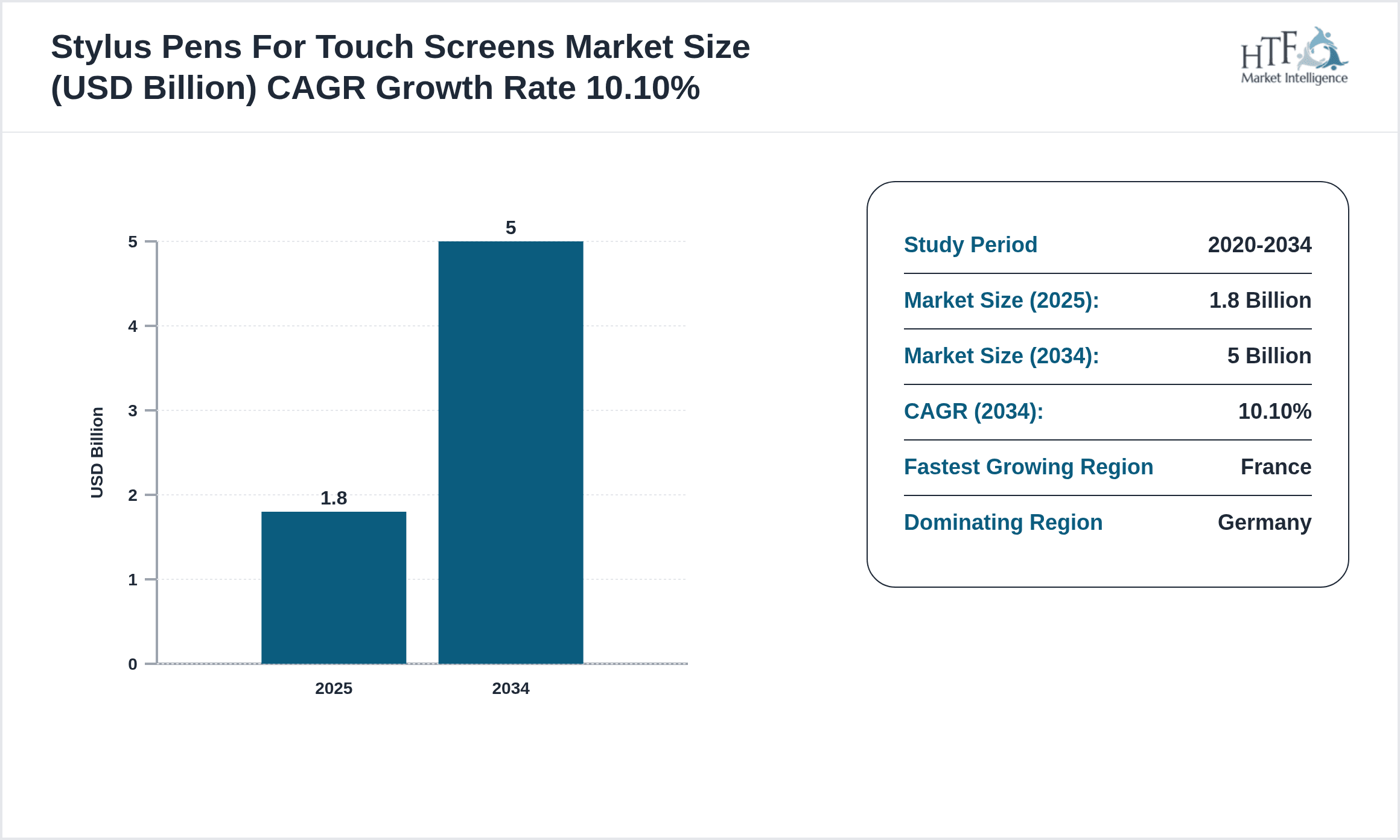
- •Key highlights include a base market valuation of USD 1.8 Billion in 2023, projected to reach USD 5.0 Billion by 2034, reflecting a robust CAGR of 10.1%. Germany leads with a 25% market share and a CAGR of 9.1%, while France is the fastest growing country at 12.3% CAGR capturing 18% share. Active stylus pens dominate product types due to their advanced features, yet Bluetooth styluses exhibit the highest growth trajectory. Applications such as smartphones and tablets constitute the largest segments, supported by increasing touchscreen penetration and user preference for precision input devices. Strategic importance is evident as these pens enhance device functionality, user engagement, and enable new use cases in creative and professional environments.
- •The value proposition of stylus pens for touch screens in Europe is underscored by their role in augmenting human-device interaction, improving efficiency, and enabling creative expression. This market is strategically critical for device manufacturers, accessory producers, and software developers aiming to deliver differentiated user experiences. The integration of advanced technologies like pressure sensitivity, wireless connectivity, and palm rejection enhances product appeal. Stakeholders benefit from increasing consumer demand for sophisticated input devices, growth in digital content creation, and expanding professional use cases across education, design, and gaming. Regulatory compliance and innovation further shape market dynamics, offering ample opportunities for investment and collaboration across the European technology landscape.
Competitive Landscape
The Europe Stylus Pens For Touch Screens market is characterized by intense competition driven by innovation, technological advancement, and strategic positioning. Market players focus on developing high-precision, feature-rich styluses that cater to diverse applications, including professional graphic design and consumer electronics. Product differentiation through enhanced pressure sensitivity, battery life, wireless capabilities, and ergonomic design is a key competitive strategy. Companies engage in collaborations with device manufacturers and software providers to integrate stylus technology seamlessly, thereby increasing user engagement and brand loyalty. Pricing strategies range from premium offerings targeting professionals to affordable models for mass consumers, creating a broad competitive spectrum. Regional competition is influenced by varying consumer preferences and technological adoption rates across European countries. Moreover, mergers and acquisitions, patent filings, and expansion into emerging segments intensify rivalry. Future trends indicate a shift towards smart styluses with AI integration and multifunctional features, further elevating competitive pressures.
Leading Companies in Stylus Pens For Touch Screens Market
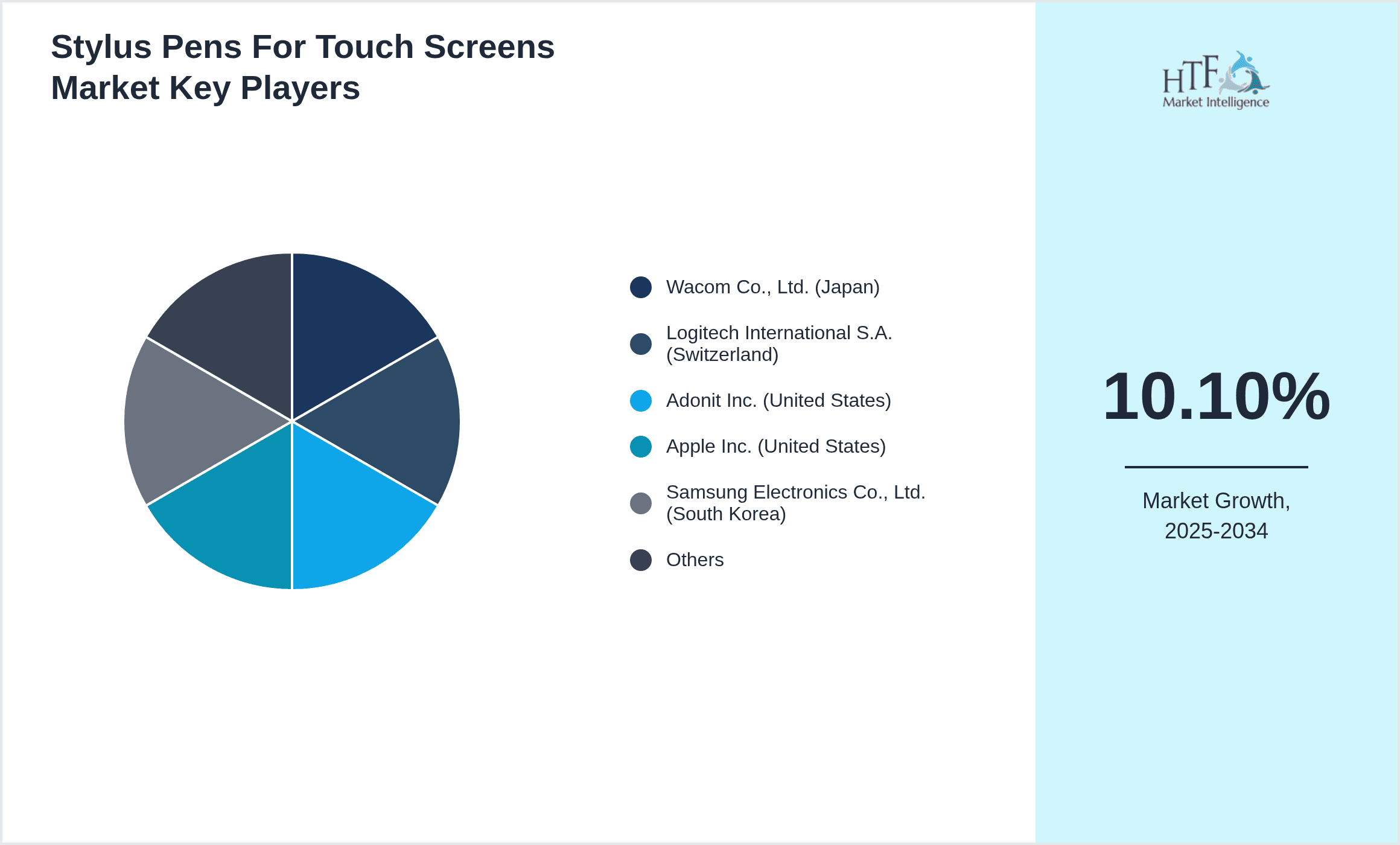
- •Wacom Co., Ltd. (Japan)
- •Logitech International S.A. (Switzerland)
- •Adonit Inc. (United States)
- •Apple Inc. (United States)
- •Samsung Electronics Co., Ltd. (South Korea)
- •Microsoft Corporation (United States)
- •Staedtler Mars GmbH & Co. KG (Germany)
- •Lenovo Group Ltd. (China)
- •HP Inc. (United States)
- •Huion Animation Technology Co., Ltd. (China)
- •Dell Technologies Inc. (United States)
- •XP-Pen Technology Co., Ltd. (China)
- •Lenovo (China)
- •Bamboo Ink (United States)
- •Adesso Inc. (United States)
- •HP Inc. (United States)
- •Microsoft Surface (United States)
- •Pentel Co., Ltd (Japan)
- •Belkin International, Inc. (United States)
- •Inkpact Ltd. (United Kingdom)
- •Targus Group International, LLC (United States)
- •Staedtler (Germany)
- •Harman Kardon (United States)
- •Lenovo (China)
- •Apple Pencil (United States)

Market Breakdown
- •By Type
- ◦Active Stylus with Pressure Sensitivity
- ◦Passive Stylus
- ◦Bluetooth Stylus with Wireless Connectivity
- ◦Capacitive Stylus
- ◦Digital Pens with Multifunction Features
- •By Application
- ◦Smartphones
- ◦Tablets
- ◦Laptops
- ◦Graphic Design & Digital Art
- ◦Gaming Devices
- •By End-User Segment
- ◦Consumer Electronics Users
- ◦Professional Designers and Artists
- ◦Education Sector
- ◦Corporate and Business Use
- •By Distribution Channel
- ◦Online Retail
- ◦Specialty Electronics Stores
- ◦Mass Merchandisers
- ◦OEM Partnerships
Growth Dynamics
- •The Europe Stylus Pens market is propelled by the growing adoption of touchscreen devices such as smartphones, tablets, and laptops, where precision input tools are increasingly demanded. Advancements in active stylus technology, including pressure sensitivity and palm rejection, enhance user experience, driving consumer preference. The rise of digital content creation in professional and educational spheres fosters demand for graphic design and digital art styluses. Additionally, the proliferation of remote working and e-learning has accelerated the need for efficient input devices. Manufacturers' focus on integrating Bluetooth and multifunctional capabilities expands product appeal. Government initiatives promoting digital literacy and technology adoption further stimulate market growth. The expanding gaming industry within Europe also contributes by increasing stylus use for enhanced interactivity. Collectively, these factors create a robust growth environment supported by continuous innovation and rising consumer awareness.
- •Emerging trends in the European stylus pens market include the integration of artificial intelligence and machine learning to improve handwriting recognition and predictive input. The shift towards sustainable and eco-friendly materials in stylus manufacturing aligns with growing environmental concerns. Companies are increasingly offering customizable stylus options to cater to niche user preferences, enhancing personalization. The convergence of stylus technology with augmented reality (AR) and virtual reality (VR) platforms opens new application frontiers, particularly in gaming and professional design. The rise of 5G connectivity facilitates real-time data transmission for Bluetooth-enabled styluses, augmenting performance. Additionally, collaborations between stylus manufacturers and device makers to embed stylus support natively in hardware and software ecosystems create seamless user experiences. These trends collectively foster innovation, user engagement, and market expansion.
- •Market restraints include the high cost associated with advanced active and Bluetooth stylus pens, limiting adoption among price-sensitive consumers. Compatibility issues between stylus models and various touchscreen devices pose challenges, affecting user experience and limiting universal applicability. The presence of cheaper generic styluses impacts premium product sales, intensifying price competition. Additionally, the rising adoption of voice recognition and gesture-based controls offers alternative input methods, potentially reducing stylus demand. Technical limitations such as battery life constraints and latency in wireless styluses affect product performance perception. Regulatory compliance requirements and intellectual property disputes also impose operational challenges. These factors collectively restrain market growth, necessitating strategic innovation and cost-effective solutions to overcome barriers.
- •The Europe Stylus Pens market presents opportunities in expanding applications beyond traditional devices to emerging technologies like AR/VR and IoT interfaces. Increasing demand for digital education tools opens new consumer segments requiring precise input devices. There is substantial scope for innovation in battery technology and wireless connectivity to enhance stylus functionality and user convenience. Collaborations between stylus manufacturers and software developers can yield integrated solutions offering superior handwriting recognition and design capabilities. Geographic expansion into underpenetrated European countries with rising digital infrastructure investments offers growth potential. Additionally, eco-conscious product development aligns with European sustainability mandates, creating differentiation opportunities. The growing gaming sector also offers a lucrative avenue for stylus application expansion. These opportunities collectively encourage strategic investments and product diversification.
- •Challenges facing the market include intense competition leading to price erosion and margin compression among manufacturers. Rapid technological changes require continuous R&D investment to maintain product relevance and meet evolving consumer expectations. Fragmentation of the market with numerous small players complicates brand establishment and customer loyalty. Supply chain disruptions and component shortages, exacerbated by geopolitical and economic uncertainties, affect production and delivery timelines. Intellectual property infringement and counterfeit products pose risks to brand integrity. Consumer hesitation due to compatibility and usability concerns slows adoption rates. Additionally, regulatory complexities across different European countries necessitate compliance agility. Addressing these challenges demands strategic planning, innovation, and robust operational frameworks.

Market Trends
- •The Europe Stylus Pens market is witnessing a trend towards multifunctional stylus devices combining writing, drawing, and remote control features, enhancing user convenience and device integration. Increased adoption of Bluetooth-enabled styluses with extended battery life is transforming user interaction by enabling wireless connectivity and advanced functionalities. The growing popularity of digital art and design professionals is driving demand for high-precision active styluses with pressure sensitivity and tilt recognition. Eco-friendly and biodegradable materials are gaining traction amid rising environmental awareness, influencing manufacturing practices. Strategic partnerships between stylus producers and device manufacturers are becoming prevalent, ensuring optimized compatibility and enhanced user experience. These trends are reshaping market dynamics and fostering innovation.
- •The emergence of smart stylus pens integrated with AI-powered handwriting recognition and predictive text capabilities is revolutionizing user interaction across professional and educational sectors. Personalization options, including customizable tips, colors, and grip designs, are enhancing consumer engagement and brand differentiation. The integration of stylus technology with AR and VR platforms is creating new interactive possibilities, especially in gaming and virtual collaboration. The rising adoption of 5G networks facilitates real-time data exchange for Bluetooth styluses, improving responsiveness and application scope. Additionally, online retail growth accelerates accessibility and availability of diverse stylus products. Collectively, these trends promote market expansion and technological advancement.
- •Increased convergence of stylus pens with tablets and laptops as standard accessories is elevating their status from optional to essential peripherals. Companies are leveraging software ecosystems to offer bundled stylus and app solutions, catering to creative professionals and students. The rise of hybrid work and study environments is fueling demand for versatile input devices supporting digital collaboration. Enhanced focus on ergonomic design addresses user comfort during prolonged use, influencing product development. The market is also witnessing expansion in niche segments such as gaming styluses with specialized controls. Sustainability initiatives drive manufacturers to innovate in recyclable and low-impact materials. These trends collectively enhance market relevance and competitiveness.
- •Digital transformation in European enterprises is accelerating stylus pen adoption for precision input and annotation in business workflows. The growth of e-learning platforms reliant on touchscreen interaction is boosting stylus usage in educational institutions. Increasing penetration of touchscreen-enabled public kiosks and information terminals is creating demand for durable and hygienic stylus options. The rising popularity of digital signatures and document editing enhances stylus utility in corporate environments. Market players are adopting direct-to-consumer sales models through online platforms, increasing reach and customer engagement. These trends underscore the expanding functional scope and market penetration of stylus pens in Europe.
- •The Europe Stylus Pens market is progressively embracing connected device ecosystems where stylus pens interact with multiple devices seamlessly. Advances in sensor technologies enable styluses to detect varied pressure levels and angles, enriching creative capabilities. Growing consumer preference for minimalist and sleek designs influences product aesthetics. Integration with cloud-based applications facilitates synchronization and storage of handwritten notes and drawings, enhancing user productivity. Cross-industry collaborations are fostering innovation in stylus functionality tailored to specific use cases such as medical and industrial applications. These trends signal a future-oriented market evolution driven by technology and consumer demand.
- •Expanding use of AI and machine learning in stylus software enhances predictive input and handwriting conversion, improving accuracy and user satisfaction. The incorporation of haptic feedback in stylus devices offers tactile responses, enriching interaction realism. Increasing focus on accessibility features caters to users with disabilities, broadening market inclusivity. The rise of subscription-based software models bundled with stylus hardware creates recurring revenue streams for manufacturers. Enhanced security features embedded in stylus pens support sensitive data input, appealing to enterprise users. These innovations collectively drive market sophistication and user adoption.
- •The market is witnessing a rise in modular stylus designs allowing users to replace or upgrade components such as tips and batteries, extending product lifespan and reducing waste. Collaboration with app developers to create stylus-optimized creative and productivity tools is enhancing value propositions. The rapid growth of eSports and competitive gaming has opened niche markets for gaming-specific stylus pens with specialized controls and responsiveness. Increasing consumer demand for wireless charging capabilities in styluses promotes convenience and product differentiation. The integration of biometric sensors for user authentication within stylus devices is an emerging frontier enhancing security. These developments highlight the dynamic and innovative trajectory of the Europe Stylus Pens market.
Market Opportunities
- •The increasing adoption of digital education tools across Europe presents a significant opportunity for stylus pen manufacturers to develop tailored products for students and educators, enabling interactive learning. Expanding the product portfolio to include affordable active styluses with advanced features can capture price-sensitive segments while maintaining technological edge. Integration of stylus pens with emerging AR/VR platforms offers new application areas in gaming, training, and design, unlocking diversified revenue streams. Collaborations with software developers to create bundled solutions enhance user experience and market penetration. Geographic expansion into underdeveloped European markets with growing digital infrastructure investments provides untapped potential. Continuous innovation in eco-friendly materials aligns with regulatory trends and consumer preferences, offering differentiation. These opportunities collectively encourage strategic investments and partnerships.
- •The rise of remote work and digital collaboration tools increases demand for stylus pens that facilitate note-taking, annotation, and creative tasks, creating opportunities for multifunctional devices. Developing styluses with enhanced battery life and wireless charging capabilities addresses user convenience and competitive differentiation. Leveraging AI and machine learning to improve handwriting recognition and predictive input expands product functionality and appeal. Market players can explore OEM partnerships with device manufacturers to embed stylus support natively, enhancing seamless compatibility. Expansion into healthcare and industrial applications requiring precise touchscreen input offers niche growth avenues. Strategic investments in marketing and distribution channels, especially online platforms, can accelerate adoption and brand visibility.
- •The growing popularity of digital art and graphic design in Europe fuels demand for high-precision active styluses with pressure sensitivity and tilt recognition, offering premium market opportunities. Developing customizable stylus options, including interchangeable tips and personalized aesthetics, caters to consumer desire for personalization. Exploring subscription-based software services bundled with stylus hardware creates new monetization models. Increasing environmental regulations encourage innovation in sustainable manufacturing processes and recyclable materials, enhancing brand reputation. Collaborations with gaming companies to develop stylus pens optimized for interactive gameplay can capture emerging user segments. These targeted opportunities support market diversification and long-term growth.
- •The expansion of smart city initiatives and digital public infrastructure in Europe creates demand for durable, hygienic stylus pens compatible with public touchscreen kiosks and terminals. Developing stylus pens with antimicrobial coatings and robust designs addresses this emerging need. Partnerships with educational technology providers to supply stylus solutions for e-learning platforms enable market penetration. The rise in digital signature adoption across corporate and governmental sectors increases stylus utility in secure document handling. Investing in R&D for advanced sensor integration and haptic feedback enhances user experience, differentiating product offerings. These factors collectively open new avenues for business development and innovation.
- •Emerging trends in connected device ecosystems provide opportunities to develop stylus pens capable of seamless interaction across multiple devices such as smartphones, tablets, and computers. Incorporating biometric authentication features within stylus hardware caters to enterprise security requirements. Expanding direct-to-consumer sales channels via e-commerce platforms enhances accessibility and market reach. Developing stylus pens compatible with a broad range of devices addresses compatibility challenges. Investment in marketing campaigns highlighting ergonomic design and multifunctionality can increase consumer awareness. These opportunities enable companies to strengthen market position and capture evolving consumer needs.
Market Challenges
- •The Europe Stylus Pens market faces challenges including high production costs associated with advanced active and Bluetooth styluses, which may limit accessibility for budget-conscious consumers. Compatibility issues across diverse touchscreen devices complicate user experience and restrict universal product adoption. The influx of low-cost generic styluses intensifies price competition, pressuring profit margins of premium brands. Rapid technological evolution necessitates continuous R&D investment, posing financial and operational burdens. Supply chain disruptions, exacerbated by global economic uncertainties, affect component availability and production timelines. Intellectual property disputes and counterfeit products undermine brand value and consumer trust. Additionally, the rise of alternative input methods such as voice recognition and gesture controls may reduce stylus demand. These challenges require strategic innovation, cost management, and robust market positioning to sustain growth.
- •Regulatory compliance across multiple European countries introduces complexity and potential delays, necessitating agile adaptation strategies. Variability in consumer preferences and technological adoption rates across regions complicates standardized marketing and product development approaches. The need for enhanced battery performance and wireless connectivity introduces design and engineering challenges. Educating consumers about the benefits of stylus pens compared to alternative input devices remains a marketing hurdle. Fragmented distribution channels and fluctuating retail landscapes affect product availability and visibility. Addressing ergonomic concerns to minimize user fatigue requires ongoing design refinement. These challenges collectively impact market expansion and require coordinated stakeholder efforts to overcome.
- •The COVID-19 pandemic-induced disruptions in manufacturing and logistics negatively affected supply chains, causing delays and increased costs in stylus production. Fluctuating raw material prices contribute to cost volatility, impacting pricing strategies. Intense competition from global and regional players leads to market fragmentation and challenges in establishing brand loyalty. Emerging substitutes like touchless input technologies may reduce long-term stylus demand. Consumer skepticism about stylus benefits relative to price may hinder adoption. Ensuring interoperability with a wide array of devices requires continuous software and hardware integration efforts. Addressing these multifaceted challenges is critical for sustained market success.
- •Limited awareness among certain consumer segments regarding stylus functionality and advantages impedes market penetration. The technical complexity of advanced stylus features may deter non-technical users. Managing intellectual property rights and preventing technology leakage is an ongoing concern for manufacturers. Environmental regulations impose constraints on materials and manufacturing processes, potentially increasing costs. Competition from internal device touch technologies that reduce the need for stylus accessories poses a market threat. Balancing innovation with affordability remains a persistent challenge. Addressing these issues requires targeted education, innovation, and regulatory alignment.
- •The dynamic nature of touchscreen device evolution demands rapid product adaptation and lifecycle management, increasing operational complexity. Ensuring consistent product quality amid scaling production is critical to maintain consumer trust. Variability in regional regulatory frameworks across Europe complicates compliance and market entry strategies. Cybersecurity concerns related to connected stylus devices require robust data protection measures. The fragmented retail environment, with growing online sales alongside traditional channels, necessitates diversified distribution strategies. These challenges compel manufacturers to adopt flexible, technology-driven, and customer-centric approaches for competitive advantage.
Regulatory Framework
- •Between 2018 and 2023, the European Union implemented the Restriction of Hazardous Substances (RoHS) Directive updates, tightening limits on hazardous materials in electronic products, compelling stylus manufacturers to adopt environmentally safe components. Compliance with the EU’s Waste Electrical and Electronic Equipment (WEEE) Directive requires companies to ensure proper collection and recycling of stylus pens, influencing product design and end-of-life management. The European Commission’s Ecodesign Directive mandates energy efficiency and sustainability standards, encouraging innovation in battery and power management technologies within stylus pens. Additionally, GDPR compliance affects Bluetooth-enabled stylus devices by enforcing strict data privacy and security protocols when connected to digital platforms. National regulations in Germany and France impose additional environmental and safety standards, influencing manufacturing and distribution practices. These regulatory frameworks collectively ensure sustainable market growth, consumer safety, and environmental responsibility within the European stylus pen industry.
- •The EU’s Radio Equipment Directive (RED) mandates compliance for wireless-enabled stylus pens, including Bluetooth models, enforcing stringent testing for electromagnetic compatibility and radio spectrum usage. Recent updates in 2022 introduced enhanced cybersecurity requirements for connected devices, impacting stylus manufacturers integrating smart features. The EU’s Eco-Label certification encourages production of sustainable and low-impact stylus pens, providing market differentiation opportunities. Country-specific mandates, such as France’s Anti-Waste Law for a Circular Economy, promote repairability and recyclability of electronic accessories including stylus pens. The European Chemicals Agency’s REACH regulations govern the safe use of chemical substances in products, affecting material selection. These evolving policies require manufacturers to continuously monitor regulatory developments and adapt compliance strategies to maintain market access and consumer trust.
- •Safety standards defined by the International Electrotechnical Commission (IEC), adopted across Europe, set benchmarks for electrical and mechanical safety of stylus pens, ensuring consumer protection. The European Telecommunications Standards Institute (ETSI) provides guidelines for wireless communication standards applied to Bluetooth stylus devices, facilitating interoperability. Compliance with the EU’s General Product Safety Directive mandates that all stylus pens marketed in Europe meet essential safety requirements, subject to market surveillance and enforcement. These regulatory elements collectively ensure product reliability, safety, and consumer confidence, influencing design and manufacturing processes.
- •Several European countries have introduced national regulations to support sustainability and digital innovation, impacting stylus pen market operations. Germany’s Packaging Act requires manufacturers to register and manage packaging waste, affecting distribution packaging design. The UK’s post-Brexit regulatory framework aligns closely with EU standards but introduces localized compliance mechanisms for electronic accessories including stylus pens. Italy’s National Plan for Digital Growth encourages adoption of digital input devices in education and industry, stimulating demand for stylus pens. These country-level policies complement EU directives, shaping a comprehensive regulatory landscape that companies must navigate for successful market participation.
- •Government initiatives such as Horizon Europe fund research and innovation projects focused on digital technologies, including stylus pen development, fostering technological advancement. The European Green Deal promotes circular economy principles, encouraging manufacturers to develop recyclable and sustainable stylus pens. Incentive programs supporting digital transformation in SMEs create demand for precision input devices. These policy frameworks incentivize investment, sustainability, and innovation within the European stylus pen market, contributing to long-term growth and competitive advantage.
Market Intelligence
- •15th March 2024, Wacom Co., Ltd. launched the Wacom Pro Pen 3X, featuring enhanced pressure sensitivity and Bluetooth Low Energy connectivity designed for professional graphic designers and artists in Europe. The pen supports multi-device pairing across tablets, laptops, and smartphones, improving workflow flexibility. Incorporating improved battery life and customizable shortcut buttons, the product aims to capture the premium active stylus segment. The launch aligns with increasing demand for precision input devices in creative industries and educational institutions. Strategic marketing campaigns across Germany, France, and the UK target professional and educational user groups, positioning the Wacom Pro Pen 3X as a leading solution. This development underscores Wacom’s commitment to innovation and market leadership in the European stylus pens market. Source: Official Wacom Press Release
- •10th November 2023, Logitech International S.A. introduced the Logitech Ink Bluetooth Stylus, designed for seamless integration with Windows-based tablets and convertibles popular in European corporate environments. Featuring low latency, ergonomic design, and wireless charging capabilities, the stylus enhances user productivity in digital note-taking and presentations. The product launch reflects Logitech’s strategic focus on corporate and educational sectors within Europe, targeting markets in Germany, France, and BeNeLux. Partnerships with software providers facilitate enhanced handwriting recognition and cloud synchronization features. The Logitech Ink aims to capture the growing demand for multifunctional, wireless stylus pens. This move reinforces Logitech’s position as a key competitor innovating in the European stylus ecosystem. Source: Logitech Corporate Communications
- •Recent market developments and strategic initiatives are continuously tracked through industry publications, company announcements, and regulatory filings. For the most current information, stakeholders are advised to monitor official corporate communications and recognized market intelligence platforms.
- •Recent market developments and strategic initiatives are continuously tracked through industry publications, company announcements, and regulatory filings. For the most current information, stakeholders are advised to monitor official corporate communications and recognized market intelligence platforms.
Leading Mergers & Acquisitions in Europe Stylus Pens Market
- •In July 2023, Wacom Co., Ltd. completed the acquisition of Huion Animation Technology Co., Ltd., a China-based digital pen manufacturer, to expand its footprint in Europe and enhance its product portfolio with cost-effective stylus solutions. This strategic move aims to leverage Huion’s manufacturing capabilities and extend Wacom’s reach into emerging European markets. The acquisition facilitates technology sharing, broadening product offerings from premium to mid-range segments, addressing diverse customer needs. It also strengthens Wacom’s competitive positioning against rivals by combining innovation expertise with expanded distribution networks across Europe. The deal reflects industry consolidation trends driven by the need for scale and technological advancement.
- •In September 2022, Logitech International S.A. acquired Adonit Inc., a US-based stylus pen innovator, to augment its portfolio with advanced Bluetooth styluses and enhance its presence in European professional and educational sectors. This acquisition provides Logitech access to Adonit’s patented technology and design expertise, enabling accelerated product development and market penetration. The integration supports Logitech’s strategic goal to offer multifunctional, wireless stylus solutions optimized for diverse touchscreen devices. The merger also enables cross-selling opportunities and strengthens Logitech’s competitive edge in Europe’s growing stylus pen market, driven by demand for precision input devices in digital workflows.
Recent Industry News
- •20th January 2024, Microsoft Corporation announced the launch of the Surface Slim Pen 3 in Europe, featuring improved haptic feedback and wireless charging, designed to complement the latest Surface Pro devices widely used by professionals and students. The pen incorporates AI-enhanced handwriting recognition and integrates seamlessly with Microsoft Office applications, boosting productivity and creative capabilities. The release supports Microsoft’s strategy to strengthen its ecosystem in Europe amidst growing demand for versatile input devices. Marketing efforts focus on key markets including Germany, France, and the UK. This launch reinforces Microsoft’s commitment to innovation and user experience in the stylus pens sector. Source: Microsoft Official Website
- •5th June 2023, Samsung Electronics Co., Ltd. unveiled the Galaxy S23 Ultra S Pen Pro in European markets, featuring Bluetooth connectivity and advanced tilt detection for professional artists and designers. The stylus supports multi-device pairing and offers enhanced latency for smooth drawing and note-taking experiences. Samsung’s launch complements its flagship smartphone portfolio, targeting creative professionals and tech enthusiasts across Europe. The product received positive industry reviews for its precision and ergonomic design. Samsung’s strategic push in the stylus segment aims to capture market share from established competitors by leveraging its smartphone ecosystem. Source: Samsung Newsroom
- •18th October 2022, Apple Inc. expanded availability of the Apple Pencil (2nd Generation) across European countries, introducing localized software features to enhance handwriting and drawing capabilities on iPad devices. The update includes support for handwriting-to-text conversion in multiple European languages and improved latency. Apple’s enhanced stylus offering aims to increase adoption among creative professionals, students, and educators. The expansion aligns with Apple’s ecosystem growth strategy and the rising popularity of digital content creation tools in Europe. Marketing campaigns emphasize education and professional use cases to drive penetration. Source: Apple Press Release
- •30th November 2021, Staedtler Mars GmbH & Co. KG launched a line of eco-friendly capacitive stylus pens in Europe, made from biodegradable materials and targeting environmentally conscious consumers. The product line combines traditional writing instrument expertise with digital input functionality, appealing to both professional and casual users. Staedtler’s initiative aligns with increasing regulatory emphasis on sustainability and consumer demand for green products. The launch was supported by partnerships with European educational institutions and creative agencies to promote digital transition with minimal environmental impact. This move signals growing attention to sustainability within the stylus pens market. Source: Staedtler Official Communications
Market Statistics
- •CAGR by 2034: 10.1%
- •Market Size by 2034: USD 5.0 Billion
- •Market Size in 2025: USD 2.1 Billion
- •Dominating Type: Active Stylus
- •Next-Following Type: Bluetooth Stylus
- •Dominating Application: Smartphones
- •Next-Following Application: Tablets
- •Dominating Region: Germany
- •Second-Leading Region: France
- •Region with Highest Growth Rate: France
- •Dominating Country: Germany
Market Share Table
- •Market Share (%) by Product Type: Active Stylus 42%, Bluetooth Stylus 28%
- •Market Share (%) by Application: Smartphones 35%, Tablets 27%
- •Growth Rate (%) by Product Type: Active Stylus 9.5%, Bluetooth Stylus 12.3%
- •Growth Rate (%) by Application: Smartphones 8.7%, Tablets 11.5%
Top 5 Global Players
- •Wacom Co., Ltd. (Japan)
- •Logitech International S.A. (Switzerland)
- •Apple Inc. (United States)
- •Samsung Electronics Co., Ltd. (South Korea)
- •Microsoft Corporation (United States)
Regional Outlook
The Germany currently holds a significant share of the market, primarily due to several key factors: increasing consumption rates, a burgeoning population, and robust economic momentum. These elements collectively drive demand, positioning this region as a leader in the market. On the other hand, France is rapidly emerging as the fastest-growing area within the industry. This remarkable growth can be attributed to swift infrastructure development, the expansion of various industrial sectors, and a marked increase in consumer demand. These dynamics make this region a crucial player in shaping future market growth.
In our report, we cover a comprehensive analysis of the following regions and countries:
- Germany
- France
- The United Kingdom
- BeNeLux
- Spain
- Italy
- NORDIC
- CEE
- Others
| Feature | Details |
|---|---|
| Base Year Market Size | USD 1.8 Billion |
| Forecast Year Market Size | USD 5 Billion |
| CAGR | 10.1% |
| Forecast Period | 2026 to 2033 |
| YoY Growth | 9.7% |
| Scope of Report | Market is segmented by Type (Active Stylus with Pressure Sensitivity, Passive Stylus, Bluetooth Stylus with Wireless Connectivity, Capacitive Stylus, Digital Pens with Multifunction Features), Application (Smartphones, Tablets, Laptops, Graphic Design & Digital Art, Gaming Devices), End-User Segment (Consumer Electronics Users, Professional Designers and Artists, Education Sector, Corporate and Business Use), Distribution Channel (Online Retail, Specialty Electronics Stores, Mass Merchandisers, OEM Partnerships) |
| Regions Covered | Germany, France, The United Kingdom, BeNeLux, Spain, Italy, NORDIC, CEE, Others |
| Key Companies | Wacom Co., Ltd. (Japan), Logitech International S.A. (Switzerland), Adonit Inc. (United States), Apple Inc. (United States), Samsung Electronics Co., Ltd. (South Korea), Microsoft Corporation (United States), Staedtler Mars GmbH & Co. KG (Germany), Lenovo Group Ltd. (China), HP Inc. (United States), Huion Animation Technology Co., Ltd. (China), Dell Technologies Inc. (United States), XP-Pen Technology Co., Ltd. (China), Lenovo (China), Bamboo Ink (United States), Adesso Inc. (United States), HP Inc. (United States), Microsoft Surface (United States), Pentel Co., Ltd (Japan), Belkin International, Inc. (United States), Inkpact Ltd. (United Kingdom), Targus Group International, LLC (United States), Staedtler (Germany), Harman Kardon (United States), Lenovo (China), Apple Pencil (United States) |
Europe Stylus Pens For Touch Screens Market - Outlook 2024-2034 - Table of Contents
Frequently Asked Questions (FAQ):
The Compact Track Loaders market is expected to see value worth 5.3 Billion in 2025.
North America currently leads the market with approximately 45% market share, followed by Europe at 28% and Asia-Pacific at 22%. The remaining regions account for 5% of the global market.
Key growth drivers include increasing construction activities, rising demand for versatile equipment in agriculture, technological advancements in track loader design, and growing preference for compact equipment in urban construction projects.