
GCC Online Lithium Battery Separator Appearance Inspection System Market - GCC Industry Size & Growth Analysis 2024-2034
GCC Online Lithium Battery Separator Appearance Inspection System Market is segmented by Type (Automated Optical Inspection, Machine Vision Inspection, X-ray Inspection, Infrared Inspection, Ultrasonic Inspection), Application (Electric Vehicles, Consumer Electronics, Energy Storage Systems, Industrial Equipment, Aerospace), End User Industry (Battery Manufacturers, Automotive OEMs, Electronics Manufacturers, Energy Companies), Deployment Model (Cloud-based Inspection Systems, On-premise Inspection Systems, Hybrid Inspection Systems), and Geography (Bahrain, Kuwait, Oman, Qatar, Saudi Arabia, United Arab Emirates)
Pricing
Report Overview
Executive Summary
- •The GCC Online Lithium Battery Separator Appearance Inspection System market is a specialized segment focused on delivering state-of-the-art inspection solutions to ensure the quality and reliability of lithium battery separators. These inspection systems deploy technologies such as automated optical inspection, machine vision, X-ray, infrared, and ultrasonic scanning to detect defects like surface irregularities, contamination, and structural flaws in separators, which are critical for the safety and performance of lithium-ion batteries. The market scope spans multiple applications including electric vehicles, consumer electronics, energy storage systems, industrial equipment, and aerospace sectors across the GCC countries. Increasing adoption of electric vehicles and growing renewable energy infrastructure in the GCC fuels the need for stringent quality control in battery manufacturing. This market combines hardware, software, and integrated services designed to enhance production efficiency, reduce defects, and comply with strict quality standards. Key industry players offer tailored solutions to meet regional regulatory requirements and evolving technological demands, making this market critical to the GCC’s expanding lithium battery ecosystem.
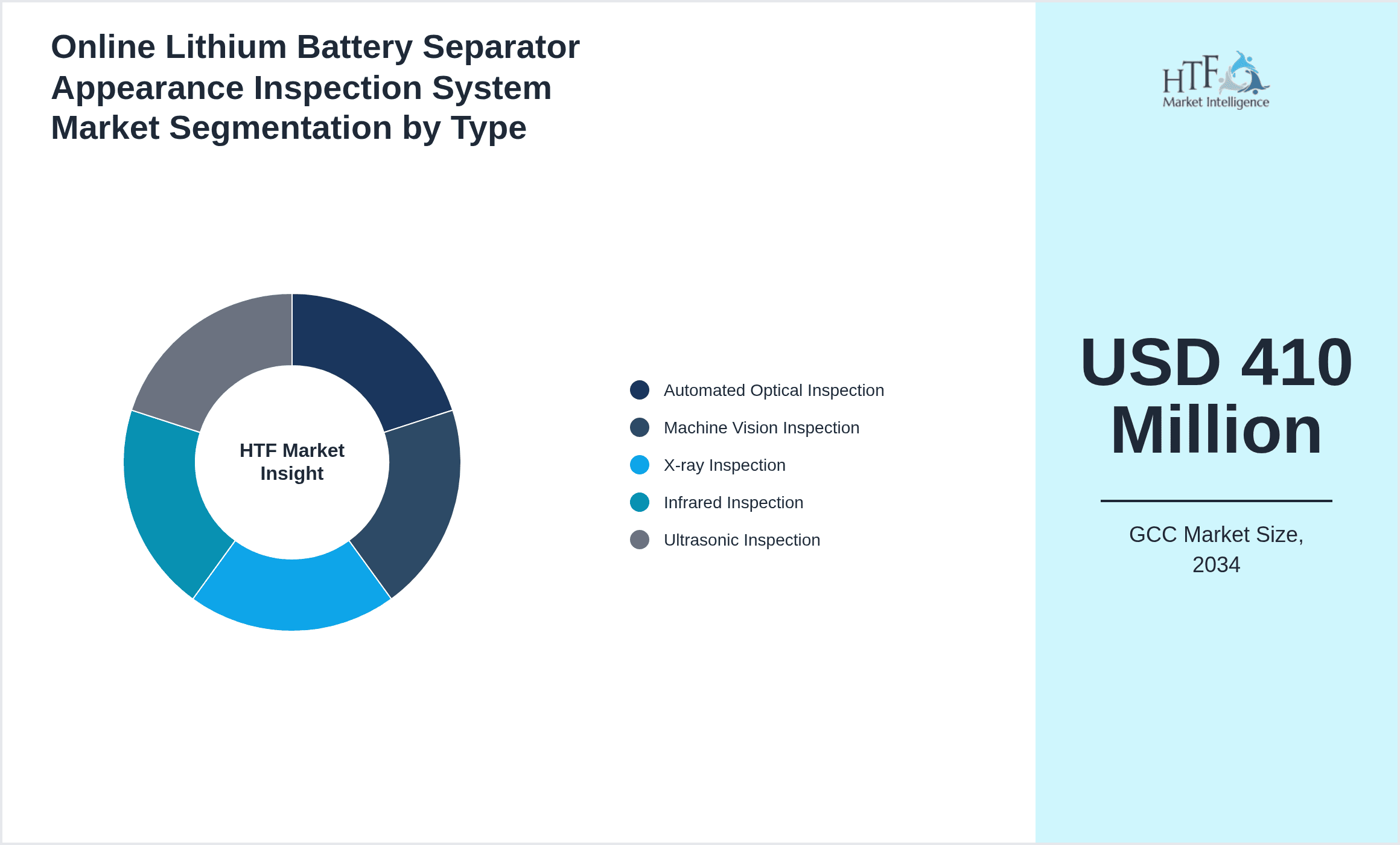
- •The GCC market for online lithium battery separator appearance inspection systems is expected to grow significantly, driven by rapid industrialization and increased electric vehicle penetration. Market size was valued at USD 120 million in 2024 and is projected to reach USD 410 million by 2034, reflecting a CAGR of 12.5%. Saudi Arabia leads the market, holding 35% share, while the United Arab Emirates exhibits the fastest growth at 15.2% CAGR. Automated optical inspection dominates product types due to its precision and cost-effectiveness, whereas machine vision inspection is the fastest growing segment. The expanding energy storage and consumer electronics sectors contribute substantially to application demand. These growth indicators highlight the strategic importance of appearance inspection systems in ensuring battery safety, enhancing manufacturing quality, and supporting GCC's sustainability goals.
- •The GCC online lithium battery separator appearance inspection system market offers significant value to battery manufacturers, automotive companies, and electronics producers by ensuring defect-free battery components that enhance product safety and longevity. The strategic importance of this market extends to government agencies enforcing quality and safety regulations, and technology providers innovating inspection methods tailored for high-volume production. With the GCC's increasing focus on clean energy and electric mobility, these inspection systems enable manufacturers to meet stringent compliance and performance standards, reduce recalls, and optimize operational costs. The integration of AI and machine learning into inspection platforms further enhances defect detection accuracy, providing a competitive edge to early adopters in this growing market.

Competitive Landscape
The GCC online lithium battery separator appearance inspection system market is characterized by intense competition among global technology leaders and regional specialists focusing on innovation and customization. Market participants compete by integrating advanced imaging technologies, AI-driven analytics, and real-time defect detection capabilities to deliver superior inspection accuracy and throughput. Strategic partnerships with battery manufacturers and OEMs are common to develop bespoke inspection solutions tailored to GCC-specific production environments. Companies deploy competitive pricing models while investing heavily in R&D to enhance system capabilities and maintain technological leadership. The rivalry fosters rapid innovation cycles, with firms continuously upgrading hardware and software to meet evolving standards. Market entry barriers include high capital intensity and the need for specialized technical expertise, which limits new entrants. Regional players benefit from localized service networks and regulatory familiarity, complementing the global reach of multinational corporations. Future trends indicate consolidation through mergers and acquisitions and increased focus on AI-enabled inspection platforms to drive competitive advantage.
Leading Companies in Online Lithium Battery Separator Appearance Inspection System Market
- •Keyence Corporation (Japan)
- •Omron Corporation (Japan)
- •Vistec Semiconductor Systems AG (Germany)
- •Cognex Corporation (United States)
- •Teledyne DALSA Inc. (Canada)
- •Hitachi High-Tech Corporation (Japan)
- •Baumer Group (Switzerland)
- •Sony Corporation (Japan)
- •Zeiss Group (Germany)
- •Nikon Corporation (Japan)
- •Datalogic S.p.A. (Italy)
- •Flir Systems, Inc. (United States)
- •OmniVision Technologies, Inc. (United States)
- •Panasonic Corporation (Japan)
- •Samsung Electronics Co., Ltd. (South Korea)
- •Hitachi Industrial Equipment Systems Co., Ltd. (Japan)
- •Rockwell Automation, Inc. (United States)
- •BOSCH Sensortec GmbH (Germany)
- •STMicroelectronics N.V. (Switzerland)
- •Texas Instruments Incorporated (United States)
- •Analog Devices, Inc. (United States)
- •Murata Manufacturing Co., Ltd. (Japan)
- •Advantest Corporation (Japan)
- •Schneider Electric SE (France)
- •ABB Ltd (Switzerland)

Market Breakdown
- •By Type
- ◦Automated Optical Inspection
- ◦Machine Vision Inspection
- ◦X-ray Inspection
- ◦Infrared Inspection
- ◦Ultrasonic Inspection
- •By Application
- ◦Electric Vehicles
- ◦Consumer Electronics
- ◦Energy Storage Systems
- ◦Industrial Equipment
- ◦Aerospace
- •By End User Industry
- ◦Battery Manufacturers
- ◦Automotive OEMs
- ◦Electronics Manufacturers
- ◦Energy Companies
- •By Deployment Model
- ◦Cloud-based Inspection Systems
- ◦On-premise Inspection Systems
- ◦Hybrid Inspection Systems
Growth Dynamics
- •The GCC market growth is propelled by escalating demand for electric vehicles, necessitating stringent quality control in lithium battery production. Leading automotive manufacturers in Saudi Arabia and UAE are integrating advanced inspection systems to ensure safety and compliance, driving market expansion.
- •Technological advancements such as AI-enabled machine vision and real-time defect detection enhance inspection accuracy and reduce production downtime. Companies investing in R&D to develop innovative inspection solutions contribute significantly to market growth across GCC manufacturing hubs.
- •Government initiatives promoting renewable energy and energy storage infrastructure in the GCC bolster demand for high-quality lithium batteries, thereby amplifying the need for sophisticated separator inspection systems to maintain industry standards.
- •Rising consumer electronics manufacturing in GCC countries, especially UAE and Saudi Arabia, fuels demand for battery separators inspected with high precision to ensure product reliability and minimize recalls, further supporting market growth.
- •Collaborations between inspection system providers and battery manufacturers enable tailored solutions that meet unique regional production requirements, fostering technology adoption and market penetration in GCC.
- •Increasing awareness about safety concerns related to lithium-ion batteries and stricter regulatory compliance in GCC countries compel manufacturers to adopt advanced inspection systems, driving market demand.
- •The expansion of industrial equipment reliant on lithium batteries in GCC economies creates additional application opportunities for appearance inspection systems, contributing to sustained market growth.
Market Trends
- •The GCC market is witnessing a rising shift toward automation with integration of machine learning algorithms in inspection systems, enabling predictive defect detection and process optimization in battery manufacturing.
- •Deployment of cloud-based inspection solutions is gaining traction, offering remote monitoring capabilities and data analytics services that enhance operational efficiency for GCC manufacturers.
- •Sustainability trends in the GCC lithium battery sector are encouraging adoption of non-destructive inspection techniques such as infrared and ultrasonic methods to reduce waste and improve product lifecycle management.
- •Strategic partnerships between GCC-based battery manufacturers and global inspection technology firms are fostering localized innovation and faster technology transfer tailored to regional market needs.
- •Increasing focus on miniaturization and high-density battery designs in GCC’s consumer electronics sector drives demand for more precise and compact inspection systems capable of detecting micro-defects.
- •Regulatory emphasis on battery safety standards in GCC countries is influencing manufacturers to upgrade inspection infrastructure, thereby shaping market dynamics toward higher quality assurance.
- •Emerging trend of integrating multi-sensor inspection systems combining optical, X-ray, and ultrasonic technologies enhances defect detection coverage and accuracy in GCC battery manufacturing lines.

Market Opportunities
- •The rapid electrification of transport in GCC offers substantial opportunities for inspection system providers to supply tailored solutions aligned with automotive battery quality demands.
- •Expanding renewable energy projects across the GCC increase demand for energy storage solutions, presenting growth avenues for online separator inspection systems ensuring battery reliability.
- •Investment in smart manufacturing and Industry 4.0 initiatives within GCC industrial sectors opens doors for integration of AI-driven inspection systems to streamline battery separator production.
- •Increasing consumer electronics manufacturing hubs in UAE and Saudi Arabia create niche market segments for high-precision inspection systems adapted to compact battery components.
- •Collaborative ventures between GCC governments and technology innovators foster development of region-specific inspection solutions, enabling technology providers to capitalize on localized market needs.
- •Growth in aerospace and defense sectors in GCC require advanced inspection capabilities for lithium batteries used in critical applications, creating specialized market opportunities.
- •Emerging trends in flexible and solid-state battery technologies necessitate new inspection methodologies, positioning innovative system providers to lead market evolution in GCC.
Market Challenges
- •High capital expenditure required for advanced inspection systems creates adoption barriers for small and medium-sized battery manufacturers in the GCC region.
- •Limited availability of skilled technical personnel to operate and maintain sophisticated inspection equipment poses a significant challenge to market growth in GCC countries.
- •Variability in regulatory standards and compliance enforcement across GCC nations complicates standardization efforts and market penetration for inspection system providers.
- •Complexity in integrating multi-technology inspection platforms with existing production lines leads to operational disruptions and increased costs for GCC manufacturers.
- •Global supply chain disruptions impacting availability of critical components for inspection systems affect timely deployment and scalability within the GCC market.
- •Rapid technological changes demand continuous innovation, challenging companies to keep up with evolving inspection requirements and maintain competitive edge in the GCC.
- •Cybersecurity concerns related to cloud-based inspection solutions restrict adoption in sensitive GCC industrial environments requiring stringent data protection mechanisms.
Regulatory Framework
- •Between 2020 and 2024, GCC countries introduced stringent battery safety regulations mandating comprehensive quality checks on lithium battery components, including separators, to mitigate fire and explosion risks. Compliance with these regulations requires adoption of advanced inspection systems capable of detecting micro-level defects and ensuring product conformity.
- •The Saudi Standards, Metrology and Quality Organization (SASO) updated its battery safety standards in 2022, emphasizing real-time online inspection and traceability throughout the battery separator manufacturing process. This regulatory move has driven market demand for automated inspection solutions within the Saudi manufacturing sector.
- •The UAE’s Emirates Authority for Standardization and Metrology (ESMA) enforced mandatory certification of lithium battery components in 2023, requiring suppliers to demonstrate robust inspection protocols for separator quality assurance. This has led to increased uptake of advanced inspection technologies in the region.
- •Kuwait and Qatar introduced guidelines between 2021 and 2023 focused on environmental safety and sustainability in battery production, promoting non-destructive inspection techniques such as infrared and ultrasonic methods to reduce material waste and energy consumption.
- •GCC-wide harmonization efforts for battery manufacturing standards are ongoing, with regulatory bodies collaborating to establish unified inspection requirements and certification processes to facilitate cross-border trade and technology adoption by 2025.
Market Intelligence
- •15th January 2025, Keyence Corporation launched its next-generation Automated Optical Inspection (AOI) system tailored for lithium battery separator production lines. The new system integrates AI-powered defect recognition algorithms, enabling real-time high-resolution inspections with enhanced accuracy and throughput. Targeted at GCC manufacturers, this launch supports growing demand for advanced quality assurance in electric vehicle battery supply chains. The system offers seamless integration with existing manufacturing execution systems, reducing downtime and operational costs. This innovation is expected to accelerate adoption of AOI technologies across GCC lithium battery plants, strengthening product safety and regulatory compliance.
- •10th March 2025, Cognex Corporation introduced a Machine Vision Inspection platform equipped with 3D imaging and deep learning capabilities designed for the GCC market’s lithium battery separator industry. This product offers superior defect detection for complex separator geometries and materials, addressing emerging challenges of next-gen battery designs. The platform facilitates predictive maintenance and data analytics, enhancing production efficiency and yield rates. Cognex’s regional partnership with UAE-based integrators aims to localize support and customization, boosting market penetration in GCC’s growing battery manufacturing sector.
- •22nd May 2025, Omron Corporation announced a strategic collaboration with a leading Saudi battery manufacturer to deploy integrated X-ray and infrared inspection systems for separator quality assurance. This partnership focuses on developing tailored inspection solutions that meet stringent GCC regulatory standards and optimize production workflows. Omron’s combined technology approach enhances defect detection accuracy, reduces false positives, and supports increased automation levels. The initiative signifies a major step towards localized innovation and adoption of multi-sensor inspection technologies in the GCC lithium battery sector.
- •8th July 2025, Flir Systems, Inc. completed the expansion of its regional service and support center in Dubai to better serve GCC clients in the lithium battery inspection market. The expansion includes enhanced technical training facilities and rapid response teams for maintenance and upgrades. This move underscores growing demand for reliable inspection system services in the region, enabling manufacturers to maintain high uptime and quality standards. Flir’s investment reflects confidence in GCC’s expanding lithium battery separator inspection market and supports future technological advancements.
- •Source: Official company press releases and industry reports
Regional Outlook
The Saudi Arabia currently holds a significant share of the market, primarily due to several key factors: increasing consumption rates, a burgeoning population, and robust economic momentum. These elements collectively drive demand, positioning this region as a leader in the market. On the other hand, United Arab Emirates is rapidly emerging as the fastest-growing area within the industry. This remarkable growth can be attributed to swift infrastructure development, the expansion of various industrial sectors, and a marked increase in consumer demand. These dynamics make this region a crucial player in shaping future market growth.
In our report, we cover a comprehensive analysis of the following regions and countries:
- Bahrain
- Kuwait
- Oman
- Qatar
- Saudi Arabia
- United Arab Emirates
| Feature | Details |
|---|---|
| Base Year Market Size | USD 120 Million |
| Forecast Year Market Size | USD 410 Million |
| CAGR | 12.5% |
| Forecast Period | 2026 to 2033 |
| YoY Growth | 12.5% |
| Scope of Report | Market is segmented by Type (Automated Optical Inspection, Machine Vision Inspection, X-ray Inspection, Infrared Inspection, Ultrasonic Inspection), Application (Electric Vehicles, Consumer Electronics, Energy Storage Systems, Industrial Equipment, Aerospace), End User Industry (Battery Manufacturers, Automotive OEMs, Electronics Manufacturers, Energy Companies), Deployment Model (Cloud-based Inspection Systems, On-premise Inspection Systems, Hybrid Inspection Systems) |
| Regions Covered | Bahrain, Kuwait, Oman, Qatar, Saudi Arabia, United Arab Emirates |
| Key Companies | Keyence Corporation (Japan), Omron Corporation (Japan), Vistec Semiconductor Systems AG (Germany), Cognex Corporation (United States), Teledyne DALSA Inc. (Canada), Hitachi High-Tech Corporation (Japan), Baumer Group (Switzerland), Sony Corporation (Japan), Zeiss Group (Germany), Nikon Corporation (Japan), Datalogic S.p.A. (Italy), Flir Systems, Inc. (United States), OmniVision Technologies, Inc. (United States), Panasonic Corporation (Japan), Samsung Electronics Co., Ltd. (South Korea), Hitachi Industrial Equipment Systems Co., Ltd. (Japan), Rockwell Automation, Inc. (United States), BOSCH Sensortec GmbH (Germany), STMicroelectronics N.V. (Switzerland), Texas Instruments Incorporated (United States), Analog Devices, Inc. (United States), Murata Manufacturing Co., Ltd. (Japan), Advantest Corporation (Japan), Schneider Electric SE (France), ABB Ltd (Switzerland) |
GCC Online Lithium Battery Separator Appearance Inspection System Market - GCC Industry Size & Growth Analysis 2024-2034 - Table of Contents
Frequently Asked Questions (FAQ):
The Compact Track Loaders market is projected to grow at a CAGR of 6.8% from 2025 to 2030, driven by increasing demand in construction and agricultural sectors.
North America currently leads the market with approximately 45% market share, followed by Europe at 28% and Asia-Pacific at 22%. The remaining regions account for 5% of the global market.
Key growth drivers include increasing construction activities, rising demand for versatile equipment in agriculture, technological advancements in track loader design, and growing preference for compact equipment in urban construction projects.