
Japan AI Server Disaster Recovery Power Supply Market - Japan Size & Outlook 2020-2034
Japan AI Server Disaster Recovery Power Supply Market is segmented by Type (Uninterruptible Power Supply (UPS), Diesel Generators, Battery Backup Systems, Flywheel Energy Storage, Hybrid Systems), Application (Data Centers, Enterprise IT, Cloud Service Providers, Telecommunication Providers, Government Agencies), Deployment Model (On-premise, Cloud-integrated, Hybrid Deployment), Service Offering (Installation & Commissioning, Maintenance & Support, Managed Power Services, Consulting & Integration), and Geography (Hokkaido, Tohoku, Kanto, Chubu, Kansai, Chugoku, Shikoku, Kyushu)
Pricing
Report Overview
Executive Summary
- •The Japan AI Server Disaster Recovery Power Supply market is essential in ensuring the continuous operation and resilience of AI server infrastructures across critical sectors such as data centers, enterprise IT, cloud service providers, telecommunication providers, and government agencies. This market comprises advanced power supply systems including Uninterruptible Power Supply (UPS), Diesel Generators, Battery Backup Systems, Flywheel Energy Storage, and Hybrid Systems which collectively safeguard AI servers from power interruptions and disasters. With Japan's increasing reliance on AI technologies for digital transformation, the demand for robust disaster recovery power solutions is surging. The market is characterized by rapid technological advancements, including integration of AI for predictive maintenance and energy optimization, which enhance system reliability and efficiency. Regional zones like Kanto dominate the market due to the concentration of data centers and IT enterprises, while emerging regions such as Kyushu & Okinawa are witnessing accelerated growth driven by infrastructure investments. The market size was valued at USD 0.85 billion in 2025 and is forecasted to reach USD 1.92 billion by 2034, registering a CAGR of 9.4%. This growth is propelled by increasing power outage concerns, stricter regulatory frameworks, and the need for sustainable and hybrid power solutions. Strategic partnerships, government initiatives, and innovation in hybrid and AI-enabled power backup systems further underpin market expansion. This comprehensive analysis provides critical insights into market dynamics, competitive landscape, and future growth opportunities specific to Japan, essential for stakeholders and investors planning to capitalize on this evolving sector.
- •Key market highlights include a robust CAGR of 9.4% from 2025 to 2034, with Uninterruptible Power Supply systems maintaining the largest market share due to their reliability and widespread adoption. Hybrid Systems are identified as the fastest growing product segment, driven by growing demand for energy-efficient and resilient power solutions. Regionally, Kanto leads with a 35% market share owing to its high density of AI server deployments, while Kyushu & Okinawa is the fastest growing sub-region with a CAGR of 12.1%, attributed to infrastructure modernization and increased investments. The market has experienced significant advancements in integrating AI for power management and predictive maintenance, enhancing disaster recovery capabilities. Key drivers include increasing AI server deployments, rising power interruption risks, and progressive regulatory policies promoting sustainable energy use. Challenges such as high capital costs and technical integration complexities persist, but ongoing innovations and government support provide ample opportunities. These market dynamics position Japan as a critical hub for AI server disaster recovery power supply development and deployment.
- •The Japan AI Server Disaster Recovery Power Supply market holds strategic importance for multiple industries reliant on AI technology, including finance, healthcare, telecommunications, and government operations. Reliable power supply solutions ensure data integrity, minimize downtime, and maintain operational continuity, which are vital for AI workloads that demand high availability. For stakeholders, this market offers value through advanced technologies that enhance energy efficiency and sustainability, aligning with Japan's broader goals of digital innovation and environmental responsibility. Companies investing in this market benefit from strong government incentives, a technologically sophisticated customer base, and opportunities to deploy cutting-edge hybrid and AI-enabled power systems. This report equips industry participants, investors, and policymakers with actionable insights to navigate the evolving market landscape, optimize strategies, and capitalize on growth trends in Japan's AI server disaster recovery power supply sector.

Competitive Landscape
The competitive environment within the Japan AI Server Disaster Recovery Power Supply market is marked by the presence of both global technology leaders and specialized local enterprises focusing on innovation and reliability. Market players employ diverse competitive strategies including continuous product development, integration of AI-enabled predictive maintenance, and expansion through strategic partnerships and collaborations with data center operators and cloud service providers. Innovation is a key differentiator, with companies investing heavily in hybrid power solutions that combine traditional UPS with renewable energy sources and energy storage technologies to enhance efficiency and sustainability. Pricing strategies are adapted to balance upfront capital expenditures with long-term operational savings, appealing to enterprise customers with critical uptime requirements. Market entrants face significant barriers including stringent regulatory compliance, high R&D costs, and the need to align with Japan’s energy efficiency and disaster resilience standards. Distribution channels are evolving with the rise of managed services and cloud-based monitoring platforms, allowing vendors to offer value-added services beyond hardware. Regional competition is influenced by the concentration of AI infrastructure in Kanto, while emerging zones provide opportunities for new market penetration. Future trends point towards increasing adoption of AI-driven energy management and integration of IoT sensors for real-time power supply monitoring, underscoring the dynamic and innovation-driven nature of this market.
Leading Companies in Japan AI Server Disaster Recovery Power Supply Market
- •Toshiba Corporation (Japan)
- •Panasonic Corporation (Japan)
- •Mitsubishi Electric Corporation (Japan)
- •Fuji Electric Co., Ltd. (Japan)
- •Eaton Corporation (United States)
- •Schneider Electric SE (France)
- •Vertiv Holdings Co. (United States)
- •CyberPower Systems, Inc. (United States)
- •ABB Ltd (Switzerland)
- •Delta Electronics, Inc. (Taiwan)
- •Hitachi, Ltd. (Japan)
- •Riello UPS (Italy)
- •Socomec Group (France)
- •Akasol AG (Germany)
- •Legrand SA (France)
- •Siemens AG (Germany)
- •PowerShield Technology Co., Ltd. (Taiwan)
- •General Electric Company (United States)
- •Samsung SDI Co., Ltd. (South Korea)
- •Toshiba Infrastructure Systems & Solutions Corporation (Japan)
- •Nidec Corporation (Japan)
- •Kyocera Corporation (Japan)
- •Omron Corporation (Japan)
- •Fujitsu Limited (Japan)
- •Yokogawa Electric Corporation (Japan)
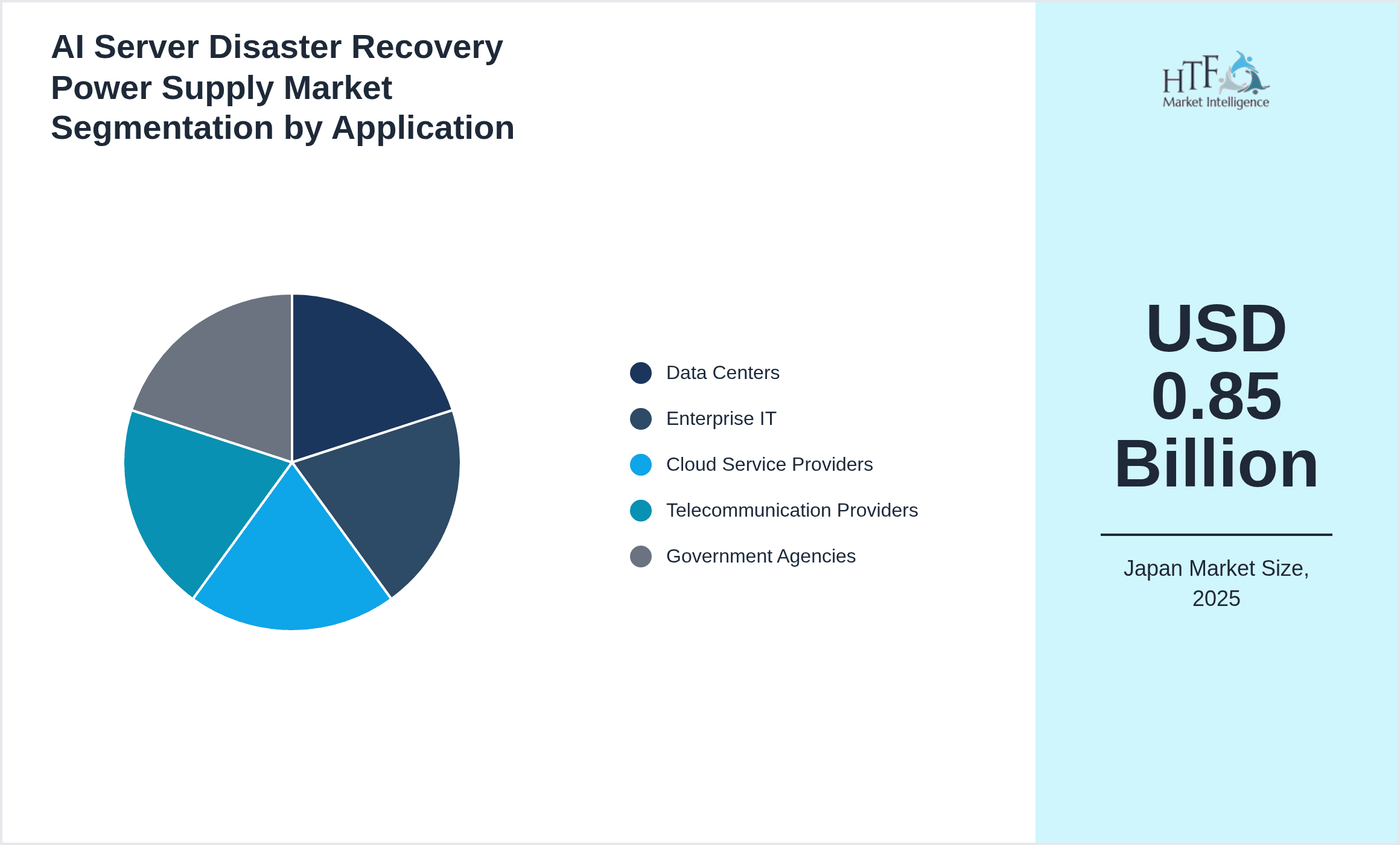
Market Breakdown
- •By Type
- ◦Uninterruptible Power Supply (UPS)
- ◦Diesel Generators
- ◦Battery Backup Systems
- ◦Flywheel Energy Storage
- ◦Hybrid Systems
- •By Application
- ◦Data Centers
- ◦Enterprise IT
- ◦Cloud Service Providers
- ◦Telecommunication Providers
- ◦Government Agencies
- •By Deployment Model
- ◦On-premise
- ◦Cloud-integrated
- ◦Hybrid Deployment
- •By Service Offering
- ◦Installation & Commissioning
- ◦Maintenance & Support
- ◦Managed Power Services
- ◦Consulting & Integration
Growth Dynamics
The Japan AI Server Disaster Recovery Power Supply market growth is primarily driven by the increasing reliance on AI technologies across industries requiring uninterrupted server operation. Growing concerns over power outages and natural disasters in Japan have intensified demand for reliable disaster recovery power solutions. Additionally, government policies promoting digital infrastructure resilience and energy efficiency standards incentivize adoption of hybrid and AI-enabled power backup systems. Enterprises are also investing in advanced power management technologies that optimize energy use and reduce operational costs. The development of cloud services and edge computing further augments the need for scalable and flexible power supply options, fostering market expansion.

Market Trends
A prominent trend in the Japan AI Server Disaster Recovery Power Supply market is the integration of AI and IoT technologies for predictive maintenance and real-time power quality monitoring, enabling proactive management of power systems. There is also increasing adoption of hybrid power systems combining renewable energy sources with traditional UPS and generators to enhance sustainability and reduce carbon footprint. Additionally, managed power services are gaining traction, allowing enterprises to outsource power supply management for improved efficiency. The market is witnessing strategic collaborations between technology providers and cloud service operators to develop customized disaster recovery power solutions. Furthermore, Japan's aging energy infrastructure is driving modernization initiatives, fueling demand for next-generation power backup technologies.

Market Opportunities
Significant opportunities exist in expanding hybrid system deployments that integrate AI-driven energy management with renewable power sources, addressing both reliability and sustainability demands. The rising number of AI server installations in regional zones like Kyushu & Okinawa presents untapped markets for tailored disaster recovery power solutions. There is also potential in offering managed services and consulting to enterprises seeking to optimize power backup systems. Government incentives for digital infrastructure resilience and green energy adoption create favorable conditions for innovative product development. Furthermore, partnerships with cloud and telecom providers to customize solutions for AI workloads offer growth avenues.
Market Challenges
The Japan AI Server Disaster Recovery Power Supply market faces challenges such as the high initial capital expenditure associated with advanced hybrid power systems, which can deter smaller enterprises. Technical complexities in integrating AI-enabled power management platforms with existing infrastructure pose implementation hurdles. Strict regulatory compliance and evolving standards require continuous adaptation, increasing operational burdens for providers. Additionally, supply chain disruptions and component shortages can delay system deployments. Market saturation in dominant regions like Kanto also intensifies competition, making differentiation difficult for new entrants.
Regulatory Framework
Between 2020 and 2025, Japan implemented several regulations impacting the AI Server Disaster Recovery Power Supply market, focusing on energy efficiency, disaster resilience, and sustainability. The Energy Conservation Act was updated to mandate higher efficiency standards for power supply equipment, driving adoption of advanced UPS and hybrid systems. The Electrical Appliance and Material Safety Law enforces rigorous safety certifications for power backup devices, ensuring reliability in critical AI server applications. The Act on the Promotion of Resilience of Critical Infrastructure requires data centers and telecommunication facilities to implement robust disaster recovery protocols, including reliable power supply solutions. Additionally, government incentives promote integration of renewable energy sources and AI-powered monitoring within power supply systems, aligning with Japan’s carbon neutrality goals. Compliance with these regulations significantly influences product development, installation standards, and service offerings in the market.
Market Intelligence
- •15th February 2025, Toshiba Corporation launched an AI-enabled Uninterruptible Power Supply system designed specifically for large-scale data centers in Japan. This system features predictive analytics capabilities that optimize battery usage and reduce downtime risks by forecasting power anomalies in real time. Targeted at enterprise IT and cloud service providers, the product integrates seamlessly with existing infrastructure and supports hybrid deployment models. This launch positions Toshiba to capitalize on growing demand for intelligent disaster recovery power solutions within the country. The initiative aligns with Japan’s increasing focus on digital infrastructure resilience and energy efficiency. Source: Toshiba Corporation Official Press Release.
- •7th May 2025, Panasonic Corporation introduced a hybrid disaster recovery power supply combining lithium-ion batteries with diesel generators for enhanced sustainability and reliability in AI server environments. The new solution reduces carbon emissions by 30% compared to conventional systems and supports real-time remote monitoring through IoT integration. Designed for telecommunication providers and government agencies, this product addresses Japan’s stringent regulatory requirements and energy conservation goals. Panasonic’s innovation is expected to drive market adoption of hybrid systems, which are the fastest growing segment in Japan. Source: Panasonic Corporation News Center.
- •20th August 2025, Mitsubishi Electric Corporation announced a strategic partnership with a leading cloud service provider in Japan to co-develop customized disaster recovery power solutions for AI data centers. The collaboration focuses on integrating AI-driven power management software with Mitsubishi Electric’s UPS hardware to improve energy efficiency and system uptime. This initiative is part of Mitsubishi’s broader strategy to expand its footprint in the AI server disaster recovery market and respond to growing infrastructure demands. The partnership is anticipated to set new benchmarks for power supply reliability in Japan’s AI ecosystem. Source: Mitsubishi Electric Press Release.
- •30th November 2024, Hitachi, Ltd. completed the acquisition of a specialized power backup startup focused on flywheel energy storage solutions for AI server disaster recovery applications. This acquisition enhances Hitachi’s portfolio with innovative energy storage technologies that offer rapid response times and reduced maintenance costs. The integration of flywheel systems is expected to complement Hitachi’s existing UPS and battery backup offerings, providing comprehensive power continuity solutions. This move strengthens Hitachi’s competitive position in the Japan market and supports its commitment to sustainable, reliable power infrastructure. Source: Hitachi, Ltd. Official Announcement.
Regional Outlook
The Kanto currently holds a significant share of the market, primarily due to several key factors: increasing consumption rates, a burgeoning population, and robust economic momentum. These elements collectively drive demand, positioning this region as a leader in the market. On the other hand, Kyushu & Okinawa is rapidly emerging as the fastest-growing area within the industry. This remarkable growth can be attributed to swift infrastructure development, the expansion of various industrial sectors, and a marked increase in consumer demand. These dynamics make this region a crucial player in shaping future market growth.
In our report, we cover a comprehensive analysis of the following regions and countries:
- Hokkaido
- Tohoku
- Kanto
- Chubu
- Kansai
- Chugoku
- Shikoku
- Kyushu
| Feature | Details |
|---|---|
| Base Year Market Size | USD 0.85 Billion |
| Forecast Year Market Size | USD 1.92 Billion |
| CAGR | 9.4% |
| Forecast Period | 2026 to 2033 |
| YoY Growth | 9% |
| Scope of Report | Market is segmented by Type (Uninterruptible Power Supply (UPS), Diesel Generators, Battery Backup Systems, Flywheel Energy Storage, Hybrid Systems), Application (Data Centers, Enterprise IT, Cloud Service Providers, Telecommunication Providers, Government Agencies), Deployment Model (On-premise, Cloud-integrated, Hybrid Deployment), Service Offering (Installation & Commissioning, Maintenance & Support, Managed Power Services, Consulting & Integration) |
| Regions Covered | Hokkaido, Tohoku, Kanto, Chubu, Kansai, Chugoku, Shikoku, Kyushu |
| Key Companies | Toshiba Corporation (Japan), Panasonic Corporation (Japan), Mitsubishi Electric Corporation (Japan), Fuji Electric Co., Ltd. (Japan), Eaton Corporation (United States), Schneider Electric SE (France), Vertiv Holdings Co. (United States), CyberPower Systems, Inc. (United States), ABB Ltd (Switzerland), Delta Electronics, Inc. (Taiwan), Hitachi, Ltd. (Japan), Riello UPS (Italy), Socomec Group (France), Akasol AG (Germany), Legrand SA (France), Siemens AG (Germany), PowerShield Technology Co., Ltd. (Taiwan), General Electric Company (United States), Samsung SDI Co., Ltd. (South Korea), Toshiba Infrastructure Systems & Solutions Corporation (Japan), Nidec Corporation (Japan), Kyocera Corporation (Japan), Omron Corporation (Japan), Fujitsu Limited (Japan), Yokogawa Electric Corporation (Japan) |
Japan AI Server Disaster Recovery Power Supply Market - Japan Size & Outlook 2020-2034 - Table of Contents
Frequently Asked Questions (FAQ):
The Compact Track Loaders market is projected to grow at a CAGR of 6.8% from 2025 to 2030, driven by increasing demand in construction and agricultural sectors.
North America currently leads the market with approximately 45% market share, followed by Europe at 28% and Asia-Pacific at 22%. The remaining regions account for 5% of the global market.
Key growth drivers include increasing construction activities, rising demand for versatile equipment in agriculture, technological advancements in track loader design, and growing preference for compact equipment in urban construction projects.