
Asia-Pacific Spindle Motors For PCB Market - Outlook 2020-2034
Asia-Pacific Spindle Motors For PCB Market is segmented by Motor Type (Brushless DC Motors, AC Motors, Universal Motors, Servo Motors, Stepper Motors), Application in PCB Manufacturing (PCB Drilling, PCB Milling, PCB Routing, PCB Inspection, PCB Assembly), Service Type (Installation and Commissioning, Maintenance and Repair, Spare Parts Supply, Technical Support), Deployment Model (Cloud-based Monitoring Systems, On-premise Control Systems, Hybrid Deployment), and Geography (Asai-Pacific)
Pricing
Report Overview
Executive Summary
- •The Asia-Pacific spindle motors for PCB market is a specialized segment within the electric motor industry focused on providing precision spindle motors tailored for printed circuit board manufacturing processes such as drilling, milling, routing, inspection, and assembly. These motors are essential for enabling high rotational speeds and precision, which are critical for fabricating complex and miniaturized PCBs used across electronics, automotive, telecommunications, and consumer electronics sectors. The market features key motor types including brushless DC motors, AC motors, universal motors, servo motors, and stepper motors, each offering unique performance characteristics to meet diverse production demands. Asia-Pacific represents a major manufacturing hub for PCB production driven by countries like China, Japan, India, South Korea, and Southeast Asia, where growing electronics manufacturing capacity and technological advancements fuel demand for high-performance spindle motors. The market has evolved with increasing automation, stringent quality requirements, and energy efficiency considerations shaping product development. From 2020 to 2025, the market showed steady growth supported by the expansion of electronics manufacturing and is forecast to continue its robust trajectory through 2034. Strategic investments, government initiatives, and innovation in motor technologies are expected to sustain competitive advantage and market expansion within the region. Overall, Asia-Pacific spindle motors for PCB market plays a vital role in the global electronics supply chain by enabling efficient and precise PCB fabrication, which is foundational to modern electronic devices and systems.
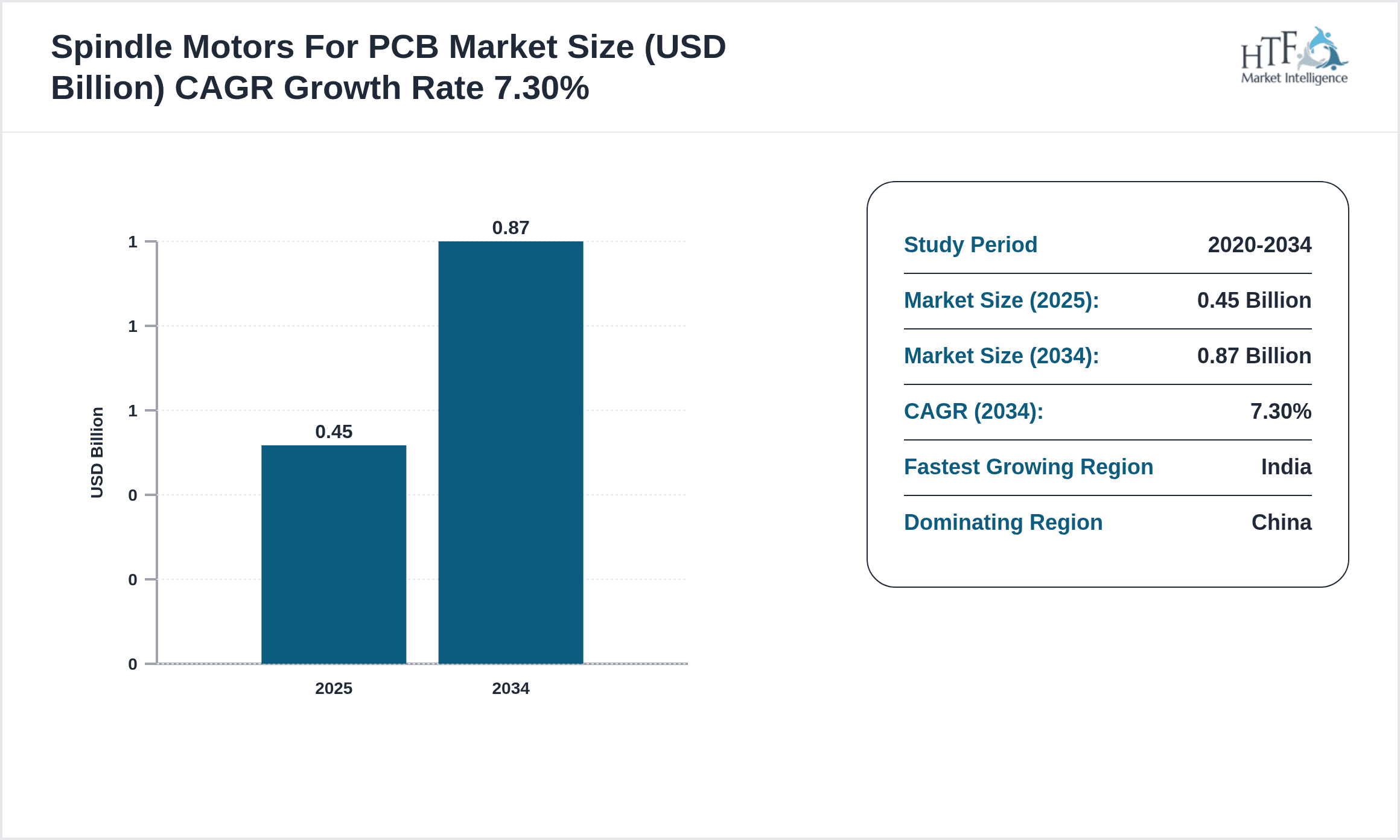
- •Key market highlights include a base market size of USD 0.45 Billion in 2025, expanding to an estimated USD 0.87 Billion by 2034, reflecting a compound annual growth rate (CAGR) of 7.3%. China dominates the regional market with a 45% share, supported by its massive electronics manufacturing ecosystem and infrastructure. The fastest growing country is India, projected to grow at a CAGR of 10.5% driven by increased PCB production capacity and government incentives to boost electronics manufacturing. Brushless DC motors lead product segments due to their efficiency and precision, while servo motors exhibit the fastest growth owing to rising demand for high-precision applications. Year-on-year growth averages 7.0%, underscoring steady market expansion fueled by technological innovation and regional industrial growth. Market dynamics are shaped by factors such as increasing demand for miniaturized PCBs, automation in manufacturing, and the rise of electronic vehicle and 5G technologies requiring advanced PCB solutions.
- •The Asia-Pacific spindle motors for PCB market holds strategic importance across multiple industries, enabling manufacturers to meet quality and efficiency standards essential for advanced electronics production. For stakeholders including motor manufacturers, PCB fabricators, and end-use sectors such as automotive electronics and telecommunication equipment producers, this market offers significant value through enabling high-speed, reliable, and energy-efficient motor solutions. The ongoing modernization of manufacturing lines and the push for Industry 4.0 adoption in Asia-Pacific countries elevate the demand for intelligent spindle motor systems with enhanced control and diagnostics capabilities. Furthermore, the market’s growth supports broader economic development goals by fostering local manufacturing ecosystems, creating employment opportunities, and driving technological exports. Investors and industry players benefit from the expanding electronics landscape, which continuously demands improved spindle motor performance to support next-generation PCB designs and applications. Consequently, the Asia-Pacific spindle motors for PCB market is a critical enabler of regional and global electronics innovation and competitiveness.
Competitive Landscape
The Asia-Pacific spindle motors for PCB market is characterized by a competitive environment with a blend of global motor manufacturers and specialized regional players. Companies compete on technology innovation, product reliability, speed control precision, energy efficiency, and after-sales service to cater to the stringent requirements of PCB manufacturing. Market leaders invest heavily in R&D to develop brushless DC and servo motors with advanced features such as integrated sensors, IoT connectivity, and predictive maintenance capabilities. Strategic partnerships with PCB machinery manufacturers and electronics OEMs help secure long-term supply agreements and enhance market presence. Pricing strategies are carefully balanced with performance value to maintain competitiveness, especially as lower-cost regional players challenge incumbents. Distribution channels are optimized through direct sales and authorized distributors to ensure timely delivery and technical support across Asia-Pacific. Market entry barriers include high capital intensity for motor development and the need for certifications complying with regional standards. Regional competition is intensified by countries like China and Japan with established manufacturing bases, while emerging markets such as India and Southeast Asia exhibit rapid growth potential. Future competitive trends point towards increased digitalization of spindle motors, adoption of smart manufacturing systems, and consolidation via mergers and acquisitions to expand product portfolios and geographical reach.
Leading Companies in Spindle Motors For PCB Market
- •Nidec Corporation (Japan)
- •WEG Industries (Brazil)
- •Siemens AG (Germany)
- •Oriental Motor Co., Ltd. (Japan)
- •ABB Ltd (Switzerland)
- •Yaskawa Electric Corporation (Japan)
- •Mitsubishi Electric Corporation (Japan)
- •Schneider Electric SE (France)
- •Bosch Rexroth AG (Germany)
- •Kollmorgen Corporation (United States)
- •Fanuc Corporation (Japan)
- •Delta Electronics, Inc. (Taiwan)
- •Rockwell Automation, Inc. (United States)
- •Panasonic Corporation (Japan)
- •Sanyo Denki Co., Ltd. (Japan)
- •Tokyo Electric Motor Co., Ltd. (Japan)
- •Siemens Digital Industries Software (Germany)
- •Nakanishi Inc. (Japan)
- •Oriental Motor (China) Co. Ltd. (China)
- •Shenzhen Inovance Technology Co., Ltd. (China)
- •Hyundai Electric & Energy Systems Co., Ltd. (South Korea)
- •Fuji Electric Co., Ltd. (Japan)
- •Lenze SE (Germany)
- •Delta Electronics (India) Pvt. Ltd. (India)
- •Toshiba Corporation (Japan)

Market Breakdown
- •By Motor Type
- ◦Brushless DC Motors
- ◦AC Motors
- ◦Universal Motors
- ◦Servo Motors
- ◦Stepper Motors
- •By Application in PCB Manufacturing
- ◦PCB Drilling
- ◦PCB Milling
- ◦PCB Routing
- ◦PCB Inspection
- ◦PCB Assembly
- •By Service Type
- ◦Installation and Commissioning
- ◦Maintenance and Repair
- ◦Spare Parts Supply
- ◦Technical Support
- •By Deployment Model
- ◦Cloud-based Monitoring Systems
- ◦On-premise Control Systems
- ◦Hybrid Deployment
Growth Dynamics
The Asia-Pacific spindle motors for PCB market experiences robust growth driven by rapid expansion in electronics manufacturing hubs across China, India, and Southeast Asia. Increasing demand for miniaturized and high-density PCBs in smartphones, automotive electronics, and telecommunications propels investments in advanced spindle motor solutions that offer high precision and speed. Government initiatives promoting local electronics production and Industry 4.0 adoption further stimulate market development by encouraging automation and modernization of PCB fabrication lines. Technological advancements such as brushless DC and servo motors with integrated sensors enhance motor efficiency and reliability, reducing downtime and improving production throughput. Additionally, the rising adoption of electric vehicles and 5G infrastructure increases PCB complexity, necessitating superior spindle motors. Regional industrial diversification and growing small and medium enterprises in electronics manufacturing contribute to expanding customer bases. However, supply chain disruptions and component cost volatility require manufacturers to focus on resilient procurement strategies and cost optimization to sustain growth momentum in this competitive landscape.

Market Trends
Emerging trends in the Asia-Pacific spindle motors for PCB market include the integration of IoT and Industry 4.0 capabilities, enabling real-time monitoring and predictive maintenance of spindle motors. This digital transformation enhances operational efficiency and reduces unexpected downtime in PCB production lines. Another notable trend is the shift towards energy-efficient brushless DC motors, which lower power consumption and comply with regional environmental regulations. Manufacturers are also focusing on miniaturization and compact motor designs to cater to smaller, high-density PCB applications. Collaborative innovation between motor manufacturers and PCB equipment providers is increasing, aiming to develop customized motor solutions that meet specific customer requirements and improve overall system performance. The market also witnesses a growing preference for hybrid deployment models combining cloud-based analytics with on-premise controls, facilitating flexible and scalable manufacturing operations. These trends collectively drive enhanced productivity, cost savings, and sustainability within the Asia-Pacific PCB manufacturing ecosystem.

Market Opportunities
Significant growth opportunities in the Asia-Pacific spindle motors for PCB market arise from expanding electronics manufacturing sectors in emerging economies such as India and Southeast Asia, where increasing investments and government incentives foster local production capabilities. The rising demand for electric vehicles and 5G technologies creates new application segments requiring advanced spindle motors with higher precision and durability. Innovations in motor technology, including integration of smart sensors and AI-enabled control systems, open avenues for product differentiation and premium offerings. Additionally, opportunities exist in servicing aftermarket demand for maintenance, spare parts, and technical support, driven by the increasing installed base of spindle motors in PCB factories. Expansion into new geographic markets and collaboration with PCB equipment manufacturers for co-development of specialized motors further enhance growth prospects. These factors collectively offer stakeholders considerable scope for revenue growth and market penetration over the forecast period.
Market Challenges
The Asia-Pacific spindle motors for PCB market faces challenges including high manufacturing costs associated with precision motor technologies, which can limit adoption among smaller PCB manufacturers. Supply chain disruptions, particularly in semiconductor components and rare earth materials used in motor production, pose risks to timely delivery and cost stability. Intense competition from low-cost regional producers exerts pricing pressure on established manufacturers, impacting profit margins. Regulatory compliance with diverse environmental and safety standards across Asia-Pacific countries adds complexity to product development and market entry. Additionally, rapid technological changes require continuous R&D investment to keep pace with evolving PCB manufacturing needs. Workforce skill shortages in advanced motor manufacturing and maintenance further constrain operational efficiency. Addressing these challenges requires strategic partnerships, investment in innovation, and adaptive supply chain management.
Regulatory Framework
From 2020 to 2025, Asia-Pacific countries have implemented various regulations impacting the spindle motors for PCB market. China introduced updated environmental protection standards in 2021 mandating reduced power consumption and lower emissions for industrial motors, compelling manufacturers to develop energy-efficient spindle motors. Japan's Ministry of Economy, Trade and Industry enforced stricter safety and electromagnetic compatibility standards in 2022, requiring compliance certification for motors used in PCB production equipment. India reinforced import-export policies in 2023 to promote domestic manufacturing under the 'Make in India' initiative, providing incentives for local motor producers and setting higher quality benchmarks. South Korea updated machinery safety directives in 2024 focusing on worker protection and operational reliability. Australia introduced energy rating requirements for industrial motors in 2025, aligning with global sustainability goals. These regulations drive innovation towards eco-friendly, safe, and reliable spindle motor designs while influencing market access and competitive dynamics. Compliance with diverse regional standards necessitates tailored product development and testing protocols, thereby shaping market strategies for manufacturers and suppliers in the Asia-Pacific region.
Market Intelligence
- •15th February 2025, Nidec Corporation (Japan) launched its latest brushless DC spindle motor specifically designed for high-speed PCB drilling applications. This motor features integrated IoT sensors enabling real-time performance monitoring and predictive maintenance, aimed at reducing downtime in PCB manufacturing lines. The product supports speeds up to 80,000 RPM, delivering enhanced precision and energy efficiency compliant with new environmental regulations in Asia-Pacific. Nidec targets key electronics manufacturers in China and India, positioning this launch as a pivotal upgrade for automated PCB fabrication. The strategic initiative underlines Nidec’s commitment to innovation and expanding its footprint in the rapidly growing Asia-Pacific spindle motors market. Source: Nidec Official Press Release.
- •10th May 2025, Shenzhen Inovance Technology Co., Ltd. (China) introduced a new servo spindle motor series optimized for PCB milling and routing tasks. The motors offer enhanced torque control and compact design, facilitating usage in miniaturized PCB production lines. This innovation supports the increasing demand for high-density PCBs in consumer electronics and automotive sectors. The company emphasized sustainability by improving motor efficiency and reducing material waste during manufacturing. The launch is part of Inovance’s broader strategy to lead the Asia-Pacific market through advanced, eco-friendly motor technologies. Source: Shenzhen Inovance Technology Official Website.
- •22nd August 2025, Mitsubishi Electric Corporation (Japan) announced a strategic partnership with a leading PCB machinery manufacturer to co-develop next-generation spindle motors integrating AI-driven control systems. This initiative aims to enhance motor precision, reduce energy consumption, and enable adaptive process optimization in PCB fabrication. The collaboration aligns with Industry 4.0 trends and is expected to accelerate adoption of smart manufacturing in Asia-Pacific electronics production. Mitsubishi Electric plans to leverage its extensive R&D capabilities and regional manufacturing presence to capitalize on growing demand for intelligent spindle motors. Source: Mitsubishi Electric Corporate News.
- •30th November 2025, Delta Electronics, Inc. (Taiwan) completed acquisition of a specialized spindle motor startup focused on brushless DC motor technology for PCB applications. This acquisition strengthens Delta’s product portfolio and enhances its technological capabilities in precision motor control. The deal is expected to provide synergies in R&D and expand Delta’s market share across Asia-Pacific. The move reflects ongoing consolidation trends within the spindle motors market as companies seek competitive advantages through innovation and expanded geographic reach. Source: Delta Electronics Investor Relations.
Regional Outlook
The China currently holds a significant share of the market, primarily due to several key factors: increasing consumption rates, a burgeoning population, and robust economic momentum. These elements collectively drive demand, positioning this region as a leader in the market. On the other hand, India is rapidly emerging as the fastest-growing area within the industry. This remarkable growth can be attributed to swift infrastructure development, the expansion of various industrial sectors, and a marked increase in consumer demand. These dynamics make this region a crucial player in shaping future market growth.
In our report, we cover a comprehensive analysis of the following regions and countries:
| Feature | Details |
|---|---|
| Base Year Market Size | USD 0.45 Billion |
| Forecast Year Market Size | USD 0.87 Billion |
| CAGR | 7.3% |
| Forecast Period | 2026 to 2033 |
| YoY Growth | 7% |
| Scope of Report | Market is segmented by Motor Type (Brushless DC Motors, AC Motors, Universal Motors, Servo Motors, Stepper Motors), Application in PCB Manufacturing (PCB Drilling, PCB Milling, PCB Routing, PCB Inspection, PCB Assembly), Service Type (Installation and Commissioning, Maintenance and Repair, Spare Parts Supply, Technical Support), Deployment Model (Cloud-based Monitoring Systems, On-premise Control Systems, Hybrid Deployment) |
| Key Companies | Nidec Corporation (Japan), WEG Industries (Brazil), Siemens AG (Germany), Oriental Motor Co., Ltd. (Japan), ABB Ltd (Switzerland), Yaskawa Electric Corporation (Japan), Mitsubishi Electric Corporation (Japan), Schneider Electric SE (France), Bosch Rexroth AG (Germany), Kollmorgen Corporation (United States), Fanuc Corporation (Japan), Delta Electronics, Inc. (Taiwan), Rockwell Automation, Inc. (United States), Panasonic Corporation (Japan), Sanyo Denki Co., Ltd. (Japan), Tokyo Electric Motor Co., Ltd. (Japan), Siemens Digital Industries Software (Germany), Nakanishi Inc. (Japan), Oriental Motor (China) Co. Ltd. (China), Shenzhen Inovance Technology Co., Ltd. (China), Hyundai Electric & Energy Systems Co., Ltd. (South Korea), Fuji Electric Co., Ltd. (Japan), Lenze SE (Germany), Delta Electronics (India) Pvt. Ltd. (India), Toshiba Corporation (Japan) |
Asia-Pacific Spindle Motors For PCB Market - Outlook 2020-2034 - Table of Contents
Research enthusiast focused on transforming data uncovering into actionable insights through data-driven decision-making.
Frequently Asked Questions (FAQ):
The Compact Track Loaders market is projected to grow at a CAGR of 6.8% from 2025 to 2030, driven by increasing demand in construction and agricultural sectors.
North America currently leads the market with approximately 45% market share, followed by Europe at 28% and Asia-Pacific at 22%. The remaining regions account for 5% of the global market.
Key growth drivers include increasing construction activities, rising demand for versatile equipment in agriculture, technological advancements in track loader design, and growing preference for compact equipment in urban construction projects.