
Asia-Pacific RF GaAs Device Fabrication Market Size, Growth & Revenue 2025-2034
Asia-Pacific RF GaAs Device Fabrication Market is segmented by Type (High Electron Mobility Transistor, Monolithic Microwave Integrated Circuit, Heterojunction Bipolar Transistor, Schottky Diode, PIN Diode), Application (Wireless Communication, Radar Systems, Satellite Communication, Aerospace & Defense, IoT Devices), Wafer Size (4 Inch, 6 Inch, 8 Inch, 12 Inch), Fabrication Technology (Epitaxial Growth, Ion Implantation, Photolithography, Etching, Metallization), and Geography (Japan, China, Southeast Asia, India, Australia, South Korea, Others)
Pricing
Report Overview
Executive Summary
- •The Asia-Pacific RF GaAs Device Fabrication market involves the production of gallium arsenide semiconductor devices optimized for radio frequency applications, critical for high-speed wireless communication, radar, satellite, aerospace, and IoT technologies. This market segment focuses on advanced fabrication processes that enable superior electron mobility and high-frequency performance, making GaAs devices preferred over traditional silicon-based components in high-frequency scenarios. The scope includes wafer manufacturing, device design, and integration technologies tailored to meet the stringent demands of communication infrastructure, defense systems, and consumer electronics prevalent in the Asia-Pacific region. Increasing infrastructure investments, technological advances in device miniaturization, and the rise of 5G and satellite communication networks have propelled the adoption of RF GaAs devices. This market is essential for supporting the region’s digital transformation and connectivity goals, offering enhanced signal integrity, low noise, and high power efficiency required in next-generation communication systems.
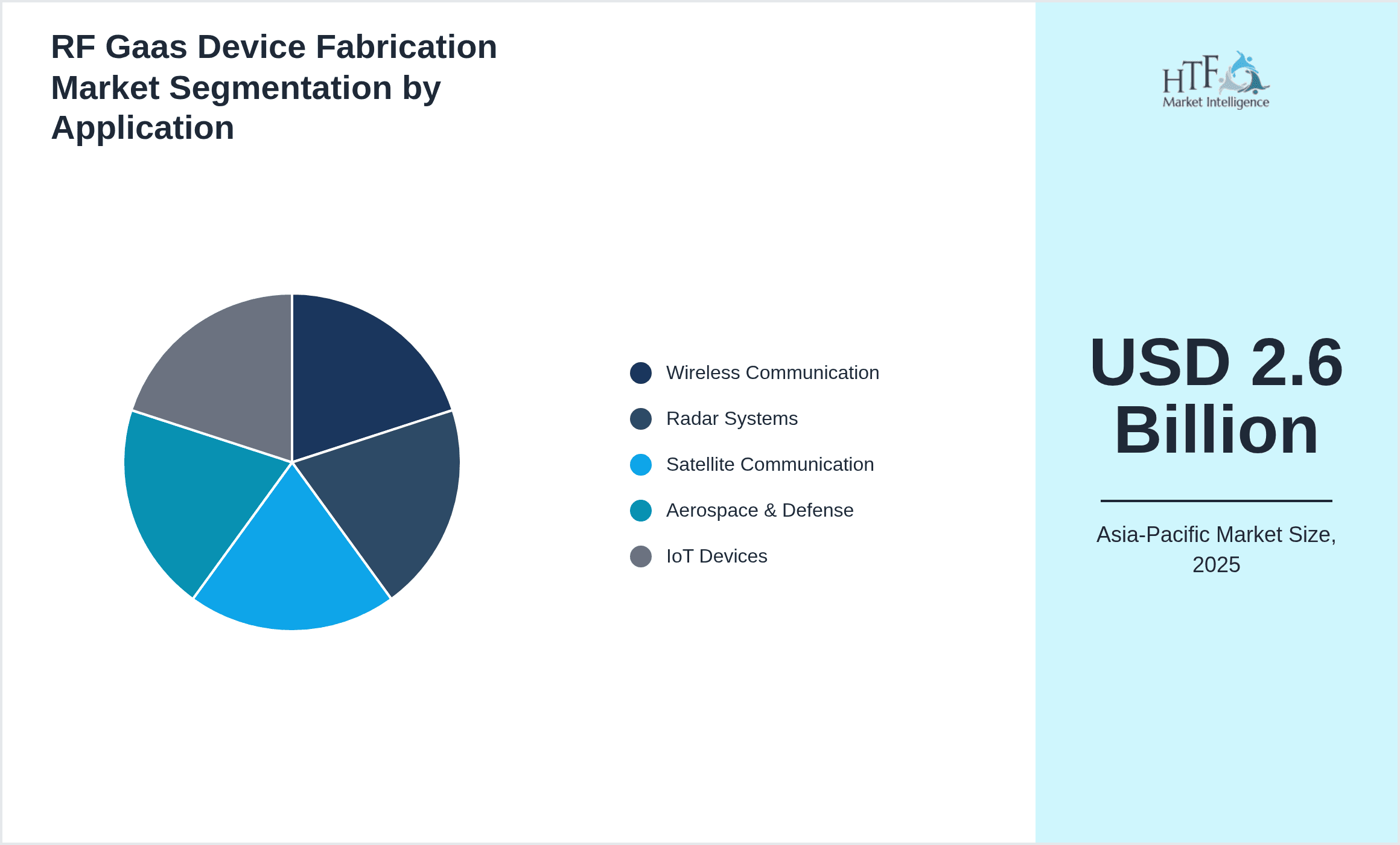
- •The market is projected to grow from USD 2.6 Billion in 2025 to USD 5.9 Billion by 2034, exhibiting a compound annual growth rate of 8.9%. China dominates the regional market with a 38% share, driven by its robust semiconductor manufacturing ecosystem and government support. India represents the fastest-growing country with a CAGR of 12.3%, fueled by increasing domestic demand and government initiatives to bolster semiconductor fabrication capabilities. High Electron Mobility Transistors lead the product segment due to their widespread application in 5G and radar systems, while Monolithic Microwave Integrated Circuits show the fastest growth because of expanding aerospace and satellite communication applications. The wireless communication application segment holds the largest share, supported by rapid 5G deployment across Asia-Pacific. Market growth is underpinned by technological innovation and increasing demand in defense and IoT sectors.
- •The Asia-Pacific RF GaAs Device Fabrication market presents strategic importance to semiconductor manufacturers, telecom operators, defense contractors, and IoT solution providers. It enables the development of advanced RF components critical for enhancing network capacity, signal quality, and system reliability. Investment in fabrication technology and regional manufacturing capability expansion reduces dependency on imports and supports localized supply chains. Stakeholders benefit from rising demand for high-frequency devices in emerging economies and mature markets alike, leveraging innovations in device architecture and process technologies. This market also offers opportunities for partnerships and mergers to accelerate technology adoption and geographic reach. The convergence of communication, defense, and consumer electronics drives sustained growth, emphasizing the necessity of RF GaAs technology in Asia-Pacific’s digital and industrial evolution.

Competitive Landscape
Key industry players in the Asia-Pacific RF GaAs Device Fabrication market employ diverse strategic approaches to maintain and enhance their market positions. Companies focus on advancing fabrication technology through continuous R&D investments aimed at improving device performance, reducing costs, and enabling miniaturization. Strategic partnerships with telecom providers, defense agencies, and technology firms facilitate product customization and market penetration. Expansion of manufacturing footprints within Asia-Pacific countries supports localized supply chains and mitigates geopolitical risks. Innovation in process technology such as epitaxy, lithography, and wafer-scale integration remains central to sustaining competitive advantage. Firms also pursue mergers and acquisitions to consolidate resources, enhance technological capabilities, and expand product portfolios. Adoption of automation and AI in fabrication processes improves yield and quality control. These strategies collectively strengthen resilience against market volatility and position companies to capitalize on the rapid growth of RF applications across Asia-Pacific.
Leading Companies in RF GaAs Device Fabrication Market
- •Qorvo (United States)
- •Skyworks Solutions (United States)
- •MACOM Technology Solutions (United States)
- •NXP Semiconductors (Netherlands)
- •Wolfspeed (United States)
- •Sumitomo Electric Industries (Japan)
- •Taiyo Yuden (Japan)
- •Broadcom Inc. (United States)
- •STMicroelectronics (Switzerland)
- •Infineon Technologies (Germany)
- •Rohm Semiconductor (Japan)
- •Win Semiconductor (Taiwan)
- •Global Communication Semiconductors (Singapore)
- •Fuji Electric (Japan)
- •Skyworks Solutions (Japan)
- •Marubun Corporation (Japan)
- •Nissin Electric (Japan)
- •Taiwan Semiconductor Manufacturing Company (Taiwan)
- •Samsung Electronics (South Korea)
- •Sony Semiconductor Solutions (Japan)
Market Breakdown
- •By Type
- ◦High Electron Mobility Transistor
- ◦Monolithic Microwave Integrated Circuit
- ◦Heterojunction Bipolar Transistor
- ◦Schottky Diode
- ◦PIN Diode
- •By Application
- ◦Wireless Communication
- ◦Radar Systems
- ◦Satellite Communication
- ◦Aerospace & Defense
- ◦IoT Devices
- •By Wafer Size
- ◦4 Inch
- ◦6 Inch
- ◦8 Inch
- ◦12 Inch
- •By Fabrication Technology
- ◦Epitaxial Growth
- ◦Ion Implantation
- ◦Photolithography
- ◦Etching
- ◦Metallization
Growth Dynamics
Robust expansion of 5G infrastructure across China, India, and South Korea fuels demand for high-performance RF GaAs devices, necessitating advanced fabrication capabilities to support high-frequency, low-noise applications critical to network reliability and capacity. Government initiatives such as China’s Made in China 2025 and India’s Semiconductor Mission provide substantial funding and policy support to domestic manufacturers, accelerating capacity expansion and technology upgrades. Increasing investment in aerospace and defense applications, including radar and satellite communication, drives adoption of specialized GaAs components requiring precise fabrication techniques. Furthermore, the growing proliferation of IoT devices with stringent RF performance requirements stimulates demand for compact, energy-efficient GaAs devices. Leading companies have responded by integrating automation and AI-driven process optimization to enhance yield and reduce costs. Recent collaboration between Taiwanese and Japanese fabs to co-develop next-generation epitaxial wafers exemplifies cross-border cooperation driving innovation and capacity scaling. These factors collectively underpin the Asia-Pacific RF GaAs Device Fabrication market’s steady growth trajectory.

Market Trends
Emerging trends in the Asia-Pacific RF GaAs Device Fabrication market include the adoption of advanced wafer-scale integration techniques and epitaxial growth processes that enhance device performance and scalability. Increasing use of monolithic microwave integrated circuits in satellite and aerospace sectors reflects the region’s focus on sophisticated communication systems for defense and civilian applications. The integration of AI and machine learning in fabrication lines enables predictive maintenance and real-time quality control, improving operational efficiency and reducing defect rates. Additionally, expansion of fabrication plants in Southeast Asia driven by cost advantages and government incentives diversifies the regional supply base. The rise of multi-band and multi-mode RF devices to support diverse wireless standards generates demand for versatile fabrication processes. Industry players also invest in environmentally sustainable manufacturing practices aligning with regional regulatory frameworks. These trends position the Asia-Pacific market at the forefront of semiconductor innovation, catering to escalating demand for high-frequency RF components in 5G, IoT, and aerospace applications.

Market Opportunities
The Asia-Pacific RF GaAs Device Fabrication market holds significant opportunities driven by rapid 5G rollout and increasing defense modernization programs across China, India, and Southeast Asia. Expanding satellite communication networks and growing demand for secure, high-throughput connectivity open avenues for advanced MMIC and HBT device fabrication innovations. Emerging economies investing in indigenous semiconductor manufacturing capabilities provide fertile ground for capacity expansion and technology localization, reducing import dependency. The increasing adoption of IoT devices requiring low power and high frequency performance stimulates demand for customized fabrication solutions. Collaborations between fabless design houses and foundries facilitate co-development of application-specific RF GaAs devices, accelerating market penetration. Furthermore, environmental regulations encourage adoption of greener fabrication technologies, creating opportunities for manufacturers innovating in sustainable process development. Strategic investments in wafer size upgrades and process automation also enhance production efficiency and profitability. Overall, technological advancement coupled with regional infrastructure investments underpin a promising growth outlook for the Asia-Pacific RF GaAs Device Fabrication market.
Market Challenges
High capital expenditure requirements for establishing and upgrading GaAs device fabrication facilities pose significant barriers to market entry and expansion in Asia-Pacific. Complex and costly epitaxial growth and lithography processes demand sophisticated equipment and skilled workforce, limiting scalability for smaller players. Supply chain disruptions affecting raw materials like high-purity gallium and arsenic have caused production delays and cost volatility, as seen during geopolitical tensions impacting trade flows. Intense competition from silicon-based RF alternatives, especially with improvements in silicon carbide technologies, challenges GaAs device adoption in certain applications. Additionally, regulatory compliance with diverse environmental and safety standards across Asia-Pacific countries adds operational complexity. Recent delays in capacity expansion projects in India due to regulatory approvals exemplify these challenges. Protecting intellectual property rights amid increasing regional manufacturing also remains a concern, affecting technology transfer and collaboration. These factors collectively constrain rapid market growth and necessitate strategic risk management by industry participants.
Regulatory Framework
In the past five years, Asia-Pacific countries have implemented several regulations impacting RF GaAs device fabrication. China’s Environmental Protection Law revisions emphasize stringent emissions and waste management protocols, compelling fabs to adopt cleaner manufacturing technologies. India’s Semiconductor Policy 2022 introduces incentives for domestic fabrication units but mandates compliance with energy efficiency and pollution control standards. Japan enforces comprehensive chemical substance regulations under its Chemical Substances Control Law, affecting raw material handling in device fabrication. South Korea’s Industrial Safety and Health Act updates include specific provisions for semiconductor manufacturing safety, improving workplace standards. Additionally, regional trade agreements like the Regional Comprehensive Economic Partnership facilitate cross-border supply chain integration but require adherence to standardized quality and safety certifications. These regulations collectively shape operational practices, promoting sustainable growth while ensuring product safety and environmental responsibility within the Asia-Pacific RF GaAs Device Fabrication industry.
Recent Industry Insights
Recent market developments and strategic initiatives are continuously tracked through industry publications, company announcements, and regulatory filings. For the most current information, stakeholders are advised to monitor official corporate communications and recognized market intelligence platforms.
Recent Merger and Acquisition
Recent market developments and strategic initiatives are continuously tracked through industry publications, company announcements, and regulatory filings. For the most current information, stakeholders are advised to monitor official corporate communications and recognized market intelligence platforms.
Regional Outlook
The China currently holds a significant share of the market, primarily due to several key factors: increasing consumption rates, a burgeoning population, and robust economic momentum. These elements collectively drive demand, positioning this region as a leader in the market. On the other hand, India is rapidly emerging as the fastest-growing area within the industry. This remarkable growth can be attributed to swift infrastructure development, the expansion of various industrial sectors, and a marked increase in consumer demand. These dynamics make this region a crucial player in shaping future market growth.
In our report, we cover a comprehensive analysis of the following regions and countries:
- Japan
- China
- Southeast Asia
- India
- Australia
- South Korea
- Others
| Feature | Details |
|---|---|
| Base Year Market Size | USD 2.6 Billion |
| Forecast Year Market Size | USD 5.9 Billion |
| CAGR | 8.9% |
| Forecast Period | 2026 to 2033 |
| YoY Growth | 8.5% |
| Scope of Report | Market is segmented by Type (High Electron Mobility Transistor, Monolithic Microwave Integrated Circuit, Heterojunction Bipolar Transistor, Schottky Diode, PIN Diode), Application (Wireless Communication, Radar Systems, Satellite Communication, Aerospace & Defense, IoT Devices), Wafer Size (4 Inch, 6 Inch, 8 Inch, 12 Inch), Fabrication Technology (Epitaxial Growth, Ion Implantation, Photolithography, Etching, Metallization) |
| Regions Covered | Japan, China, Southeast Asia, India, Australia, South Korea, Others |
| Key Companies | Qorvo (United States), Skyworks Solutions (United States), MACOM Technology Solutions (United States), NXP Semiconductors (Netherlands), Wolfspeed (United States), Sumitomo Electric Industries (Japan), Taiyo Yuden (Japan), Broadcom Inc. (United States), STMicroelectronics (Switzerland), Infineon Technologies (Germany), Rohm Semiconductor (Japan), Win Semiconductor (Taiwan), Global Communication Semiconductors (Singapore), Fuji Electric (Japan), Skyworks Solutions (Japan), Marubun Corporation (Japan), Nissin Electric (Japan), Taiwan Semiconductor Manufacturing Company (Taiwan), Samsung Electronics (South Korea), Sony Semiconductor Solutions (Japan) |
Asia-Pacific RF GaAs Device Fabrication Market Size, Growth & Revenue 2025-2034 - Table of Contents
Frequently Asked Questions (FAQ):
The Compact Track Loaders market is projected to grow at a CAGR of 6.8% from 2025 to 2030, driven by increasing demand in construction and agricultural sectors.
North America currently leads the market with approximately 45% market share, followed by Europe at 28% and Asia-Pacific at 22%. The remaining regions account for 5% of the global market.
Key growth drivers include increasing construction activities, rising demand for versatile equipment in agriculture, technological advancements in track loader design, and growing preference for compact equipment in urban construction projects.