
GCC Post CMP Cleaners Market Size, Growth & Revenue 2025-2034
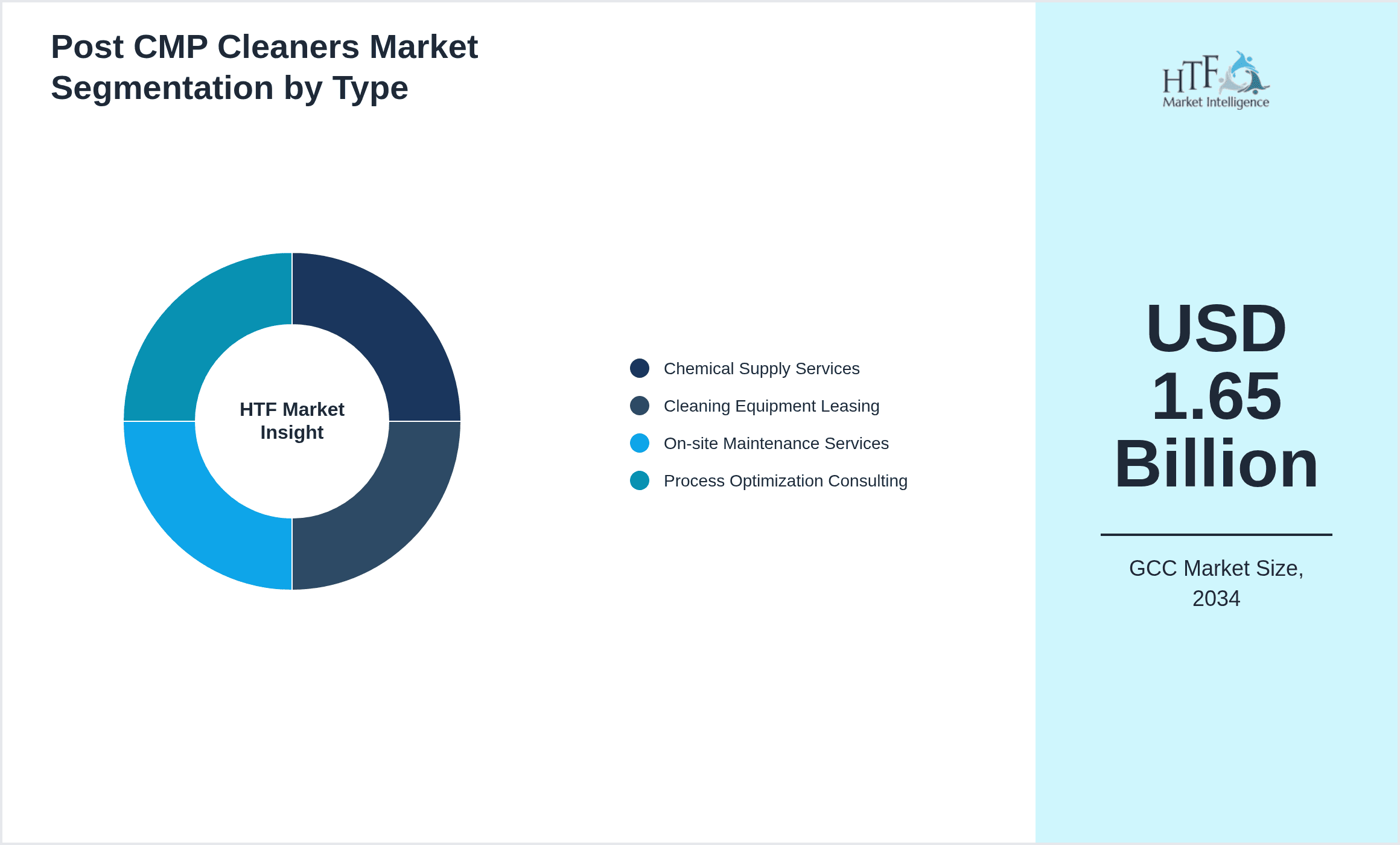
GCC Post CMP Cleaners Market is segmented by Post CMP Cleaner Type (Aqueous Cleaners, Solvent-Based Cleaners, Ultrasonic Cleaners, Plasma Cleaners, Other Specialized Cleaners), End-Use Application (Semiconductor Manufacturing, Electronics Assembly, Photovoltaic Cell Production, MEMS Device Fabrication, Flat Panel Display Manufacturing), Service Type (Chemical Supply Services, Cleaning Equipment Leasing, On-site Maintenance Services, Process Optimization Consulting), Deployment Model (Automated Cleaning Systems, Manual Cleaning Processes, Hybrid Cleaning Solutions), and Geography (Bahrain, Kuwait, Oman, Qatar, Saudi Arabia, United Arab Emirates)
Pricing
Report Overview
Executive Summary
- •The GCC Post CMP Cleaners market involves specialized cleaning solutions designed to remove residues after chemical mechanical planarization processes primarily in semiconductor manufacturing. This market includes various cleaner types such as aqueous, solvent-based, ultrasonic, and plasma cleaners, which are essential to maintain wafer integrity and device performance. End users include semiconductor fabs, electronics assembly plants, MEMS manufacturers, photovoltaic cell producers, and flat panel display fabricators. The value chain extends from chemical suppliers and equipment manufacturers to service providers offering installation and maintenance. Increasing semiconductor and electronics investments in GCC nations, particularly in Saudi Arabia and UAE, underpin market growth. Rising demand for high purity cleaning to minimize defects and yield loss drives innovation in cleaner formulations and equipment. Additionally, regulatory frameworks governing chemical use and environmental standards influence market dynamics, requiring players to adopt sustainable and compliant technologies. The market is characterized by steady CAGR driven by expanding semiconductor fabs, growing MEMS and photovoltaic manufacturing, and increasing demand for advanced cleaning technologies such as plasma cleaners. Strategic partnerships and regional government initiatives to boost local semiconductor manufacturing further enhance growth prospects, positioning GCC as an emerging hub for post CMP cleaning solutions.
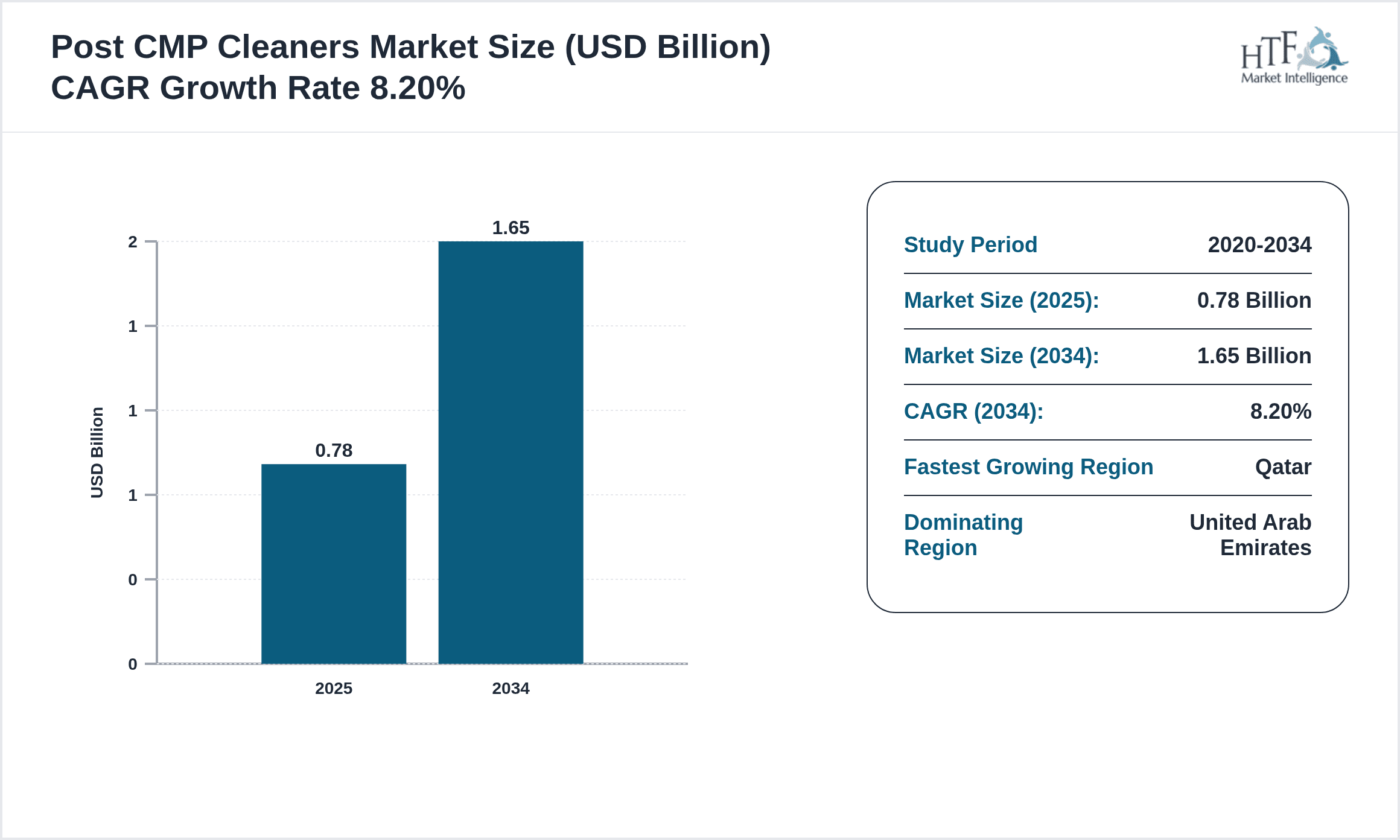
- •Key market highlights include a base year market size of USD 0.78 billion in 2025, expanding to USD 1.65 billion by 2034 at a CAGR of 8.2%. The United Arab Emirates dominates the regional market with a 35% share, while Qatar is the fastest growing country with a CAGR of 12.0%. Among cleaner types, aqueous cleaners currently lead due to their effectiveness and lower environmental impact, whereas plasma cleaners represent the fastest growing segment driven by their superior cleaning performance for advanced nodes. Applications in semiconductor manufacturing command the largest market segment, followed by electronics assembly and photovoltaic cells. Year-on-year growth is estimated at 8.0%, reflecting steady investment in semiconductor fabrication and related electronics industries within the GCC region.
- •The GCC Post CMP Cleaners market holds significant strategic importance for semiconductor and electronics stakeholders aiming to establish resilient supply chains and localized manufacturing capabilities. Effective CMP cleaning ensures high yields and device reliability, critical for high-tech electronics and solar panel production. Stakeholders benefit from tailored cleaning solutions that improve operational efficiency and compliance with environmental standards. The growing semiconductor ecosystem in GCC countries supported by government incentives and infrastructure development creates a promising landscape for chemical and equipment suppliers, system integrators, and research institutions focused on CMP process optimization. The market’s value proposition lies in enabling cleaner, safer, and more efficient manufacturing processes aligned with regional industrial diversification agendas.
Competitive Landscape
The GCC Post CMP Cleaners market features a competitive environment driven by innovation in cleaner chemistries and equipment technologies. Manufacturers compete on product efficacy, environmental compliance, and compatibility with advanced semiconductor nodes. Competitive strategies include strategic partnerships with local fabs, investments in R&D for sustainable formulations, and expanding service offerings such as on-site cleaning system support. Market positioning hinges on technological leadership, supply chain reliability, and adherence to stringent purity standards. M&A activities in the global CMP cleaning space influence regional dynamics by facilitating technology transfer and market access. Pricing strategies balance cost-efficiency with high performance, while distribution networks leverage regional hubs in UAE and Saudi Arabia. Adoption of automation and digital monitoring enhances competitive advantage. Barriers to entry include high capital requirements and technical expertise. Regional competition intensifies as GCC countries pursue semiconductor self-sufficiency, encouraging localization of cleaner production and services. Future trends indicate increased collaboration between chemical suppliers and semiconductor manufacturers to co-develop next-generation CMP cleaning solutions tailored to GCC market needs.
Leading Companies in Post CMP Cleaners Market
- •Cabot Microelectronics Corporation (United States)
- •Fujimi Incorporated (Japan)
- •Hitachi Chemical Company (Japan)
- •Entegris, Inc. (United States)
- •BASF SE (Germany)
- •Dow Inc. (United States)
- •Ecolab Inc. (United States)
- •Nippon Chemical Industrial Co., Ltd. (Japan)
- •Aztec Technology LLC (United States)
- •Honeywell International Inc. (United States)
- •Solvay S.A. (Belgium)
- •Mitsubishi Chemical Corporation (Japan)
- •Teknokroma (Spain)
- •Wako Pure Chemical Industries, Ltd. (Japan)
- •Heraeus Holding GmbH (Germany)
- •Ashland Global Holdings Inc. (United States)
- •Sumitomo Chemical Co., Ltd. (Japan)
- •Kanto Chemical Co., Inc. (Japan)
- •Jiangsu Zhongke Microelectronics Co., Ltd. (China)
- •Merck KGaA (Germany)
- •LG Chem Ltd. (South Korea)
- •Bruker Corporation (United States)
- •Advanced ChemTech (United States)
- •MicroCare Corporation (United States)
- •Horizon Technology, Inc. (United States)

Market Breakdown
- •By Post CMP Cleaner Type
- ◦Aqueous Cleaners
- ◦Solvent-Based Cleaners
- ◦Ultrasonic Cleaners
- ◦Plasma Cleaners
- ◦Other Specialized Cleaners
- •By End-Use Application
- ◦Semiconductor Manufacturing
- ◦Electronics Assembly
- ◦Photovoltaic Cell Production
- ◦MEMS Device Fabrication
- ◦Flat Panel Display Manufacturing
- •By Service Type
- ◦Chemical Supply Services
- ◦Cleaning Equipment Leasing
- ◦On-site Maintenance Services
- ◦Process Optimization Consulting
- •By Deployment Model
- ◦Automated Cleaning Systems
- ◦Manual Cleaning Processes
- ◦Hybrid Cleaning Solutions
Growth Dynamics
- •The GCC Post CMP Cleaners market is driven by expanding semiconductor fabrication capacity in Saudi Arabia and UAE, supported by government initiatives to develop high-tech manufacturing hubs. These expansions increase demand for advanced cleaning solutions essential for device yield and quality.
- •Rising adoption of plasma cleaning technologies enhances market growth by offering superior residue removal for cutting-edge semiconductor nodes and MEMS devices, aligning with industry trends toward miniaturization and precision manufacturing.
- •Stringent environmental regulations in GCC countries encourage the shift from solvent-based to aqueous and plasma cleaners, promoting sustainable manufacturing practices and stimulating innovation in eco-friendly cleaner formulations.
- •Increasing use of photovoltaic cells and flat panel displays in the region fuels demand for specialized post CMP cleaners tailored to these applications, diversifying the market beyond semiconductor fabs.
- •Collaborations between chemical suppliers and semiconductor fabs in the GCC region facilitate customized cleaning solutions, enabling process optimization and reinforcing supplier-customer relationships critical for market expansion.
- •Investment in automation and digital monitoring of CMP cleaning processes enhances operational efficiency, reduces chemical consumption, and supports consistent cleaning performance, driving adoption of automated systems.
- •Growing awareness of contamination control and yield improvement among GCC electronics manufacturers strengthens demand for high-performance post CMP cleaners, creating opportunities for premium products.
Market Trends
- •A notable trend in the GCC Post CMP Cleaners market is the increasing integration of plasma cleaning techniques due to their efficiency in removing organic residues without chemical waste, aligning with sustainability goals.
- •The rise of semiconductor fabs in Saudi Arabia and UAE is fostering localized demand for post CMP cleaning chemicals, reducing dependence on imports and encouraging regional production capabilities.
- •Manufacturers are investing in environmentally friendly aqueous cleaner formulations to comply with GCC environmental regulations and reduce hazardous emissions, reflecting a shift toward green manufacturing processes.
- •Hybrid cleaning solutions combining ultrasonic and chemical methods are gaining traction for complex device geometries, improving cleaning efficacy and throughput in MEMS and advanced semiconductor device fabrication.
- •Digitalization of cleaning process monitoring using IoT sensors and AI analytics is emerging as a key trend, enabling real-time process control and predictive maintenance, thereby enhancing yield and reducing downtime.
- •Strategic partnerships between global chemical suppliers and GCC fabrication facilities facilitate technology transfer and adaptation of post CMP cleaning products to local market requirements.
- •Rising demand for flat panel displays across GCC nations drives innovations in cleaner chemistries designed specifically for display glass substrates, expanding the market application scope.

Market Opportunities
- •The planned expansion of semiconductor manufacturing facilities in GCC countries presents significant opportunities for post CMP cleaner suppliers to establish early partnerships and supply chains, capturing market share.
- •Development of eco-friendly and bio-degradable cleaner formulations offers growth avenues as GCC regulatory bodies tighten environmental standards and manufacturers seek sustainable alternatives.
- •Emerging markets such as MEMS and photovoltaic cell production in GCC provide diversification opportunities for post CMP cleaner manufacturers to tailor solutions for specialized applications.
- •Investment in R&D for plasma cleaner technology adaptation to GCC environmental conditions can create unique competitive advantages and open new market segments.
- •Collaborations with local universities and research institutions can foster innovation and development of next-generation cleaning technologies suited to GCC market dynamics.
- •Expanding service offerings including on-site maintenance and process consulting enable suppliers to build long-term relationships and recurring revenue streams in the GCC region.
- •Government incentives promoting high-tech manufacturing and diversification of GCC economies support investment in post CMP cleaning infrastructure and capacity expansion.
Market Challenges
- •High capital investment required for advanced post CMP cleaning equipment and chemical formulation R&D poses a barrier to new entrants and smaller suppliers in the GCC market.
- •Limited local production capabilities for specialized cleaning chemicals result in reliance on imports, increasing supply chain risks and costs in the GCC region.
- •Stringent environmental and safety regulations necessitate continuous compliance efforts and product reformulation, increasing operational complexity and costs for manufacturers.
- •Rapid technological evolution in semiconductor nodes demands frequent updates to cleaning solutions, challenging suppliers to maintain relevance and competitive advantage.
- •Shortage of skilled technical personnel to manage and optimize CMP cleaning processes limits operational efficiency and adoption of advanced cleaning technologies in GCC fabs.
- •Volatility in raw material prices and global supply chain disruptions impact pricing stability and availability of post CMP cleaning products.
- •Market fragmentation and presence of multiple international suppliers create competitive pressure and price sensitivity among GCC customers.
Regulatory Framework
- •The GCC countries have implemented progressive environmental regulations between 2020 and 2025 focusing on chemical safety, emissions control, and waste management, mandating manufacturers to ensure compliance in post CMP cleaning operations. These regulations require the use of eco-friendly chemicals and proper disposal systems to minimize environmental impact.
- •Regulatory bodies in Saudi Arabia and UAE enforce strict occupational health and safety standards pertaining to chemical handling and usage, driving manufacturers to adopt safer formulations and automated cleaning systems to reduce worker exposure and enhance operational safety.
- •GCC-wide harmonization initiatives aim to standardize chemical registration, classification, and labeling, facilitating smoother market entry and trade of post CMP cleaning chemicals across member states.
- •Specific mandates on reduction of volatile organic compounds (VOCs) and hazardous air pollutants (HAPs) have prompted a shift from solvent-based to aqueous and plasma cleaning technologies, influencing product development and market trends.
- •Government incentives and certification programs encourage adoption of sustainable manufacturing practices including use of green chemicals and energy-efficient cleaning equipment, supporting long-term environmental goals within the GCC industrial sectors.
Market Intelligence
- •5th February 2025, Cabot Microelectronics Corporation announced the launch of a new environmentally compliant aqueous post CMP cleaner specifically formulated for semiconductor fabs in the GCC region. This product features reduced waste generation and enhanced residue removal efficiency suitable for advanced node manufacturing. The company aims to leverage growing semiconductor investments in Saudi Arabia and UAE with this region-tailored solution, strengthening its local market presence and supporting sustainable manufacturing goals. Source: Cabot Microelectronics official press release.
- •12th April 2025, BASF SE introduced a plasma-based post CMP cleaning technology designed for MEMS and photovoltaic cell manufacturers in the GCC. This innovation offers superior cleaning performance with minimal chemical usage and aligns with GCC environmental regulations. BASF's strategic partnership with a leading UAE semiconductor fab aims to pilot this technology for large-scale adoption. The move is expected to accelerate the transition to greener cleaning processes within the region’s electronics manufacturing sector. Source: BASF corporate news.
- •20th July 2024, Dow Inc. completed a strategic collaboration with a Saudi Arabian semiconductor equipment integrator to develop customized ultrasonic cleaning systems optimized for GCC fabs. The initiative focuses on enhancing process control and reducing chemical consumption while maintaining high cleaning standards for advanced semiconductor devices. This partnership supports Dow’s expansion strategy in the Middle East and aims to foster regional innovation in post CMP cleaning solutions. Source: Dow official announcement.
- •15th October 2024, Entegris, Inc. announced the opening of a regional technical support center in Dubai, UAE, dedicated to post CMP cleaning solutions. This facility will provide on-site consulting, maintenance, and training services to GCC semiconductor manufacturers, enhancing customer engagement and accelerating technology adoption. The move reflects Entegris’ commitment to strengthening its footprint in the GCC market and supporting local fabs’ operational excellence. Source: Entegris press release.
Regional Outlook
The United Arab Emirates currently holds a significant share of the market, primarily due to several key factors: increasing consumption rates, a burgeoning population, and robust economic momentum. These elements collectively drive demand, positioning this region as a leader in the market. On the other hand, Qatar is rapidly emerging as the fastest-growing area within the industry. This remarkable growth can be attributed to swift infrastructure development, the expansion of various industrial sectors, and a marked increase in consumer demand. These dynamics make this region a crucial player in shaping future market growth.
In our report, we cover a comprehensive analysis of the following regions and countries:
- Bahrain
- Kuwait
- Oman
- Qatar
- Saudi Arabia
- United Arab Emirates
| Feature | Details |
|---|---|
| Base Year Market Size | USD 0.78 Billion |
| Forecast Year Market Size | USD 1.65 Billion |
| CAGR | 8.2% |
| Forecast Period | 2026 to 2033 |
| YoY Growth | 8% |
| Scope of Report | Market is segmented by Post CMP Cleaner Type (Aqueous Cleaners, Solvent-Based Cleaners, Ultrasonic Cleaners, Plasma Cleaners, Other Specialized Cleaners), End-Use Application (Semiconductor Manufacturing, Electronics Assembly, Photovoltaic Cell Production, MEMS Device Fabrication, Flat Panel Display Manufacturing), Service Type (Chemical Supply Services, Cleaning Equipment Leasing, On-site Maintenance Services, Process Optimization Consulting), Deployment Model (Automated Cleaning Systems, Manual Cleaning Processes, Hybrid Cleaning Solutions) |
| Regions Covered | Bahrain, Kuwait, Oman, Qatar, Saudi Arabia, United Arab Emirates |
| Key Companies | Cabot Microelectronics Corporation (United States), Fujimi Incorporated (Japan), Hitachi Chemical Company (Japan), Entegris, Inc. (United States), BASF SE (Germany), Dow Inc. (United States), Ecolab Inc. (United States), Nippon Chemical Industrial Co., Ltd. (Japan), Aztec Technology LLC (United States), Honeywell International Inc. (United States), Solvay S.A. (Belgium), Mitsubishi Chemical Corporation (Japan), Teknokroma (Spain), Wako Pure Chemical Industries, Ltd. (Japan), Heraeus Holding GmbH (Germany), Ashland Global Holdings Inc. (United States), Sumitomo Chemical Co., Ltd. (Japan), Kanto Chemical Co., Inc. (Japan), Jiangsu Zhongke Microelectronics Co., Ltd. (China), Merck KGaA (Germany), LG Chem Ltd. (South Korea), Bruker Corporation (United States), Advanced ChemTech (United States), MicroCare Corporation (United States), Horizon Technology, Inc. (United States) |
GCC Post CMP Cleaners Market Size, Growth & Revenue 2025-2034 - Table of Contents
Frequently Asked Questions (FAQ):
The Compact Track Loaders market is projected to grow at a CAGR of 6.8% from 2025 to 2030, driven by increasing demand in construction and agricultural sectors.
North America currently leads the market with approximately 45% market share, followed by Europe at 28% and Asia-Pacific at 22%. The remaining regions account for 5% of the global market.
Key growth drivers include increasing construction activities, rising demand for versatile equipment in agriculture, technological advancements in track loader design, and growing preference for compact equipment in urban construction projects.