
South America AI Answer Generator Market Size, Growth & Revenue 2024-2034
South America AI Answer Generator Market is segmented by Application (Customer Support, Education & E-Learning, Healthcare, E-commerce, Financial Services), Type (Rule-Based, Machine Learning-Based, Hybrid, Deep Learning-Based, Neural Network-Based), and Geography (Brazil, Argentina, Chile, Peru, Colombia, Rest of South America)
Pricing
Report Overview
Executive Summary
- •The South America AI Answer Generator market comprises AI-driven technologies designed to automate response generation across industries such as customer support, education, healthcare, e-commerce, and financial services. These systems utilize a spectrum of methods including rule-based algorithms, machine learning, deep learning, and neural networks to deliver contextually relevant answers to end-users. The market scope extends to software platforms, cloud and on-premise deployments, and includes a variety of AI models tailored for specific applications and languages prevalent in South America. Increasing digital transformation initiatives, rising demand for efficient customer interaction, and the surge in AI adoption across enterprises are key factors driving market expansion. The competitive landscape is marked by innovation in natural language understanding and integration capabilities, fostering enhanced user experience and operational cost reduction. Strategic investments in AI technologies and partnerships within the region are accelerating growth, positioning South America as a promising market for AI answer generation solutions.
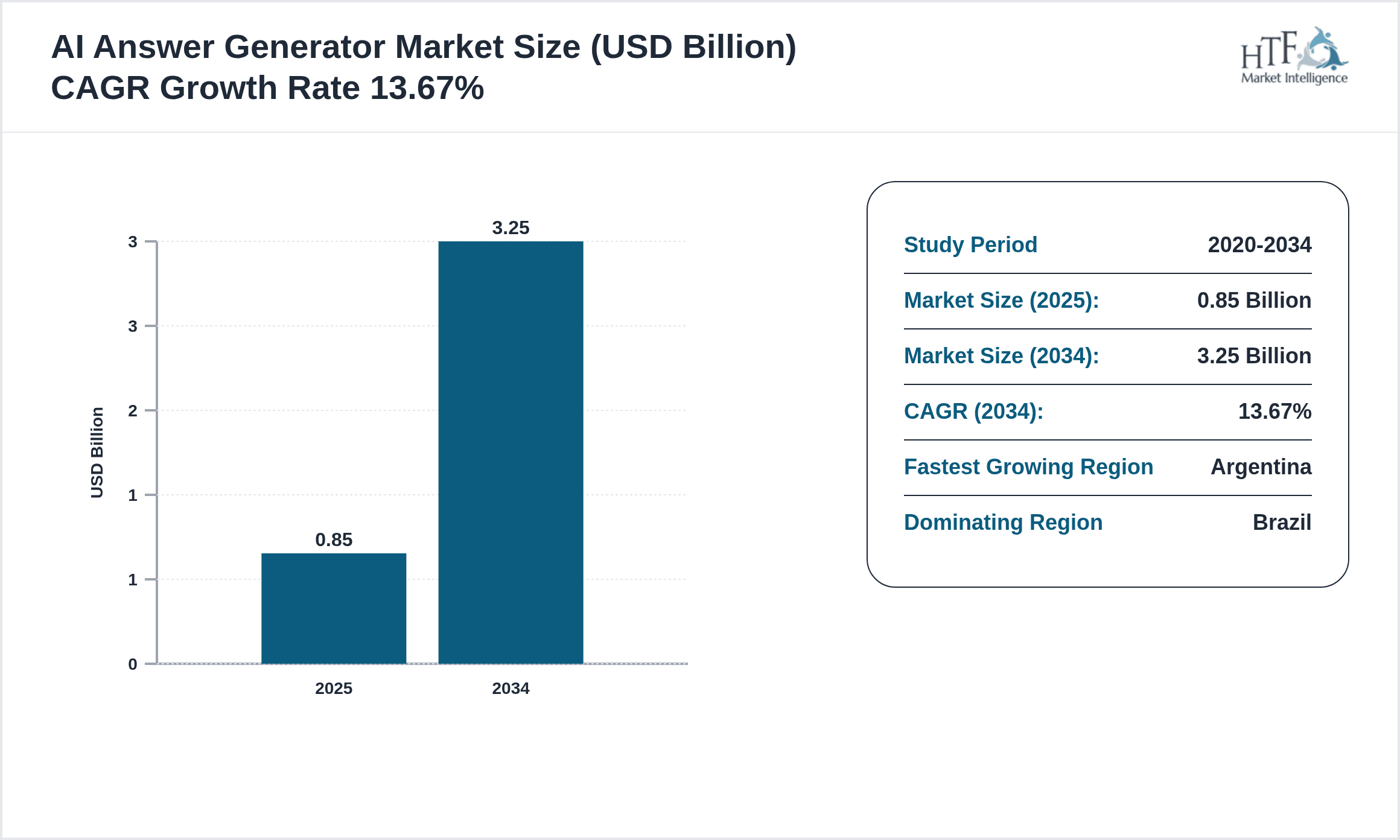
- •Key market highlights include a base market size of USD 0.85 Billion in 2024 with a robust CAGR of 13.67% projected through 2034, reaching USD 3.25 Billion. Machine Learning-Based AI answer generators dominate the product type segment, while Deep Learning-Based solutions are emerging as the fastest-growing technology. Brazil leads the regional market with a 35% share, followed by Argentina growing at the highest CAGR of 16.2%. Applications in customer support and education hold the largest shares, reflecting strong adoption in service-oriented and knowledge sectors. Market dynamics are influenced by technological advancements, increasing AI literacy, and regulatory frameworks fostering ethical AI use.
- •The South America AI Answer Generator market offers significant value across multiple industries by enhancing customer engagement, streamlining operations, and reducing response times. Its strategic importance is underscored by growing digital economies, the need for multilingual support solutions, and the rising penetration of internet and mobile devices. Stakeholders including AI developers, service providers, and end-user enterprises benefit from innovations in AI models and deployment flexibility. The market's evolution aligns with broader trends in AI democratization and intelligent automation, making it a pivotal technology domain with transformative potential for South America's economic and social landscape.
Competitive Landscape
The South America AI Answer Generator market is characterized by intense competition among global and regional players leveraging innovation, strategic partnerships, and tailored solutions to capture market share. Companies invest heavily in R&D to enhance natural language processing capabilities, multilingual support, and integration with enterprise systems. Market leaders focus on differentiating through product customization, scalability, and user experience improvements, while mid-sized firms emphasize niche applications and localized offerings. Pricing strategies vary, with subscription-based models gaining traction alongside traditional licensing. The competitive environment also witnesses collaborations between AI startups and established technology firms to accelerate solution deployment. Regional factors such as language diversity and regulatory compliance further influence competitive positioning. Entry barriers include high development costs and the need for specialized talent, while ongoing M&A activities and technology acquisitions shape market consolidation and future growth trajectories.
Leading Companies in AI Answer Generator Market
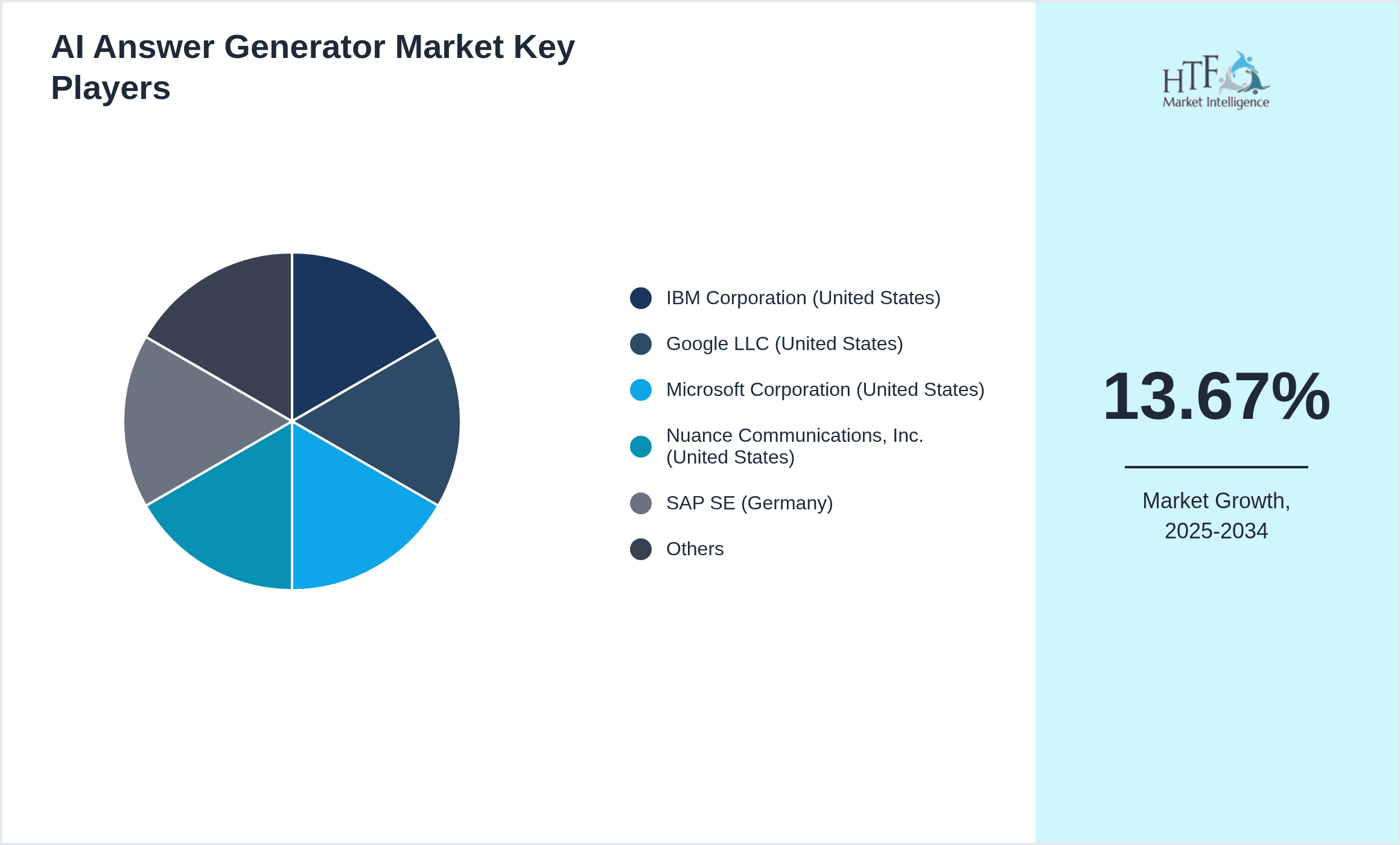
- •IBM Corporation (United States)
- •Google LLC (United States)
- •Microsoft Corporation (United States)
- •Nuance Communications, Inc. (United States)
- •SAP SE (Germany)
- •Oracle Corporation (United States)
- •LivePerson, Inc. (United States)
- •Inbenta Technologies (United States)
- •Aivo (Argentina)
- •SAS Institute Inc. (United States)
- •Cognigy GmbH (Germany)
- •Rasa Technologies GmbH (Germany)
- •Ada Support Inc. (Canada)
- •Kasisto, Inc. (United States)
- •Boost.ai AS (Norway)
- •Kasisto, Inc. (United States)
- •Kore.ai (United States)
- •Haptik Inc. (India)
- •Yellow.ai (India)
- •Botpress (Canada)
- •Clinc LLC (United States)
- •Affectiva (United States)
- •Mindsay (France)
- •Creative Virtual Ltd. (United Kingdom)
- •Nu Echo AB (Sweden)

Market Breakdown
- •By AI Answer Generator Type
- ◦Rule-Based AI Answer Generator
- ◦Machine Learning-Based AI Answer Generator
- ◦Hybrid AI Answer Generator
- ◦Deep Learning-Based AI Answer Generator
- ◦Neural Network-Based AI Answer Generator
- •By Application Sector
- ◦Customer Support
- ◦Education & E-Learning
- ◦Healthcare
- ◦E-commerce
- ◦Financial Services
- •By Deployment Model
- ◦Cloud-Based Deployment
- ◦On-Premise Deployment
- ◦Hybrid Deployment
- •By End User Industry
- ◦Small and Medium Enterprises (SMEs)
- ◦Large Enterprises
- ◦Government Organizations
- ◦Educational Institutions
Growth Dynamics
- •The South America AI Answer Generator market is propelled by increasing digital transformation initiatives among enterprises seeking automated customer engagement solutions. The rise in smartphone penetration and internet accessibility across Brazil, Argentina, and Chile has expanded the user base for AI-driven communication tools. Additionally, the growing adoption of machine learning and deep learning technologies enables more sophisticated and context-aware answer generation, fostering enhanced user experiences. Government support for AI innovation and investments in education further stimulate market growth by promoting AI literacy and infrastructure development. Enterprises in financial services and healthcare increasingly deploy AI answer generators to improve operational efficiency and reduce response times, thus driving demand. The proliferation of cloud computing platforms also facilitates scalable and cost-effective AI deployments, accelerating adoption rates across diverse industries in South America.
- •Emerging trends include the integration of multilingual capabilities to address the region’s diverse linguistic landscape, enabling AI answer generators to cater to Portuguese, Spanish, and indigenous languages. Hybrid AI models combining rule-based and machine learning approaches are gaining traction to provide more accurate and adaptable responses. The expansion of AI answer generators into education technology platforms supports remote learning through instant query resolution and tutoring assistance. Increasing collaboration between AI startups in South America and global technology firms fosters innovation in natural language processing and domain-specific AI solutions. Furthermore, the shift towards cloud-based and hybrid deployment models offers flexibility and reduces infrastructure costs, making AI answer generators accessible to SMEs and startups, thereby broadening market penetration.
- •Despite its growth, the market faces restraints including challenges related to data privacy regulations and concerns over AI bias that may limit adoption in sensitive sectors like healthcare and finance. Infrastructure disparities in rural areas can hinder widespread AI solution deployment. The high cost of AI system development and integration, coupled with a shortage of skilled AI professionals in South America, poses significant barriers for enterprises, especially smaller companies. Additionally, linguistic nuances and dialect diversity require extensive training data, complicating AI model accuracy. Regulatory uncertainties around AI ethics and data security also necessitate cautious adoption. These factors collectively restrain faster market expansion and necessitate targeted strategies to overcome technical and regulatory challenges.
- •Opportunities abound in untapped verticals such as government services and agriculture, where AI answer generators can streamline citizen engagement and provide real-time advisory services. The increasing focus on natural language understanding and sentiment analysis presents avenues for product differentiation and enhanced user satisfaction. Expansion into emerging economies within South America opens new customer bases with growing digital adoption. Strategic partnerships and collaborations can bolster R&D efforts, driving innovation tailored to regional needs. Moreover, integrating AI answer generators with other AI-driven tools like chatbots and virtual assistants enhances value propositions. Investment in developing multilingual and dialect-specific AI models offers significant market potential. The growing trend of AI democratization also creates opportunities for SaaS-based AI answer generator platforms targeting SMEs.
- •The South America AI Answer Generator market contends with challenges such as the evolving regulatory landscape governing AI applications and data protection, which demands continuous compliance efforts. Market fragmentation due to diverse language and cultural contexts complicates standardization of AI solutions. The lack of robust AI infrastructure in certain regions leads to uneven adoption rates. Competitive pressure from global technology giants necessitates continuous innovation and localization by regional players. Additionally, concerns over AI explainability and trustworthiness may impede acceptance among conservative industries. Talent scarcity in AI and data science fields limits the pace of development and deployment. Addressing these challenges requires strategic investment in training, infrastructure, and regulatory alignment to sustain growth momentum.

Market Trends
- •The South America AI Answer Generator market is witnessing a significant shift toward hybrid AI models that combine rule-based logic with machine learning to enhance response accuracy and adaptability. Companies are increasingly investing in multilingual AI capabilities to cater to diverse linguistic needs across the region, including Portuguese and Spanish dialects. There is also growing integration of AI answer generators with omnichannel customer support systems, enabling seamless user experiences across platforms such as social media, messaging apps, and websites. Sustainability and ethical AI adoption are gaining importance, pushing vendors to develop transparent and bias-mitigated AI solutions. Additionally, cloud-native deployments are becoming widespread, providing scalable and cost-effective options for enterprises of all sizes while enabling rapid innovation cycles.
- •Advancements in natural language processing, particularly transformer-based models, are driving innovation in AI answer generators, allowing for more context-aware and conversational interactions. The rise of AI-as-a-Service platforms is democratizing access to sophisticated AI tools, enabling SMEs to leverage AI without heavy upfront investments. Strategic partnerships between local AI startups and global tech firms are fostering knowledge transfer and accelerating product development. The education sector is rapidly adopting AI answer generators to support e-learning, personalized tutoring, and student engagement. Furthermore, the financial services industry is implementing AI solutions for real-time query handling and fraud detection, reflecting growing trust in AI's capabilities to enhance operational efficiency.
- •The integration of AI answer generators with voice recognition and virtual assistant technologies is expanding the modalities of user interaction, facilitating hands-free and more natural communication. There is an increasing trend toward embedding AI answer generation within enterprise resource planning (ERP) and customer relationship management (CRM) systems to streamline workflows. Adoption of explainable AI frameworks is rising, addressing regulatory and ethical concerns by enhancing transparency and user trust. The COVID-19 pandemic accelerated digital transformation efforts, leading to a surge in AI adoption to manage remote customer service and support. Moreover, AI-driven analytics embedded within answer generators are enabling businesses to gain actionable insights from customer interactions, further optimizing service delivery and product development strategies.
- •Collaborations between AI developers and telecommunications providers in South America are creating opportunities to deliver AI answer generator solutions integrated within communication infrastructure. The market is also observing increased venture capital funding targeting AI startups specializing in answer generation and conversational AI. Growing consumer preference for instant and accurate responses is driving demand for AI solutions capable of understanding nuanced queries and providing personalized answers. The emergence of regional AI innovation hubs is fostering ecosystem development and talent cultivation. Finally, regulatory bodies are increasingly engaging stakeholders to formulate AI governance frameworks, influencing market practices and compliance strategies.
- •Looking ahead, the South America AI Answer Generator market is poised to benefit from advancements in edge computing, enabling faster and localized AI processing, especially in remote areas. The evolution of AI ethics and data privacy legislation will shape product development and market entry strategies. Integration with emerging technologies such as augmented reality (AR) and virtual reality (VR) may open new application domains. The rise of conversational commerce and AI-powered personal assistants is expected to expand use cases. Additionally, growing emphasis on AI interoperability standards will facilitate multi-vendor ecosystems, enhancing solution flexibility and adoption. These trends collectively underpin a dynamic and rapidly evolving market landscape.
Market Opportunities
- •Expanding digital infrastructure in South America presents a strategic opportunity for AI answer generator providers to penetrate underserved markets, particularly in rural and semi-urban areas. There is significant growth potential in customizing AI solutions for local languages and dialects, enabling broader adoption across diverse demographic segments. The increasing demand for AI-driven customer engagement in the financial and healthcare sectors opens avenues for specialized applications adhering to regulatory compliance. Strategic collaborations with telecommunications and cloud service providers can enhance distribution channels and scalability. Furthermore, the rise of SMEs adopting AI as a service offers a fertile ground for subscription-based models, facilitating market expansion. Investment in explainable and ethical AI technologies can differentiate offerings and build trust among cautious industries. Additionally, integration with emerging digital education platforms provides a growing opportunity to support remote and personalized learning experiences. The convergence of AI with IoT and mobile platforms also opens new frontiers for innovative answer generation use cases, broadening market scope and impact.
- •The growing e-commerce sector in South America is ripe for AI answer generator integration to enhance customer support and streamline transaction processes. Providers can capitalize on the rising trend of conversational commerce by developing AI solutions that facilitate seamless interactions across social media and messaging apps. Expansion into government services for citizen engagement and public information dissemination represents an untapped market segment. The increasing focus on AI democratization through low-code/no-code platforms enables organizations with limited technical expertise to adopt AI answer generators effectively. Opportunities also exist in developing AI solutions tailored to regulatory reporting and compliance assistance. Additionally, leveraging AI analytics to derive insights from customer interactions can create value-added services. The ongoing urbanization and smartphone adoption further drive demand for mobile-optimized AI answer generators. Strategic geographic expansion targeting emerging economies within South America will enhance market reach and revenue streams.
- •Investment in R&D for context-aware AI models that can handle complex and domain-specific queries offers providers competitive advantages and higher market share potential. The integration of emotional intelligence and sentiment analysis into AI answer generators can improve user engagement and satisfaction, opening new commercial avenues. Partnerships with academic institutions and AI research centers in South America can foster innovation and talent development. The rise of omnichannel customer service strategies necessitates AI solutions that provide consistent and seamless answers across platforms, representing a key opportunity. Additionally, providers can explore AI-powered language translation and localization services as complementary offerings. The adoption of AI in sectors like tourism and hospitality for personalized assistance is an emerging opportunity. Lastly, growing awareness of AI ethics and transparency positions companies investing in responsible AI practices favorably among consumers and regulators, driving long-term success.
- •The integration of AI answer generators with emerging technologies such as blockchain for secure data handling and smart contracts for automated service delivery represents a forward-looking opportunity. Expansion into hybrid deployment models combining cloud and on-premise solutions caters to diverse customer preferences and regulatory requirements. Increased government funding and incentives for AI innovation in South America can be leveraged to accelerate product development and market penetration. The rising trend of AI-enabled virtual assistants in education and healthcare sectors offers new use cases and revenue streams. Providers can also capitalize on growing demand for personalized AI solutions in retail and financial advisory services. Strategic acquisitions and mergers within the AI ecosystem present opportunities to consolidate capabilities and expand offerings. Finally, addressing the demand for AI solutions that support accessibility and inclusivity can unlock niche markets and enhance social impact.
- •Developing AI answer generators optimized for mobile platforms aligns with increasing mobile internet usage in South America, broadening accessibility and user engagement. Providers can explore integration with social media platforms to tap into high-traffic communication channels. The surge in remote work and digital collaboration tools creates demand for AI solutions capable of facilitating internal enterprise communications and knowledge management. There is potential in offering AI answer generators as modular components within larger digital transformation suites, enhancing cross-selling opportunities. Additionally, focusing on AI security and compliance features addresses enterprise concerns, fostering adoption. Expansion of AI education and training services supports market growth by enhancing user proficiency. Finally, leveraging data analytics from AI interactions to inform product development and marketing strategies offers a competitive edge.
Market Challenges
- •One of the foremost challenges in the South America AI Answer Generator market is the scarcity of high-quality, annotated datasets tailored to regional languages and dialects, which hinders the development of accurate and context-aware AI models. The complexity of natural language processing across diverse linguistic landscapes poses technical difficulties, requiring extensive research and development efforts. Additionally, fragmented regulatory frameworks across different countries create compliance challenges for AI providers, especially concerning data privacy and ethical usage. Infrastructure limitations, particularly in rural areas, restrict consistent access to AI services. The high initial investment and ongoing operational costs for developing and maintaining advanced AI systems limit adoption among SMEs. Furthermore, the lack of skilled AI professionals impedes rapid deployment and customization. Market players also face challenges related to building user trust in AI-generated responses, especially in sensitive sectors such as healthcare and finance. These challenges necessitate strategic collaboration, innovation, and adherence to evolving regulatory standards.
- •The evolving nature of AI regulations in South America requires companies to continuously adapt products and processes, increasing operational complexity and cost. Integration of AI answer generators with legacy enterprise systems can be technically challenging and resource-intensive. There is also a risk of AI bias and ethical concerns arising from inadequate training data or algorithmic transparency, potentially affecting adoption and reputation. Competition from global technology giants with extensive resources exerts pressure on regional players to innovate rapidly while maintaining cost-effectiveness. Language and cultural nuances demand significant localization, increasing development timelines and expenses. Data security concerns and cyber threats pose additional risks that must be mitigated through robust security measures. Lastly, limited awareness and understanding of AI capabilities among potential end users can slow market penetration, underscoring the need for education and marketing initiatives.
- •The rapid pace of technological advancement creates pressure to continually update AI answer generator capabilities, requiring sustained investment in R&D. Market fragmentation due to diverse customer requirements and preferences complicates product standardization and scalability. Limited access to venture capital and funding in some South American countries constrains startup growth and innovation capacity. Furthermore, interoperability issues between different AI platforms and enterprise software can hinder seamless integration. The COVID-19 pandemic, while accelerating digital adoption, also introduced uncertainties affecting investment decisions and project timelines. Addressing these challenges demands strategic foresight, partnerships, and flexible business models to navigate a complex and dynamic environment. Companies must balance innovation with regulatory compliance and user-centric design to achieve sustainable growth.
- •Competition from low-cost AI solutions and open-source platforms challenges proprietary AI answer generator providers to justify premium pricing through differentiation and superior service. The need for real-time processing and low latency in AI responses requires advanced computing infrastructure, which may be costly or unavailable in certain regions. Ethical concerns around AI decision-making and transparency require adherence to emerging guidelines, adding to compliance burdens. Talent retention and acquisition remain difficult due to global competition for AI experts. Additionally, language diversity within South America increases complexity in maintaining and updating AI models to accurately reflect cultural contexts. Market education is required to overcome skepticism and build trust in AI technologies, especially among traditional industries. These multifaceted challenges necessitate comprehensive strategies encompassing technology, regulation, and customer engagement.
- •Supply chain disruptions affecting hardware and software components can delay AI answer generator deployment and updates. Variability in internet connectivity quality across South America limits consistent user experience. The lack of standardized metrics for evaluating AI answer generator performance complicates benchmarking and customer decision-making. Resistance to change within organizations may slow AI adoption despite clear benefits. Finally, balancing data privacy with AI training needs requires innovative solutions to protect user information while enhancing AI model accuracy. Overcoming these challenges involves coordinated efforts among industry stakeholders, policymakers, and technology developers to foster a supportive ecosystem for AI growth.
Regulatory Framework
- •Between 2020 and 2024, South America witnessed the introduction of comprehensive data protection regulations inspired by global standards such as the EU GDPR, notably Brazil’s General Data Protection Law (LGPD) enacted in 2020, mandating stringent controls on personal data handling by AI systems. These regulations require AI answer generator providers to ensure transparency, user consent, and data security, impacting system design and deployment. Argentina and Chile have also updated their data privacy laws aligning with international norms to facilitate cross-border data flows while safeguarding citizen rights. Regulatory bodies are increasingly focusing on AI ethics, mandating frameworks for accountability, explainability, and bias mitigation. The evolving policy landscape necessitates continuous compliance monitoring and adaptation by market participants. Governments are concurrently promoting AI innovation through incentives and funding programs to balance regulation with growth. Overall, the regulatory framework in South America aims to foster responsible AI adoption while protecting consumer interests and enabling technological advancement.
- •Enforcement mechanisms include penalties for non-compliance with data protection and AI transparency standards, encouraging adherence among enterprises deploying AI answer generators. Stakeholders are expected to implement privacy-by-design principles and conduct impact assessments for AI applications. Collaborative initiatives between governments and industry associations are underway to develop guidelines and best practices for AI system development and usage. Additionally, some countries have introduced specific mandates for AI use in critical sectors such as healthcare and finance, emphasizing safety and reliability. These regulatory developments shape market dynamics by influencing product features, deployment models, and vendor selection criteria. The increasing emphasis on ethical AI aligns with broader social and legal expectations, enhancing public trust and facilitating wider acceptance of AI answer generators within South America’s diverse markets.
- •Safety and operational guidelines for AI implementations have been articulated in national AI strategies, promoting standardized testing and certification processes. Environmental considerations related to AI infrastructure energy consumption are gaining regulatory attention, encouraging sustainable practices. Licensing requirements for AI software providers and clarity on liability in AI decision-making are emerging policy areas under discussion. Regional cooperation through organizations such as MERCOSUR aims to harmonize AI regulations to facilitate trade and innovation. The regulatory environment remains dynamic, with ongoing consultations and revisions anticipated to address technological evolution and societal impacts. Market participants must proactively engage with regulatory developments to ensure compliance and leverage policy incentives effectively.
- •Country-specific mandates include Brazil's LGPD enforcement beginning in 2021, requiring clear user data usage disclosures and rights to data access and deletion. Argentina’s updated Personal Data Protection Act emphasizes cross-border data transfer safeguards. Chile’s AI strategy includes ethical AI guidelines and support for innovation hubs. These mandates impact AI answer generator deployment strategies, particularly concerning data residency and processing standards. Governments provide support programs offering funding, training, and infrastructure development to encourage AI adoption within SMEs and public institutions. Timelines for full regulatory compliance vary, necessitating phased implementation approaches by companies to align with evolving legal requirements.
- •Overall, the regulatory framework in South America balances fostering AI innovation with protecting individual rights through comprehensive data protection laws, ethical AI guidelines, and supportive government initiatives. Companies operating in the AI answer generator market must navigate a complex compliance landscape involving transparency, data security, and accountability. Proactive engagement with regulators and adherence to emerging standards will be critical to maintaining competitive advantage and ensuring sustainable market growth.
Market Intelligence
- •15th March 2024, Aivo, an Argentina-based AI company, launched an advanced AI answer generator platform integrating deep learning and natural language processing tailored for Latin American Spanish and Portuguese. The platform offers real-time multilingual support for customer service across e-commerce and financial sectors, enhancing response accuracy and reducing resolution times by up to 40%. This launch strengthens Aivo’s position in South America’s AI market, catering to regional linguistic diversity with localized AI models. The solution supports cloud and hybrid deployments, aligning with the growing preference for flexible AI infrastructure among enterprises. Strategic partnerships with leading telecommunications providers enable wider accessibility across Brazil and Argentina, supporting scalable growth. This innovation reflects increasing regional demand for sophisticated AI answer generators that address specific cultural and language nuances. Source: Aivo Official Press Release.
- •10th November 2023, IBM Corporation announced the expansion of its AI answer generator solutions in South America by introducing Watson Assistant enhancements featuring improved sentiment analysis and context retention capabilities. The upgraded platform targets industries including healthcare and education, providing more personalized and empathetic responses to users. IBM’s initiative includes collaborations with local AI research institutions to develop region-specific datasets and AI ethics frameworks. The expansion supports cloud-based and on-premise deployments, accommodating diverse customer needs. IBM’s commitment to ethical AI aligns with South America’s regulatory environment, facilitating adoption in sensitive sectors. This strategic move reinforces IBM’s competitive positioning in the South American AI market, emphasizing innovation and compliance. Source: IBM Newsroom.
- •Recent market developments and strategic initiatives are continuously tracked through industry publications, company announcements, and regulatory filings. For the most current information, stakeholders are advised to monitor official corporate communications and recognized market intelligence platforms.
- •Recent market developments and strategic initiatives are continuously tracked through industry publications, company announcements, and regulatory filings. For the most current information, stakeholders are advised to monitor official corporate communications and recognized market intelligence platforms.
Regional Outlook
The Brazil currently holds a significant share of the market, primarily due to several key factors: increasing consumption rates, a burgeoning population, and robust economic momentum. These elements collectively drive demand, positioning this region as a leader in the market. On the other hand, Argentina is rapidly emerging as the fastest-growing area within the industry. This remarkable growth can be attributed to swift infrastructure development, the expansion of various industrial sectors, and a marked increase in consumer demand. These dynamics make this region a crucial player in shaping future market growth.
In our report, we cover a comprehensive analysis of the following regions and countries:
- Brazil
- Argentina
- Chile
- Peru
- Colombia
- Rest of South America
| Feature | Details |
|---|---|
| Base Year Market Size | USD 0.85 Billion |
| Forecast Year Market Size | USD 3.25 Billion |
| CAGR | 13.67% |
| Forecast Period | 2026 to 2033 |
| YoY Growth | 13.67% |
| Regions Covered | Brazil, Argentina, Chile, Peru, Colombia, Rest of South America |
| Key Companies | IBM Corporation (United States), Google LLC (United States), Microsoft Corporation (United States), Nuance Communications, Inc. (United States), SAP SE (Germany), Oracle Corporation (United States), LivePerson, Inc. (United States), Inbenta Technologies (United States), Aivo (Argentina), SAS Institute Inc. (United States), Cognigy GmbH (Germany), Rasa Technologies GmbH (Germany), Ada Support Inc. (Canada), Kasisto, Inc. (United States), Boost.ai AS (Norway), Kasisto, Inc. (United States), Kore.ai (United States), Haptik Inc. (India), Yellow.ai (India), Botpress (Canada), Clinc LLC (United States), Affectiva (United States), Mindsay (France), Creative Virtual Ltd. (United Kingdom), Nu Echo AB (Sweden) |
South America AI Answer Generator Market Size, Growth & Revenue 2024-2034 - Table of Contents
Frequently Asked Questions (FAQ):
The Compact Track Loaders market is projected to grow at a CAGR of 6.8% from 2025 to 2030, driven by increasing demand in construction and agricultural sectors.
North America currently leads the market with approximately 45% market share, followed by Europe at 28% and Asia-Pacific at 22%. The remaining regions account for 5% of the global market.
Key growth drivers include increasing construction activities, rising demand for versatile equipment in agriculture, technological advancements in track loader design, and growing preference for compact equipment in urban construction projects.