
United Kingdom Custom Made Clothes Market Size, Growth & Revenue 2025-2034
United Kingdom Custom Made Clothes Market is segmented by Application (Casual Wear, Formal Wear, Sportswear, Outerwear, Accessories), Type (Bespoke Tailoring, Made-to-Measure, Ready-to-Customize, Luxury Custom Clothing, Sustainable Custom Clothing), and Geography (England, Scotland, Wales, Northern Ireland)
Pricing
Report Overview
Executive Summary
The United Kingdom Custom Made Clothes Market is a specialized sector focused on delivering personalized apparel tailored to individual preferences. This market spans bespoke tailoring, made-to-measure, ready-to-customize, luxury, and sustainable clothing, addressing demands in casual, formal, sports, outerwear, and accessory categories. It thrives on craftsmanship, innovative textile technologies, and digital customization platforms, serving clients through both physical boutiques and online channels. The market's scope extends across key UK regions including London, Southeast England, Midlands, North West England, and Scotland, where consumer inclination towards unique, high-quality, and sustainable fashion fuels expansion. Industry growth is propelled by increasing disposable incomes, heightened environmental consciousness, and advancements in customization technology, positioning the sector as a dynamic and evolving landscape within the UK’s broader fashion industry.

Competitive Landscape
Competition within the United Kingdom Custom Made Clothes Market is characterized by a blend of traditional bespoke tailors and innovative digital-first apparel companies. Market participants emphasize differentiation through craftsmanship, fabric quality, and technological integration such as 3D body scanning and AI-driven design tools. Rivalry intensifies with the entry of sustainable fashion brands and online customization platforms, challenging established players to innovate continuously. Strategic collaborations, niche market targeting, and premium service offerings define competitive strategies, while market consolidation through partnerships and acquisitions remains moderate. Pricing strategies vary from luxury bespoke pricing to accessible made-to-measure options, appealing to diverse consumer segments. Regional competition is robust, with London and Southeast England as pivotal hubs fostering innovation and market leadership.
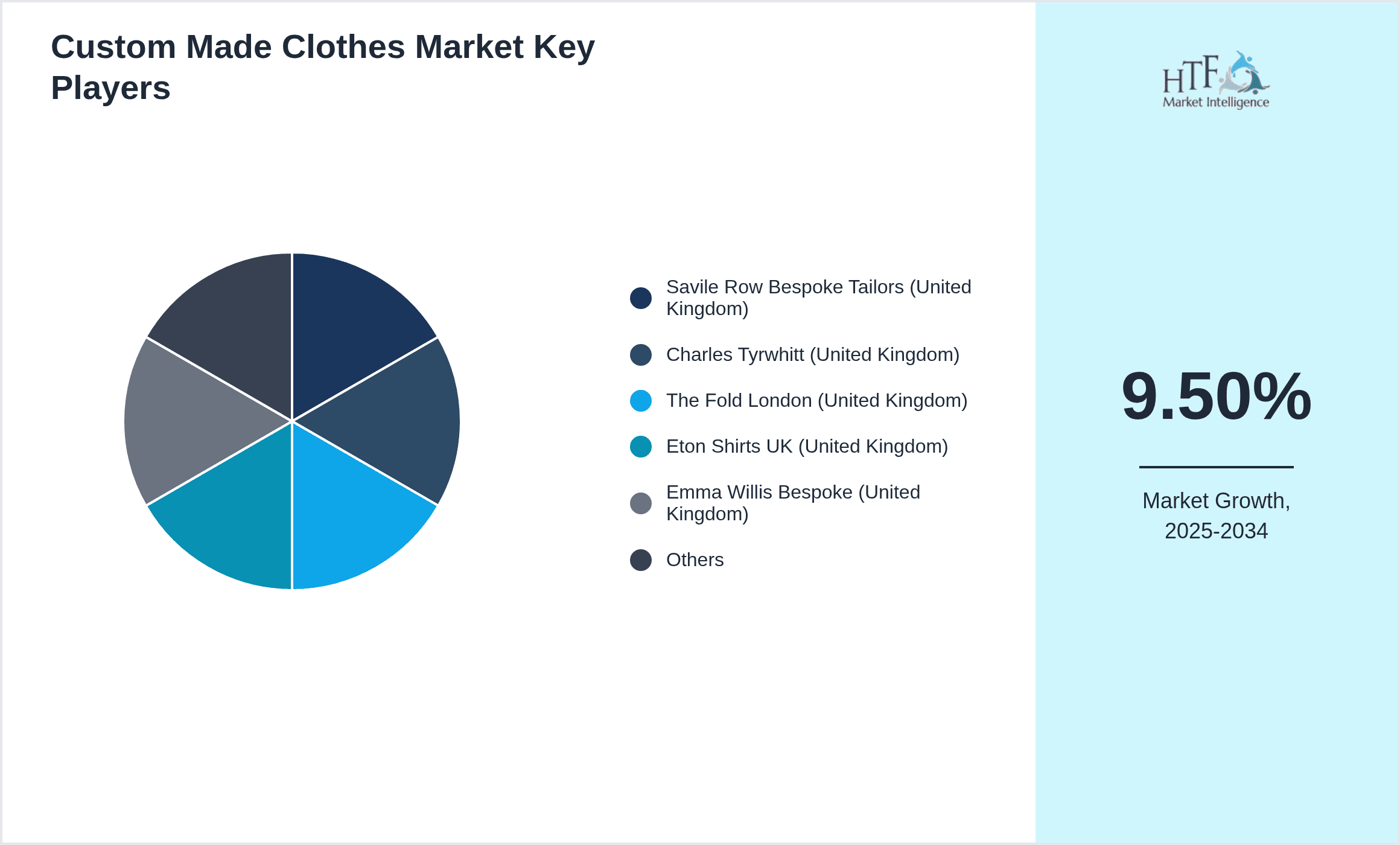
Leading Companies in United Kingdom Custom Made Clothes Market
- •Savile Row Bespoke Tailors (United Kingdom)
- •Charles Tyrwhitt (United Kingdom)
- •The Fold London (United Kingdom)
- •Eton Shirts UK (United Kingdom)
- •Emma Willis Bespoke (United Kingdom)
- •Private White V.C. (United Kingdom)
- •Richard James London (United Kingdom)
- •Albion (United Kingdom)
- •Bespoke Innovations Ltd (United Kingdom)
- •Otto & Spike (United Kingdom)
- •Hockerty UK (United Kingdom)
- •Hardy Amies (United Kingdom)
- •Tailor Store UK (United Kingdom)
- •Thom Sweeney (United Kingdom)
- •Cad & The Dandy (United Kingdom)
- •Jermyn Street Shirts (United Kingdom)
- •Turnbull & Asser (United Kingdom)
- •Percival (United Kingdom)
- •J.Hilburn UK (United Kingdom)
- •T.M.Lewin (United Kingdom)
- •Bespoke Atelier London (United Kingdom)
- •Oliver Brown Bespoke (United Kingdom)
- •Richard Anderson Bespoke (United Kingdom)
- •London Custom Tailors (United Kingdom)
- •Savile Club Tailors (United Kingdom)

Market Breakdown
- •By Type
- ◦Bespoke Tailoring
- ◦Made-to-Measure
- ◦Ready-to-Customize
- ◦Luxury Custom Clothing
- ◦Sustainable Custom Clothing
- •By Application
- ◦Casual Wear
- ◦Formal Wear
- ◦Sportswear
- ◦Outerwear
- ◦Accessories
- •By Distribution Channel
- ◦Physical Retail Boutiques
- ◦Online Customization Platforms
- ◦Direct-to-Consumer
- ◦Wholesale to Retailers
- •By Fabric and Material
- ◦Natural Fibers
- ◦Synthetic Fibers
- ◦Blended Fabrics
- ◦Eco-Friendly and Recycled Materials
Growth Dynamics
- •Government initiatives promoting sustainable fashion and local manufacturing have accelerated investment in custom apparel production, enhancing market expansion prospects with regulatory incentives and grants.
- •Strategic partnerships between traditional tailors and technology firms have enabled seamless digital customization experiences, integrating 3D scanning and AI tools to boost consumer engagement and operational efficiency.
- •Technological innovation in fabric development, including sustainable textiles and smart fabrics, is driving product differentiation and attracting environmentally conscious consumers seeking personalized apparel solutions.
- •Rising consumer preference for unique, well-fitted clothing amid increasing awareness of fashion sustainability supports continued adoption of custom made clothes across demographics.
- •Investment in e-commerce platforms and virtual fitting solutions reduces barriers to entry for bespoke services, expanding market reach beyond traditional urban hubs into regional UK zones.
- •Collaborations with luxury brands and influencers amplify market visibility, reinforcing bespoke clothing as aspirational and fostering higher willingness to pay among target customers.
- •The integration of data analytics and customer feedback loops enhances product development cycles, enabling rapid response to fashion trends and consumer demands within the custom apparel sector.

Market Trends
- •The surge in sustainable custom clothing reflects growing environmental concerns, with brands adopting eco-friendly materials and circular fashion principles to attract conscious consumers.
- •Digital transformation is reshaping customer experience through virtual fittings, AI-driven style recommendations, and augmented reality visualization, enhancing convenience and personalization.
- •Luxury bespoke tailoring is expanding its footprint beyond London into emerging regional markets, supported by affluent consumers seeking exclusivity and superior craftsmanship.
- •Collaborative customization platforms enabling co-creation between designers and clients are gaining popularity, fostering stronger brand loyalty and unique fashion statements.
- •Integration of smart textiles offering functionalities like temperature regulation and stain resistance is emerging as a key differentiator in custom apparel offerings.
- •Omnichannel sales strategies merging online convenience with in-store personalization experiences are becoming standard practice among leading UK custom clothing providers.
- •Shifts towards gender-neutral and inclusive clothing designs are influencing product lines, reflecting broader societal changes and expanding market appeal.
Market Opportunities
- •Expanding into underserved UK regions outside London and Southeast England presents significant growth potential by tapping into rising local affluence and fashion awareness.
- •Integrating augmented reality and virtual reality in the customization process can enhance user engagement and reduce return rates, offering a competitive advantage.
- •Collaborations with sustainable fabric producers and technology innovators open avenues for product diversification and stronger positioning in eco-conscious segments.
- •Developing subscription-based custom clothing services can secure recurring revenue streams and deepen customer relationships in an evolving retail landscape.
- •Leveraging data analytics to personalize marketing and design can increase customer acquisition and retention through targeted offerings aligned with individual preferences.
- •Expanding partnerships with luxury retailers and fashion influencers can amplify brand visibility and access premium consumer segments within the UK market.
- •Incorporating circular economy principles through take-back and recycling programs can enhance sustainability credentials and attract eco-aware consumers.
Market Challenges
- •High production costs and skilled labor shortages constrain scalability and limit price competitiveness against mass-produced apparel alternatives.
- •Consumer hesitation towards online customization due to fit uncertainty and technology unfamiliarity hinders faster market penetration.
- •Fragmented market structure with numerous small-tailoring shops creates challenges for brand consolidation and consistent quality standards.
- •Regulatory compliance with evolving sustainability standards imposes additional operational complexities and cost burdens.
- •Supply chain disruptions affecting sustainable fabric availability impact production timelines and consumer satisfaction.
- •Limited consumer awareness of custom clothing benefits outside major cities restricts broader adoption across the UK population.
- •Competitive pressure from fast fashion and ready-to-wear brands offering lower prices challenges bespoke apparel market share growth.
Regulatory Framework
- •The UK Government’s 2020 Textile Strategy introduced stringent environmental compliance requirements focusing on sustainable sourcing and waste reduction, impacting custom clothing manufacturers by mandating eco-friendly practices.
- •In 2022, the Environmental Protection Act amendments enforced stricter regulations on chemical use in textiles, compelling bespoke tailors to adopt safer dyeing and finishing processes.
- •The 2021 Consumer Rights Act update enhanced transparency obligations for custom garment retailers, requiring clear communication of customization limitations and return policies.
- •The UK Fashion Industry Charter on Climate Change, launched in 2023, incentivizes companies to reduce carbon footprints, encouraging adoption of sustainable fabrics and energy-efficient production methods.
- •The Brexit-induced trade policies since 2021 have affected import tariffs on raw materials, influencing cost structures for UK-based bespoke clothing manufacturers relying on international suppliers.
Market Intelligence
- •15th January 2025, Savile Row Bespoke Tailors launched an AI-powered virtual fitting room platform enabling clients across the UK to experience precise garment fitting remotely. This innovation reduces fitting errors and customer returns, enhancing operational efficiency and expanding their digital outreach beyond traditional London clientele. The platform integrates 3D scanning and personalized style recommendations, positioning the company at the forefront of digital transformation in bespoke tailoring. Source: Savile Row Bespoke Tailors Official Website
- •22nd March 2025, The Fold London announced a strategic partnership with a sustainable fabric producer to exclusively source eco-friendly textiles for its custom-made casual wear line. This collaboration aims to reduce the environmental impact of production while meeting growing consumer demand for sustainable fashion in the UK. The initiative includes a take-back recycling program to close the garment lifecycle loop. Source: The Fold London Press Release
- •10th May 2024, Charles Tyrwhitt expanded its online customization platform by integrating augmented reality (AR) technology, allowing customers to visualize garments in real-time before purchase. This enhancement improves user experience and reduces fitting uncertainty, driving higher conversion rates. The company also launched a new made-to-measure suit collection tailored for the UK’s professional segment. Source: Charles Tyrwhitt Corporate News
- •5th February 2025, Bespoke Innovations Ltd completed acquisition of a regional tailoring chain in Southeast England, consolidating market presence and expanding bespoke service offerings. This move enables scale efficiencies, broader geographic coverage, and the introduction of technology-enabled customization services targeting emerging affluent markets outside London. Source: Industry Publication, UK Fashion Market Insights
Dominant Segments
- •Bespoke tailoring remains the leading product segment, renowned for high precision, superior craftsmanship, and premium pricing that appeals to affluent UK consumers seeking exclusivity.
- •Physical retail boutiques, especially in London and Southeast England, dominate the distribution landscape, complemented increasingly by online customization platforms enhancing accessibility.
- •Sustainable custom clothing is the fastest growing segment, driven by rising environmental awareness among younger demographics and regulatory encouragement.
Market Explosion: A Rapidly Growing Sector
- •The United Kingdom Custom Made Clothes Market is valued at USD 1.2 Billion in 2025, reflecting strong consumer demand for personalized apparel.
- •Forecasts project market growth to reach USD 2.8 Billion by 2034, driven by increasing adoption of bespoke and sustainable clothing solutions.
- •The sector is expected to expand at a CAGR of 9.5% between 2025 and 2034, supported by technological innovation and shifting consumer preferences.
- •Additional growth is indicated by an annual average revenue increase of approximately 9.1%, signaling robust market momentum.
Key Drivers of Growth
- •UK government incentives promoting sustainable manufacturing practices provide financial support and regulatory clarity, encouraging market participants to innovate.
- •Strategic partnerships between bespoke tailors and technology firms enhance customization capabilities and digital reach, improving customer engagement.
- •Technological advancements in fabric technology and AI-driven design tools enable higher quality, efficient production, and personalized offerings.
Future Outlook: A Connected and Sustainable Ecosystem
- •Market expansion will increasingly target regional UK zones such as Southeast England, Midlands, and Scotland, leveraging rising local affluence and fashion adoption.
- •London continues to dominate as the core hub for bespoke tailoring and fashion innovation within the UK market.
- •Long-term industry transformation will emphasize sustainability, digital integration, and circular economy principles, fostering a connected and eco-conscious apparel ecosystem.
The Road Ahead: Embrace the Digital Customization Revolution
- •The United Kingdom Custom Made Clothes Market is set to transform through digital innovation and sustainability integration, reshaping consumer expectations and industry standards.
- •Embracing advanced technologies and eco-conscious practices will drive long-term growth, positioning the UK as a global leader in personalized apparel.
Regional Outlook
The London currently holds a significant share of the market, primarily due to several key factors: increasing consumption rates, a burgeoning population, and robust economic momentum. These elements collectively drive demand, positioning this region as a leader in the market. On the other hand, Southeast England is rapidly emerging as the fastest-growing area within the industry. This remarkable growth can be attributed to swift infrastructure development, the expansion of various industrial sectors, and a marked increase in consumer demand. These dynamics make this region a crucial player in shaping future market growth.
In our report, we cover a comprehensive analysis of the following regions and countries:
- England
- Scotland
- Wales
- Northern Ireland
| Feature | Details |
|---|---|
| Base Year Market Size | USD 1.2 Billion |
| Forecast Year Market Size | USD 2.8 Billion |
| CAGR | 9.5% |
| Forecast Period | 2026 to 2033 |
| YoY Growth | 9.1% |
| Regions Covered | England, Scotland, Wales, Northern Ireland |
| Key Companies | Savile Row Bespoke Tailors (United Kingdom), Charles Tyrwhitt (United Kingdom), The Fold London (United Kingdom), Eton Shirts UK (United Kingdom), Emma Willis Bespoke (United Kingdom), Private White V.C. (United Kingdom), Richard James London (United Kingdom), Albion (United Kingdom), Bespoke Innovations Ltd (United Kingdom), Otto & Spike (United Kingdom), Hockerty UK (United Kingdom), Hardy Amies (United Kingdom), Tailor Store UK (United Kingdom), Thom Sweeney (United Kingdom), Cad & The Dandy (United Kingdom), Jermyn Street Shirts (United Kingdom), Turnbull & Asser (United Kingdom), Percival (United Kingdom), J.Hilburn UK (United Kingdom), T.M.Lewin (United Kingdom), Bespoke Atelier London (United Kingdom), Oliver Brown Bespoke (United Kingdom), Richard Anderson Bespoke (United Kingdom), London Custom Tailors (United Kingdom), Savile Club Tailors (United Kingdom) |
United Kingdom Custom Made Clothes Market Size, Growth & Revenue 2025-2034 - Table of Contents
Frequently Asked Questions (FAQ):
The Compact Track Loaders market is projected to grow at a CAGR of 6.8% from 2025 to 2030, driven by increasing demand in construction and agricultural sectors.
North America currently leads the market with approximately 45% market share, followed by Europe at 28% and Asia-Pacific at 22%. The remaining regions account for 5% of the global market.
Key growth drivers include increasing construction activities, rising demand for versatile equipment in agriculture, technological advancements in track loader design, and growing preference for compact equipment in urban construction projects.