
South America Machine Learning Recommendation Algorithm Market - Outlook 2024-2034
South America Machine Learning Recommendation Algorithm Market is segmented by Type (Collaborative Filtering, Content-Based Filtering, Hybrid Filtering, Context-Aware Filtering, Deep Learning-Based), Application (E-commerce, Media & Entertainment, Healthcare, Banking & Finance, Retail), Deployment Model (Cloud-based, On-premise, Hybrid), End User Industry (Retailers, Financial Institutions, Healthcare Providers, Media Companies, Telecommunications), and Geography (Brazil, Argentina, Chile, Peru, Colombia, Rest of South America)
Pricing
Report Overview
Executive Summary
- •The South America Machine Learning Recommendation Algorithm market represents a critical segment of the region's digital innovation landscape, offering personalized algorithmic solutions that enhance user engagement and drive revenue growth across multiple industries such as e-commerce, healthcare, and finance. This market is defined by the deployment of sophisticated recommendation systems including collaborative filtering, content-based, hybrid, context-aware, and deep learning-based algorithms tailored to the unique consumer behaviors and data ecosystems found in South American countries. With a growing digital footprint and increasing adoption of AI technologies, the market boundaries encompass software development, system integration, and service delivery that address localized needs and regulatory frameworks. Primary use cases include personalized product suggestions, content curation, fraud detection, and customer retention strategies. The market’s evolution is fueled by rising internet penetration, mobile commerce expansion, and enhanced data availability, positioning South America as a fertile ground for advanced machine learning applications that support business optimization and enhanced consumer experiences.
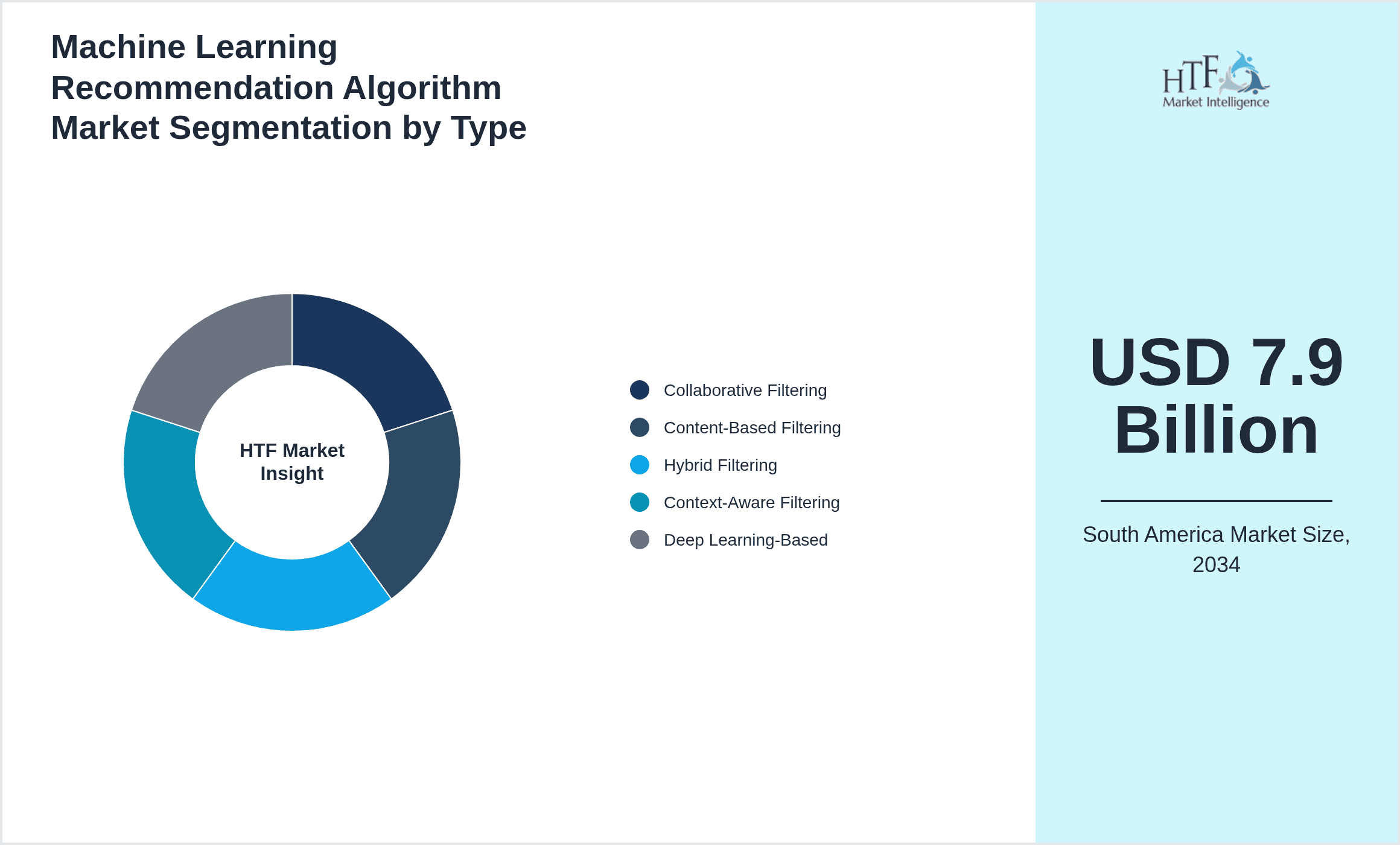
- •Key highlights of the South America Machine Learning Recommendation Algorithm market include a robust CAGR of 15.8% projected from 2024 to 2034, with the market size expected to expand from USD 1.8 billion in 2024 to USD 7.9 billion by 2034. Brazil dominates the regional landscape, accounting for approximately 35% market share, while Argentina is emerging as the fastest-growing country with a CAGR of 19.3%. Collaborative filtering remains the leading product type due to its effectiveness and widespread implementation, but deep learning-based algorithms are gaining rapid traction owing to superior accuracy and adaptability. Applications in e-commerce and media & entertainment represent the largest segments, driven by increasing consumer demand for personalized experiences. The market’s year-over-year growth stands at 15.1%, underscoring a significant expansion trajectory supported by technological advances and rising AI adoption across industries.
- •The strategic importance of the South America Machine Learning Recommendation Algorithm market lies in its capacity to transform traditional business models, enabling companies to harness data-driven insights for competitive advantage. By delivering tailored recommendations, businesses enhance customer satisfaction and loyalty, which is crucial in the region’s rapidly digitizing economies. Stakeholders ranging from technology providers to end-users benefit from increased operational efficiency and monetization opportunities. The market’s growth is further propelled by supportive government policies promoting AI innovation, investment in digital infrastructure, and growing consumer affinity for personalized digital interactions. Ultimately, this market serves as a cornerstone for the broader AI ecosystem in South America, facilitating innovation, economic development, and enhanced digital services across diverse sectors.

Competitive Landscape
The competitive environment in the South America Machine Learning Recommendation Algorithm market is characterized by a dynamic interplay of global technology leaders and emerging regional innovators. Market players focus on differentiation through continuous algorithmic enhancements, integration capabilities with various platforms, and customization tailored to local market nuances. Innovation is a key competitive strategy, with companies investing heavily in deep learning and hybrid recommendation models to improve accuracy and user engagement. Strategic partnerships and collaborations with local enterprises enable wider market penetration and service localization. Price competitiveness and scalable solutions also define market positioning, as vendors strive to offer cost-effective yet high-performance recommendation systems. Additionally, competition revolves around building robust data privacy and compliance frameworks to address strict regional regulations. Overall, the rivalry fosters rapid technological advancement, improved customer-centric solutions, and expansion into new verticals, which collectively drive the market’s sustained growth and maturity in South America.
Key Players in Machine Learning Recommendation Algorithm Market
- •IBM Corporation (United States)
- •Google LLC (United States)
- •Microsoft Corporation (United States)
- •SAP SE (Germany)
- •Oracle Corporation (United States)
- •Amazon Web Services, Inc. (United States)
- •Accenture plc (Ireland)
- •Cognizant Technology Solutions (United States)
- •Globant S.A. (Argentina)
- •Nubank (Brazil)
- •TOTVS S.A. (Brazil)
- •Despegar.com (Argentina)
- •Mercado Libre, Inc. (Argentina)
- •Stefanini IT Solutions (Brazil)
- •NeuralMind (Brazil)
- •Axur (Brazil)
- •Docket (Brazil)
- •Inmetrics (Brazil)
- •K2 Partnering Solutions (Brazil)
- •B2W Companhia Digital (Brazil)
- •Linio (Colombia)
- •VTEX (Brazil)
- •Movile (Brazil)
- •Arco Educação (Brazil)
- •Take Blip (Brazil)

Market Breakdown
- •By Type
- ◦Collaborative Filtering
- ◦Content-Based Filtering
- ◦Hybrid Filtering
- ◦Context-Aware Filtering
- ◦Deep Learning-Based
- •By Application
- ◦E-commerce
- ◦Media & Entertainment
- ◦Healthcare
- ◦Banking & Finance
- ◦Retail
- •By Deployment Model
- ◦Cloud-based
- ◦On-premise
- ◦Hybrid
- •By End User Industry
- ◦Retailers
- ◦Financial Institutions
- ◦Healthcare Providers
- ◦Media Companies
- ◦Telecommunications
Growth Dynamics
- •The South America Machine Learning Recommendation Algorithm market is primarily driven by increasing digital transformation initiatives across industries such as retail, finance, and healthcare. Companies in Brazil and Argentina are aggressively adopting AI-powered recommendation systems to enhance customer personalization and operational efficiency. The surge in e-commerce activities, accelerated by mobile device penetration and improved internet infrastructure, significantly fuels demand for sophisticated recommendation algorithms. Additionally, growing investments in AI research and development by local startups and multinational firms create a robust innovation ecosystem. Government support through digital economy policies and AI-focused programs further bolster market growth. The convergence of big data availability and advanced analytics capabilities enables businesses to leverage machine learning algorithms for more accurate and context-aware recommendations, ultimately driving higher customer engagement and revenue expansion across South American markets.
- •Trends in the South America market reveal an increasing shift towards hybrid recommendation models that combine collaborative filtering and content-based techniques to improve accuracy and relevance. The adoption of deep learning algorithms is gaining momentum due to their superior capability in handling complex data and delivering real-time personalized recommendations. Cloud-based deployment of recommendation systems is becoming prevalent, offering scalability and cost efficiency. Moreover, integration of recommendation algorithms with conversational AI and voice assistants is emerging, enhancing user interaction and experience. Regional players are focusing on developing localized datasets and culturally tailored algorithms to better serve diverse South American consumer bases. Sustainability and ethical AI practices are also influencing development trends, with companies emphasizing transparency and fairness in recommendation outputs.
- •Restraints impacting market growth include data privacy concerns and stringent regulations in South America that limit data collection and algorithmic processing. The high initial investment and complexity involved in deploying advanced machine learning recommendation systems pose challenges for small and medium enterprises. Additionally, scarcity of skilled AI professionals in the region hampers rapid deployment and optimization of these algorithms. Fragmented market landscapes and inconsistent digital infrastructure across countries create integration difficulties. Resistance to change and limited awareness of AI benefits among some traditional industries further restrict adoption rates. Moreover, algorithmic biases and lack of standardized frameworks for evaluating recommendation accuracy can undermine user trust and acceptance, slowing down widespread market penetration.
- •Opportunities in the South America Machine Learning Recommendation Algorithm market arise from expanding internet connectivity and smartphone adoption, unlocking new user bases for personalized services. Growth in sectors such as healthcare and banking, increasingly leveraging AI for customer engagement and fraud detection, presents fertile ground for algorithm deployment. Collaborations between global tech firms and regional businesses can accelerate technology transfer and market expansion. Emerging economies within South America offer untapped potential for tailored recommendation solutions addressing local languages and cultural preferences. Additionally, government initiatives promoting AI education and innovation hubs create an enabling environment. The rising trend of omnichannel retailing also opens avenues for integrating recommendation algorithms across digital and physical customer touchpoints, enhancing overall consumer experience and loyalty.
- •Challenges confronting the South America market include infrastructure disparities that limit consistent access to high-quality data needed for effective machine learning. Complex regulatory environments with evolving data protection laws necessitate constant compliance efforts, increasing operational costs. Market fragmentation with diverse languages, cultures, and economic conditions complicates algorithm localization and scalability. Dependence on imported technologies and limited indigenous AI development capacity restricts innovation. Furthermore, cybersecurity threats targeting sensitive consumer data can erode confidence in AI systems. The ongoing global chip shortage indirectly affects hardware availability for AI deployments. Finally, competition from established global players with greater resources may overwhelm local companies, posing challenges for market entrants and sustaining long-term growth.
Market Trends
- •The South America market is witnessing a pronounced trend of integrating machine learning recommendation algorithms with big data analytics platforms, enabling real-time personalization and enhanced predictive capabilities. Companies are increasingly leveraging user behavioral data to refine recommendation accuracy and improve customer lifetime value. The rise of mobile commerce has prompted algorithm optimization for mobile-first environments, ensuring seamless user experiences. Additionally, there is growing adoption of explainable AI to provide transparency in recommendation logic, addressing trust and ethical concerns. Regional startups are innovating with AI-powered chatbots that incorporate recommendation engines, expanding omnichannel engagement. Sustainability considerations are influencing algorithm design to promote responsible consumption patterns. These trends collectively underscore the market's maturation and emphasis on user-centric, ethical, and scalable AI solutions.
- •Emerging trends include the deployment of federated learning models to enhance data privacy while enabling collaborative algorithm training across institutions in South America. This approach mitigates data sharing barriers and complies with local data protection regulations. The use of reinforcement learning for dynamic recommendation adjustments based on user feedback is gaining traction. Cloud-native architectures and microservices are enabling flexible and scalable deployment of recommendation systems. Partnerships between technology providers and academic institutions foster innovation and talent development. Moreover, the integration of natural language processing with recommendation algorithms facilitates improved content discovery in Spanish and Portuguese languages, catering to diverse regional audiences. The convergence of AI with IoT devices is also expanding personalized recommendation applications in smart homes and retail.
- •Strategic trends show increased collaboration between multinational corporations and local South American companies to co-develop tailored recommendation solutions suited to regional markets. Investments in AI startups focused on recommendation technologies have surged, promoting innovation ecosystems. Companies are adopting subscription-based and SaaS models for recommendation algorithm delivery, lowering entry barriers. The rise of ethical AI frameworks and standards is influencing product development and market positioning. Integration with augmented reality and virtual assistants is creating novel customer engagement avenues. Data localization requirements are shaping infrastructure investments, prompting localized data centers. These strategic shifts highlight a market moving towards collaborative, customer-centric, and compliant AI adoption with a focus on sustainable growth.
- •Digitalization across industries drives operational efficiency improvements through AI-powered recommendation systems capable of automating personalized marketing and content delivery. Sustainability initiatives inspire algorithmic designs that prioritize eco-friendly product recommendations. Market segmentation by customer demographics and preferences is refined using advanced clustering techniques, enabling hyper-personalized experiences. Enhanced data visualization tools integrated with recommendation platforms assist decision-makers in understanding consumer patterns. The proliferation of 5G networks in South America accelerates real-time data processing capabilities for recommendation engines. Multi-cloud strategies adopted by enterprises improve system resilience and flexibility. These trends collectively foster a sophisticated ecosystem where machine learning recommendation algorithms play a pivotal role in business transformation and consumer engagement.
- •Collaborations between technology vendors and telecommunication companies are increasing, allowing for embedded recommendation services within communication platforms. Open-source frameworks for machine learning recommendations are gaining popularity, reducing development costs and accelerating innovation. Consumer preference shifts towards privacy-preserving AI solutions influence market offerings. The emergence of AI ethics committees within organizations ensures responsible deployment of recommendation algorithms. Regional governments are investing in AI literacy and workforce development programs, expanding the talent pool. Cross-industry data sharing initiatives, within regulatory limits, enhance algorithm training datasets. The evolution of blockchain technology is explored for securing data provenance and enhancing recommendation system transparency. These developments reflect a market that values innovation, responsibility, and cross-sector cooperation.
- •Consumer behavior analysis indicates growing demand for personalized and contextually relevant recommendations, with users expecting seamless omnichannel experiences. Market segmentation is refined using AI-driven customer profiling, enabling targeted marketing strategies. Value chain evolution includes integration of recommendation algorithms into supply chain and inventory management for demand forecasting. There is an increasing focus on scalability and modularity in AI solutions to accommodate business growth. Advances in edge computing enable low-latency recommendations on devices, enhancing user experience in remote areas. The adoption of multilingual recommendation systems supports the region’s linguistic diversity. Future directions involve exploring quantum computing potentials for accelerating recommendation algorithm processing. The market is poised for disruptive innovations that redefine personalization standards and competitive dynamics.
- •Future directions emphasize development of adaptive recommendation algorithms capable of learning from changing consumer preferences and market trends in real time. Disruptive innovations include integration with immersive technologies such as augmented reality for interactive product discovery. There is exploration of hybrid human-AI recommendation models to combine algorithmic efficiency with human intuition. Privacy-enhancing computation techniques are being advanced to support compliance and user trust. The market anticipates increased focus on cross-border data collaboration within South America to enrich recommendation datasets. Strategic implications suggest that companies investing in research and development and ecosystem partnerships will lead market transformation. The overall trajectory points to a personalized, ethical, and technologically sophisticated machine learning recommendation algorithm landscape by 2034.

Market Opportunities
- •Expanding internet penetration and smartphone usage across South America create vast new user segments for machine learning recommendation algorithms, particularly in underserved rural and semi-urban areas. This presents opportunities for tailored algorithmic solutions addressing local languages, cultural nuances, and consumption patterns, enhancing engagement and market reach. Additionally, growth in digital payment adoption and fintech services opens avenues for recommendation systems in personalized financial product offerings and fraud prevention. The healthcare sector’s increasing digitization supports AI-driven patient engagement and treatment recommendation solutions. Collaborations with regional governments to promote AI innovation hubs and startup accelerators provide conducive environments for market entry and expansion. Furthermore, the rising demand for omnichannel retail experiences enables integration of recommendation algorithms across physical and digital platforms, offering differentiated customer journeys and loyalty programs. These opportunities highlight significant growth potential through localization, sector diversification, and ecosystem collaboration.
- •Untapped segments such as small and medium enterprises (SMEs) in South America represent a promising opportunity for cost-effective, scalable recommendation algorithm solutions. The integration of AI with emerging technologies like Internet of Things (IoT) and voice assistants enables novel applications in smart retail and home automation. Expansion into multilingual recommendation systems tailored for Spanish and Portuguese speakers addresses linguistic diversity challenges. Strategic partnerships with telecom operators facilitate bundled offerings that enhance accessibility. Increasing consumer awareness about personalized digital experiences drives demand for advanced AI solutions. Innovative business models, including AI-as-a-Service, lower barriers to adoption and encourage experimentation. Geographic expansion into growing economies like Colombia and Chile further diversifies market reach. These factors collectively create avenues for capturing new customer bases and strengthening market presence.
- •Investment opportunities exist in developing hybrid and deep learning-based recommendation algorithms that outperform traditional methods in accuracy and adaptability. Integration with blockchain technology offers prospects for secure, transparent recommendation ecosystems, enhancing user trust. There is scope for developing industry-specific recommendation solutions, such as for healthcare diagnostics or financial advisory, leveraging domain expertise. Government incentives for AI research and digital transformation programs support funding and innovation. Expansion of cloud infrastructure and data centers across South America enables efficient algorithm deployment and scalability. Collaborations with academic institutions foster talent development and cutting-edge research. Additionally, growing emphasis on ethical AI and data privacy compliance opens markets for solutions focusing on transparency and fairness. These investments position companies at the forefront of technological leadership and market differentiation.
- •Geographical expansion into emerging South American markets like Peru and Ecuador presents opportunities to establish early mover advantages in machine learning recommendation algorithms. New applications in sectors such as education and public services broaden market scope, enabling AI-driven personalized learning and citizen engagement. Product development focusing on mobile-first and offline-capable recommendation systems caters to infrastructure limitations. Enhancing service portfolios with consulting and integration support addresses adoption challenges faced by traditional industries. Value proposition improvements through real-time analytics and adaptive algorithms increase customer satisfaction and retention. Strategic alliances with local technology firms accelerate market entry and cultural adaptation. These opportunities underscore the potential for growth through diversification, innovation, and regional collaboration.
- •Partnership and acquisition prospects abound in consolidating fragmented market segments and expanding technological capabilities. Collaborations between global AI leaders and South American startups facilitate knowledge sharing and co-creation of innovative recommendation systems. Government-backed initiatives promoting AI ethics and standards offer frameworks for market differentiation. Growing demand for privacy-preserving AI solutions invites development of compliant, secure recommendation platforms. Integration with emerging 5G networks enables ultra-low latency services, enhancing user experience. Future market needs include adaptive algorithms capable of evolving with changing consumer behaviors and regulatory landscapes. These strategic opportunities enable companies to build resilient, future-ready market positions aligned with evolving technological and societal trends.
- •Emerging regulatory frameworks in South America focusing on data protection and AI transparency create opportunities for companies specializing in compliant recommendation algorithm development. There is growing societal demand for AI solutions that reduce bias and promote inclusivity, opening markets for ethical AI offerings. Increasing digital literacy among consumers enhances acceptance and usage of personalized recommendation services. Expansion of AI education and training programs supports talent pipeline development, enabling scalable growth. Industry verticals such as logistics and tourism are beginning to adopt recommendation algorithms, presenting new application areas. The shift towards subscription and outcome-based pricing models provides flexible revenue streams. These evolving market needs and regulatory changes drive innovation and strategic positioning for long-term success.
- •Future market needs indicate increased demand for interoperable recommendation platforms that integrate seamlessly with diverse enterprise systems, enhancing usability and adoption. Regulatory changes emphasizing user consent and data sovereignty require algorithmic transparency and auditability, fostering trust. Societal trends towards responsible AI encourage development of explainable recommendation models. The rise of digital ecosystems and marketplaces demands scalable, customizable recommendation solutions capable of serving heterogeneous user bases. Investment in AI infrastructure and cloud capabilities will support real-time, high-volume recommendation processing. These trends project a market evolution focused on adaptability, compliance, and user-centric innovation, driving competitive advantage and sustainable growth.
Market Challenges
- •A major challenge in the South America Machine Learning Recommendation Algorithm market is navigating the complex and evolving data privacy regulations across different countries, which restrict data availability and impose stringent compliance requirements. This regulatory complexity increases operational costs and complicates algorithm development and deployment. Technical limitations such as insufficient high-quality data and underdeveloped digital infrastructure in certain regions hinder the effectiveness and scalability of recommendation systems. The shortage of skilled AI professionals limits innovation capacity and prolongs implementation timelines. Market fragmentation caused by linguistic and cultural diversity necessitates extensive localization efforts, increasing development complexity. Additionally, resistance from traditional industries to adopt AI-driven solutions slows market penetration. These challenges require strategic investments in compliance, talent development, and technological adaptation to overcome barriers and realize growth potential.
- •Resource constraints pose significant obstacles for small and medium-sized enterprises in adopting advanced machine learning recommendation algorithms due to high initial costs and technical expertise requirements. Integration of recommendation systems with legacy IT infrastructure presents compatibility and performance issues. Algorithmic biases and lack of transparency can lead to user distrust and regulatory scrutiny, impacting adoption rates. Competition from large global technology providers with extensive resources may marginalize local players, limiting market diversity. Cybersecurity threats targeting sensitive consumer data exacerbate risks and necessitate robust protection measures. Infrastructure disparities between urban and rural areas affect consistent service delivery and user experience. Addressing these multifaceted challenges is critical for fostering an inclusive and sustainable machine learning recommendation algorithm market in South America.
- •Companies face difficulties in maintaining data quality and consistency across diverse sources, which affects recommendation accuracy and system reliability. Rapidly changing consumer preferences require agile algorithm updates, challenging development cycles. Limited standardization in evaluation metrics for recommendation performance complicates benchmarking and improvement efforts. Economic volatility in certain South American countries impacts investment flows and market confidence. Intellectual property concerns around proprietary algorithms and data usage create legal complexities. Dependence on imported AI hardware and software components exposes the market to supply chain disruptions. These operational and strategic challenges necessitate comprehensive risk management and innovation strategies to sustain market momentum.
- •The heterogeneity of South American markets demands extensive customization of recommendation algorithms, increasing development costs and time to market. Limited access to real-time data due to infrastructural constraints affects the responsiveness of recommendation systems. Organizations encounter challenges in balancing personalization with privacy, needing to implement sophisticated anonymization and consent mechanisms. Market education gaps regarding AI benefits and implementation practices impede adoption in certain sectors. Interoperability issues between diverse technology stacks hinder seamless integration and scalability. Furthermore, fluctuating regulatory landscapes require continuous monitoring and adaptation, straining resources. Overcoming these challenges is essential to unlock the full potential of machine learning recommendation algorithms within the region.
- •The relatively nascent stage of AI adoption in some South American countries limits mature market demand and ecosystem development. Competition among numerous small vendors can lead to fragmented offerings and inconsistent quality. Difficulties in securing sustained funding for AI projects reduce long-term innovation prospects. Ethical concerns about algorithmic decisions and potential job displacements generate public skepticism. The need for multilingual support in recommendation systems increases complexity and costs. Lack of comprehensive data governance frameworks affects data sharing and collaboration opportunities. Addressing these societal, economic, and technological challenges is critical for establishing a robust and competitive machine learning recommendation algorithm market in South America.
Regulatory Framework
- •Between 2019 and 2024, South American countries have progressively enacted data protection laws aligned with international standards, such as Brazil’s General Data Protection Law (LGPD) in 2020, mandating strict user consent and data handling protocols. These regulations significantly influence the development and deployment of machine learning recommendation algorithms by requiring transparency, data minimization, and security measures. Enforcement mechanisms include substantial penalties for non-compliance, compelling companies to adopt comprehensive compliance strategies.
- •Argentina implemented its Personal Data Protection Act with amendments since 2019, enhancing safeguards for personal data used in AI systems. This legislation impacts algorithmic processing by imposing accountability obligations and rights for data subjects, affecting recommendation model training and data utilization.
- •Chile established regulations governing AI applications in the public sector, emphasizing ethical AI principles and transparency, setting precedents for private sector adoption. These guidelines encourage responsible AI use and influence market practices for recommendation algorithms.
- •Peru and Colombia have introduced data privacy frameworks focusing on cross-border data transfers and security standards, affecting multinational companies operating recommendation systems in these countries. Compliance with these mandates is essential for market access and operational continuity.
- •Regional policy initiatives promote AI research, innovation, and digital transformation with government-backed funding programs and strategic roadmaps. These frameworks provide incentives for local development of machine learning recommendation technologies and foster collaboration between academia and industry.
Market Intelligence
- •15th March 2024, Globant S.A., an Argentina-based technology company, launched an advanced deep learning-based recommendation engine tailored to the Latin American e-commerce sector. The new platform integrates natural language processing and real-time analytics to enhance personalization accuracy, supporting multi-language capabilities for Spanish and Portuguese speakers. This innovation aims to improve user engagement and conversion rates for regional retailers by delivering context-aware product suggestions. Globant’s strategic objective is to capitalize on growing digital commerce and expand its AI services portfolio across South America, positioning itself as a leader in localized recommendation technologies. Source: Globant Official Press Release.
- •22nd July 2023, Nubank, headquartered in Brazil, introduced a machine learning recommendation system within its mobile banking app to offer personalized financial product suggestions, including credit offers and investment options. Leveraging customer transaction data and behavioral analytics, the system dynamically adapts to individual financial profiles, enhancing customer satisfaction and cross-selling opportunities. Nubank’s initiative reflects increasing fintech adoption of AI-driven personalization in South America, aiming to deepen customer relationships and boost revenue streams while adhering to Brazil’s stringent data protection regulations. The launch marks a significant step in integrating AI capabilities within regional financial services ecosystems. Source: Nubank Corporate Announcement.
- •Recent market developments and strategic initiatives are continuously tracked through industry publications, company announcements, and regulatory filings. For the most current information, stakeholders are advised to monitor official corporate communications and recognized market intelligence platforms.
- •Recent market developments and strategic initiatives are continuously tracked through industry publications, company announcements, and regulatory filings. For the most current information, stakeholders are advised to monitor official corporate communications and recognized market intelligence platforms.
Mergers & Acquisitions
- •In November 2023, Globant S.A. completed the acquisition of a Brazilian AI startup specializing in deep learning recommendation algorithms. This strategic move enhances Globant’s capabilities in delivering localized, high-accuracy recommendation solutions across South America’s e-commerce and media sectors. The acquisition strengthens Globant’s product portfolio and accelerates innovation by integrating proprietary AI technologies, enabling the firm to better compete with global players and meet increasing regional demand. This consolidation reflects a broader trend of market maturation and the pursuit of technological leadership in the South American machine learning recommendation algorithm space.
- •In May 2022, Mercado Libre, the leading e-commerce platform in Latin America, acquired a Chilean AI company focused on personalized recommendation software. The acquisition aims to bolster Mercado Libre’s recommendation engine for its marketplace and payment platforms, improving customer engagement and sales conversion rates. By integrating advanced machine learning algorithms and contextual filtering techniques, Mercado Libre seeks to enhance user experience and maintain its dominant market position amid intensifying competition. This deal underscores the strategic importance of AI-driven personalization in sustaining growth and competitiveness within South America’s digital economy.
Recent Industry News
- •10th January 2024, Amazon Web Services (AWS) expanded its machine learning services in South America by launching a dedicated recommendation algorithm toolkit optimized for regional languages and consumer behaviors. This initiative supports local startups and enterprises in deploying scalable, customizable recommendation systems on the cloud, aiming to accelerate AI adoption across sectors like retail and finance. AWS’s investment in localized AI infrastructure and training resources reflects its commitment to addressing South America’s unique market requirements and fostering innovation. Source: Amazon Web Services Official Blog.
- •5th August 2023, Microsoft Corporation announced a partnership with Brazil’s TOTVS to integrate advanced machine learning recommendation algorithms into enterprise resource planning (ERP) software. This collaboration facilitates personalized product and service recommendations within business workflows, improving decision-making and customer interactions. The initiative targets South American enterprises seeking AI-driven business intelligence solutions, highlighting growing synergy between global cloud providers and regional technology firms. Source: Microsoft News Center.
- •18th September 2022, Google LLC introduced enhancements to its recommendation AI models incorporating federated learning techniques for improved data privacy compliance in South America. These updates enable organizations to collaboratively train algorithms without exposing sensitive customer data, aligning with local regulatory requirements. Google’s innovation supports wider adoption of machine learning recommendation systems by addressing privacy concerns and enhancing model performance. Source: Google AI Blog.
- •12th June 2021, IBM Corporation launched an AI-powered recommendation platform tailored for Latin American healthcare providers, focusing on patient treatment personalization and resource optimization. The solution utilizes machine learning algorithms to analyze medical histories and clinical data, aiming to improve patient outcomes and operational efficiency. IBM’s initiative demonstrates the expanding role of recommendation algorithms beyond retail and finance into critical sectors within South America. Source: IBM Press Release.
Regional Outlook
The Brazil currently holds a significant share of the market, primarily due to several key factors: increasing consumption rates, a burgeoning population, and robust economic momentum. These elements collectively drive demand, positioning this region as a leader in the market. On the other hand, Argentina is rapidly emerging as the fastest-growing area within the industry. This remarkable growth can be attributed to swift infrastructure development, the expansion of various industrial sectors, and a marked increase in consumer demand. These dynamics make this region a crucial player in shaping future market growth.
In our report, we cover a comprehensive analysis of the following regions and countries:
- Brazil
- Argentina
- Chile
- Peru
- Colombia
- Rest of South America
| Feature | Details |
|---|---|
| Base Year Market Size | USD 1.8 Billion |
| Forecast Year Market Size | USD 7.9 Billion |
| CAGR | 15.8% |
| Forecast Period | 2026 to 2033 |
| YoY Growth | 15.1% |
| Scope of Report | Market is segmented by Type (Collaborative Filtering, Content-Based Filtering, Hybrid Filtering, Context-Aware Filtering, Deep Learning-Based), Application (E-commerce, Media & Entertainment, Healthcare, Banking & Finance, Retail), Deployment Model (Cloud-based, On-premise, Hybrid), End User Industry (Retailers, Financial Institutions, Healthcare Providers, Media Companies, Telecommunications) |
| Regions Covered | Brazil, Argentina, Chile, Peru, Colombia, Rest of South America |
| Key Companies | IBM Corporation (United States), Google LLC (United States), Microsoft Corporation (United States), SAP SE (Germany), Oracle Corporation (United States), Amazon Web Services, Inc. (United States), Accenture plc (Ireland), Cognizant Technology Solutions (United States), Globant S.A. (Argentina), Nubank (Brazil), TOTVS S.A. (Brazil), Despegar.com (Argentina), Mercado Libre, Inc. (Argentina), Stefanini IT Solutions (Brazil), NeuralMind (Brazil), Axur (Brazil), Docket (Brazil), Inmetrics (Brazil), K2 Partnering Solutions (Brazil), B2W Companhia Digital (Brazil), Linio (Colombia), VTEX (Brazil), Movile (Brazil), Arco Educação (Brazil), Take Blip (Brazil) |
South America Machine Learning Recommendation Algorithm Market - Outlook 2024-2034 - Table of Contents
Frequently Asked Questions (FAQ):
The Compact Track Loaders market is projected to grow at a CAGR of 6.8% from 2025 to 2030, driven by increasing demand in construction and agricultural sectors.
North America currently leads the market with approximately 45% market share, followed by Europe at 28% and Asia-Pacific at 22%. The remaining regions account for 5% of the global market.
Key growth drivers include increasing construction activities, rising demand for versatile equipment in agriculture, technological advancements in track loader design, and growing preference for compact equipment in urban construction projects.