
North America Automatic Passenger Count Market Size, Growth & Revenue 2025-2034
North America Automatic Passenger Count Market is segmented by Automatic Passenger Count Technology Type (Infrared Sensors, Video Imaging Systems, Pressure Mat Sensors, Weight Sensors, Radio Frequency Identification (RFID)), Transit Application Segment (Urban Transit, Intercity Bus, Light Rail Transit, Commuter Rail, Airport Transit), Deployment Model (On-Premise Systems, Cloud-Based Solutions, Hybrid Models), End-User Segment (Public Transit Authorities, Private Transportation Operators, Airport Authorities, Rail Operators), and Geography (United States, Canada, Mexico)
Pricing
Report Overview
Executive Summary
- •The North America Automatic Passenger Count market is a vital segment within the public transportation technology industry, focusing on systems that automatically record passenger counts for transit vehicles. These systems leverage a range of sensor technologies such as infrared, video imaging, pressure mats, weight sensors, and RFID to provide accurate, real-time data critical for operational efficiency and service planning. The market serves a broad application scope including urban transit, intercity buses, light rail, commuter rail, and airport transit, reflecting the diverse transit demands across the United States, Canada, and Mexico. Increasing urbanization, government initiatives to modernize public transport infrastructure, and the growing emphasis on data-driven transit management are key factors propelling market growth. The adoption of APC systems aids transit authorities in optimizing route planning, reducing operational costs, and enhancing passenger experience through improved service accuracy. By 2034, the market is projected to grow significantly, driven by technological advancements and expanding transit networks across North America.
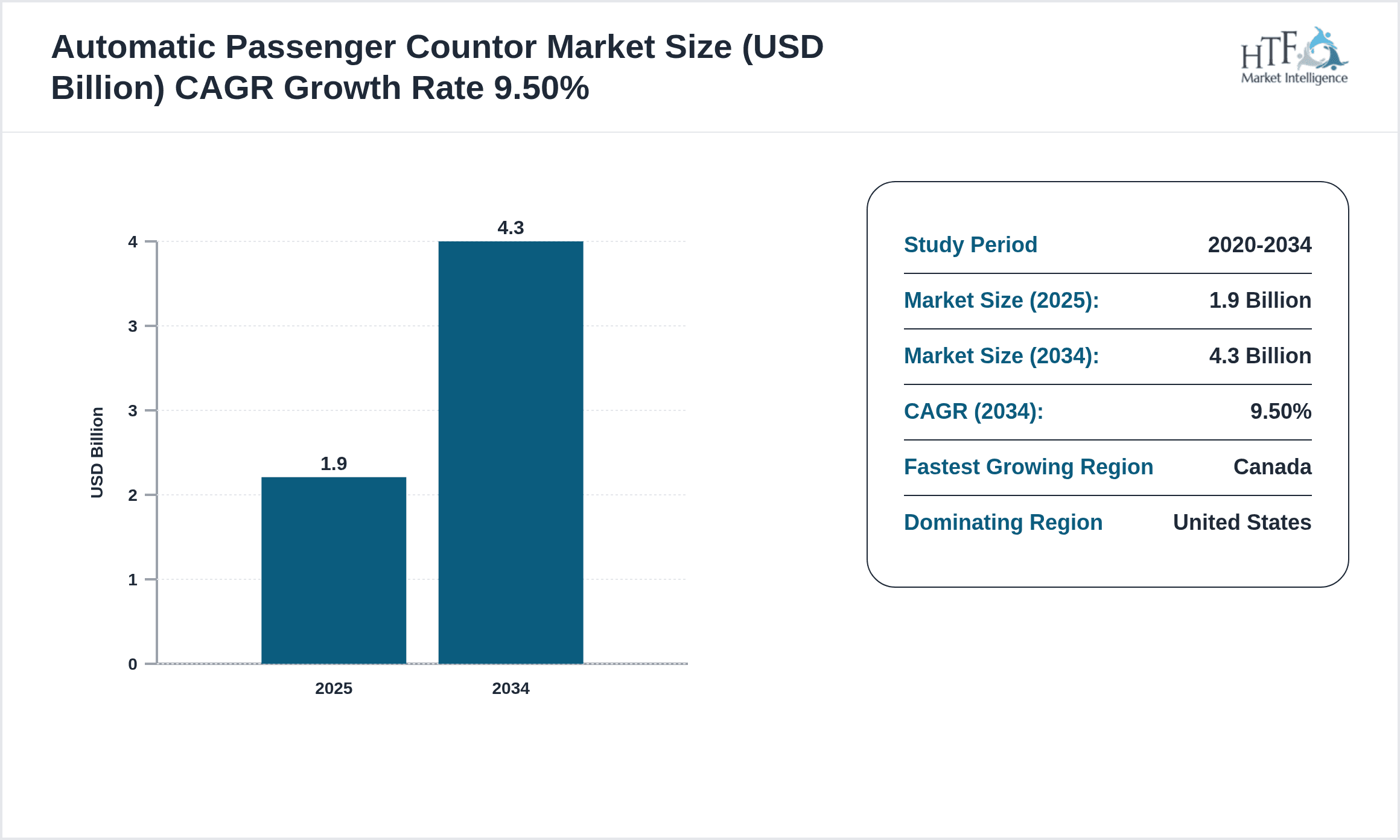
- •The market is expected to witness a compounded annual growth rate (CAGR) of approximately 9.5% from 2025 to 2034, expanding from a base market size of USD 1.9 billion in 2025 to USD 4.3 billion by 2034. The United States dominates the market with a substantial share of around 65%, followed by Canada, which is the fastest-growing country with a CAGR exceeding 12%. Video imaging systems currently lead the product segment due to their accuracy and integration capabilities, while RFID is the fastest growing technology, fueled by enhanced automation and contactless data capture. Urban transit remains the largest application segment, reflecting the high demand for passenger data in metropolitan areas. Market dynamics are shaped significantly by increasing investments in smart transit infrastructure and regulatory mandates requiring precise passenger data for fare management and service improvements.
- •The North America Automatic Passenger Count market presents a compelling value proposition for transit authorities, technology providers, and stakeholders engaged in public transportation. The integration of APC systems into transit operations enables data-driven decision-making, enhances revenue assurance through accurate fare collection, and supports sustainability goals by facilitating optimized vehicle deployment. Furthermore, advancements in sensor technology and software analytics offer scalable solutions adaptable to various transit modes and operational complexities. Strategic importance is underscored by government funding programs aimed at modernizing transit infrastructure and the increasing need for reliable ridership data amidst growing urban populations. As transit networks evolve, the APC market is poised to play a crucial role in shaping efficient, safe, and passenger-centric public transportation systems across North America.
Competitive Landscape
The North America Automatic Passenger Count market is characterized by intense competition among technology providers specializing in sensor development, data analytics, and transit system integration. Market players focus on innovation to enhance accuracy, ease of deployment, and integration with existing transit management systems. Competitive strategies include investing in R&D for advanced video imaging and RFID technologies, forming strategic partnerships with transit authorities, and expanding service portfolios to include software and analytics platforms. The rivalry is also shaped by pricing strategies, after-sales support, and the ability to customize solutions to diverse transit modes. Market entry barriers include the technical complexity of APC systems and stringent regulatory requirements for data privacy and accuracy. Regional competition is robust, with firms striving to capture contracts in the United States and Canada, the largest markets. Future trends indicate increased consolidation through mergers and acquisitions, as companies seek to broaden their technological capabilities and geographic reach within the North American market.
Leading Companies in North America Automatic Passenger Count Market
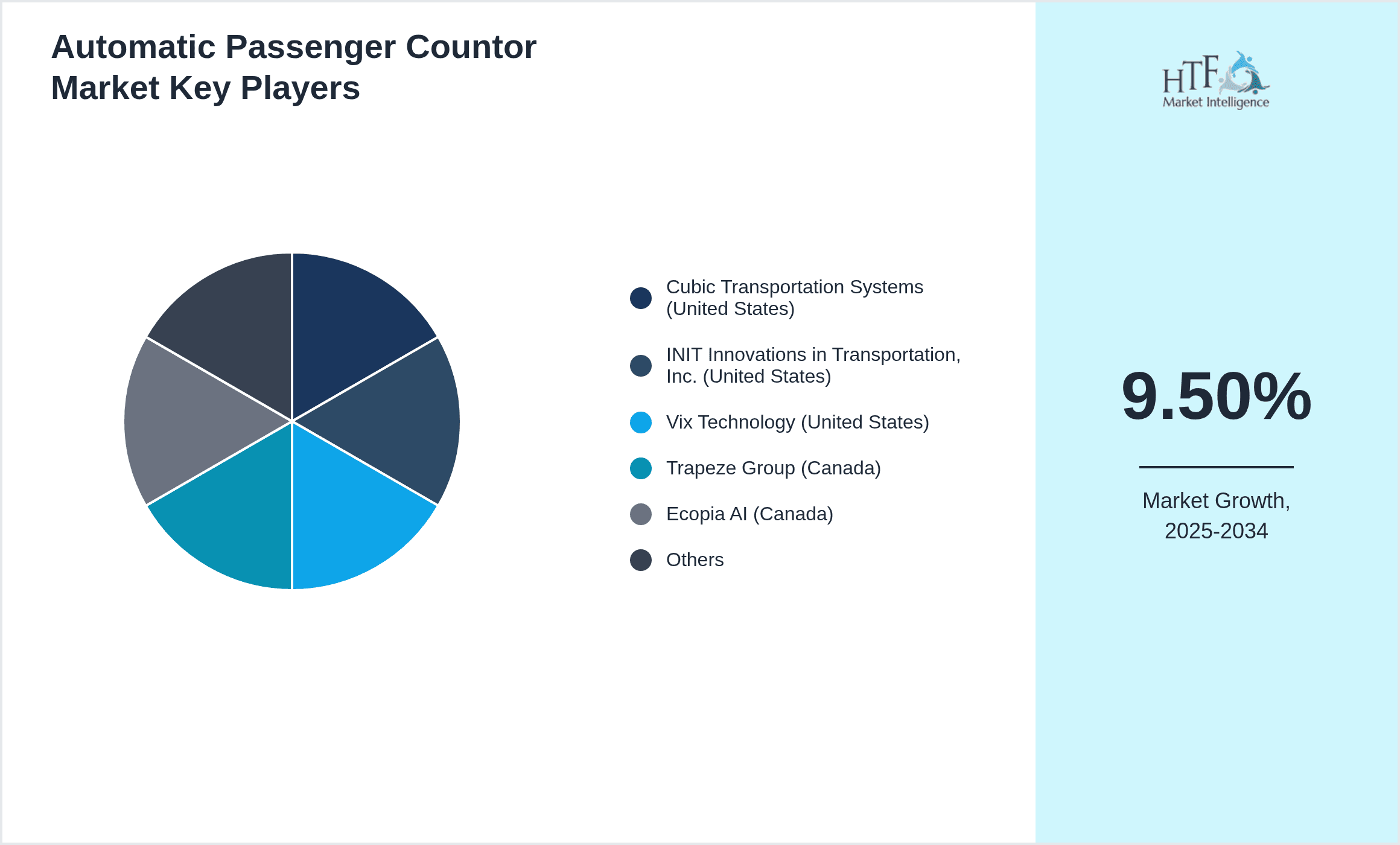
- •Cubic Transportation Systems (United States)
- •INIT Innovations in Transportation, Inc. (United States)
- •Vix Technology (United States)
- •Trapeze Group (Canada)
- •Ecopia AI (Canada)
- •Siemens Mobility (United States)
- •Masabi (United Kingdom)
- •Kapsch TrafficCom (Austria)
- •Alstom (France)
- •Ecolane (United States)
- •Sensys Networks (United States)
- •MARC Analytics (United States)
- •BusPatrol (Canada)
- •Feelgood Technologies (United States)
- •Patron Technology (Canada)
- •Navtech Radar (United Kingdom)
- •Thales Group (France)
- •Innovate Transport (United States)
- •TransLoc (United States)
- •Axis Communications (Sweden)
- •Q-Free ASA (Norway)
- •Mobisoft Infotech (United States)
- •Waycare Technologies (United States)
- •Civitas Networks for Health (United States)
- •Urban SDK (United States)
Market Breakdown
- •By Automatic Passenger Count Technology Type
- ◦Infrared Sensors
- ◦Video Imaging Systems
- ◦Pressure Mat Sensors
- ◦Weight Sensors
- ◦Radio Frequency Identification (RFID)
- •By Transit Application Segment
- ◦Urban Transit
- ◦Intercity Bus
- ◦Light Rail Transit
- ◦Commuter Rail
- ◦Airport Transit
- •By Deployment Model
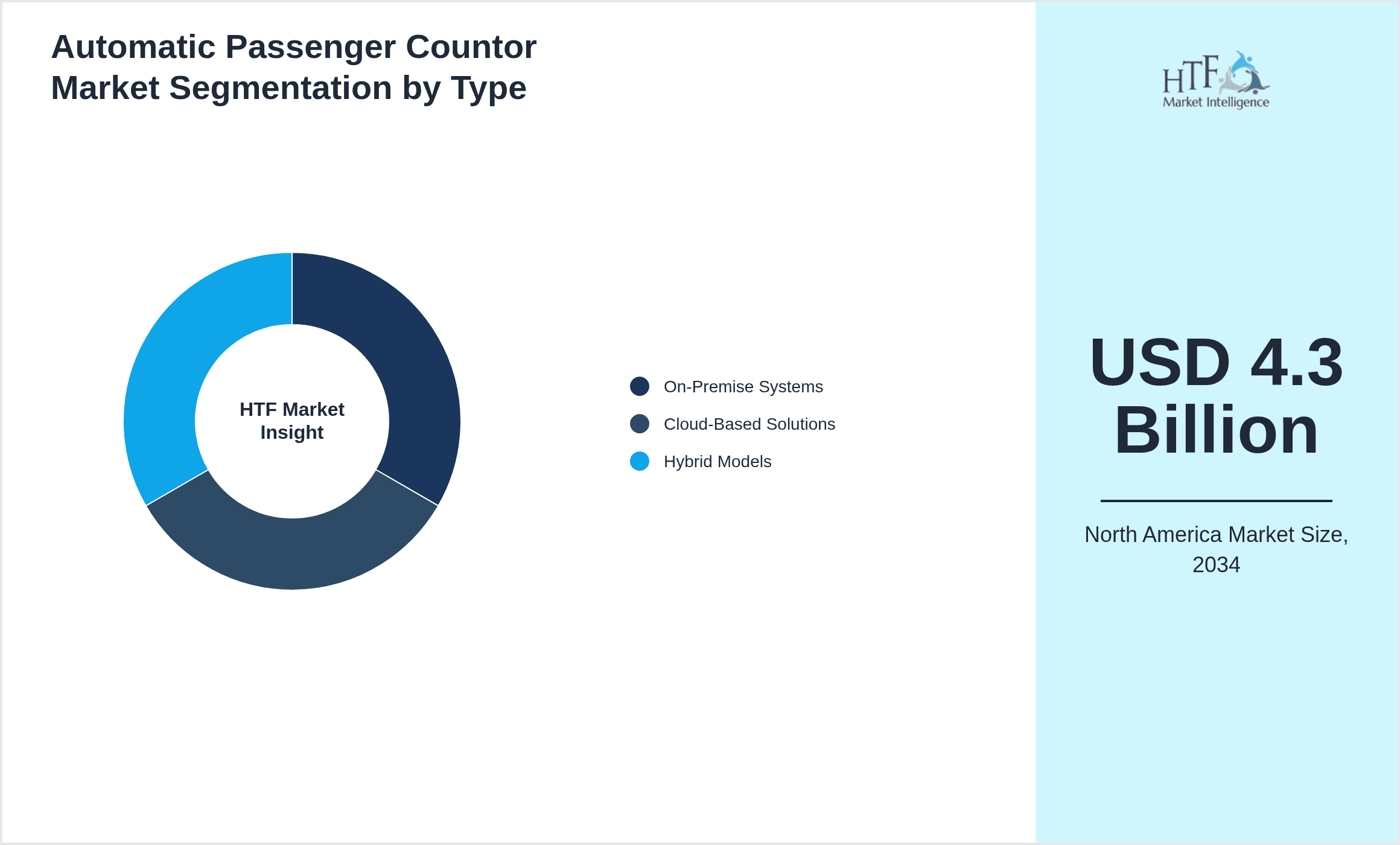
- ◦On-Premise Systems
- ◦Cloud-Based Solutions
- ◦Hybrid Models
- •By End-User Segment
- ◦Public Transit Authorities
- ◦Private Transportation Operators
- ◦Airport Authorities
- ◦Rail Operators
Growth Dynamics
- •The North America Automatic Passenger Count market is driven by increasing urbanization, which fuels demand for efficient public transit management. Growing population density in metropolitan areas necessitates accurate passenger data to optimize route planning and operational efficiency. Public transit agencies are investing heavily in APC technologies to improve scheduling accuracy and reduce operational costs, supporting a shift towards smart city initiatives. Furthermore, government funding and grants focused on sustainable transportation infrastructure enhance market growth. The integration of APC systems with advanced analytics platforms enables real-time data insights, empowering transit operators to respond swiftly to changing passenger patterns and improve service delivery across various transit modes.
- •Technological advancements, particularly in video imaging and RFID technologies, are significantly shaping market growth. These innovations provide higher accuracy, improved data granularity, and ease of integration with existing transit management systems. The proliferation of cloud-based APC solutions also facilitates scalable deployments and seamless data sharing among stakeholders. Additionally, the adoption of AI-driven analytics to interpret passenger count data is enhancing predictive transit planning and resource allocation. These technological trends contribute to the growing adoption of APC systems across North American transit networks, enabling smarter and more responsive public transportation services.
- •The expansion of public transit infrastructure, including light rail and commuter rail projects in major North American cities, is creating new market opportunities. Investments aimed at reducing traffic congestion and environmental impact are driving transit agencies to adopt APC technologies for improved operational insights. Moreover, the rise in intercity and airport transit demand necessitates efficient passenger flow monitoring, further propelling market growth. These infrastructure developments, supported by federal and state funding, ensure sustained demand for APC systems across multiple transit applications, reinforcing the market’s upward trajectory.
- •Regulatory mandates requiring accurate passenger data for fare collection and reporting are key growth enablers. Compliance with safety standards and data privacy laws compels transit agencies to implement reliable APC solutions. Additionally, policies promoting smart transportation systems encourage the adoption of advanced passenger counting technologies. These regulations not only standardize system requirements but also incentivize transit authorities to upgrade legacy systems, thereby expanding the market. The regulatory environment creates a structured framework that supports market expansion and technology innovation within North America.
- •Increasing passenger expectations for improved transit experience and service reliability drive the demand for APC systems. Accurate passenger counts enable dynamic scheduling and capacity management, reducing overcrowding and wait times. Enhanced data collection also supports multimodal transit integration and real-time passenger information systems. As commuters seek seamless and efficient transportation options, transit operators prioritize APC technology deployment to meet these expectations. This customer-centric focus fosters continued market growth and technology adoption across North American transit networks.
Market Trends
- •The North America APC market is witnessing a trend toward the integration of APC systems with Internet of Things (IoT) platforms, enabling seamless connectivity and real-time monitoring. This connectivity allows transit agencies to gather extensive operational data beyond passenger counts, including vehicle occupancy and travel patterns, enhancing decision-making capabilities. The trend is supported by advancements in sensor miniaturization and wireless communications, facilitating cost-effective deployments across transit fleets.
- •Another key trend is the adoption of AI and machine learning algorithms for passenger data analytics. These technologies help transit operators predict demand fluctuations, optimize resource allocation, and improve service reliability. AI-driven analytics also assist in anomaly detection and maintenance forecasting, reducing downtime and operational disruptions. This shift towards intelligent data processing is transforming the APC market landscape across North America.
- •Cloud adoption is accelerating in the APC market, with transit agencies leveraging cloud-based platforms for scalable data storage and processing. Cloud solutions enhance collaboration among multiple stakeholders, including transit operators, city planners, and regulatory bodies. This trend supports the development of integrated smart city transportation ecosystems, where passenger data feeds into broader urban mobility management systems, promoting efficiency and sustainability.
- •The market is also trending toward multimodal APC system deployments, where integrated counting solutions serve buses, rail, and airport transit simultaneously. This holistic approach enables unified ridership analytics and coordinated service planning across different transit modes. It reflects the evolving needs of urban transit networks seeking comprehensive passenger insights to support seamless mobility.
- •Sustainability is becoming a prominent trend influencing APC technology adoption. Transit agencies are using passenger data to minimize fuel consumption and emissions by optimizing vehicle deployment and reducing empty trips. This aligns with governmental goals to reduce carbon footprints and promotes APC systems as essential tools in achieving environmental targets within the North American public transportation sector.
Market Opportunities
- •The expansion of smart city initiatives across North America presents significant opportunities for APC system providers. Integration of passenger counting technology with broader urban mobility platforms enables innovative services such as demand-responsive transit and dynamic pricing models. Companies can capitalize on these developments by offering scalable, interoperable solutions tailored to evolving city transportation ecosystems.
- •Emerging transit markets in mid-sized North American cities offer untapped potential for APC technology adoption. These cities are investing in modernizing their transit infrastructure and require cost-effective passenger counting solutions to enhance service planning. Targeting these regions with adaptable product offerings can drive market penetration and revenue growth.
- •The growing trend toward contactless and automated fare collection creates synergy opportunities for APC system integration. Providers can develop combined solutions that enhance revenue assurance and operational efficiency. This convergence expands the market scope and fosters long-term partnerships with transit agencies.
- •Advancements in sensor technology, particularly in RFID and video imaging, open avenues for product innovation and differentiation. Companies investing in R&D can introduce next-generation APC solutions offering superior accuracy, ease of installation, and data analytics capabilities, strengthening their competitive positioning.
- •Public-private partnerships and government funding programs aimed at improving transit infrastructure provide financial support and facilitate large-scale APC deployments. Engaging with these initiatives enables market players to participate in funded projects, accelerating adoption and expanding market reach.
Market Challenges
- •High initial investment costs for advanced APC systems pose a significant barrier to adoption, particularly for smaller transit agencies with limited budgets. The cost of deploying and maintaining sophisticated sensor technologies can delay procurement decisions and slow market growth, especially in less urbanized areas.
- •Integration complexity with existing transit infrastructure and legacy systems challenges market participants. Diverse operational environments and varying technology standards require customized solutions, increasing implementation timelines and costs. Ensuring interoperability remains a key obstacle for APC providers.
- •Data privacy and security concerns related to passenger information collected by APC systems impose regulatory compliance burdens. Transit agencies and technology providers must navigate stringent data protection laws, which can complicate system design and deployment, affecting market adoption rates.
- •Technical limitations such as sensor inaccuracies caused by environmental factors, passenger behavior, or vehicle design impact data reliability. These limitations necessitate continuous system calibration and maintenance, adding operational complexity and costs for transit operators.
- •Market fragmentation with multiple competing technologies and standards creates buyer uncertainty. Transit agencies face challenges in selecting optimal APC solutions amidst evolving technology landscapes, which can slow procurement cycles and delay market expansion.
Regulatory Framework
- •Between 2020 and 2025, the Federal Transit Administration (FTA) updated guidelines mandating the use of automated passenger counting systems for federally funded transit projects. These guidelines specify minimum accuracy requirements and system reliability standards to ensure consistent data collection across transit operators. This regulation has accelerated APC adoption by linking compliance to funding eligibility.
- •Data privacy regulations, including provisions under the California Consumer Privacy Act (CCPA) and similar state laws, have introduced strict controls on passenger data handling. Transit agencies and APC providers must implement robust data protection measures, including anonymization and secure data storage, to comply with these evolving legal frameworks.
- •Safety standards established by the American Public Transportation Association (APTA) require APC systems to meet rigorous operational and environmental durability criteria. These standards ensure that installed systems perform reliably under a variety of transit conditions, supporting consistent passenger data collection.
- •Regional mandates in Canada, such as those by Transport Canada, promote the adoption of intelligent transportation systems, including APC technologies, to enhance public transit efficiency and safety. These initiatives include incentives and funding programs encouraging modernization efforts.
- •State-level policies in the United States encourage the integration of APC data with broader mobility management platforms to support smart city transportation goals. These policies foster interoperability and data sharing among transit agencies, technology providers, and municipal planners, driving market growth and innovation.
Market Intelligence
- •15th February 2025, Cubic Transportation Systems launched its latest video imaging APC solution designed for urban transit fleets in North America. The new system features enhanced AI-powered analytics, enabling transit agencies to obtain real-time passenger flow insights with improved accuracy. The product supports cloud-based deployment and integrates seamlessly with existing fare collection systems, aiming to optimize operational efficiency and reduce costs. This launch represents Cubic's commitment to advancing smart transit technologies tailored for the evolving demands of North American public transportation networks. Source: Cubic Transportation Systems Official Release.
- •30th June 2025, INIT Innovations in Transportation, Inc. announced a strategic partnership with Transport Canada to deploy RFID-based APC systems across commuter rail networks in Canada. The collaboration aims to improve passenger data accuracy and support federal smart transit initiatives. INIT's technology offers scalable solutions that facilitate automated fare collection and ridership analytics, enhancing service planning. This partnership underscores growing government-industry cooperation to modernize transit operations through innovative passenger counting technologies. Source: INIT Corporate News.
- •12th October 2024, Trapeze Group expanded its North American presence by acquiring a regional transit technology provider specializing in pressure mat sensors. This acquisition strengthens Trapeze's product portfolio and service capabilities, enabling comprehensive APC solutions for urban and intercity transit. The move enhances market penetration and supports integrated transit management system offerings across the United States and Canada. Source: Trapeze Group Press Statement.
- •8th March 2025, Ecopia AI introduced a cloud-based APC analytics platform that leverages satellite imagery and AI to complement traditional passenger counting methods. Targeted at airport transit and commuter rail operators in North America, the platform offers highly accurate passenger flow predictions and automated reporting features. This innovation reflects the market trend toward data-driven transit management and supports smart city objectives. Source: Ecopia AI Press Release.
Regional Outlook
The United States currently holds a significant share of the market, primarily due to several key factors: increasing consumption rates, a burgeoning population, and robust economic momentum. These elements collectively drive demand, positioning this region as a leader in the market. On the other hand, Canada is rapidly emerging as the fastest-growing area within the industry. This remarkable growth can be attributed to swift infrastructure development, the expansion of various industrial sectors, and a marked increase in consumer demand. These dynamics make this region a crucial player in shaping future market growth.
In our report, we cover a comprehensive analysis of the following regions and countries:
- United States
- Canada
- Mexico
| Feature | Details |
|---|---|
| Base Year Market Size | USD 1.9 Billion |
| Forecast Year Market Size | USD 4.3 Billion |
| CAGR | 9.5% |
| Forecast Period | 2026 to 2033 |
| YoY Growth | 9.1% |
| Scope of Report | Market is segmented by Automatic Passenger Count Technology Type (Infrared Sensors, Video Imaging Systems, Pressure Mat Sensors, Weight Sensors, Radio Frequency Identification (RFID)), Transit Application Segment (Urban Transit, Intercity Bus, Light Rail Transit, Commuter Rail, Airport Transit), Deployment Model (On-Premise Systems, Cloud-Based Solutions, Hybrid Models), End-User Segment (Public Transit Authorities, Private Transportation Operators, Airport Authorities, Rail Operators) |
| Regions Covered | United States, Canada, Mexico |
| Key Companies | Cubic Transportation Systems (United States), INIT Innovations in Transportation, Inc. (United States), Vix Technology (United States), Trapeze Group (Canada), Ecopia AI (Canada), Siemens Mobility (United States), Masabi (United Kingdom), Kapsch TrafficCom (Austria), Alstom (France), Ecolane (United States), Sensys Networks (United States), MARC Analytics (United States), BusPatrol (Canada), Feelgood Technologies (United States), Patron Technology (Canada), Navtech Radar (United Kingdom), Thales Group (France), Innovate Transport (United States), TransLoc (United States), Axis Communications (Sweden), Q-Free ASA (Norway), Mobisoft Infotech (United States), Waycare Technologies (United States), Civitas Networks for Health (United States), Urban SDK (United States) |
North America Automatic Passenger Count Market Size, Growth & Revenue 2025-2034 - Table of Contents
Frequently Asked Questions (FAQ):
The Compact Track Loaders market is projected to grow at a CAGR of 6.8% from 2025 to 2030, driven by increasing demand in construction and agricultural sectors.
North America currently leads the market with approximately 45% market share, followed by Europe at 28% and Asia-Pacific at 22%. The remaining regions account for 5% of the global market.
Key growth drivers include increasing construction activities, rising demand for versatile equipment in agriculture, technological advancements in track loader design, and growing preference for compact equipment in urban construction projects.