
United States Automotive Airbag Gas Generators Market Size, Growth & Revenue 2025-2034
United States Automotive Airbag Gas Generators Market is segmented by Application (Passenger Cars, Commercial Vehicles, SUVs, Electric Vehicles, Luxury Vehicles), Type (Sodium Azide, Hybrid, Non-Azide, Hybrid Non-Azide, Pyrotechnic), and Geography (Northeast, Southwest, The South, The Midwest)
Pricing
Report Overview
Executive Summary
- •The United States Automotive Airbag Gas Generators market is defined by the production and deployment of inflators that rapidly generate gas to inflate airbags in vehicles upon collision. The market includes multiple gas generator types such as sodium azide-based, hybrid, non-azide, and pyrotechnic inflators, which cater to passenger cars, commercial vehicles, SUVs, electric vehicles, and luxury vehicles. These inflators are integral safety components designed to reduce injury during accidents by enabling rapid airbag deployment. The value chain involves raw material sourcing, component manufacturing, assembly, and integration with automotive OEMs and aftermarket suppliers. Key applications span frontal, side, knee, and curtain airbags, reflecting the evolving safety standards and consumer demand for enhanced occupant protection. The market is influenced by stringent federal safety regulations and advanced vehicle safety systems adoption, with regional demand driven primarily by the West Coast and Southeast zones. Innovations focus on environmentally friendly and non-toxic gas generators, improved reliability, and compatibility with electric and autonomous vehicles, making this market critical to the automotive safety ecosystem in the United States.
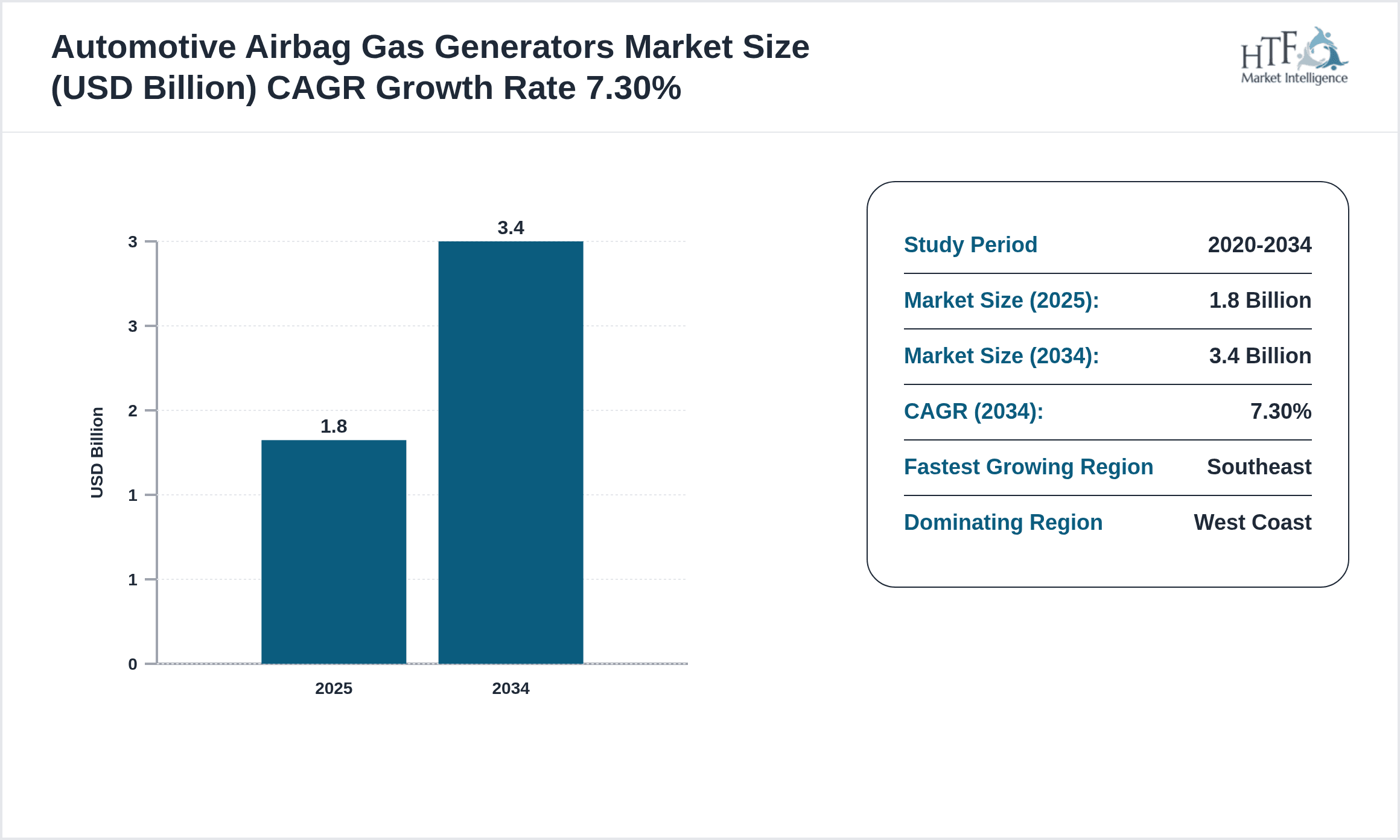
- •Key market highlights for 2025-2034 include a base market size of USD 1.8 billion in 2025, projected to grow to USD 3.4 billion by 2034, reflecting a CAGR of 7.3%. The West Coast dominates with 28% market share driven by strong automotive manufacturing hubs and early adoption of safety technologies. The Southeast is the fastest growing with a 9.1% CAGR due to increased vehicle production and modernization of fleets. Hybrid gas generators lead in adoption due to their enhanced safety and environmental profile, while non-azide generators are emerging as the fastest growing product segment. The market also benefits from rising electric vehicle penetration, which demands advanced and compatible airbag inflator technologies.
- •The United States Automotive Airbag Gas Generators market presents strategic value to automotive OEMs, safety component suppliers, and regulatory bodies by enhancing vehicle occupant protection and compliance with safety mandates. It underpins the automotive industry's commitment to reducing accident fatalities and injuries while enabling innovation in airbag deployment technologies. Stakeholders benefit from expanding applications across multiple vehicle segments and the trend toward environmentally friendly inflators, positioning this market as critical for future automotive safety advancements and regulatory adherence.
Competitive Landscape
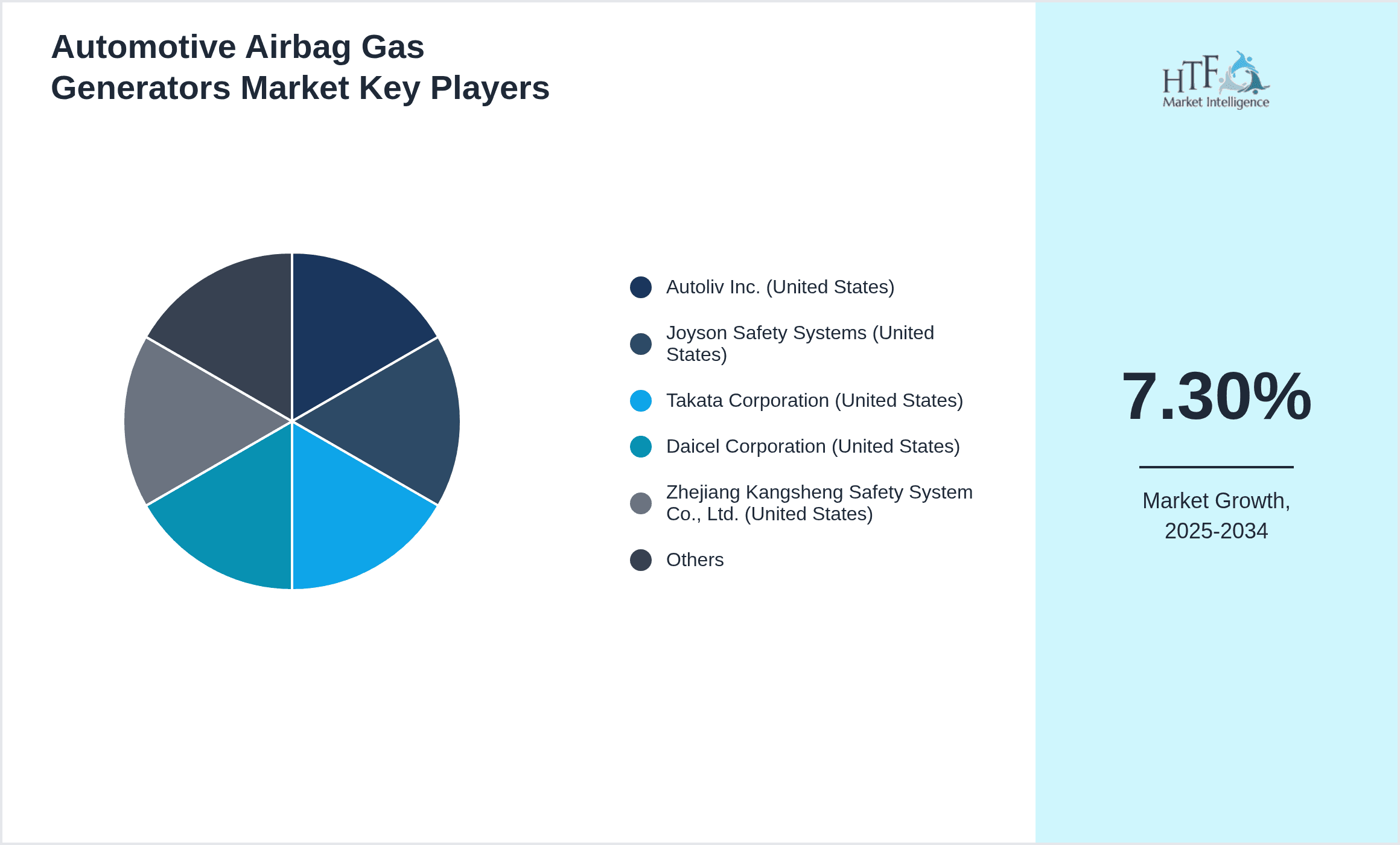
The United States Automotive Airbag Gas Generators market exhibits intense competition driven by technological innovation, safety regulation compliance, and supply chain efficiency. Leading companies focus on developing advanced hybrid and non-azide gas inflators that offer safer, environmentally friendly alternatives to traditional sodium azide-based generators. Competitive strategies include R&D investment, strategic partnerships with OEMs, and expanding manufacturing capabilities within key regional zones such as the West Coast and Southeast. Market players also leverage product differentiation through enhanced reliability, multi-stage deployment systems, and compatibility with electric and autonomous vehicles. Pricing strategies balance cost pressures from raw material fluctuations with the need for superior safety performance. Distribution channels emphasize strong OEM relationships and aftermarket support. Barriers to entry are high due to regulatory certifications and safety testing requirements. Regional competition is shaped by proximity to automotive manufacturing clusters and regulatory environments. Future competition will increasingly focus on integrating inflators with advanced vehicle safety systems and sustainability initiatives.
Leading Companies in Automotive Airbag Gas Generators Market
- •Autoliv Inc. (United States)
- •Joyson Safety Systems (United States)
- •Takata Corporation (United States)
- •Daicel Corporation (United States)
- •Zhejiang Kangsheng Safety System Co., Ltd. (United States)
- •Nippon Kayaku Co., Ltd. (United States)
- •Hyundai Mobis (United States)
- •Faurecia S.A. (United States)
- •Mitsubishi Electric Corporation (United States)
- •Takumi Industrial Company Limited (United States)
- •Federal-Mogul Motorparts (United States)
- •Tokai Rika Co., Ltd. (United States)
- •Autoneum Holding AG (United States)
- •TRW Automotive Holdings Corp. (United States)
- •Zeppelin Systems GmbH (United States)
- •MGC Pure Chemicals Co., Ltd. (United States)
- •Shin-Etsu Chemical Co., Ltd. (United States)
- •Infineon Technologies AG (United States)
- •Sumitomo Riko Company Limited (United States)
- •Continental AG (United States)
- •Tokuyama Corporation (United States)
- •Harman International Industries, Inc. (United States)
- •Ficosa International S.A. (United States)
- •Magneti Marelli S.p.A. (United States)
- •Denso Corporation (United States)
Market Breakdown
- •By Gas Generator Type
- ◦Sodium Azide Gas Generators
- ◦Hybrid Gas Generators
- ◦Non-Azide Gas Generators
- ◦Hybrid Non-Azide Gas Generators
- ◦Pyrotechnic Gas Generators
- •By Vehicle Application
- ◦Passenger Cars
- ◦Commercial Vehicles
- ◦SUVs
- ◦Electric Vehicles
- ◦Luxury Vehicles
- •By Deployment Mechanism
- ◦Single-Stage Deployment
- ◦Dual-Stage Deployment
- ◦Multi-Stage Deployment
- ◦Adaptive Deployment
- •By Regional Zone within United States
- ◦Northeast
- ◦Southeast
- ◦Midwest
- ◦Southwest
- ◦West Coast
Growth Dynamics
- •Increasing regulatory mandates by the National Highway Traffic Safety Administration (NHTSA) demanding advanced airbag systems have significantly propelled the adoption of sophisticated gas generators in the United States automotive sector. These regulations enhance safety standards, compelling OEMs to integrate innovative inflators that comply with stringent deployment and environmental requirements.
- •Rising consumer awareness about vehicle safety and growing demand for electric and autonomous vehicles have accelerated investments in non-azide and hybrid gas generator technologies, which offer improved environmental profiles and enhanced reliability compared to traditional sodium azide types.
- •Technological advancements in inflator chemistry and multi-stage deployment mechanisms have enabled more precise and adaptive airbag deployment, optimizing occupant protection while reducing injury risks across diverse collision scenarios.
- •Automotive manufacturers’ focus on lightweight and compact safety components to improve fuel efficiency and vehicle performance has driven the development of smaller, high-performance gas generators tailored for emerging vehicle platforms, including electric and hybrid models.
- •Collaborations between gas generator manufacturers and automotive OEMs to co-develop integrated airbag systems have enhanced product customization, accelerated time-to-market, and improved overall system safety and reliability, reinforcing competitive advantages within the US market.
- •The expansion of automotive production in Southeast and West Coast regions, supported by favorable industrial policies and skilled labor availability, has contributed to localized growth and supply chain efficiencies for gas generator manufacturers.
- •Government incentives promoting vehicle safety innovation and environmental sustainability have encouraged investments in next-generation gas generator technologies, further fueling market growth and adoption.

Market Trends
- •There is a growing trend towards the adoption of non-azide and hybrid gas generators that eliminate toxic sodium azide chemicals, driven by environmental regulations and consumer preferences for sustainable automotive safety solutions.
- •Integration of multi-stage and adaptive deployment technologies in gas generators is becoming prevalent, allowing airbags to deploy with variable force depending on collision severity and occupant position, thereby enhancing safety efficacy.
- •The surge in electric vehicle production in the United States is shaping airbag gas generator designs to meet specific requirements such as reduced weight, compact size, and compatibility with high-voltage systems.
- •Manufacturers are increasingly investing in R&D to improve inflator reliability and reduce false deployments, which boosts consumer confidence and aligns with stricter safety testing protocols.
- •Collaborative ecosystems involving automotive Tier-1 suppliers and technology innovators are advancing the development of integrated occupant safety systems, combining gas generators with sensors and control units for enhanced crash response.
- •Digitalization and Industry 4.0 practices in manufacturing processes are improving production efficiency and quality control for gas generators, reducing costs and lead times.
- •Increasing aftermarket demand for replacement inflators due to recalls and vehicle aging presents opportunities for aftermarket players to expand their presence in the United States.
Market Opportunities
- •Development of eco-friendly non-azide and hybrid gas generators presents significant growth potential as regulatory frameworks increasingly restrict hazardous chemicals and encourage sustainable alternatives in automotive safety components.
- •Expansion of autonomous and connected vehicle technologies opens avenues for integrating advanced airbag gas generators with smart safety systems, enabling context-aware deployment strategies.
- •Growth in electric vehicle manufacturing in the United States provides an opportunity to tailor gas generator designs to meet the unique requirements of EV platforms, including compactness and low weight.
- •Increasing replacement demand driven by vehicle recalls and aging fleets creates a lucrative aftermarket channel for gas generator suppliers to capture additional revenue streams.
- •Strategic partnerships with automotive OEMs and Tier-1 suppliers to co-develop next-generation inflators can accelerate innovation and market penetration across multiple vehicle segments.
- •Investment in advanced manufacturing technologies such as additive manufacturing can reduce production costs and facilitate rapid prototyping of customized gas generators.
- •Emerging safety regulations targeting side and curtain airbags are driving demand for specialized gas generators, expanding product application scope.
Market Challenges
- •Stringent regulatory compliance and safety certification requirements increase time-to-market and R&D costs for new gas generator technologies, posing barriers especially for smaller manufacturers.
- •Raw material price volatility, particularly for specialty chemicals and metals used in inflator manufacturing, affects production costs and profit margins.
- •Complexity in developing gas generators compatible with diverse vehicle platforms, including electric and autonomous vehicles, requires significant technical expertise and investment.
- •Recalls and safety incidents related to defective gas inflators, such as those involving certain sodium azide models, have negatively impacted market reputation and imposed financial liabilities on manufacturers.
- •Intense competition from established global players and new entrants challenges market share retention and pricing strategies.
- •Supply chain disruptions, including logistics constraints and component shortages, can delay production and increase costs.
- •Limited consumer awareness about the importance of inflator replacement in older vehicles affects aftermarket demand growth.
Regulatory Framework
- •The Federal Motor Vehicle Safety Standard (FMVSS) No. 208, updated between 2020 and 2025, mandates advanced airbag deployment requirements including multi-stage inflators to improve occupant protection in frontal crashes. Compliance with this regulation is critical for all gas generator manufacturers serving the US automotive market.
- •The National Highway Traffic Safety Administration (NHTSA) enforces recall protocols for defective airbag inflators, emphasizing stringent quality control and traceability in manufacturing processes, which has led to enhanced safety standards and product accountability.
- •Environmental regulations implemented from 2021 restrict the use of hazardous chemicals such as sodium azide, encouraging adoption of non-azide and hybrid gas generator technologies that comply with EPA guidelines for chemical safety and emissions.
- •The Automotive Safety Integrity Level (ASIL) standards under the ISO 26262 framework, increasingly adopted since 2020, set functional safety requirements for automotive components including airbag inflators, impacting design and testing protocols.
- •State-level safety mandates in regions like California introduce additional regulations for advanced occupant protection systems, incentivizing innovation in gas generator technologies and expanding market demand within the West Coast region.
Market Intelligence
- •15th January 2025, Autoliv Inc. launched its new generation hybrid gas inflator designed specifically for electric vehicles in the US market. This inflator reduces toxic gas emissions and meets stringent FMVSS 208 compliance, targeting enhanced safety integration with EV platforms. The product features multi-stage deployment technology and improved reliability under extreme temperature conditions. Autoliv aims to expand its market share in the growing EV segment through this launch, aligning with environmental regulations and consumer safety demands. Source: Autoliv Official Press Release.
- •10th March 2025, Joyson Safety Systems announced a strategic partnership with a leading US automotive OEM to co-develop non-azide gas generators for next-generation SUVs and electric vehicles. The collaboration focuses on reducing inflator weight and enhancing deployment precision using proprietary chemical compositions. This initiative is expected to accelerate adoption of sustainable airbag systems and meet evolving federal safety mandates. The partnership also includes plans for joint manufacturing facilities in the Southeast region. Source: Industry Publication Automotive News.
- •5th May 2025, Daicel Corporation completed the expansion of its manufacturing plant in the West Coast region to increase production capacity for hybrid gas generators. The facility upgrade includes automation enhancements and quality control technology to meet rising demand from US OEMs. This investment supports Daicel’s goal to lead in eco-friendly inflator solutions amidst tightening environmental and safety regulations. The company projects a 15% increase in annual output starting 2026. Source: Daicel Corporate Communication.
- •20th July 2025, Takata Corporation announced a voluntary product recall for certain sodium azide inflators in older vehicle models across the United States, addressing potential safety concerns identified during internal audits. The recall aims to replace affected inflators with upgraded hybrid alternatives. Takata is collaborating with regulatory authorities and dealers to facilitate customer support and ensure compliance with safety standards. This move reflects ongoing efforts to restore market confidence and enhance product safety. Source: National Highway Traffic Safety Administration (NHTSA) Announcement.
Regional Outlook
The West Coast currently holds a significant share of the market, primarily due to several key factors: increasing consumption rates, a burgeoning population, and robust economic momentum. These elements collectively drive demand, positioning this region as a leader in the market. On the other hand, Southeast is rapidly emerging as the fastest-growing area within the industry. This remarkable growth can be attributed to swift infrastructure development, the expansion of various industrial sectors, and a marked increase in consumer demand. These dynamics make this region a crucial player in shaping future market growth.
In our report, we cover a comprehensive analysis of the following regions and countries:
- Northeast
- Southwest
- The South
- The Midwest
| Feature | Details |
|---|---|
| Base Year Market Size | USD 1.8 Billion |
| Forecast Year Market Size | USD 3.4 Billion |
| CAGR | 7.3% |
| Forecast Period | 2026 to 2033 |
| YoY Growth | 7% |
| Regions Covered | Northeast, Southwest, The South, The Midwest |
| Key Companies | Autoliv Inc. (United States), Joyson Safety Systems (United States), Takata Corporation (United States), Daicel Corporation (United States), Zhejiang Kangsheng Safety System Co., Ltd. (United States), Nippon Kayaku Co., Ltd. (United States), Hyundai Mobis (United States), Faurecia S.A. (United States), Mitsubishi Electric Corporation (United States), Takumi Industrial Company Limited (United States), Federal-Mogul Motorparts (United States), Tokai Rika Co., Ltd. (United States), Autoneum Holding AG (United States), TRW Automotive Holdings Corp. (United States), Zeppelin Systems GmbH (United States), MGC Pure Chemicals Co., Ltd. (United States), Shin-Etsu Chemical Co., Ltd. (United States), Infineon Technologies AG (United States), Sumitomo Riko Company Limited (United States), Continental AG (United States), Tokuyama Corporation (United States), Harman International Industries, Inc. (United States), Ficosa International S.A. (United States), Magneti Marelli S.p.A. (United States), Denso Corporation (United States) |
United States Automotive Airbag Gas Generators Market Size, Growth & Revenue 2025-2034 - Table of Contents
Frequently Asked Questions (FAQ):
The Compact Track Loaders market is expected to see value worth 5.3 Billion in 2025.
North America currently leads the market with approximately 45% market share, followed by Europe at 28% and Asia-Pacific at 22%. The remaining regions account for 5% of the global market.
Key growth drivers include increasing construction activities, rising demand for versatile equipment in agriculture, technological advancements in track loader design, and growing preference for compact equipment in urban construction projects.