
United States Immersive Media Solutions Market Size, Growth & Revenue 2024-2034
United States Immersive Media Solutions Market is segmented by Type (Hardware (VR headsets, AR glasses, haptic devices), Software (Platforms, Development Tools, SDKs), Services (Integration, Maintenance, Consulting), Content (Gaming, Training Simulations, 360-Degree Videos), Platforms (Cloud-based Delivery, Streaming Services)), Application (Virtual Reality (Gaming, Entertainment), Augmented Reality (Training, Retail, Healthcare), Mixed Reality (Enterprise Collaboration, Design), 360-Degree Video (Media, Events), Haptic Feedback (Simulations, Medical Training)), Deployment Model (Cloud-based, On-premise, Hybrid), End-Use Industry (Entertainment & Gaming, Healthcare & Medical Training, Education & E-Learning, Manufacturing & Design, Retail & Marketing), and Geography (Northeast, Southwest, The South, The Midwest)
Pricing
Report Overview
Executive Summary
- •The United States Immersive Media Solutions market represents a dynamic sector focused on delivering cutting-edge virtual, augmented, and mixed reality experiences. It comprises hardware devices like VR headsets and AR glasses, software platforms for content creation and distribution, immersive content across entertainment, education, healthcare, and services such as integration and support. This market is driven by advancements in sensor technology, computing power, and network capabilities, enabling seamless interactive experiences. The industry scope extends to consumer entertainment, enterprise training, remote collaboration, and healthcare applications, reflecting broad adoption across sectors. Market growth is propelled by increasing demand for immersive digital interaction, innovation in display and haptic feedback technologies, and expanding availability of content ecosystems. With the U.S. as a leading innovation hub, this market plays a strategic role in shaping future digital engagement and immersive communication paradigms, making it a critical frontier in the technology landscape.
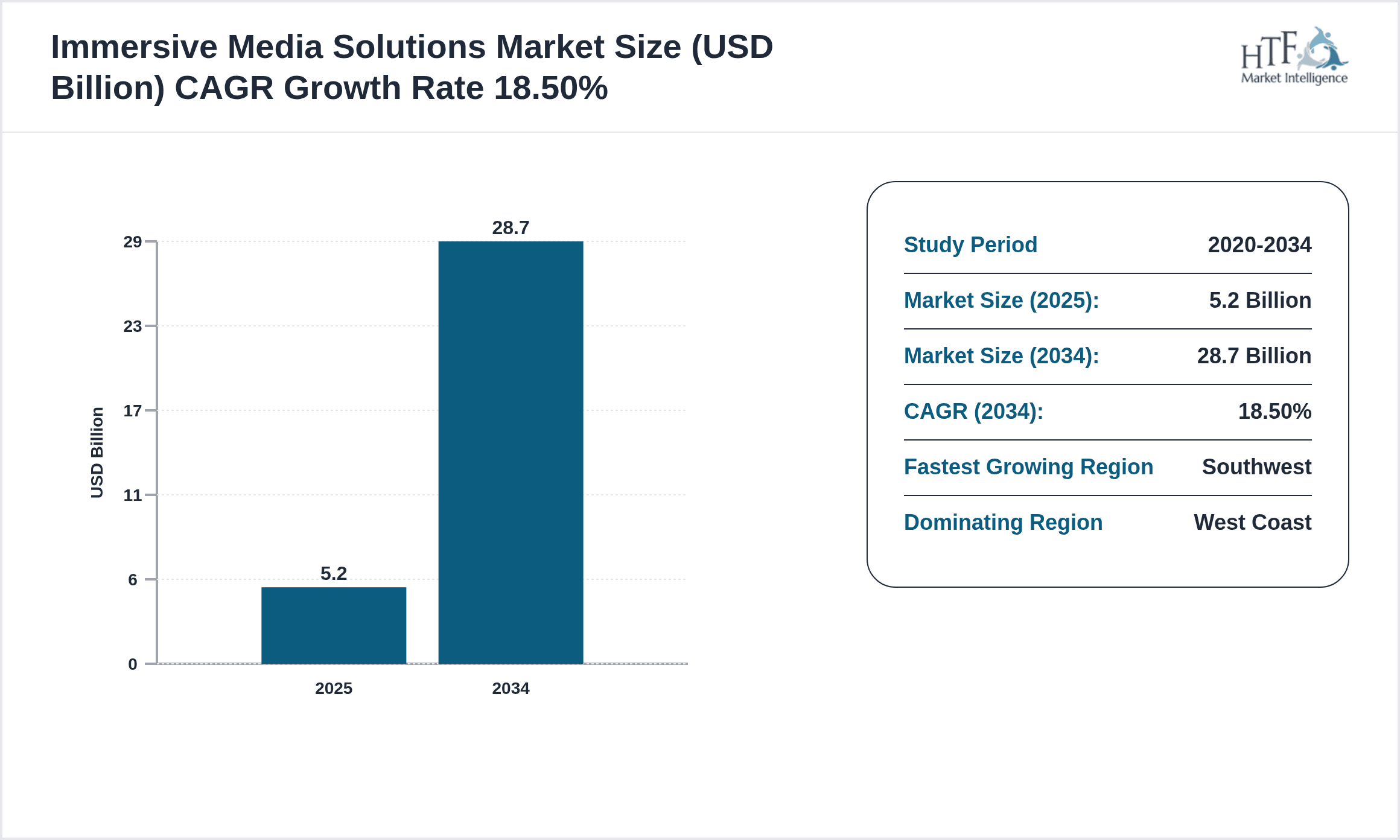
- •In 2024, the United States Immersive Media Solutions market is valued at USD 5.2 Billion and is projected to reach USD 28.7 Billion by 2034, growing at a CAGR of 18.5%. The dominant segment is hardware, accounting for the largest revenue share due to continued innovation in VR/AR devices. Content solutions are the fastest growing type, driven by demand for diverse immersive experiences. The West Coast dominates the regional market with 32% share, while the Southwest region is the fastest growing with a CAGR of 21.2%. Key applications include virtual reality gaming, augmented reality in training and healthcare, and mixed reality for enterprise collaboration. Market indicators reveal robust investment, rising consumer adoption, and expanding enterprise use cases, positioning the U.S. as a global leader in immersive media solutions.
- •Immersive media solutions offer significant value to industries such as entertainment, education, healthcare, and manufacturing by enabling enhanced visualization, remote collaboration, and experiential learning. For stakeholders including hardware manufacturers, software developers, content creators, and service providers, this market presents strategic growth opportunities fueled by technological advances and increasing user engagement. The integration of immersive media into mainstream applications enhances productivity and customer experience, fostering innovation across sectors. The market's expansion aligns with broader digital transformation trends, emphasizing its importance in shaping future communication and interaction modalities. As immersive media technologies mature, their strategic role in the U.S. economy and global technology leadership continues to strengthen.
Competitive Landscape
The United States Immersive Media Solutions market exhibits intense competition characterized by rapid technological innovation, strategic partnerships, and diverse business models. Market players compete on hardware performance, software capabilities, content quality, and service integration. Innovation in display technologies, sensor accuracy, and haptic feedback differentiates leaders, while ecosystem development and platform compatibility influence market positioning. Companies adopt aggressive R&D strategies and form alliances with content creators and technology providers to enhance offerings. Pricing strategies vary from premium hardware to subscription-based software and services, aiming to capture both consumer and enterprise segments. Regional hubs, especially the West Coast, foster a vibrant startup ecosystem, intensifying rivalry and accelerating product development cycles. Market entry barriers include high capital requirements and technological expertise, but evolving standards and open platforms are lowering these obstacles. Future competition will likely revolve around AI integration, cloud streaming, and cross-device interoperability, shaping the market's technological trajectory and value chain.
Leading Companies in Immersive Media Solutions Market
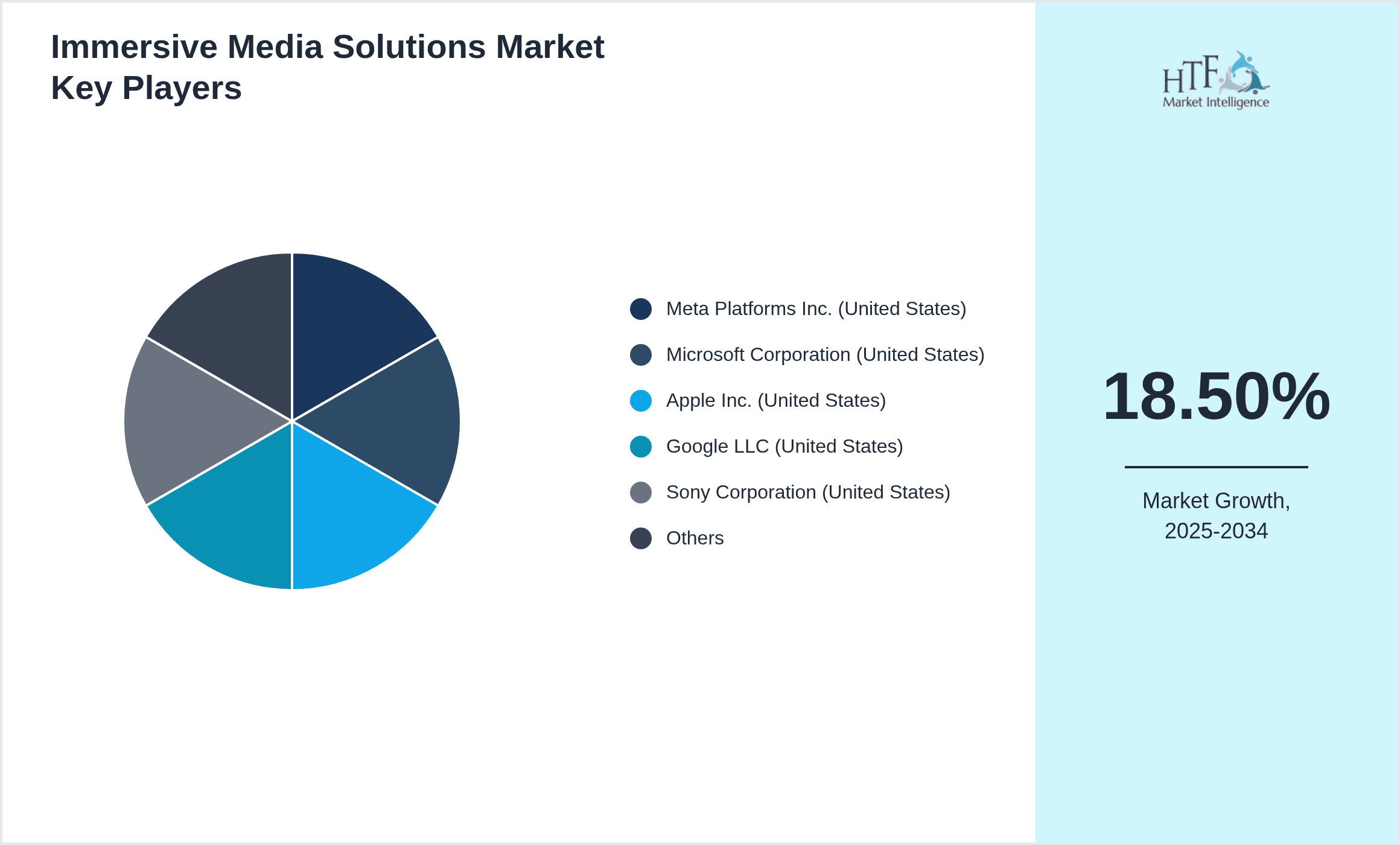
- •Meta Platforms Inc. (United States)
- •Microsoft Corporation (United States)
- •Apple Inc. (United States)
- •Google LLC (United States)
- •Sony Corporation (United States)
- •HTC Corporation (United States)
- •Magic Leap, Inc. (United States)
- •Snap Inc. (United States)
- •Unity Technologies (United States)
- •NVIDIA Corporation (United States)
- •Valve Corporation (United States)
- •Epic Games, Inc. (United States)
- •Qualcomm Incorporated (United States)
- •Adobe Inc. (United States)
- •Pico Interactive (United States)
- •Vuzix Corporation (United States)
- •Lenovo Group Limited (United States)
- •Varjo Technologies (United States)
- •EON Reality Inc. (United States)
- •Zappar Ltd. (United States)
- •6D.ai (United States)
- •Improbable Worlds Limited (United States)
- •Niantic, Inc. (United States)
- •Lumus Ltd. (United States)
- •Blippar Limited (United States)
Market Breakdown
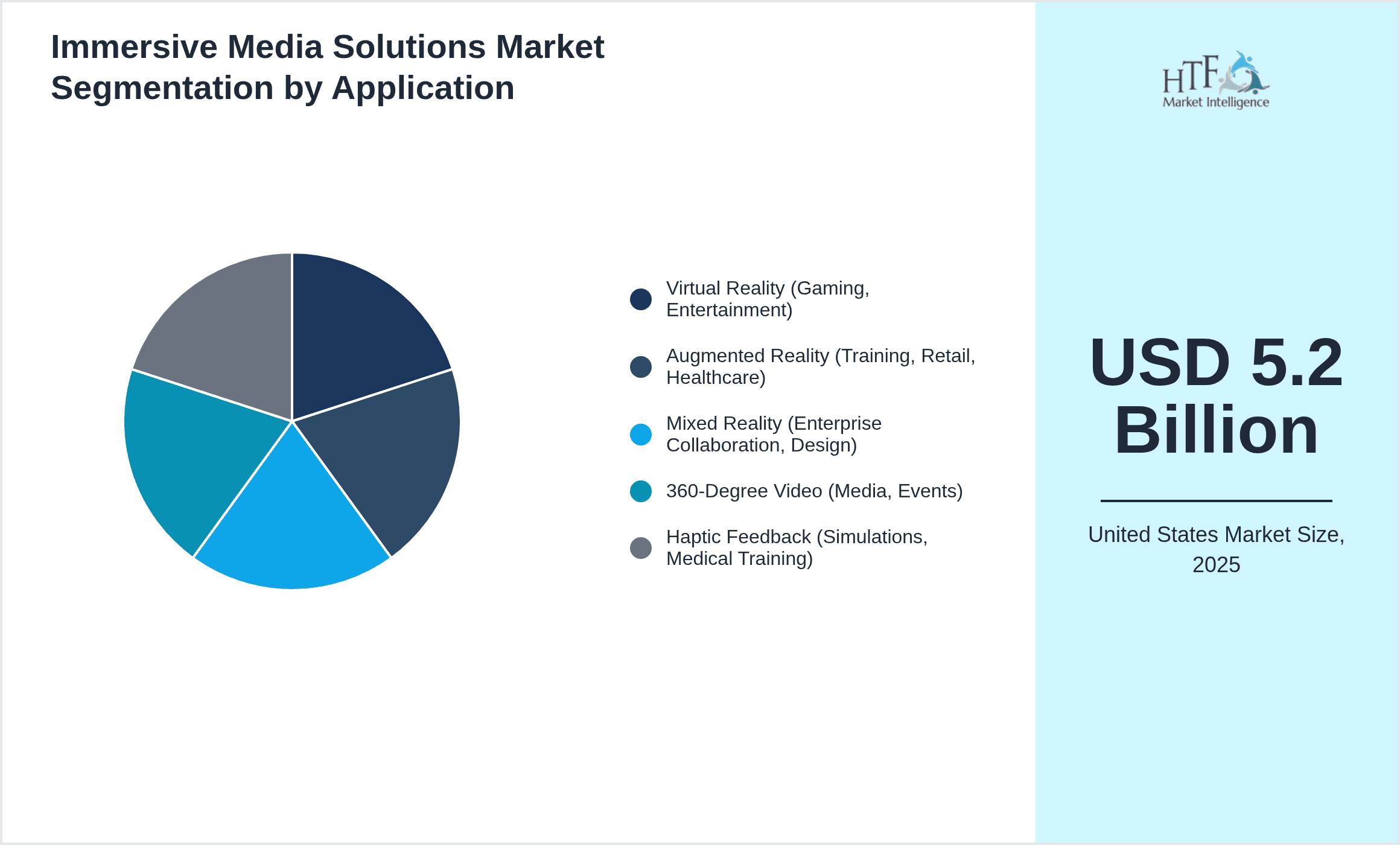
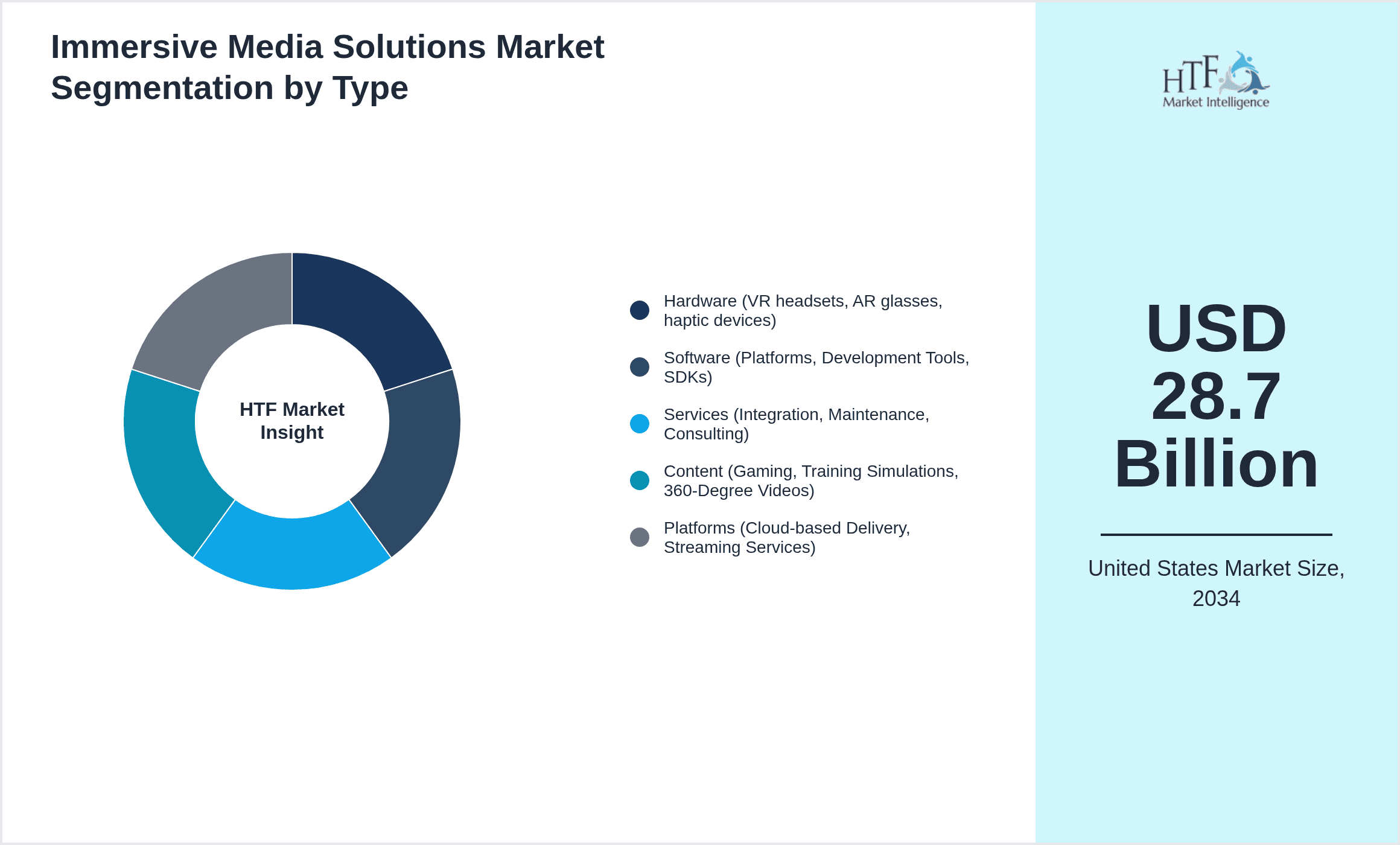
- •By Type
- ◦Hardware (VR headsets, AR glasses, haptic devices)
- ◦Software (Platforms, Development Tools, SDKs)
- ◦Services (Integration, Maintenance, Consulting)
- ◦Content (Gaming, Training Simulations, 360-Degree Videos)
- ◦Platforms (Cloud-based Delivery, Streaming Services)
- •By Application
- ◦Virtual Reality (Gaming, Entertainment)
- ◦Augmented Reality (Training, Retail, Healthcare)
- ◦Mixed Reality (Enterprise Collaboration, Design)
- ◦360-Degree Video (Media, Events)
- ◦Haptic Feedback (Simulations, Medical Training)
- •By Deployment Model
- ◦Cloud-based
- ◦On-premise
- ◦Hybrid
- •By End-Use Industry
- ◦Entertainment & Gaming
- ◦Healthcare & Medical Training
- ◦Education & E-Learning
- ◦Manufacturing & Design
- ◦Retail & Marketing
Growth Dynamics
The United States Immersive Media Solutions market is propelled by rapid advancements in hardware technologies such as lightweight VR headsets and AR glasses, which enhance user comfort and engagement. Significant investments by tech giants in R&D are expanding device capabilities and interoperability. Additionally, the proliferation of 5G networks enables seamless streaming of high-fidelity immersive content, facilitating adoption across consumer and enterprise sectors. The increasing integration of immersive media in training, healthcare, and remote collaboration is diversifying use cases, driving market expansion. Government initiatives supporting digital innovation and growing consumer interest in experiential entertainment further bolster growth. These factors collectively contribute to robust market momentum and a sustained CAGR of 18.5% through 2034.
Market Trends
Emerging trends in the United States Immersive Media Solutions market include the convergence of AI with immersive platforms to deliver personalized experiences and real-time content adaptation. The rise of spatial computing and mixed reality applications is transforming enterprise workflows, enabling enhanced visualization and remote collaboration. Subscription-based content delivery models and cloud streaming are becoming prevalent, reducing hardware dependencies and expanding accessibility. Additionally, sustainability trends are prompting manufacturers to develop eco-friendly devices with recyclable materials. The increasing focus on social VR and metaverse platforms is reshaping consumer engagement patterns, creating new monetization avenues. These trends underscore the market’s evolution towards integrated, user-centric immersive ecosystems.
Market Opportunities
Significant opportunities exist in the development of immersive content tailored for healthcare training and therapy, addressing a growing demand for effective remote medical education and rehabilitation tools. Expansion into enterprise sectors such as manufacturing and design offers potential for immersive visualization and prototyping applications. The rise of metaverse platforms creates new avenues for content monetization and user engagement. Advancements in haptic feedback and sensory technologies open possibilities for more realistic simulations and training programs. Additionally, partnerships between hardware manufacturers and software developers can accelerate ecosystem growth, enhancing market penetration. These opportunities position the United States market for transformative growth driven by cross-industry adoption and innovation.
Market Challenges
The United States Immersive Media Solutions market faces challenges including high hardware costs that limit consumer adoption, especially for premium VR devices. Technical issues such as latency, motion sickness, and limited battery life hinder user experience and broader acceptance. Content development remains complex and resource-intensive, constraining the availability of high-quality immersive experiences. Privacy and data security concerns around user interactions in virtual environments pose regulatory and trust issues. Additionally, fragmentation of platforms and lack of universal standards impede interoperability and ecosystem cohesion. Addressing these challenges requires collaborative innovation, cost optimization, and regulatory clarity to sustain market growth and consumer confidence.
Regulatory Framework
Between 2019 and 2024, the United States government implemented data privacy regulations impacting immersive media platforms, mandating stringent user data protection and transparent consent mechanisms. The Federal Trade Commission enhanced oversight on digital content and advertising standards affecting immersive marketing applications. New safety guidelines were introduced for hardware manufacturers focusing on electromagnetic emissions and user ergonomics to ensure consumer well-being. Additionally, intellectual property laws were updated to address content creation and distribution rights within virtual environments. These regulatory developments require companies to comply with evolving standards, impacting product design, data management, and market operations to foster safe and secure immersive experiences.
Market Intelligence
- •15th January 2024, Meta Platforms Inc. launched the Quest Pro 2, an advanced VR headset featuring enhanced mixed reality capabilities, improved resolution, and integrated eye-tracking technology. This product targets enterprise and professional users, aiming to expand immersive collaboration and training applications. The launch reflects Meta's strategic push to lead in premium immersive hardware and drive adoption across business sectors, reinforcing its dominant market position.
- •10th September 2023, Unity Technologies introduced Unity Reflect, a real-time 3D visualization platform that integrates BIM data for immersive architectural design and construction workflows. This innovation enables seamless collaboration and dynamic project visualization, accelerating digital transformation in the construction and design industries.
- •20th March 2024, Apple Inc. announced its strategic partnership with Niantic, Inc. to co-develop AR experiences leveraging Niantic’s location-based gaming technology and Apple’s hardware ecosystem. This collaboration aims to broaden immersive AR applications in entertainment and outdoor experiences, advancing consumer engagement through innovative content.
- •5th November 2023, Microsoft Corporation completed the acquisition of Activision Blizzard, integrating gaming content with its immersive platforms to enhance the metaverse ecosystem. This merger is expected to bolster Microsoft’s content portfolio and accelerate growth in immersive entertainment.
- •Source: Official Company Press Releases, Industry Publications
Regional Outlook
The West Coast currently holds a significant share of the market, primarily due to several key factors: increasing consumption rates, a burgeoning population, and robust economic momentum. These elements collectively drive demand, positioning this region as a leader in the market. On the other hand, Southwest is rapidly emerging as the fastest-growing area within the industry. This remarkable growth can be attributed to swift infrastructure development, the expansion of various industrial sectors, and a marked increase in consumer demand. These dynamics make this region a crucial player in shaping future market growth.
In our report, we cover a comprehensive analysis of the following regions and countries:
- Northeast
- Southwest
- The South
- The Midwest
| Feature | Details |
|---|---|
| Base Year Market Size | USD 5.2 Billion |
| Forecast Year Market Size | USD 28.7 Billion |
| CAGR | 18.5% |
| Forecast Period | 2026 to 2033 |
| YoY Growth | 18.5% |
| Scope of Report | Market is segmented by Type (Hardware (VR headsets, AR glasses, haptic devices), Software (Platforms, Development Tools, SDKs), Services (Integration, Maintenance, Consulting), Content (Gaming, Training Simulations, 360-Degree Videos), Platforms (Cloud-based Delivery, Streaming Services)), Application (Virtual Reality (Gaming, Entertainment), Augmented Reality (Training, Retail, Healthcare), Mixed Reality (Enterprise Collaboration, Design), 360-Degree Video (Media, Events), Haptic Feedback (Simulations, Medical Training)), Deployment Model (Cloud-based, On-premise, Hybrid), End-Use Industry (Entertainment & Gaming, Healthcare & Medical Training, Education & E-Learning, Manufacturing & Design, Retail & Marketing) |
| Regions Covered | Northeast, Southwest, The South, The Midwest |
| Key Companies | Meta Platforms Inc. (United States), Microsoft Corporation (United States), Apple Inc. (United States), Google LLC (United States), Sony Corporation (United States), HTC Corporation (United States), Magic Leap, Inc. (United States), Snap Inc. (United States), Unity Technologies (United States), NVIDIA Corporation (United States), Valve Corporation (United States), Epic Games, Inc. (United States), Qualcomm Incorporated (United States), Adobe Inc. (United States), Pico Interactive (United States), Vuzix Corporation (United States), Lenovo Group Limited (United States), Varjo Technologies (United States), EON Reality Inc. (United States), Zappar Ltd. (United States), 6D.ai (United States), Improbable Worlds Limited (United States), Niantic, Inc. (United States), Lumus Ltd. (United States), Blippar Limited (United States) |
United States Immersive Media Solutions Market Size, Growth & Revenue 2024-2034 - Table of Contents
Frequently Asked Questions (FAQ):
The Compact Track Loaders market is projected to grow at a CAGR of 6.8% from 2025 to 2030, driven by increasing demand in construction and agricultural sectors.
North America currently leads the market with approximately 45% market share, followed by Europe at 28% and Asia-Pacific at 22%. The remaining regions account for 5% of the global market.
Key growth drivers include increasing construction activities, rising demand for versatile equipment in agriculture, technological advancements in track loader design, and growing preference for compact equipment in urban construction projects.