
South America Food Grade Polyglycerol Fatty Acid Ester Market Scope & Changing Dynamics 2024-2034
South America Food Grade Polyglycerol Fatty Acid Ester Market is segmented by Application (Baked Goods, Dairy Products, Confectionery, Beverages, Processed Foods), Type (Polyglycerol Polyricinoleate, Polyglycerol Esters of Fatty Acids, Polyglycerol Monostearate, Polyglycerol Distearate, Others), and Geography (Brazil, Argentina, Chile, Peru, Colombia, Rest of South America)
Pricing
Report Overview
Executive Summary
- •The South America Food Grade Polyglycerol Fatty Acid Ester Market is a specialized segment within the broader food additives industry, focusing on emulsifiers used to improve the quality, texture, and shelf stability of various food products. This market includes types such as polyglycerol polyricinoleate (PGPR), polyglycerol esters of fatty acids, monostearates, and others, which are widely applied in baked goods, dairy products, confectionery, beverages, and processed foods. The market scope covers manufacturing, formulation, and distribution across key South American countries including Brazil, Argentina, Chile, Peru, and Colombia. Driven by urbanization, growing processed food consumption, and rising awareness of food safety standards, the market experiences significant growth. Key characteristics include a focus on clean-label formulations and compliance with regional food regulations. This market serves food manufacturers aiming to enhance product quality while meeting consumer demands for healthier, stable, and appealing food products, reflecting evolving dietary trends and technological advancements in emulsifier production and application.
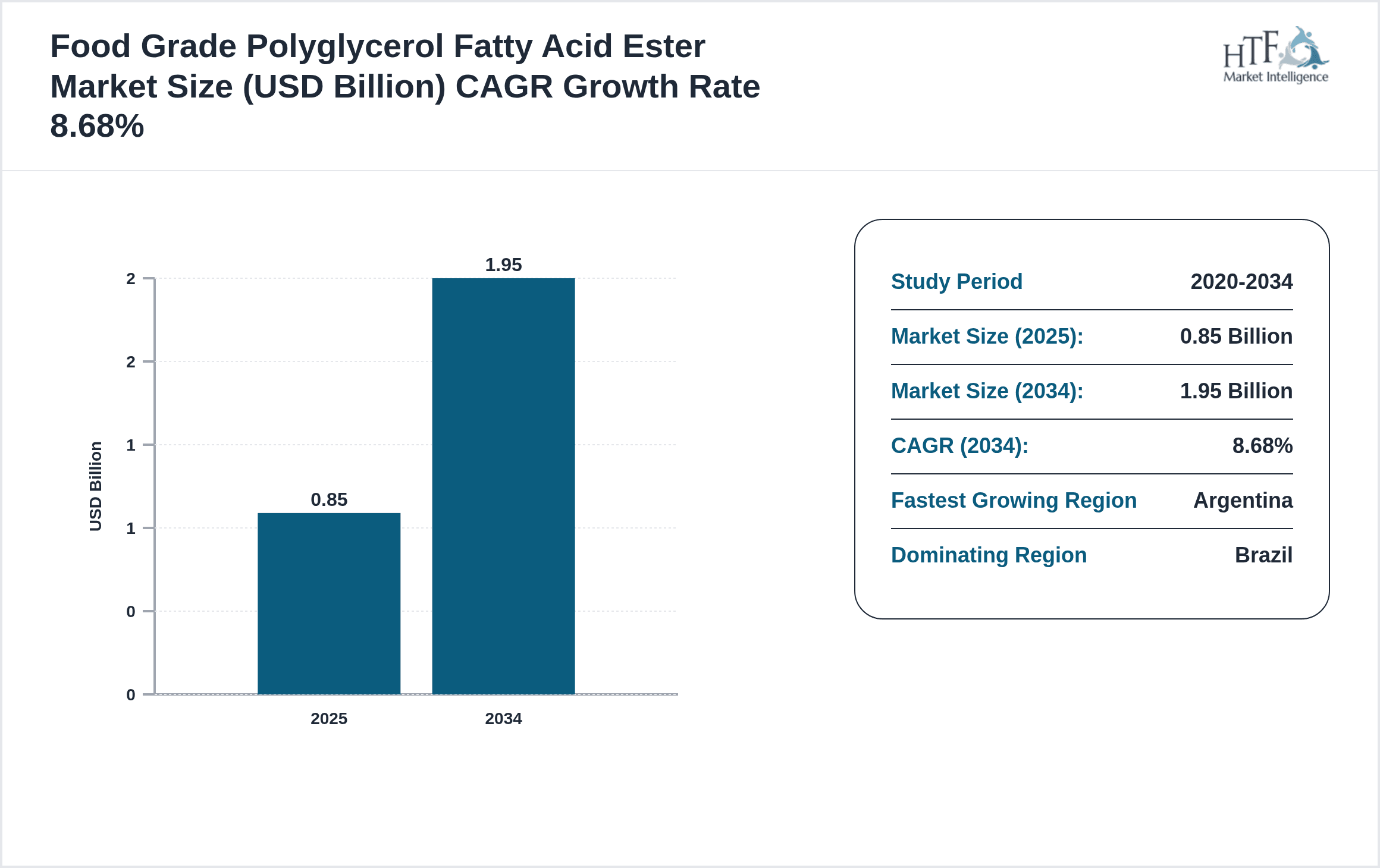
- •Key highlights include a base market size of USD 0.85 Billion in 2024, projected to reach USD 1.95 Billion by 2034, reflecting a robust CAGR of approximately 8.68%. Brazil dominates the regional market with a 42% share, while Argentina is the fastest-growing country with an 11.2% CAGR and an 18% market share. Polyglycerol polyricinoleate remains the leading type, favored for its functionality in chocolate and confectionery, whereas polyglycerol esters of fatty acids are the fastest-growing segment, driven by demand in emerging food applications. The baked goods segment is the dominant application, supported by the growing bakery industry, with dairy products following closely. Increased investments in food processing infrastructure and rising consumer preference for convenience foods fuel growth dynamics.
- •This market holds strategic importance for food manufacturers, ingredient suppliers, and regulatory bodies focused on food safety and innovation. The expanding processed food industry in South America, coupled with stringent regulatory frameworks, creates opportunities for product innovation and sustainable ingredient sourcing. Stakeholders benefit from understanding regional consumption patterns, regulatory requirements, and technological trends influencing emulsifier usage. The rising demand for plant-based and clean-label products further underscores the value proposition of food-grade polyglycerol fatty acid esters in formulating functional, stable, and consumer-preferred food products, thereby reinforcing their essential role in the food ingredients ecosystem.
Competitive Landscape
The South America Food Grade Polyglycerol Fatty Acid Ester Market features a competitive environment characterized by a mix of multinational corporations and regional manufacturers focusing on product innovation, regulatory compliance, and supply chain optimization. Companies are increasingly investing in research and development to enhance emulsifier functionality, safety, and sustainability, aligning with evolving consumer preferences for clean-label and natural ingredients. Market rivalry revolves around technological advancements such as enzyme-catalyzed production processes and the development of novel ester variants with improved emulsification properties. Strategic partnerships, collaborations, and regional expansions are common, enabling firms to strengthen distribution networks and local presence. Pricing strategies are influenced by raw material availability, particularly castor oil derivatives, and regulatory shifts that affect formulation standards. Barriers to entry include stringent quality certifications and the need for robust food safety management systems. Future trends suggest consolidation through mergers and acquisitions, increased focus on bio-based and environmentally friendly products, and enhanced customer engagement through customized ingredient solutions.
Leading Companies in Food Grade Polyglycerol Fatty Acid Ester Market
- •BASF SE (Germany)
- •Evonik Industries AG (Germany)
- •Kao Corporation (Japan)
- •P&G Chemicals (United States)
- •Danisco (Denmark)
- •Croda International Plc (United Kingdom)
- •Vantage Specialty Chemicals (United States)
- •Clariant AG (Switzerland)
- •Stepan Company (United States)
- •Byk Additives & Instruments (Germany)
- •Solvay SA (Belgium)
- •Acme-Hardesty Co. (United States)
- •Eastman Chemical Company (United States)
- •SEPPIC (France)
- •Kerry Group (Ireland)
- •ADM (Archer Daniels Midland) (United States)
- •Ingredion Incorporated (United States)
- •Croda South America Ltda. (Brazil)
- •Lonza Group AG (Switzerland)
- •Clariant Brazil Ltda. (Brazil)
- •Wilmar International Limited (Singapore)
- •Mane SA (France)
- •Lipo Chemicals, Inc. (United States)
- •Huntsman Corporation (United States)
- •Mitsubishi Chemical Corporation (Japan)
Segment Analysis for South America Food Grade Polyglycerol Fatty Acid Ester Market
- •By Type
- ◦Polyglycerol Polyricinoleate (PGPR)
- ◦Polyglycerol Esters of Fatty Acids
- ◦Polyglycerol Monostearate
- ◦Polyglycerol Distearate
- ◦Other Polyglycerol Fatty Acid Esters
- •By Application
- ◦Baked Goods
- ◦Dairy Products
- ◦Confectionery
- ◦Beverages
- ◦Processed Foods
- •By Distribution Channel
- ◦Direct Sales
- ◦Distributors & Wholesalers
- ◦Online Retail
- •By End-Use Industry
- ◦Food & Beverage Manufacturers
- ◦Bakery & Confectionery Producers
- ◦Dairy Processing Companies
- ◦Beverage Producers
Growth Dynamics in South America Food Grade Polyglycerol Fatty Acid Ester Market
- •The South America Food Grade Polyglycerol Fatty Acid Ester Market is propelled by increasing demand for processed and convenience foods driven by urbanization and changing consumer lifestyles. Rising disposable incomes in countries such as Brazil and Argentina encourage higher consumption of bakery, confectionery, and dairy products that require emulsifiers to improve texture and shelf life. Additionally, increasing awareness about food safety and quality standards compels manufacturers to adopt reliable emulsifiers compliant with regulatory frameworks. The growing preference for clean-label and natural ingredients also fuels innovation in polyglycerol fatty acid ester formulations, enhancing their acceptance across diverse applications. Investments in food processing infrastructure and expanding retail chains further accelerate market growth, enabling wider product availability and distribution. This growth dynamic is reinforced by the rising penetration of international food brands in the region, which rely on advanced emulsifiers for product differentiation and improved consumer experience, thus stimulating demand across multiple food categories.
- •Technological advancements in emulsifier production, including enzyme-catalyzed synthesis and bio-based raw materials, contribute significantly to market expansion. These innovations enable development of high-performance food-grade polyglycerol fatty acid esters with improved emulsification properties and lower environmental impact. Manufacturers in South America are adopting such technologies to meet consumer demand for sustainable and clean-label products. Furthermore, enhanced R&D efforts focus on customizing emulsifier blends tailored to specific applications like chocolate, margarine, and dairy, increasing product efficacy and reducing formulation costs. The integration of digital tools for quality control and supply chain management also optimizes production efficiency and traceability, supporting compliance with stringent food safety regulations. Collectively, these growth drivers help companies maintain competitive advantage while addressing evolving market needs.
- •The expansion of the bakery and confectionery sectors in South America serves as a major growth catalyst for food-grade polyglycerol fatty acid esters. Consumers’ increasing preference for indulgent and premium products stimulates demand for emulsifiers that improve texture, mouthfeel, and shelf stability. Countries such as Chile and Colombia exhibit growing bakery chains and artisanal product launches, further expanding emulsifier consumption. Additionally, the dairy segment’s growth, particularly in flavored and processed dairy products, drives emulsifier utilization for fat dispersion and stability enhancement. The beverage industry’s diversification into functional drinks and ready-to-drink products also opens new application avenues. This multi-sector growth ensures sustained demand across the region, supported by evolving consumer tastes and product innovation.
- •Government initiatives promoting food safety standards and quality certification in South America contribute to the market’s positive trajectory. Regulatory frameworks require strict adherence to food additive regulations, encouraging manufacturers to adopt certified emulsifiers that meet safety and efficacy criteria. This regulatory environment fosters trust among consumers and trade partners, facilitating market penetration and export opportunities. Additionally, regional trade agreements and economic partnerships enhance cross-border supply chains, enabling efficient distribution of polyglycerol fatty acid esters. These policy-driven factors underpin stable market growth and encourage investment in local production capabilities.
- •Consumer trends towards healthier, plant-based, and organic food products are shaping the demand for innovative emulsifiers in South America. Polyglycerol fatty acid esters derived from renewable sources align well with clean-label and sustainability preferences, appealing to environmentally conscious consumers. The rising popularity of vegan, gluten-free, and lactose-free products creates niche opportunities for customized emulsifier solutions. Food manufacturers are leveraging these trends to reformulate products, enhancing nutritional profiles without compromising sensory attributes. This shift in consumer behavior drives market expansion by fostering adoption of advanced emulsifiers that support health-focused product development.
Prevailing Market Trends in South America Food Grade Polyglycerol Fatty Acid Ester Market
- •The South America Food Grade Polyglycerol Fatty Acid Ester Market is witnessing a marked trend toward clean-label and natural ingredient formulations. Manufacturers increasingly replace synthetic emulsifiers with bio-based polyglycerol fatty acid esters, responding to consumer demand for transparency and health consciousness. This shift influences formulation strategies and supply chain sourcing, prioritizing sustainability and traceability throughout the production process.
- •Digitalization and Industry 4.0 adoption in food processing facilities across South America facilitate improved quality control and efficient production of emulsifiers. The integration of automation and data analytics ensures consistent product performance and regulatory compliance, enhancing manufacturer competitiveness in the regional market.
- •Collaborative innovation between ingredient suppliers and food manufacturers has intensified, focusing on developing tailored polyglycerol fatty acid ester blends that optimize texture and stability in specific food applications. These partnerships accelerate product launches and reduce time-to-market for novel food formulations.
- •Sustainability is a driving trend, with companies investing in eco-friendly sourcing of raw materials such as castor oil and adopting green chemistry processes for ester production. This aligns with global commitments to reduce environmental footprints and supports consumer preferences for responsible brands.
- •The rise of functional and fortified foods in South America is influencing emulsifier demand, as these products require stable incorporation of bioactive ingredients. Polyglycerol fatty acid esters are increasingly used to enhance nutrient dispersion and product shelf life, supporting this expanding segment.
Emerging Opportunities in South America Food Grade Polyglycerol Fatty Acid Ester Market
- •Expanding demand for plant-based and vegan food products in South America presents a lucrative opportunity for polyglycerol fatty acid ester manufacturers. Emulsifiers that facilitate fat replacement and texture enhancement in these products are highly sought after, enabling market penetration in a growing segment.
- •Increasing adoption of advanced enzymatic synthesis technologies allows production of customized emulsifiers with superior performance and reduced environmental impact, opening avenues for premium product offerings and differentiation.
- •Geographical expansion into emerging South American markets such as Peru and Colombia offers significant growth prospects due to rising urbanization and consumer spending on processed foods. Localized product adaptation and strategic partnerships can capitalize on this trend.
- •Collaboration with foodservice and bakery chains to develop specialized emulsifier solutions tailored for large-scale production can enhance brand visibility and volume sales, strengthening market presence.
- •Integration of sustainability certifications and eco-labeling in product portfolios can attract environmentally conscious consumers and comply with evolving regulatory standards, driving competitive advantage.
Critical Challenges Facing South America Food Grade Polyglycerol Fatty Acid Ester Market
- •Raw material price volatility, especially for castor oil derivatives essential in polyglycerol ester production, poses a significant challenge. Fluctuating supply and geopolitical factors can disrupt manufacturing costs and product pricing, impacting profitability.
- •Stringent and varying regulatory requirements across different South American countries complicate market entry and product registration processes. Compliance costs and delays may hinder new product launches and expansion strategies.
- •Competition from alternative emulsifiers and synthetic additives, which may offer cost advantages or established market presence, challenges the adoption of polyglycerol fatty acid esters, particularly among price-sensitive segments.
- •Limited consumer awareness about emulsifiers and their benefits can restrict market growth, necessitating educational initiatives and transparent labeling to build trust and acceptance.
- •Supply chain disruptions due to infrastructure constraints or logistic inefficiencies in certain South American regions impact timely delivery and inventory management, affecting customer satisfaction and operational efficiency.
Regulatory Overview for South America Food Grade Polyglycerol Fatty Acid Ester Market
Between 2019 and 2024, South American countries have enforced stricter food additive regulations emphasizing safety, labeling accuracy, and permissible concentration limits. Brazil’s ANVISA mandates comprehensive safety evaluations and compliance with international food standards, while Argentina and Chile have harmonized regulations aligning with Codex Alimentarius guidelines. These frameworks require manufacturers to provide detailed toxicological data and maintain traceability throughout the supply chain. Additionally, regional trade agreements facilitate mutual recognition of certifications, easing cross-border product movement. Regulatory authorities also promote the adoption of clean-label and non-GMO ingredient certifications, reflecting consumer demand for transparency. Compliance with these evolving standards ensures market access and consumer trust, driving manufacturers to invest in high-quality, certified polyglycerol fatty acid ester products tailored for the South American market.
Market Intelligence on South America Food Grade Polyglycerol Fatty Acid Ester Market
- •15th January 2025, BASF SE launched a new line of bio-based polyglycerol fatty acid esters tailored for the South American bakery sector. This product features enhanced emulsification properties with reduced environmental impact, targeting manufacturers seeking clean-label solutions. The launch aligns with growing demand for sustainable food additives and supports BASF’s strategic focus on regional market penetration and innovation-driven growth. This development is expected to strengthen BASF’s market share in Brazil and neighboring countries by offering improved product performance and regulatory compliance.
- •30th March 2025, Croda South America Ltda. announced an expansion of its production facility in São Paulo, Brazil, to increase capacity for polyglycerol polyricinoleate and related food emulsifiers. This investment aims to meet rising regional demand driven by the expanding processed food industry. The enhanced manufacturing capabilities will enable faster delivery times and customized product formulations, reinforcing Croda’s competitive position in the market. The expansion reflects confidence in South America’s growth potential and commitment to sustainable manufacturing practices.
- •20th February 2025, Evonik Industries AG introduced an innovative enzyme-catalyzed polyglycerol ester designed for improved stability in dairy applications, launched initially in Argentina and Chile. This product offers superior emulsification and heat resistance, addressing challenges faced by local dairy producers. Evonik’s technology leverages biocatalysis to reduce environmental footprint while enhancing product quality. The strategic launch positions Evonik as a leader in advanced emulsifier solutions catering to South American food manufacturers seeking performance and sustainability.
- •10th May 2025, Stepan Company completed a strategic partnership with a leading South American food ingredient distributor to expand its market reach across Peru and Colombia. This collaboration facilitates broader access to Stepan’s range of food-grade polyglycerol fatty acid esters and customized emulsifier blends. The partnership aims to strengthen customer support, improve supply chain efficiency, and accelerate product adoption in emerging markets within the region, highlighting Stepan’s commitment to regional growth and customer-centric solutions.
- •Source: Official company press releases and industry publications
Regional Outlook
The Brazil currently holds a significant share of the market, primarily due to several key factors: increasing consumption rates, a burgeoning population, and robust economic momentum. These elements collectively drive demand, positioning this region as a leader in the market. On the other hand, Argentina is rapidly emerging as the fastest-growing area within the industry. This remarkable growth can be attributed to swift infrastructure development, the expansion of various industrial sectors, and a marked increase in consumer demand. These dynamics make this region a crucial player in shaping future market growth.
In our report, we cover a comprehensive analysis of the following regions and countries:
- Brazil
- Argentina
- Chile
- Peru
- Colombia
- Rest of South America
| Feature | Details |
|---|---|
| Base Year Market Size | USD 0.85 Billion |
| Forecast Year Market Size | USD 1.95 Billion |
| CAGR | 8.68% |
| Forecast Period | 2026 to 2033 |
| YoY Growth | 8.35% |
| Regions Covered | Brazil, Argentina, Chile, Peru, Colombia, Rest of South America |
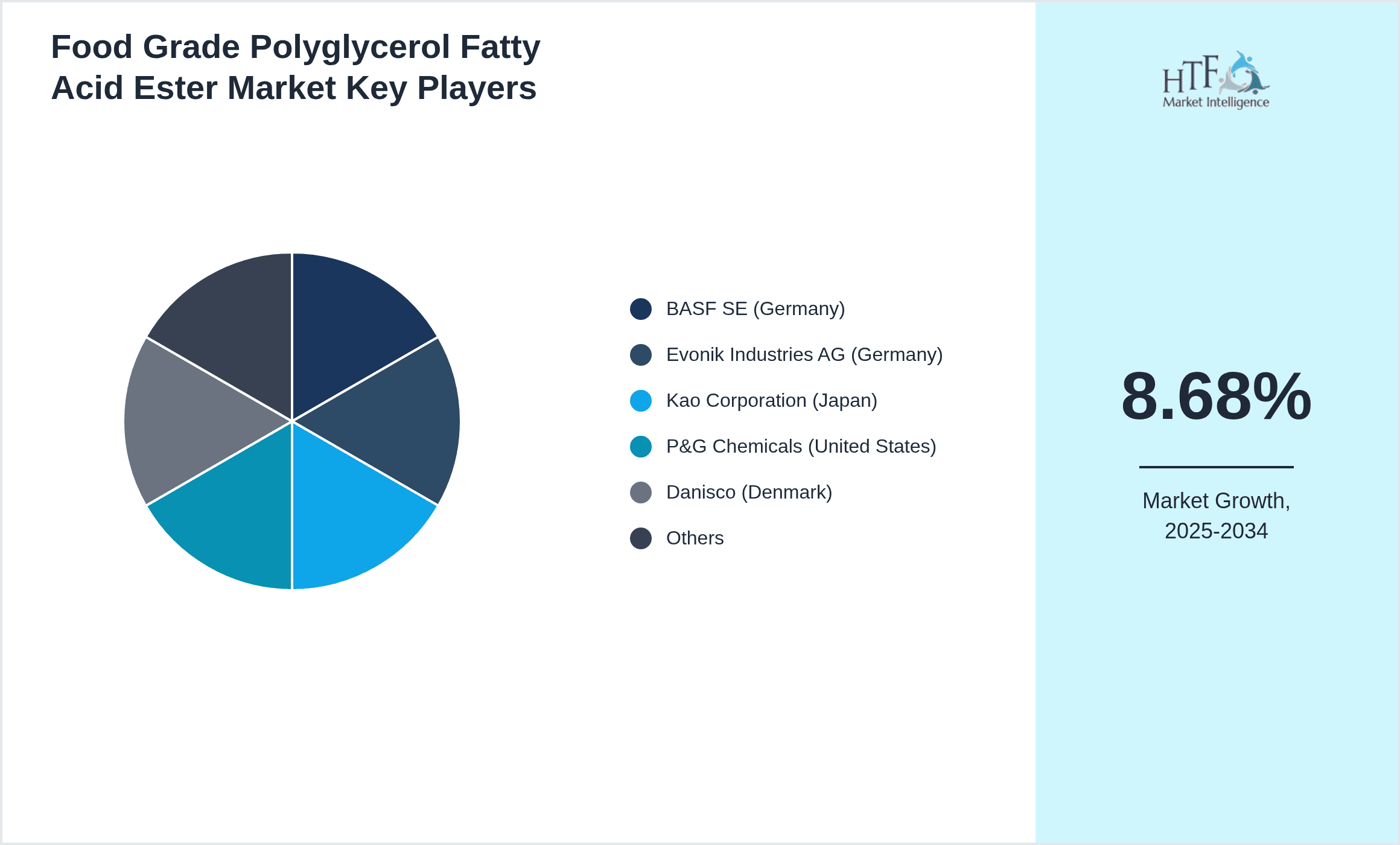
| Key Companies | BASF SE (Germany), Evonik Industries AG (Germany), Kao Corporation (Japan), P&G Chemicals (United States), Danisco (Denmark) |
South America Food Grade Polyglycerol Fatty Acid Ester Market Scope & Changing Dynamics 2024-2034 - Table of Contents
Research enthusiast focused on transforming data uncovering into actionable insights through data-driven decision-making.
Frequently Asked Questions (FAQ):
The Market market is expected to see significant growth and value in 2025.
North America currently leads the market, followed by Europe and Asia-Pacific.
Key growth drivers include increasing activities, rising demand for innovative solutions, technological advancements, and growing preference for efficient products.