
Japan Business Cloud Storage Service Market - Japan Size & Outlook 2024-2034
Japan Business Cloud Storage Service Market is segmented by Application (Data Backup & Recovery, Enterprise Content Management, Collaboration Platforms, Disaster Recovery, Big Data Analytics), Type (Public Cloud Storage, Private Cloud Storage, Hybrid Cloud Storage, Community Cloud Storage, Multi-Cloud Storage), and Geography (Hokkaido, Tohoku, Kanto, Chubu, Kansai, Chugoku, Shikoku, Kyushu)
Pricing
Report Overview
Executive Summary
- •The Japan Business Cloud Storage Service market is a critical enabler for enterprises seeking agile, cost-effective, and secure data storage solutions. This market includes various cloud storage types, such as public, private, hybrid, community, and multi-cloud models, each offering distinct advantages in scalability, security, and operational flexibility tailored to Japan’s unique business environment. The market addresses multiple applications encompassing data backup and recovery, enterprise content management, collaboration platforms, disaster recovery, and big data analytics, reflecting the diverse needs across industries. Driven by Japan’s advanced digital infrastructure, stringent data privacy regulations, and strong corporate adoption of cloud technologies, the market continues to expand rapidly. The scope includes service providers delivering cloud storage infrastructure, software, and managed services that empower organizations to optimize data utilization, enhance disaster resilience, and support digital transformation initiatives. Regional dynamics within Japan’s economic zones further shape market demand, making localized solutions essential. Overall, the market plays a pivotal role in supporting Japan's evolving digital economy and data-driven business strategies.
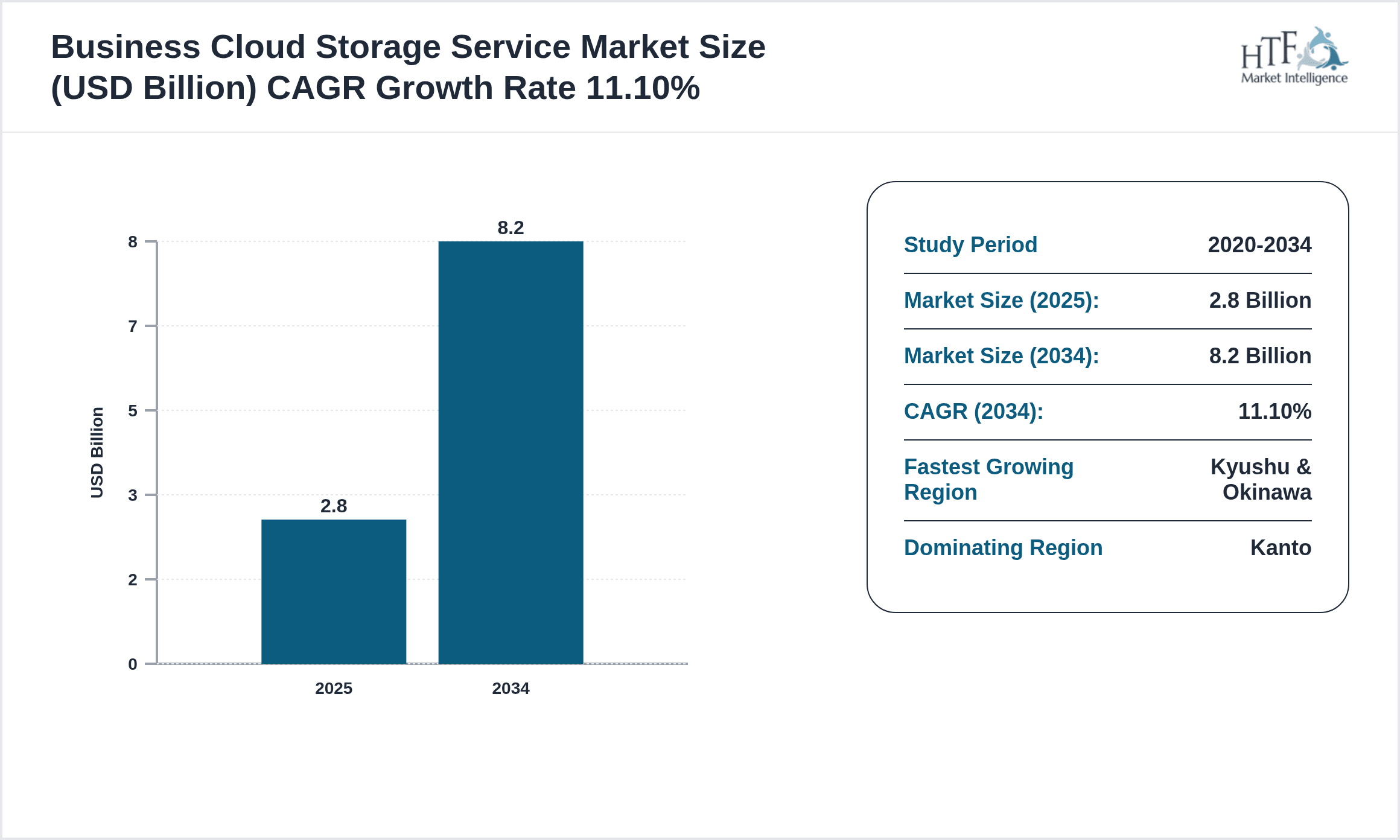
- •Key market highlights include a base market size of USD 2.8 Billion in 2024, projected to reach USD 8.2 Billion by 2034, reflecting a robust CAGR of approximately 11.1%. The dominant product type is Public Cloud Storage, commanding the largest market share, while Hybrid Cloud Storage exhibits the fastest growth trajectory. Kanto leads as the dominating regional zone with 35% market share, supported by its concentration of corporate headquarters and data centers. Kyushu & Okinawa region is identified as the fastest-growing zone with a CAGR of 14.2%, fueled by increasing digital infrastructure investments and regional cloud adoption initiatives. Market growth is further propelled by rising enterprise demand for scalable storage, compliance-driven data management, and integration with AI and analytics services. The market also faces challenges such as stringent regulatory compliance, data sovereignty concerns, and competitive pressure from global and local service providers.
- •The Japan Business Cloud Storage Service market holds strategic importance for various industries including finance, manufacturing, healthcare, retail, and telecommunications. It offers businesses the ability to enhance operational efficiency, reduce IT costs, and enable real-time data accessibility. Cloud storage services facilitate disaster recovery and business continuity planning essential in Japan’s disaster-prone environment. Moreover, the market supports innovation by enabling big data analytics and collaboration platforms critical for digital transformation. Stakeholders including cloud service providers, system integrators, and end-users benefit from the evolving landscape shaped by regulatory frameworks and technological advancements. The expanding market presents opportunities for providers to customize offerings based on regional demands and sector-specific requirements, fostering competitive differentiation and long-term growth.
Competitive Landscape
The competitive environment in the Japan Business Cloud Storage Service market is characterized by intense rivalry among global cloud giants, regional specialists, and emerging niche players. Market dynamics revolve around innovation in storage technologies, service scalability, security enhancements, and cost optimization. Leading companies focus on differentiation through advanced hybrid cloud offerings, AI integration for data management, and localized compliance solutions tailored to Japan’s regulatory landscape. Strategic partnerships and alliances with local system integrators and telecom operators form a critical component of market positioning. Competitive strategies emphasize service reliability, data sovereignty assurance, and customer-centric customization. Mergers and acquisitions are frequently leveraged to expand service portfolios, geographic reach, and technological capabilities. The competitive landscape also reflects aggressive pricing models and investment in infrastructure to support low-latency, high-availability services. Regional competition varies by sub-region, with Kanto dominating due to dense corporate presence, while emerging zones like Kyushu & Okinawa offer growth opportunities through government incentives and digital infrastructure development. Future trends suggest increased focus on sustainability, edge computing integration, and enhanced cybersecurity as key competitive differentiators.
Prominent Players in Japan Business Cloud Storage Service Market
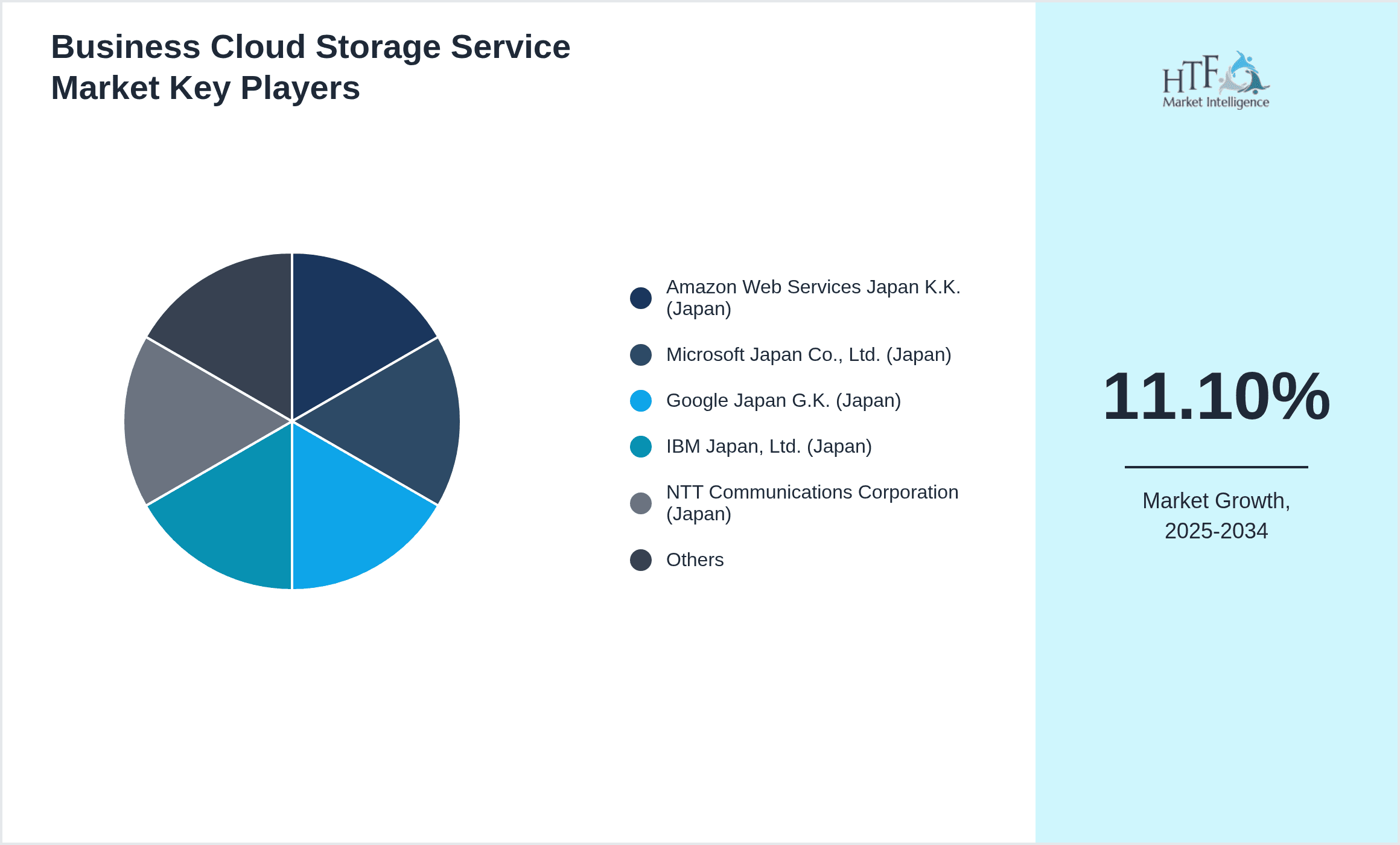
- •Amazon Web Services Japan K.K. (Japan)
- •Microsoft Japan Co., Ltd. (Japan)
- •Google Japan G.K. (Japan)
- •IBM Japan, Ltd. (Japan)
- •NTT Communications Corporation (Japan)
- •Fujitsu Limited (Japan)
- •NEC Corporation (Japan)
- •Hitachi, Ltd. (Japan)
- •Oracle Corporation Japan (Japan)
- •Rackspace Technology Japan, Inc. (Japan)
- •Salesforce.com Japan Co., Ltd. (Japan)
- •SoftBank Corp. (Japan)
- •KDDI Corporation (Japan)
- •IIJ (Internet Initiative Japan Inc.) (Japan)
- •SCSK Corporation (Japan)
- •CyberAgent, Inc. (Japan)
- •NEC Networks & System Integration Corporation (Japan)
- •Toshiba Corporation (Japan)
- •Dimension Data Japan, Inc. (Japan)
- •Mitsubishi Electric Corporation (Japan)
- •Panasonic Corporation (Japan)
- •Canon IT Solutions Inc. (Japan)
- •Trend Micro Incorporated (Japan)
- •NEC Cloud IaaS (Japan)
- •IIJ GIO Cloud Service (Japan)
Market Breakdown
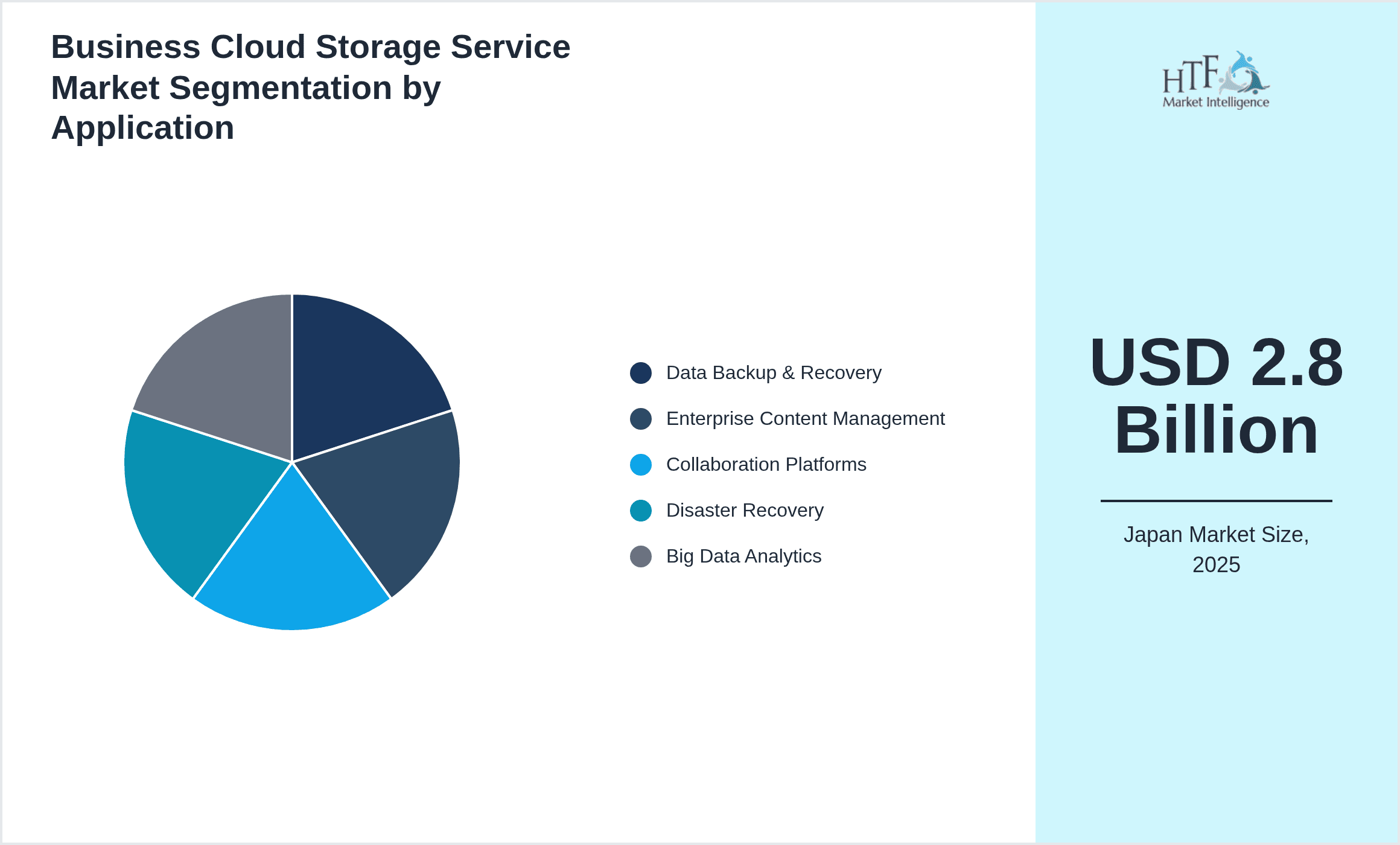
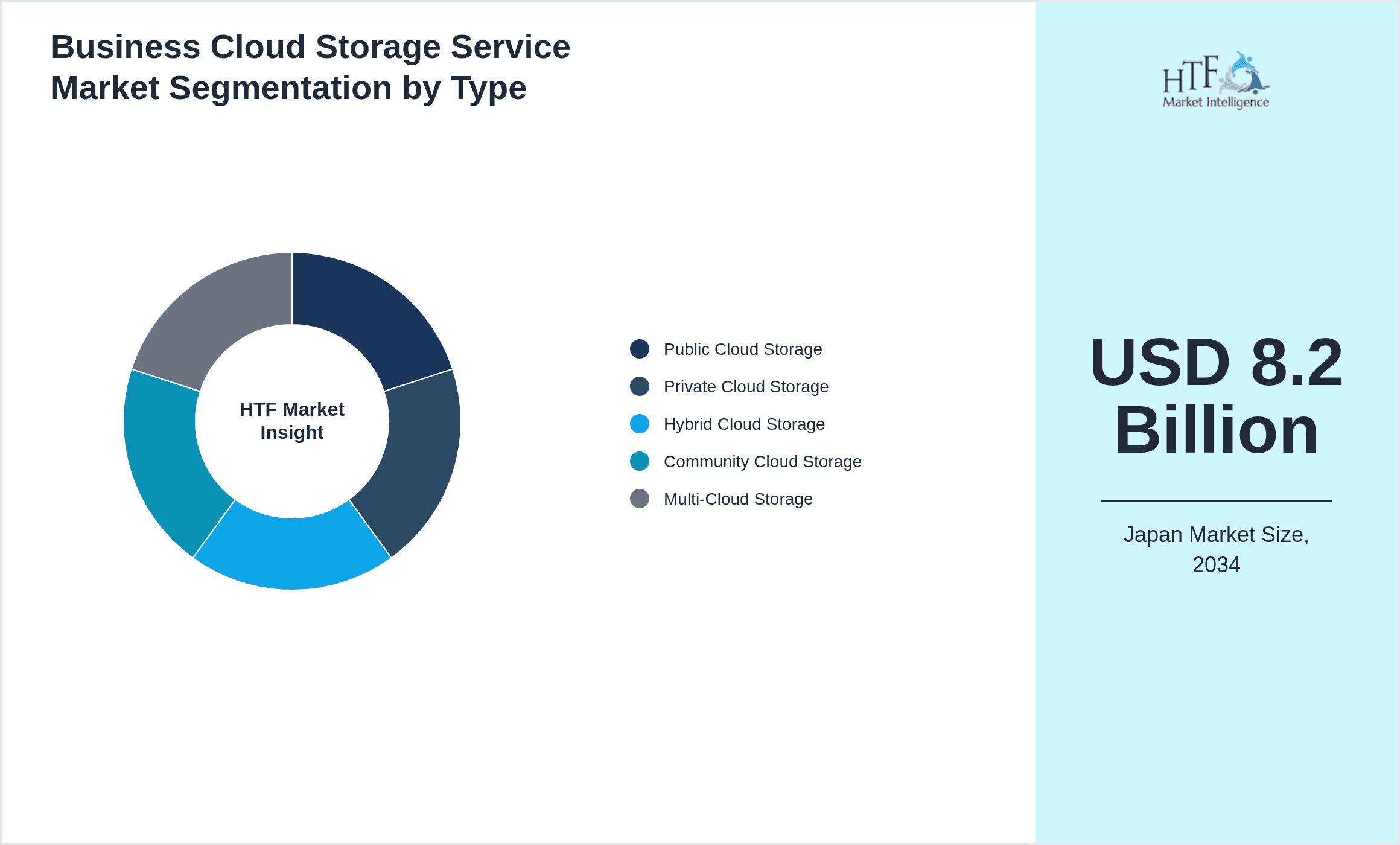
- •By Type
- ◦Public Cloud Storage
- ◦Private Cloud Storage
- ◦Hybrid Cloud Storage
- ◦Community Cloud Storage
- ◦Multi-Cloud Storage
- •By Application
- ◦Data Backup & Recovery
- ◦Enterprise Content Management
- ◦Collaboration Platforms
- ◦Disaster Recovery
- ◦Big Data Analytics
- •By End User Industry
- ◦Finance & Banking
- ◦Manufacturing
- ◦Healthcare
- ◦Retail & E-commerce
- ◦Telecommunications
- •By Deployment Model
- ◦Cloud-based
- ◦On-premise
- ◦Hybrid
Growth Dynamics
- •The growth of the Japan Business Cloud Storage Service market is propelled by increasing enterprise adoption of digital transformation initiatives, necessitating scalable and flexible data storage solutions. Businesses across sectors such as finance, manufacturing, and healthcare are investing heavily in cloud infrastructure to enhance operational efficiency and data accessibility. Government policies promoting cloud computing and data center development further support market expansion. The rising demand for hybrid cloud models, which combine the benefits of public and private clouds, addresses security concerns while maintaining flexibility, significantly driving market growth. Additionally, the surge in data volumes generated by IoT devices and big data analytics applications intensifies the need for robust cloud storage services. Cloud service providers are responding with innovative solutions offering enhanced security, compliance with Japan’s data protection laws, and integration with AI-based data management tools. Collectively, these factors create a conducive environment for sustained growth in the Japan Business Cloud Storage Service market.
- •Market trends reveal an accelerated shift towards hybrid and multi-cloud storage strategies among Japanese enterprises, driven by demands for data sovereignty, security, and workload optimization. The integration of artificial intelligence and machine learning into cloud storage platforms enhances data indexing, retrieval, and predictive analytics, enabling smarter data management and operational agility. There is also a rising preference for edge computing to reduce latency and improve real-time data processing, especially in regions with growing digital infrastructure like Kyushu & Okinawa. Cloud providers are increasingly offering industry-specific tailored solutions, catering to the nuanced requirements of finance, healthcare, and manufacturing sectors. Sustainability is becoming a focal point, with companies investing in energy-efficient data centers and green cloud technologies to meet environmental commitments. Furthermore, strategic collaborations between telecom operators and cloud vendors are expanding cloud reach and enhancing service reliability, reflecting a trend of ecosystem partnerships shaping market evolution.
- •Despite robust growth, the Japan Business Cloud Storage Service market faces restraints including stringent regulatory requirements concerning data privacy and security, especially under Japan’s Act on the Protection of Personal Information (APPI). Compliance obligations impose operational complexities and require investments in secure infrastructure and audit capabilities. High initial costs associated with migrating legacy systems to cloud platforms and integrating hybrid environments deter some small and medium enterprises. Additionally, concerns over data breaches and cyber-attacks persist, necessitating advanced security measures which increase service costs. Market fragmentation due to varying industry-specific needs and the presence of numerous local and global providers creates competitive pressure, complicating customer decision-making. Limited skilled workforce specializing in cloud architecture and data governance within Japan further restricts rapid adoption. These challenges necessitate strategic planning and innovation from service providers to mitigate risks and drive customer confidence.
- •Significant market opportunities exist in expanding cloud storage adoption among traditionally conservative sectors such as government and manufacturing, where digital transformation is gaining momentum. The rise of remote working and collaboration tools due to evolving workplace dynamics presents new demand avenues for cloud-based content management and secure storage solutions. Expansion into underpenetrated regional zones like Tohoku and Chugoku, supported by government digital infrastructure investments, offers growth potential. Advances in hybrid cloud technologies and AI-powered data management open avenues for new service offerings focused on automation, efficiency, and compliance. Strategic partnerships between cloud providers and telecom operators can extend service accessibility and reliability. Furthermore, increasing interest in green IT initiatives provides opportunities for providers specializing in sustainable cloud storage solutions. These factors collectively create a fertile environment for innovation-driven growth and market diversification within Japan.
- •Market challenges include intense competition from global cloud service giants establishing strong footholds alongside established Japanese providers, leading to pricing pressures and margin erosion. Navigating Japan’s complex regulatory framework and ensuring compliance with evolving data sovereignty and privacy laws require continuous investment in legal expertise and technology upgrades. Integration complexities arise from diverse legacy IT systems prevalent in Japanese enterprises, complicating cloud migration and hybrid deployments. Cybersecurity threats remain a persistent concern, demanding robust and constantly updated defense mechanisms. Additionally, market fragmentation and customer reluctance due to data security apprehensions slow adoption rates in some sectors. Limited awareness and understanding of cloud benefits among small and medium businesses further hamper growth. These challenges necessitate focused strategies emphasizing security, compliance, customer education, and customized solutions to sustain competitive advantage and foster market expansion.
Market Trends
- •The Japan Business Cloud Storage Service market is witnessing an accelerated adoption of hybrid cloud solutions, combining public and private cloud benefits to address security and flexibility needs. Major enterprises are leveraging AI and machine learning to enhance data management capabilities, enabling predictive analytics and optimized storage utilization. The emergence of edge computing complements cloud storage by enabling real-time data processing closer to source devices, especially critical in manufacturing and IoT-intensive industries. Cloud providers are increasingly adopting green data center initiatives to meet sustainability goals, reflecting growing environmental consciousness. Strategic partnerships between telecom operators and cloud vendors are expanding service delivery frameworks, enhancing network reliability and reducing latency. These trends collectively shape a dynamic market landscape focused on innovation, security, and operational efficiency.
- •Innovation in data security technologies, including encryption, tokenization, and zero-trust models, is a prominent trend facilitating compliance with Japan’s stringent data privacy laws. The rise of industry-specific cloud solutions, tailored for finance, healthcare, and retail verticals, enhances market relevance and customer engagement. Increasing preference for multi-cloud strategies enables businesses to optimize costs and avoid vendor lock-in. Cloud-native application development gains traction, fostering agility and rapid deployment. Furthermore, digital transformation initiatives driven by government programs and private sectors catalyze cloud adoption. The convergence of cloud storage with big data analytics platforms supports advanced insights and decision-making. Overall, these technological and strategic trends underpin the evolving market dynamics in Japan.
- •A strategic trend involves growing investments in regional data centers, particularly in zones outside Kanto, to reduce latency and comply with local data residency requirements. Cloud providers are enhancing managed service offerings, providing end-to-end solutions including migration, security, and lifecycle management, simplifying adoption for enterprises. The integration of blockchain technologies in cloud storage for enhanced data integrity and auditability is emerging. Cloud service pricing models are evolving towards more usage-based and flexible subscription plans aligning with customer consumption patterns. There is also increased focus on disaster recovery-as-a-service (DRaaS) reflecting Japan’s vulnerability to natural disasters. Collaborative ecosystems involving cloud providers, telecom companies, and system integrators are gaining importance to deliver comprehensive digital solutions. These strategic market moves are shaping competitive positioning and customer value propositions.
- •Digitalization of small and medium enterprises (SMEs) is gaining momentum, with cloud storage services becoming more accessible and affordable, expanding the market base. The rise in hybrid work models post-pandemic fuels demand for secure, remote-accessible cloud storage solutions supporting collaboration platforms. Cloud providers are investing in AI-driven automation for storage management, reducing operational overheads and improving service reliability. Sustainability initiatives drive adoption of energy-efficient cloud infrastructure, aligning with corporate social responsibility goals. There is a growing trend of integrating cloud storage with Internet of Things (IoT) ecosystems, enabling seamless data flow and analytics. Market players are increasingly focusing on customer experience enhancements through customized service portfolios and user-friendly interfaces. These trends collectively contribute to the dynamic evolution of the Japan Business Cloud Storage Service market.
- •Looking forward, the market is expected to witness disruptive innovations such as quantum-safe encryption and advanced data fabric architectures enabling seamless data mobility across clouds. The proliferation of 5G networks enhances cloud storage accessibility and performance, particularly in remote and underserved regions. Expansion of cloud marketplaces and APIs facilitates integration of diverse cloud services, fostering ecosystem growth. Regulatory evolution is anticipated to influence market practices, necessitating proactive compliance strategies. Increased collaboration between cloud providers and industry consortia promotes standardization and interoperability. The shift towards subscription-based and outcome-driven service models is likely to accelerate. Overall, these future trends indicate sustained growth, heightened competition, and continuous technological advancement shaping the Japan Business Cloud Storage Service landscape.
Market Opportunities
- •Expanding cloud storage adoption in traditionally conservative sectors such as government, manufacturing, and healthcare presents significant growth potential. These industries are increasingly prioritizing digital transformation to improve operational efficiency, data security, and regulatory compliance. Providers can capitalize by offering tailored, compliance-ready solutions addressing sector-specific challenges and data sensitivity. The rise of remote work and digital collaboration demands scalable, secure cloud storage platforms, creating opportunities for service innovation. Regional expansion into underpenetrated zones like Tohoku and Chugoku, supported by infrastructure investments and government incentives, offers untapped market potential. Integration of AI and automation in storage management can enhance service differentiation and customer value. Furthermore, green cloud initiatives aligned with corporate sustainability goals open new avenues for providers emphasizing eco-friendly solutions. Strategic partnerships with telecom operators and system integrators can enhance market reach and service reliability. These opportunities collectively underscore the potential for diversified growth in Japan’s Business Cloud Storage Service market.
- •The growing demand for hybrid and multi-cloud strategies among enterprises seeking flexibility and cost optimization creates opportunities for innovative service offerings. Providers offering seamless cloud interoperability, migration assistance, and unified management platforms can capture emerging customer segments. Investment in edge computing infrastructure enables addressing latency-sensitive applications in manufacturing and IoT, augmenting cloud storage relevance. The increasing importance of disaster recovery and business continuity solutions in Japan’s disaster-prone environment presents a lucrative niche for specialized cloud storage services. Development of industry-focused cloud marketplaces and APIs facilitates ecosystem expansion and customer engagement. Furthermore, emerging technologies such as blockchain for data integrity and quantum-safe encryption offer avenues for technological leadership. Cloud providers can also explore subscription-based and outcome-oriented pricing models to attract SMEs and startups. These market opportunities highlight the potential for innovation-driven expansion and competitive differentiation within Japan’s cloud storage service ecosystem.
- •Investment in cloud infrastructure modernization and capacity expansion, particularly in regional data centers outside Kanto, presents growth avenues aligned with local data residency requirements and latency reduction. The acceleration of big data analytics and AI-driven business models across Japanese enterprises increases demand for scalable and intelligent cloud storage solutions. Providers can leverage these trends by developing integrated storage and analytics offerings. Government initiatives promoting digital transformation and data security create a favorable environment for market development, encouraging adoption among public sector entities. Collaboration opportunities with telecom operators enhance network capabilities and service delivery, strengthening competitive positioning. Additionally, increasing awareness and education about cloud benefits among SMEs can drive market penetration. The emphasis on sustainability and energy-efficient cloud solutions aligns with corporate social responsibility goals, providing differentiation opportunities. These factors collectively create a conducive environment for sustained growth and technological advancement in the Japan Business Cloud Storage Service market.
- •Rising adoption of cloud-native applications and microservices architectures among Japanese enterprises fuels demand for flexible storage solutions that support dynamic workloads. The expansion of 5G networks enhances cloud accessibility, enabling new use cases in mobile computing and IoT, amplifying storage demand. Providers offering customized security and compliance frameworks tailored to Japan’s regulatory environment can strengthen customer trust and market share. The growing trend of outsourcing IT infrastructure management to cloud providers opens opportunities for managed cloud storage services. Strategic mergers, acquisitions, and partnerships can facilitate capability enhancement and market expansion. Furthermore, increased demand for disaster recovery-as-a-service (DRaaS) driven by natural disaster risks enhances niche market potential. Focus on user experience, simplified interfaces, and integrated service platforms can improve adoption rates. These emerging opportunities indicate diverse pathways for market players to innovate and capture value in Japan’s evolving cloud storage landscape.
- •The potential for cross-border cloud storage services supporting multinational corporations operating in Japan offers avenues for global service integration and expansion. Providers that can offer multilingual support, localized compliance, and seamless data transfer across jurisdictions may gain competitive advantage. Adoption of AI and automation in storage provisioning, monitoring, and optimization improves operational efficiency and service quality. Increasing demand for hybrid cloud disaster recovery solutions reflects the need for resilient infrastructure in Japan’s disaster-sensitive regions. Growth in cloud-based collaboration tools among SMEs and startups expands the addressable market. The development of cloud marketplaces facilitating third-party application integration enhances platform attractiveness and customer retention. Investment in sustainable and energy-efficient data centers aligns with national environmental policies and customer preferences. These factors collectively highlight the multifaceted opportunities available within the Japan Business Cloud Storage Service market for innovative and agile providers.
Market Challenges
- •One of the primary challenges in the Japan Business Cloud Storage Service market is navigating the complex and evolving regulatory landscape, including the Act on the Protection of Personal Information (APPI) and related data sovereignty requirements. Ensuring compliance necessitates substantial investment in data security infrastructure and continuous monitoring, increasing operational costs. Legacy IT system integration difficulties pose barriers to cloud adoption for many enterprises, requiring customized migration strategies and technical expertise. Intense competition from global cloud giants and local providers leads to pricing pressures and margin constraints. The scarcity of skilled professionals with expertise in cloud architecture, data governance, and cybersecurity hampers rapid deployment and innovation. Concerns over data breaches and cyber-attacks persist, demanding advanced protective measures and undermining customer confidence. Market fragmentation due to diverse industry requirements complicates standardized service delivery. These challenges require providers to adopt strategic, technology-driven, and customer-focused approaches to sustain growth and competitive advantage.
- •High initial costs associated with cloud migration and hybrid cloud deployments deter adoption among small and medium enterprises, limiting market penetration in this segment. Variability in customer awareness and understanding of cloud benefits slows decision-making and investment. The need for continuous innovation to keep pace with technological advancements strains resources, especially for smaller providers. Infrastructure constraints in regional zones outside major metropolitan areas can limit service quality and accessibility, affecting market expansion. Data latency and bandwidth limitations remain concerns for certain applications, requiring investment in edge computing and network upgrades. Resistance to change from traditional IT management practices within enterprises impedes cloud transition efforts. Additionally, geopolitical risks and international data transfer restrictions introduce uncertainties affecting cross-border cloud services. Addressing these multifaceted challenges is critical for market players aiming to capitalize on growth opportunities in Japan.
- •The complexity of managing multi-cloud environments with diverse vendor platforms poses operational and security challenges, increasing the risk of misconfigurations and data loss. Limited interoperability standards hinder seamless data portability and workload migration, affecting customer flexibility. Cloud service outages and reliability concerns, though infrequent, can significantly impact business operations and customer trust. Ensuring data privacy and protection in increasingly sophisticated cyber threat landscapes requires continuous investment in security technologies and expertise. Market fragmentation due to sector-specific regulatory requirements necessitates tailored compliance solutions, complicating service standardization. Balancing cost efficiency with high security and performance expectations remains challenging. Furthermore, evolving customer demands for personalized services require agile product development and responsive support capabilities. These challenges underscore the need for strategic focus on technology, compliance, and customer-centric innovation within the Japan Business Cloud Storage Service market.
- •The shortage of skilled IT talent specialized in cloud technologies and data management within Japan limits rapid deployment and innovation, increasing reliance on external consultants and partners. Market saturation in key metropolitan zones like Kanto intensifies competition, necessitating differentiation through service quality and innovation. Data localization requirements impose operational constraints and increase costs associated with maintaining multiple data centers. Customer concerns regarding vendor lock-in discourage long-term commitments, prompting demand for flexible, interoperable solutions. Rapid technological changes require continuous investment in research and development, challenging resource allocation. Additionally, economic uncertainties and fluctuating IT budgets among enterprises impact purchasing decisions. Overcoming these challenges requires collaborative industry efforts, talent development initiatives, and strategic investments focused on resilience and customer trust.
- •Supply chain disruptions affecting hardware availability and data center construction can delay service expansion and impact cost structures. Variability in regional infrastructure quality leads to inconsistent service experiences across Japan’s sub-regions, affecting customer satisfaction. Managing environmental impacts and achieving sustainability targets in data center operations pose operational and financial challenges. Addressing diverse customer expectations across industries necessitates flexible and customizable service portfolios, increasing complexity. Regulatory changes and tightening data privacy laws require agile compliance adaptation and risk management frameworks. Competitive pressures drive continuous price reductions, impacting profitability and investment capacity. Furthermore, geopolitical tensions influencing international cloud service agreements introduce strategic uncertainties. Providers must adopt comprehensive risk mitigation and innovation strategies to navigate these challenges effectively and sustain growth in the Japan Business Cloud Storage Service market.
Regulatory Framework
- •Between 2019 and 2024, Japan has strengthened its regulatory environment governing cloud storage services, primarily through revisions to the Act on the Protection of Personal Information (APPI) which took effect in 2020. These amendments introduced stricter data handling requirements, enhanced rights for data subjects, and mandatory breach notifications, significantly impacting cloud service providers and their compliance frameworks. The Japanese government has also implemented guidelines promoting secure cloud adoption among public institutions, encouraging transparency and accountability in data management. Additional regulations focus on cross-border data transfer restrictions, requiring localized data storage or stringent safeguards for international data flows. Compliance with these policies necessitates investments in data encryption, access controls, and audit capabilities. Moreover, regional mandates in economic zones such as Kanto and Kansai emphasize data sovereignty and disaster resilience, shaping provider infrastructure strategies. These regulatory developments ensure robust data protection while promoting cloud adoption, influencing market dynamics and service innovation in Japan’s Business Cloud Storage Service market.
- •Enforcement mechanisms include regular audits by the Personal Information Protection Commission (PPC) and penalties for non-compliance, incentivizing providers to maintain high security standards. Industry-specific regulations in finance and healthcare sectors impose additional compliance layers, mandating secure storage and controlled data access. The government’s Digital Transformation Strategy integrates cloud compliance as a core pillar, fostering public-private collaboration to enhance data security. These policy frameworks collectively create a structured environment balancing innovation with privacy and security concerns, shaping the competitive landscape and operational priorities of cloud storage service providers in Japan.
Market Intelligence
- •15th February 2024, Amazon Web Services Japan announced the launch of a new hybrid cloud storage solution integrating AI-powered data management capabilities tailored for Japanese enterprises. This service enhances data security and operational efficiency by automating storage optimization and compliance monitoring. The offering targets industries with stringent regulatory requirements, including finance and healthcare, providing scalable and secure storage options. AWS aims to strengthen its market position in Japan by addressing localized needs and supporting digital transformation initiatives. This launch is expected to accelerate hybrid cloud adoption and set new standards for intelligent cloud storage services in the region. Source: Official AWS Japan Press Release
- •10th August 2023, NTT Communications Corporation expanded its cloud storage infrastructure by inaugurating a new data center in the Kyushu & Okinawa region. This facility enhances low-latency cloud access and compliance with regional data residency regulations, addressing growing demand in southern Japan. The expansion supports hybrid cloud deployments and disaster recovery services, crucial for industries vulnerable to natural disasters. NTT’s strategic investment aims to capture market share in emerging regional zones and provide robust, localized cloud storage solutions. This move reflects broader market trends emphasizing regional infrastructure development and service diversification. Source: NTT Corporate Announcement
- •Recent market developments and strategic initiatives are continuously tracked through industry publications, company announcements, and regulatory filings. For the most current information, stakeholders are advised to monitor official corporate communications and recognized market intelligence platforms.
- •Recent market developments and strategic initiatives are continuously tracked through industry publications, company announcements, and regulatory filings. For the most current information, stakeholders are advised to monitor official corporate communications and recognized market intelligence platforms.
Mergers & Acquisitions
- •In March 2023, Fujitsu Limited acquired a majority stake in a regional cloud storage provider focused on hybrid cloud solutions in the Kansai region. This acquisition strengthens Fujitsu’s hybrid cloud portfolio and regional presence, enabling enhanced service offerings tailored to local enterprise needs. The strategic move aims to leverage synergies in infrastructure, technology, and customer base to accelerate growth in Japan’s competitive cloud storage market. Fujitsu plans to integrate advanced AI-driven data management capabilities from the acquired firm, improving operational efficiency and compliance. This consolidation reflects the broader trend of market players expanding capabilities through targeted acquisitions to address diverse customer requirements and regional dynamics within Japan.
- •In November 2022, KDDI Corporation completed the acquisition of a cloud service provider specializing in secure multi-cloud storage solutions for the finance and healthcare sectors. This acquisition enhances KDDI’s service portfolio by adding robust data protection features compliant with Japan’s regulatory standards. The transaction supports KDDI’s strategy to expand its footprint in managed cloud services and capitalize on growing demand for specialized storage solutions. Post-acquisition, KDDI has focused on integrating the provider’s technology into its existing infrastructure to offer seamless, scalable, and secure cloud storage. This strategic consolidation positions KDDI as a more competitive player in Japan’s evolving cloud storage landscape, emphasizing security and compliance.
Recent Industry News
- •20th January 2024, Microsoft Japan launched an enhanced cloud storage platform integrating advanced AI analytics and compliance automation tailored for Japanese enterprises. The platform facilitates seamless data backup, disaster recovery, and real-time analytics, addressing sector-specific security and regulatory needs. Microsoft aims to strengthen its market share by offering scalable hybrid cloud solutions optimized for Japan’s unique data sovereignty requirements. The launch includes localized support and industry-specific templates, accelerating adoption across finance, healthcare, and manufacturing sectors. This initiative reflects Microsoft’s commitment to driving digital transformation and innovation within Japan’s cloud storage market. Source: Microsoft Japan Official News
- •5th October 2023, Google Japan expanded its cloud storage services with a new data center facility in the Chubu region, enhancing regional accessibility and compliance with local data protection laws. The expansion supports Google’s multi-cloud strategy, offering improved latency and disaster recovery capabilities for enterprises. Google also introduced AI-powered data management tools integrated with its cloud storage, fostering operational efficiency and security. This development aligns with growing demand for hybrid and multi-cloud solutions across Japan’s diverse economic zones. The investment reinforces Google’s competitive positioning in Japan’s cloud storage sector. Source: Google Japan Press Release
- •12th April 2022, IBM Japan unveiled a new cloud storage service targeting the manufacturing industry, featuring blockchain-based data integrity and enhanced encryption. The service addresses critical security and traceability requirements, facilitating compliance with Japan’s stringent data regulations. IBM’s offering integrates with existing enterprise IT systems, enabling seamless cloud migration and hybrid deployments. This launch exemplifies IBM’s focus on industry-specific cloud solutions driving operational innovation and regulatory adherence. The initiative is expected to boost cloud storage adoption in Japan’s manufacturing sector, supporting digital transformation agendas. Source: IBM Japan Corporate Release
- •18th September 2021, SoftBank Corp. partnered with NEC Corporation to deliver a joint cloud storage solution emphasizing AI-driven data analytics and disaster recovery for Japanese SMEs. The collaboration combines SoftBank’s network capabilities with NEC’s cloud expertise to offer scalable, secure, and cost-effective storage services. This partnership aims to accelerate cloud adoption among SMEs by providing localized support and compliance assurance. The joint solution addresses increasing demand for hybrid cloud environments and real-time data accessibility in Japan’s evolving digital economy. This strategic alliance enhances both companies’ market presence and service portfolios. Source: SoftBank Corporate News
Regional Outlook
The Kanto currently holds a significant share of the market, primarily due to several key factors: increasing consumption rates, a burgeoning population, and robust economic momentum. These elements collectively drive demand, positioning this region as a leader in the market. On the other hand, Kyushu & Okinawa is rapidly emerging as the fastest-growing area within the industry. This remarkable growth can be attributed to swift infrastructure development, the expansion of various industrial sectors, and a marked increase in consumer demand. These dynamics make this region a crucial player in shaping future market growth.
In our report, we cover a comprehensive analysis of the following regions and countries:
- Hokkaido
- Tohoku
- Kanto
- Chubu
- Kansai
- Chugoku
- Shikoku
- Kyushu
| Feature | Details |
|---|---|
| Base Year Market Size | USD 2.8 Billion |
| Forecast Year Market Size | USD 8.2 Billion |
| CAGR | 11.1% |
| Forecast Period | 2026 to 2033 |
| YoY Growth | 10.6% |
| Regions Covered | Hokkaido, Tohoku, Kanto, Chubu, Kansai, Chugoku, Shikoku, Kyushu |
| Key Companies | Amazon Web Services Japan K.K. (Japan), Microsoft Japan Co., Ltd. (Japan), Google Japan G.K. (Japan), IBM Japan, Ltd. (Japan), NTT Communications Corporation (Japan), Fujitsu Limited (Japan), NEC Corporation (Japan), Hitachi, Ltd. (Japan), Oracle Corporation Japan (Japan), Rackspace Technology Japan, Inc. (Japan), Salesforce.com Japan Co., Ltd. (Japan), SoftBank Corp. (Japan), KDDI Corporation (Japan), IIJ (Internet Initiative Japan Inc.) (Japan), SCSK Corporation (Japan), CyberAgent, Inc. (Japan), NEC Networks & System Integration Corporation (Japan), Toshiba Corporation (Japan), Dimension Data Japan, Inc. (Japan), Mitsubishi Electric Corporation (Japan), Panasonic Corporation (Japan), Canon IT Solutions Inc. (Japan), Trend Micro Incorporated (Japan), NEC Cloud IaaS (Japan), IIJ GIO Cloud Service (Japan) |
Japan Business Cloud Storage Service Market - Japan Size & Outlook 2024-2034 - Table of Contents
Frequently Asked Questions (FAQ):
The Compact Track Loaders market is projected to grow at a CAGR of 6.8% from 2025 to 2030, driven by increasing demand in construction and agricultural sectors.
North America currently leads the market with approximately 45% market share, followed by Europe at 28% and Asia-Pacific at 22%. The remaining regions account for 5% of the global market.
Key growth drivers include increasing construction activities, rising demand for versatile equipment in agriculture, technological advancements in track loader design, and growing preference for compact equipment in urban construction projects.