
China CMOS Image Sensor Used In Laser Triangulation Market Size, Growth & Revenue 2025-2034
China CMOS Image Sensor Used In Laser Triangulation Market is segmented by Type (Front-Illuminated CMOS, Back-Illuminated CMOS, Stacked CMOS, Global Shutter CMOS, Rolling Shutter CMOS), Application (Industrial Automation, Quality Inspection, Robotics, 3D Scanning, Medical Devices), Deployment Model (Embedded Systems, Standalone Modules, Integrated Sensor Platforms), End User Industry (Automotive Manufacturing, Electronics Assembly, Healthcare Equipment, Consumer Electronics, Aerospace and Defense), and Geography (North China, Northeast China, East China, South Central China, Southwest China, Northwest China)
Pricing
Report Overview
Executive Summary
- •The China CMOS Image Sensor Used In Laser Triangulation Market is a specialized sector focused on the development and application of CMOS sensors that facilitate laser triangulation technology for precise distance and 3D measurements. This market covers various sensor types including front-illuminated, back-illuminated, stacked CMOS, global shutter, and rolling shutter designs, each offering unique benefits for different laser triangulation uses. Applications span industrial automation, robotics, quality inspection, 3D scanning, and medical devices, reflecting the broad impact of this technology across China's industrial and technological landscape. The market is driven by increasing automation, demand for high precision in manufacturing and quality control, and the integration of AI and IoT for smarter sensor solutions. China’s position as a manufacturing powerhouse and technology innovator underpins strong growth, supported by governmental initiatives and technological advancements enhancing sensor performance and cost-efficiency.
- •The market currently stands at approximately USD 0.95 billion in 2025 and is projected to reach USD 2.75 billion by 2034, reflecting a robust CAGR of 12.5%. East China dominates the market with a 34% share, while Southwest China is the fastest-growing sub-region with a CAGR of 15.2%. The back-illuminated CMOS type leads in product adoption due to superior sensitivity and resolution, whereas stacked CMOS represents the fastest-growing product segment owing to its enhanced integration capabilities and miniaturization advantages. Increasing adoption in industrial automation and quality inspection applications further propels market expansion.
- •This market offers significant strategic value to stakeholders across manufacturing, medical, and robotics sectors by enabling higher precision, efficiency, and automation reliability. The integration of advanced CMOS sensors in laser triangulation systems allows for real-time, accurate 3D measurements critical for quality assurance and process optimization in China’s competitive industrial environment. Continued innovation and supportive policy frameworks position this market as a key enabler of China’s smart manufacturing and Industry 4.0 ambitions.

Competitive Landscape
The competitive landscape in the China CMOS Image Sensor Used In Laser Triangulation Market is characterized by intense rivalry among domestic and international sensor manufacturers and integrators. Companies compete through continuous innovation in sensor technology, focusing on improving resolution, sensitivity, and processing speed to meet the evolving demands of laser triangulation applications. Strategic partnerships with industrial automation and robotics firms enhance market access and product customization. The market is also influenced by pricing strategies aimed at balancing high performance with cost-effectiveness, enabling wider adoption across various sectors. Additionally, companies invest heavily in R&D to maintain technological leadership and expand their product portfolio, while regional players leverage local manufacturing advantages to capture niche segments. The high entry barriers created by technology complexity and the need for integration expertise further shape competitive dynamics, with established players consolidating their market position through acquisitions and collaborations.
Key Players in China CMOS Image Sensor Used In Laser Triangulation Market
- •OmniVision Technologies (China): Pioneering high-resolution back-illuminated CMOS sensors for laser triangulation
- •Sony Semiconductor Solutions (China): Expanding sensor portfolio with stacked CMOS innovations tailored for industrial applications
- •SmartSens Technology (China): Advancing cost-effective front-illuminated CMOS sensors optimized for 3D scanning
- •ON Semiconductor (China)
- •Himax Technologies (China)
- •Visionox (China)
- •Aptina Imaging (China)
- •GalaxyCore (China)
- •Simgui Technology (China)
- •Will Semiconductor (China)
- •Hua Hong Semiconductor (China)
- •Truly Opto-Electronics (China)
- •Jinghao Microelectronics (China)
- •Sunny Optical Technology (China)
- •Largan Precision (China)
- •Tongyu Communication (China)
- •Tianma Microelectronics (China)
- •China National Semiconductor (China)
- •Zhejiang CSG Holding (China)
- •China Resources Microelectronics (China)
- •Shanghai Micro Electronics (China)
- •Hangzhou Silan Microelectronics (China)
- •Jilin Sino-Microelectronics (China)
- •Yangzhou Guoxin Microelectronics (China)
- •Suzhou Crystal Semiconductor (China)
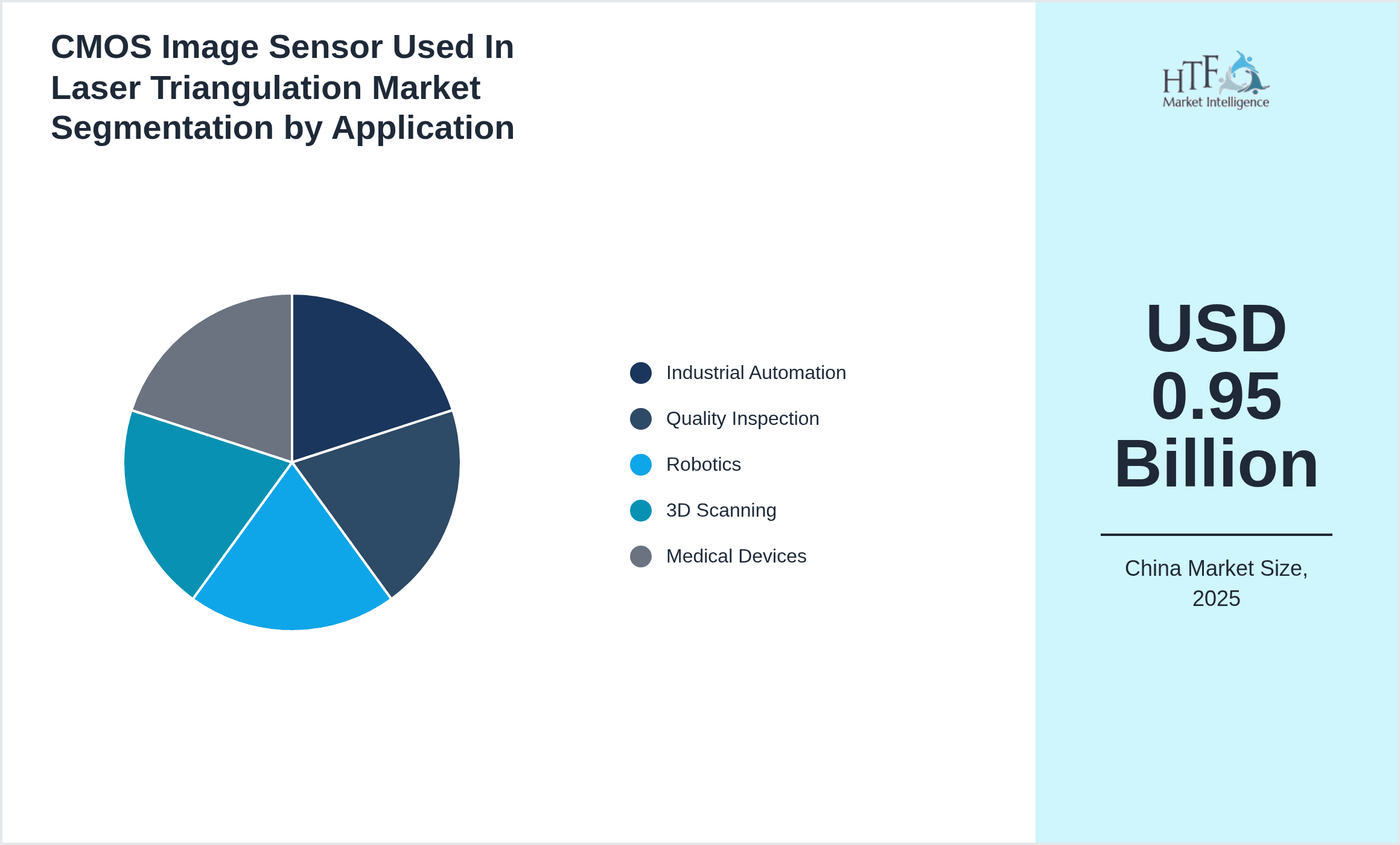
Market Breakdown
- •By Type
- ◦Front-Illuminated CMOS
- ◦Back-Illuminated CMOS
- ◦Stacked CMOS
- ◦Global Shutter CMOS
- ◦Rolling Shutter CMOS
- •By Application
- ◦Industrial Automation
- ◦Quality Inspection
- ◦Robotics
- ◦3D Scanning
- ◦Medical Devices
- •By Deployment Model
- ◦Embedded Systems
- ◦Standalone Modules
- ◦Integrated Sensor Platforms
- •By End User Industry
- ◦Automotive Manufacturing
- ◦Electronics Assembly
- ◦Healthcare Equipment
- ◦Consumer Electronics
- ◦Aerospace and Defense
Growth Dynamics
- •Robust government policies in China promoting smart manufacturing and Industry 4.0 have accelerated demand for precision sensors like CMOS image sensors used in laser triangulation, facilitating enhanced automation and quality control.
- •Strategic collaborations between CMOS sensor manufacturers and robotics firms enable development of tailored laser triangulation solutions that improve operational efficiency and cost-effectiveness across industrial sectors.
- •Technological innovations such as stacked CMOS and back-illuminated sensors are driving improvements in resolution and sensitivity, expanding application possibilities and fostering market growth in China’s competitive landscape.
- •Increasing adoption of laser triangulation in emerging sectors like medical devices and aerospace is broadening market reach, underpinned by rising demand for precise 3D measurement capabilities.
- •Cost reductions achieved through advancements in sensor fabrication and integration technologies are lowering barriers to entry, enabling wider usage in small and medium-sized enterprises.
- •China’s expanding industrial base and focus on domestic semiconductor capabilities are supporting sustained investment in CMOS sensor R&D and manufacturing capacity.
- •Emerging trends in AI-enabled sensor analytics complement laser triangulation technology, providing enhanced data processing and actionable insights for industrial applications.

Market Trends
- •Integration of AI and machine learning with CMOS image sensors is enabling smarter laser triangulation systems capable of adaptive and real-time quality inspection in manufacturing lines.
- •Rising miniaturization of CMOS sensors is facilitating their deployment in compact and portable laser triangulation devices, expanding applications in medical diagnostics and mobile robotics.
- •Increasing preference for stacked CMOS technology is driven by its higher integration density and power efficiency, supporting advanced laser triangulation solutions with improved performance.
- •The shift towards cloud-connected sensor platforms allows for centralized monitoring and predictive maintenance, enhancing operational uptime and cost savings.
- •Collaborations between semiconductor foundries and sensor designers in China are accelerating innovation cycles and reducing time to market for new CMOS sensor variants.
- •Sustainability is becoming a key consideration, with manufacturers focusing on eco-friendly production processes and materials in CMOS sensor fabrication.
- •Expansion of 5G networks in China is enhancing data transmission capabilities for sensor systems, supporting real-time laser triangulation applications in remote or automated settings.

Market Opportunities
- •Untapped applications in emerging sectors such as autonomous vehicles and smart agriculture present significant growth potential for CMOS image sensors used in laser triangulation within China.
- •Advancements in 3D sensing and imaging technologies offer opportunities for product differentiation and premium pricing strategies targeting high-precision industrial users.
- •Expansion into underpenetrated regional zones like Southwest and Northwest China can drive incremental revenue through localized solutions and partnerships.
- •Increasing government incentives for domestic semiconductor manufacturing create favorable conditions for scaling CMOS sensor production and innovation.
- •Collaborations with AI and robotics startups enable development of integrated solutions, enhancing the value proposition of laser triangulation systems.
- •Rising demand for medical diagnostic devices incorporating advanced imaging sensors represents a promising diversification avenue for market players.
- •Growing adoption of hybrid deployment models combining standalone and embedded sensor platforms supports flexible application design and customer customization.
Market Challenges
- •High manufacturing complexity and stringent quality requirements impose significant cost and technical barriers for CMOS image sensor producers in China’s laser triangulation market.
- •Intense competition from international players with advanced technology capabilities pressures domestic firms to continuously innovate and reduce costs.
- •Supply chain disruptions and raw material shortages can impact production timelines and pricing stability, affecting market growth momentum.
- •Integration challenges in adapting sensors for diverse laser triangulation applications limit rapid market adoption and scalability.
- •Regulatory compliance complexities related to semiconductor manufacturing and export controls add operational risks for companies.
- •Limited awareness and technical expertise among SMEs constrain broader deployment of advanced CMOS sensor-based laser triangulation systems.
- •Rapid technological obsolescence necessitates continuous R&D investments, increasing financial pressures on emerging market entrants.
Regulatory Framework
- •The Semiconductor Industry Promotion Law (enacted 2020) emphasizes local production incentives and technology development subsidies, fostering growth in CMOS sensor manufacturing required for laser triangulation applications.
- •China’s Export Control Regulations (updated 2021) impose compliance requirements on semiconductor technologies, affecting international collaboration and supply chain strategies.
- •Environmental Protection Standards for Semiconductor Fabrication (implemented 2019) mandate stringent emissions and waste management practices, influencing cost structures and production methods.
- •Cybersecurity Law (effective 2021) impacts data handling protocols for connected sensor platforms used in laser triangulation, requiring enhanced security measures.
- •National 14th Five-Year Plan (2021-2025) prioritizes AI and smart manufacturing technologies, providing policy support and funding for sensor innovation and industrial automation integration.
Market Intelligence
- •15th January 2025, OmniVision Technologies announced the launch of a new back-illuminated CMOS sensor specifically optimized for laser triangulation in industrial automation. This sensor offers enhanced low-light performance and higher frame rates to support real-time 3D scanning and quality inspection applications. OmniVision’s innovation aims to reduce system integration complexity and cost, enabling broader adoption across China’s manufacturing sector. The company plans to collaborate with local robotics firms to customize solutions for automotive and electronics assembly lines. Source: OmniVision official press release
- •7th March 2025, Sony Semiconductor Solutions expanded its China operations with a new R&D center focused on stacked CMOS sensor development for laser triangulation applications. The initiative targets improvements in sensor miniaturization and energy efficiency, aiming to support emerging medical device and aerospace markets. Sony’s strategic investment underscores the importance of China as a key innovation hub and leverages local talent to accelerate product development cycles. The company also announced partnerships with leading Chinese semiconductor foundries to scale production capabilities. Source: Sony Semiconductor Solutions corporate announcement
- •20th February 2025, SmartSens Technology introduced a cost-effective front-illuminated CMOS sensor designed for portable 3D scanning devices used in medical diagnostics and on-site quality control. The sensor features integrated noise reduction and enhanced dynamic range, facilitating accurate measurements in diverse lighting conditions. SmartSens plans to supply this technology to key medical equipment manufacturers across China, targeting rapid market penetration in the healthcare segment. The product launch reflects growing demand for compact and affordable laser triangulation solutions in the Chinese market. Source: SmartSens Technology press release
- •Recent market developments and strategic initiatives are continuously tracked through industry publications, company announcements, and regulatory filings. For the most current information, stakeholders are advised to monitor official corporate communications and recognized market intelligence platforms.
Regional Outlook
The East China currently holds a significant share of the market, primarily due to several key factors: increasing consumption rates, a burgeoning population, and robust economic momentum. These elements collectively drive demand, positioning this region as a leader in the market. On the other hand, Southwest China is rapidly emerging as the fastest-growing area within the industry. This remarkable growth can be attributed to swift infrastructure development, the expansion of various industrial sectors, and a marked increase in consumer demand. These dynamics make this region a crucial player in shaping future market growth.
In our report, we cover a comprehensive analysis of the following regions and countries:
- North China
- Northeast China
- East China
- South Central China
- Southwest China
- Northwest China
| Feature | Details |
|---|---|
| Base Year Market Size | USD 0.95 Billion |
| Forecast Year Market Size | USD 2.75 Billion |
| CAGR | 12.5% |
| Forecast Period | 2026 to 2033 |
| YoY Growth | 12.3% |
| Scope of Report | Market is segmented by Type (Front-Illuminated CMOS, Back-Illuminated CMOS, Stacked CMOS, Global Shutter CMOS, Rolling Shutter CMOS), Application (Industrial Automation, Quality Inspection, Robotics, 3D Scanning, Medical Devices), Deployment Model (Embedded Systems, Standalone Modules, Integrated Sensor Platforms), End User Industry (Automotive Manufacturing, Electronics Assembly, Healthcare Equipment, Consumer Electronics, Aerospace and Defense) |
| Regions Covered | North China, Northeast China, East China, South Central China, Southwest China, Northwest China |
| Key Companies | OmniVision Technologies (China), Sony Semiconductor Solutions (China), SmartSens Technology (China), ON Semiconductor (China), Himax Technologies (China), Visionox (China), Aptina Imaging (China), GalaxyCore (China), Simgui Technology (China), Will Semiconductor (China), Hua Hong Semiconductor (China), Truly Opto-Electronics (China), Jinghao Microelectronics (China), Sunny Optical Technology (China), Largan Precision (China), Tongyu Communication (China), Tianma Microelectronics (China), China National Semiconductor (China), Zhejiang CSG Holding (China), China Resources Microelectronics (China), Shanghai Micro Electronics (China), Hangzhou Silan Microelectronics (China), Jilin Sino-Microelectronics (China), Yangzhou Guoxin Microelectronics (China), Suzhou Crystal Semiconductor (China) |
China CMOS Image Sensor Used In Laser Triangulation Market Size, Growth & Revenue 2025-2034 - Table of Contents
Frequently Asked Questions (FAQ):
The Compact Track Loaders market is projected to grow at a CAGR of 6.8% from 2025 to 2030, driven by increasing demand in construction and agricultural sectors.
North America currently leads the market with approximately 45% market share, followed by Europe at 28% and Asia-Pacific at 22%. The remaining regions account for 5% of the global market.
Key growth drivers include increasing construction activities, rising demand for versatile equipment in agriculture, technological advancements in track loader design, and growing preference for compact equipment in urban construction projects.