
Europe Flatbed Trailers Market - Europe Size & Outlook 2020-2034
Europe Flatbed Trailers Market is segmented by Flatbed Trailer Type (Standard Flatbed Trailers, Extendable Flatbed Trailers, Drop Deck Flatbed Trailers, Double Drop Deck Trailers, Removable Gooseneck Trailers), Application Sector (Construction, Manufacturing, Agriculture, Logistics and Freight Transport, Energy and Utilities), Service Category (Trailer Leasing Services, Trailer Maintenance and Repair, Custom Trailer Fabrication, Aftermarket Parts and Accessories), Trailer Deployment Model (On-Road Trailers, Off-Road Trailers, Specialized Heavy Haul Trailers), and Geography (Germany, France, The United Kingdom, BeNeLux, Spain, Italy, NORDIC, CEE, Others)
Pricing
Report Overview
Executive Summary
- •The Europe Flatbed Trailers market represents a critical segment of the commercial transportation industry, focusing on trailers designed for the efficient movement of oversized and heavy goods. This market includes various trailer types tailored to diverse cargo needs across applications such as construction, manufacturing, agriculture, logistics, and energy. Flatbed trailers offer flexibility in loading and unloading, supporting industries in addressing complex transportation challenges. The market value chain spans from raw material procurement to final sales and aftersales services, encompassing manufacturers, distributors, and end-users. Regulatory mandates on safety, emissions, and vehicle standards impose significant compliance requirements, shaping product development and market adoption. The evolving market is driven by increasing construction and infrastructure projects, expanding logistics networks, and rising demand for modular and extendable trailer designs. Additionally, advancements in trailer technology and material innovation are enabling enhanced payload capacity and operational efficiency. Key European countries, notably Germany, France, and the UK, dominate the market due to established industrial bases and advanced transportation infrastructure. The forecast period through 2034 anticipates steady growth propelled by modernization in transport fleets, rising trade volumes, and investments in sustainable logistics solutions, underscoring the strategic importance of flatbed trailers in Europe's commercial vehicle ecosystem.
- •The market is poised to grow from a base size of USD 4.5 Billion in 2025 to an estimated USD 7.8 Billion by 2034, reflecting a robust CAGR of 6.2%. Germany leads the market with a 28% share, while Poland emerges as the fastest growing country with an expected CAGR of 8.5%, driven by expanding manufacturing and logistics sectors. Standard flatbed trailers retain dominance due to their versatile application across industries, whereas extendable flatbed trailers exhibit the fastest growth, catering to specialized cargo transport needs. Year-on-year growth maintains a steady pace of approximately 6.0%, supported by infrastructure development and cross-border trade within the EU. Market trends include increasing adoption of lightweight materials, integration of telematics for fleet management, and rising demand for customizable trailer configurations. Challenges such as stringent regulatory compliance and high initial investment costs moderate market expansion. Opportunities lie in electrification of trailer components, growth in e-commerce logistics, and modernization of agricultural transport fleets.
- •This market offers significant value propositions to stakeholders including manufacturers, logistics operators, and infrastructure developers by enhancing transport efficiency and cargo safety. Strategic investments in innovation and compliance with evolving European transport regulations are crucial for maintaining competitive advantage. The flatbed trailers market supports diverse industries by enabling flexible and cost-effective cargo movement solutions, contributing to regional economic growth and supply chain optimization. The anticipated growth trajectory presents lucrative opportunities for new entrants and existing players to capitalize on technological advancements and increasing demand for advanced trailer solutions in Europe’s dynamic commercial vehicle landscape.

Competitive Landscape
The competitive environment in the Europe Flatbed Trailers market is characterized by the presence of established global manufacturers alongside regional specialists that cater to localized demand. Market players compete through continuous product innovation, focusing on enhancing trailer durability, payload efficiency, and compliance with stringent European safety and environmental standards. Strategic partnerships, mergers, and acquisitions are common to expand product portfolios and geographic reach, while cost competitiveness remains critical amid fluctuating raw material prices. Distribution networks and aftersales service capabilities are pivotal for customer retention and market penetration. Leading companies invest in research and development to integrate smart technologies such as telematics and advanced materials, driving differentiation. Market entry barriers include high capital requirements, certification processes, and the need for extensive service infrastructure. Regional competition intensifies as countries within Europe promote infrastructure upgrades and green logistics initiatives, influencing demand patterns. Future competitive trends point to increased focus on sustainability, electrification, and digital integration, shaping the evolution of flatbed trailer offerings in the region.
Prominent Players in Flatbed Trailers Market
- •Schmitz Cargobull AG (Germany)
- •Kögel Trailer GmbH (Germany)
- •Wielton S.A. (Poland)
- •Tirsan Treyler Sanayi A.Ş. (Turkey)
- •Gray & Adams Ltd. (United Kingdom)
- •Krone Commercial Vehicle Group (Germany)
- •Langendorf GmbH (Germany)
- •LAG Trailers GmbH (Germany)
- •Fliegl Fahrzeugbau GmbH (Germany)
- •Schwarzmüller Group (Austria)
- •Müller Mitteltal GmbH (Germany)
- •Kässbohrer Fahrzeugwerke GmbH (Germany)
- •Kässbohrer Trailer (France)
- •Benalu (France)
- •Kässbohrer Trailer (Spain)
- •Kässbohrer Trailer (Italy)
- •Nooteboom Trailer Manufacturing B.V. (Netherlands)
- •Meiller-Kipper GmbH (Germany)
- •Goldhofer AG (Germany)
- •Meusburger Georg GmbH & Co KG (Austria)
- •Lohr Industrie (France)
- •Meiller Fahrzeugwerke GmbH & Co KG (Germany)
- •Reisch Fahrzeugbau GmbH (Germany)
- •Broshuis Trailer Group (Netherlands)
- •Meiller-Kipper GmbH (Germany)
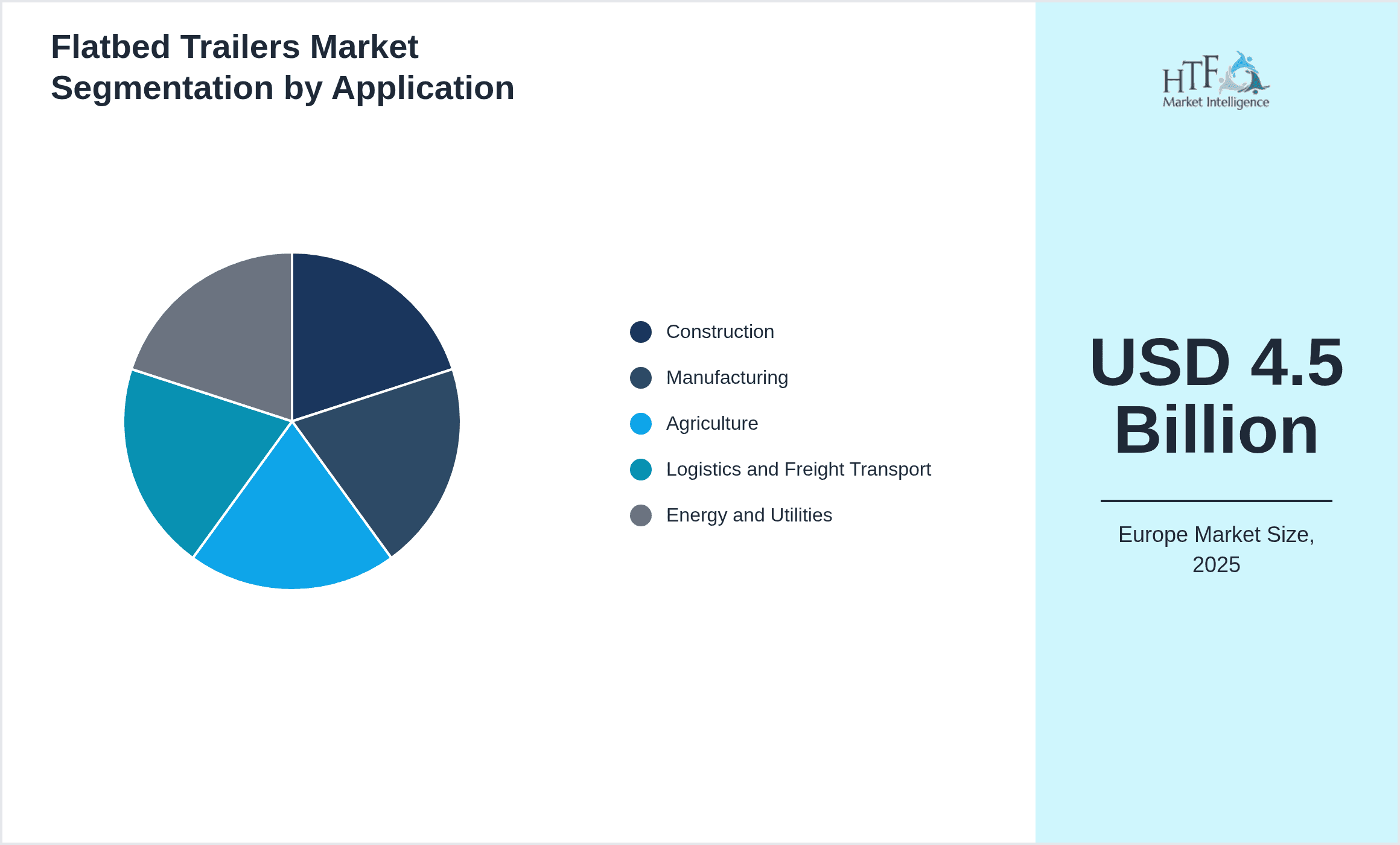
Market Breakdown
- •By Flatbed Trailer Type
- ◦Standard Flatbed Trailers
- ◦Extendable Flatbed Trailers
- ◦Drop Deck Flatbed Trailers
- ◦Double Drop Deck Trailers
- ◦Removable Gooseneck Trailers
- •By Application Sector
- ◦Construction
- ◦Manufacturing
- ◦Agriculture
- ◦Logistics and Freight Transport
- ◦Energy and Utilities
- •By Service Category
- ◦Trailer Leasing Services
- ◦Trailer Maintenance and Repair
- ◦Custom Trailer Fabrication
- ◦Aftermarket Parts and Accessories
- •By Trailer Deployment Model
- ◦On-Road Trailers
- ◦Off-Road Trailers
- ◦Specialized Heavy Haul Trailers
Growth Dynamics
- •The Europe flatbed trailers market growth is driven by the increasing demand from construction and infrastructure development projects across major countries such as Germany, France, and the UK. These projects require reliable transport solutions for oversized and heavy materials, directly boosting trailer demand.
- •Rising industrialization and expansion of manufacturing sectors in Central and Eastern Europe, particularly in countries like Poland and Czech Republic, contribute to the growing need for versatile flatbed trailers to transport machinery and components efficiently.
- •Technological advancements such as the use of lightweight materials and integration of IoT-based telematics solutions enhance trailer performance and fleet management, attracting operators seeking cost-effective and efficient logistics solutions.
- •Stringent European Union regulations on vehicle safety and emissions compel trailer manufacturers to innovate and upgrade their product offerings, which in turn stimulates demand for compliant and technologically advanced flatbed trailers.
- •The growing trend of outsourcing logistics and increasing preference for leasing over ownership among fleet operators encourages investment in modern flatbed trailers with flexible leasing and maintenance options.
- •Cross-border trade within the EU region, facilitated by improved transport infrastructure and trade agreements, drives demand for durable and efficient flatbed trailers capable of handling diverse cargo across multiple countries.
- •The rise in agricultural mechanization in Eastern Europe generates demand for specialized flatbed trailers designed to transport large farming equipment, supporting market growth in this segment.
Market Trends
- •Increasing adoption of extendable flatbed trailers allows operators to transport longer cargo safely and efficiently, meeting the needs of industries such as construction and energy that handle oversized equipment.
- •The integration of telematics and GPS tracking systems in flatbed trailers is enhancing fleet management capabilities, enabling real-time monitoring, improved route planning, and preventive maintenance.
- •Sustainability initiatives are prompting the use of lightweight and corrosion-resistant materials such as aluminum alloys and composites, reducing trailer weight and improving fuel efficiency.
- •Customization and modular trailer designs are gaining traction, allowing end users to adapt trailers for specific cargo types and operational requirements, thereby improving utilization rates.
- •Digital platforms facilitating trailer leasing and sharing are emerging, driven by growing demand for flexible and cost-effective asset utilization among logistics providers.
- •Emerging focus on electric and hybrid power-assisted trailer components aligns with the broader shift towards decarbonization in the transport sector, supporting future market evolution.
- •Enhanced safety features including advanced lighting, braking systems, and load securing mechanisms are becoming standard in new flatbed trailer models to comply with evolving European safety regulations.

Market Opportunities
- •Expanding construction activities in Eastern Europe present untapped market potential for flatbed trailer manufacturers offering tailored solutions for heavy and oversized cargo transport.
- •The rise of e-commerce and associated demand for efficient logistics provide opportunities for specialized flatbed trailers designed for rapid loading and unloading operations.
- •Investment in sustainable trailer technologies, including lightweight materials and electric components, offers manufacturers a competitive edge in a market increasingly focused on environmental compliance.
- •Collaborations between trailer manufacturers and fleet operators to develop customized leasing and maintenance packages can enhance customer retention and stimulate market growth.
- •Growth in renewable energy projects across Europe requires transport solutions for large equipment, creating niche opportunities for extendable and heavy haul flatbed trailers.
- •Emerging markets within Europe, such as the Nordic countries and the Balkans, offer prospects for market penetration due to growing infrastructure investments and modernization efforts.
- •Digitalization of trailer fleet management through IoT integration enables service providers to offer value-added services, unlocking new revenue streams and improving operational efficiency.
Market Challenges
- •High initial capital expenditure for advanced flatbed trailers limits adoption among small and medium-sized logistics operators, constraining market growth in certain segments.
- •Strict regulatory compliance across different European countries requires manufacturers to navigate complex certification processes, increasing time-to-market and operational costs.
- •Fluctuating raw material prices, particularly steel and aluminum, impact production costs and pricing strategies for trailer manufacturers, affecting market stability.
- •Intense competition from regional and global players pressures profit margins and necessitates continuous innovation and cost optimization.
- •Limited availability of skilled labor for manufacturing and maintenance services poses challenges to capacity expansion and service quality.
- •Infrastructure limitations in certain Eastern and Southern European regions restrict efficient transport operations, affecting demand for flatbed trailers.
- •Rapid technological advancements require ongoing investment in R&D, which can be a barrier for smaller manufacturers aiming to keep pace with market leaders.
Regulatory Framework
- •The European Union introduced the General Safety Regulation (EU) 2019/2144 between 2020 and 2025, mandating vehicle safety features such as advanced emergency braking and electronic stability control, significantly impacting trailer design and manufacturing standards.
- •Regulation (EU) 2018/858 on vehicle type-approval and market surveillance was enforced to ensure compliance with environmental and safety standards, requiring flatbed trailers to meet stringent emission and operational guidelines.
- •The EU Directive 96/53/EC sets maximum authorized dimensions and weights for commercial vehicles, directly influencing flatbed trailer design parameters and load capacities across member states.
- •National regulations within Germany and France impose additional certification requirements for heavy haul trailers, including load securing and lighting systems, necessitating localized compliance efforts by manufacturers.
- •Government initiatives promoting green logistics, such as subsidies for low-emission vehicles and mandates for sustainable transport practices, are encouraging manufacturers to innovate eco-friendly trailer solutions.
Market Intelligence
- •15th February 2025, Schmitz Cargobull AG launched its new generation of lightweight extendable flatbed trailers designed to optimize payload capacity while complying with the latest EU safety and emission regulations. Featuring advanced aluminum alloy construction and integrated telematics systems, the product addresses the growing demand for efficient heavy haul solutions in Europe’s construction and logistics sectors. This launch strengthens Schmitz Cargobull’s market leadership by offering enhanced operational efficiency and reduced total cost of ownership for fleet operators. Source: Schmitz Cargobull Official Press Release
- •10th April 2025, Wielton S.A. introduced a modular flatbed trailer platform enabling quick customization tailored to specific cargo requirements, including configurations for heavy machinery and agricultural equipment transport. The innovation integrates IoT-based load monitoring and predictive maintenance capabilities to enhance safety and reduce downtime. Wielton’s strategic focus on digitalization and flexible solutions positions the company to capitalize on expanding markets in Central and Eastern Europe. Source: Wielton Corporate Announcement
- •22nd June 2025, Krone Commercial Vehicle Group announced a strategic partnership with a leading telematics provider to develop fully connected flatbed trailers featuring real-time diagnostics and fleet optimization tools. This collaboration aims to boost operational efficiency and compliance with EU transport regulations for logistics companies operating across multiple European countries. The initiative reflects the industry’s shift towards digital transformation and sustainable transport solutions. Source: Krone Group News Release
- •5th September 2025, Tirsan Treyler Sanayi A.Ş. completed the acquisition of a regional flatbed trailer manufacturer in Eastern Europe to expand its production capacity and strengthen its presence in the fast-growing Polish and Czech markets. The acquisition enables Tirsan to offer a diversified product portfolio and localized service support, accelerating growth in these emerging markets. The move underscores the ongoing consolidation trend within the European flatbed trailers industry. Source: Tirsan Official Statement
Regional Outlook
The Germany currently holds a significant share of the market, primarily due to several key factors: increasing consumption rates, a burgeoning population, and robust economic momentum. These elements collectively drive demand, positioning this region as a leader in the market. On the other hand, Poland is rapidly emerging as the fastest-growing area within the industry. This remarkable growth can be attributed to swift infrastructure development, the expansion of various industrial sectors, and a marked increase in consumer demand. These dynamics make this region a crucial player in shaping future market growth.
In our report, we cover a comprehensive analysis of the following regions and countries:
- Germany
- France
- The United Kingdom
- BeNeLux
- Spain
- Italy
- NORDIC
- CEE
- Others
| Feature | Details |
|---|---|
| Base Year Market Size | USD 4.5 Billion |
| Forecast Year Market Size | USD 7.8 Billion |
| CAGR | 6.2% |
| Forecast Period | 2026 to 2033 |
| YoY Growth | 6% |
| Scope of Report | Market is segmented by Flatbed Trailer Type (Standard Flatbed Trailers, Extendable Flatbed Trailers, Drop Deck Flatbed Trailers, Double Drop Deck Trailers, Removable Gooseneck Trailers), Application Sector (Construction, Manufacturing, Agriculture, Logistics and Freight Transport, Energy and Utilities), Service Category (Trailer Leasing Services, Trailer Maintenance and Repair, Custom Trailer Fabrication, Aftermarket Parts and Accessories), Trailer Deployment Model (On-Road Trailers, Off-Road Trailers, Specialized Heavy Haul Trailers) |
| Regions Covered | Germany, France, The United Kingdom, BeNeLux, Spain, Italy, NORDIC, CEE, Others |
| Key Companies | Schmitz Cargobull AG (Germany), Kögel Trailer GmbH (Germany), Wielton S.A. (Poland), Tirsan Treyler Sanayi A.Ş. (Turkey), Gray & Adams Ltd. (United Kingdom), Krone Commercial Vehicle Group (Germany), Langendorf GmbH (Germany), LAG Trailers GmbH (Germany), Fliegl Fahrzeugbau GmbH (Germany), Schwarzmüller Group (Austria), Müller Mitteltal GmbH (Germany), Kässbohrer Fahrzeugwerke GmbH (Germany), Kässbohrer Trailer (France), Benalu (France), Kässbohrer Trailer (Spain), Kässbohrer Trailer (Italy), Nooteboom Trailer Manufacturing B.V. (Netherlands), Meiller-Kipper GmbH (Germany), Goldhofer AG (Germany), Meusburger Georg GmbH & Co KG (Austria), Lohr Industrie (France), Meiller Fahrzeugwerke GmbH & Co KG (Germany), Reisch Fahrzeugbau GmbH (Germany), Broshuis Trailer Group (Netherlands), Meiller-Kipper GmbH (Germany) |
Europe Flatbed Trailers Market - Europe Size & Outlook 2020-2034 - Table of Contents
Frequently Asked Questions (FAQ):
The Compact Track Loaders market is projected to grow at a CAGR of 6.8% from 2025 to 2030, driven by increasing demand in construction and agricultural sectors.
North America currently leads the market with approximately 45% market share, followed by Europe at 28% and Asia-Pacific at 22%. The remaining regions account for 5% of the global market.
Key growth drivers include increasing construction activities, rising demand for versatile equipment in agriculture, technological advancements in track loader design, and growing preference for compact equipment in urban construction projects.