
EMEA Biogas Upgrading Market - Europe Industry Size & Growth Analysis 2025-2034
EMEA Biogas Upgrading Market is segmented by Type (Water Scrubbing, Pressure Swing Adsorption, Chemical Absorption, Membrane Separation, Cryogenic Separation), Application (Power Generation, Transportation Fuel, Grid Injection, Industrial Use, Heating), Plant Capacity (Small Scale (Up to 250 Nm3/h), Medium Scale (250-1000 Nm3/h), Large Scale (Above 1000 Nm3/h)), Feedstock Type (Agricultural Waste, Municipal Solid Waste, Industrial Wastewater, Landfill Gas), and Geography (Germany, France, Italy, United Kingdom, Nordics, Rest of Europe, South Africa, Egypt, Turkey, United Arab Emirates, Israel, Saudi Arabia, Rest of EMEA)
Pricing
Report Overview
Executive Summary
- •The EMEA Biogas Upgrading market focuses on technologies and processes that purify raw biogas into high-purity biomethane suitable for multiple energy applications. It covers upgrading techniques such as water scrubbing, pressure swing adsorption, chemical absorption, membrane separation, and cryogenic separation. The biomethane produced is utilized in power generation, transportation fuel, grid injection, industrial heating, and other industrial uses. This market is crucial for decarbonization efforts in Europe, the Middle East, and Africa, enabling sustainable energy production from organic waste and reducing reliance on fossil fuels. It supports environmental goals by lowering greenhouse gas emissions and enhancing energy security across EMEA countries. The market is influenced by regulatory frameworks, technological advancements, and increasing investments in renewable energy infrastructure. Growing demand for clean energy solutions and government incentives are accelerating market adoption, making biogas upgrading a key component of the region's energy transition strategies.
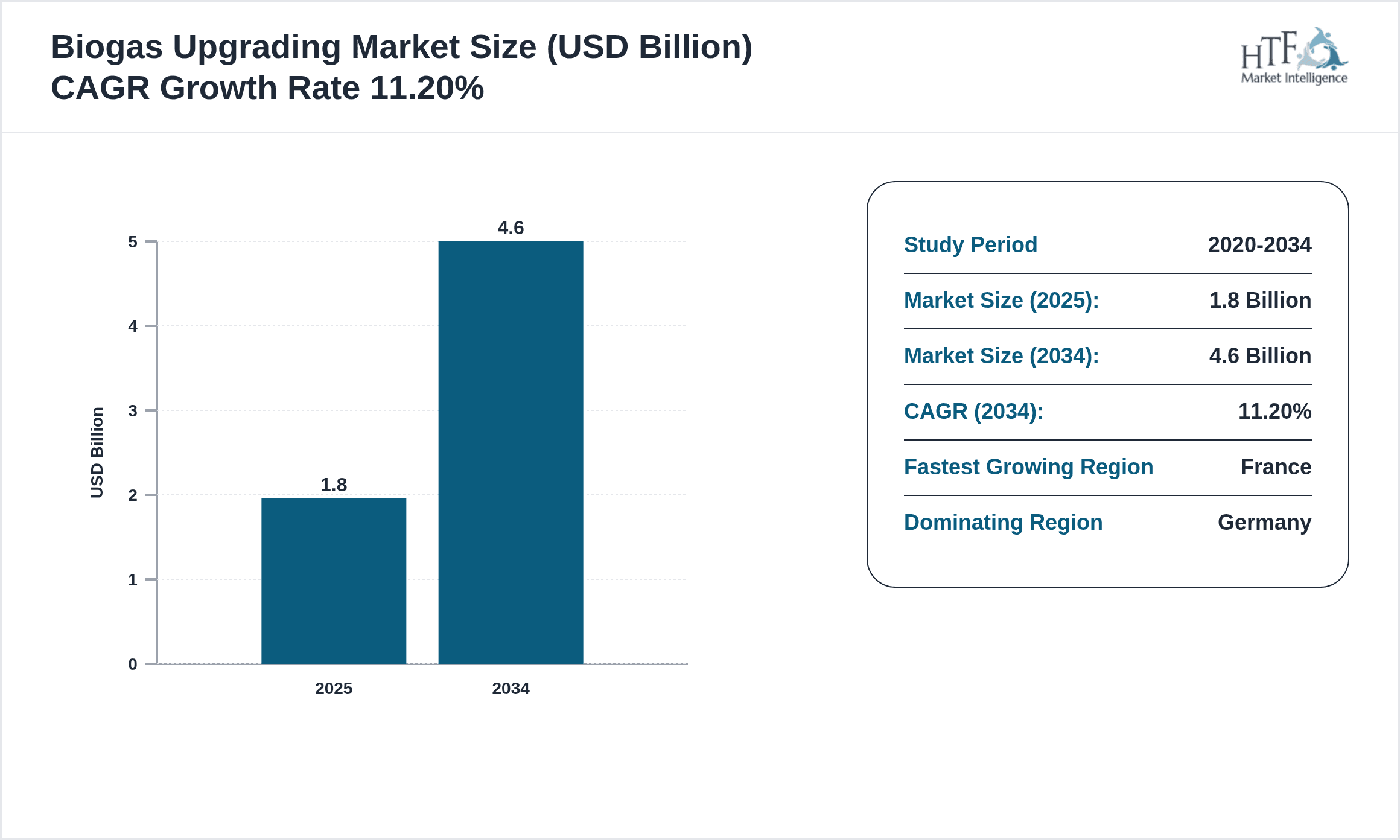
- •The EMEA Biogas Upgrading market was valued at USD 1.8 Billion in 2025 and is projected to reach USD 4.6 Billion by 2034, growing at a CAGR of 11.2%. Germany leads with a 30% market share, followed by France with the fastest growth at 14.5% CAGR. Water scrubbing dominates the technology segment, while membrane separation shows the highest growth potential. Applications such as power generation and transportation fuel drive demand across the region. Increasing governmental support, stringent emission regulations, and growing waste-to-energy initiatives highlight the market's robust expansion trajectory. Recent strategic collaborations and technology innovations by key players further reinforce market momentum.
- •The biogas upgrading market in EMEA presents significant strategic value to renewable energy companies, utilities, and governments committed to carbon neutrality. It provides a sustainable alternative to fossil fuels and aligns with environmental policies targeting emission reductions. Stakeholders benefit from enhanced energy security, diversified energy portfolios, and compliance with evolving regulatory standards. The market's growth potential offers lucrative opportunities for technology providers, project developers, and investors. The integration of biogas upgrading within circular economy frameworks strengthens the region’s sustainable development goals, fostering innovation and economic growth across multiple sectors.
Competitive Landscape
The competitive landscape in the EMEA Biogas Upgrading market is characterized by a blend of global technology providers and regional specialists focusing on strategic partnerships, innovation, and geographic expansion. Companies intensify R&D efforts to enhance upgrading efficiency, reduce operational costs, and develop modular solutions for diverse applications. Strategic alliances with waste management and energy companies facilitate integrated project delivery and market penetration. Adoption of digital technologies including IoT and AI optimizes plant operations and predictive maintenance, strengthening competitive advantages. Mergers and acquisitions consolidate market presence, enable technology portfolio expansion, and increase access to emerging markets. Pricing strategies emphasize value-added services and long-term contracts to improve customer retention. Regional competition focuses on tailoring solutions to local regulatory requirements and feedstock availability. Future competitiveness will rely heavily on sustainability commitments, technological differentiation, and agility in responding to evolving energy landscapes.
Leading Companies in Biogas Upgrading Market
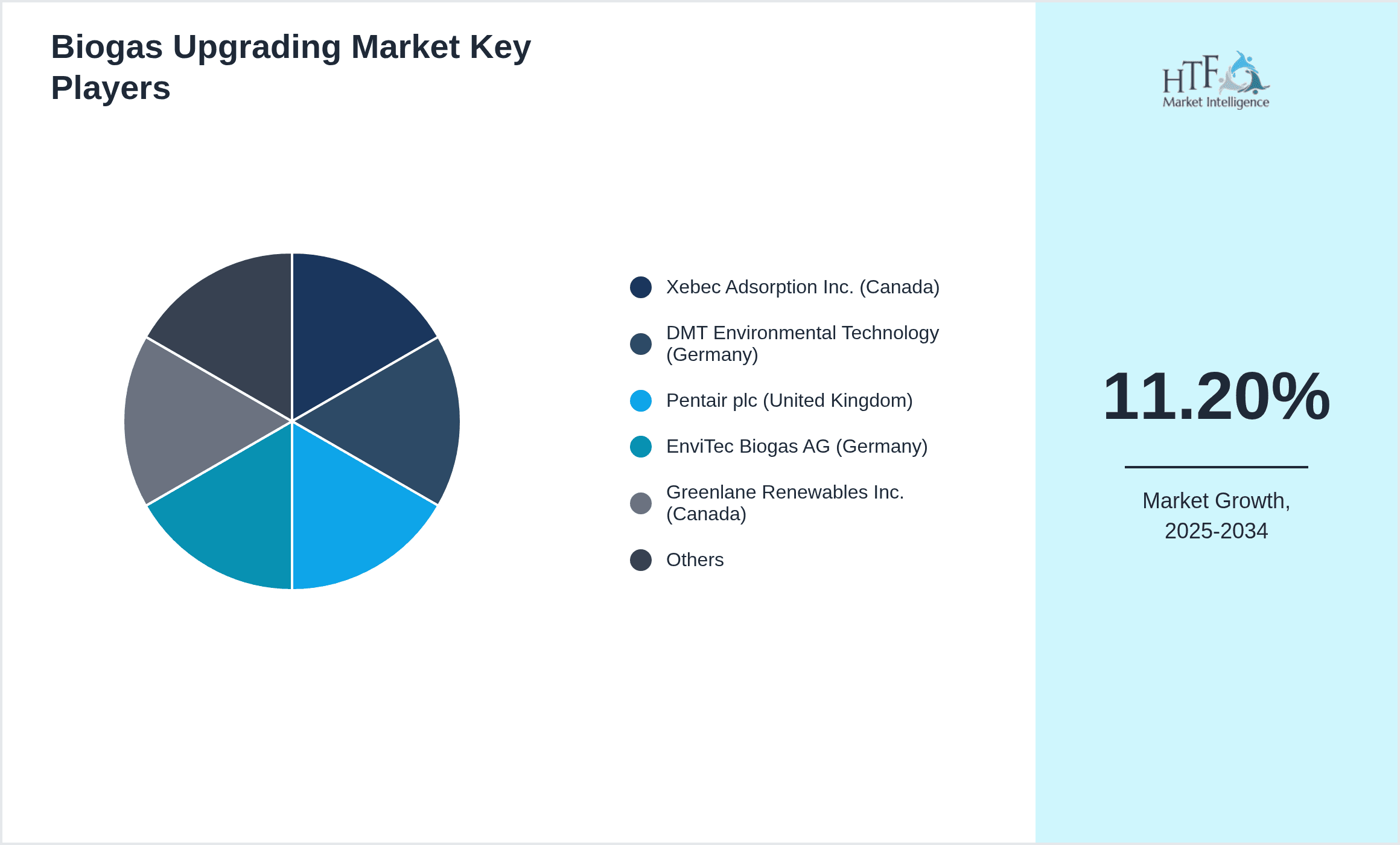
- •Xebec Adsorption Inc. (Canada)
- •DMT Environmental Technology (Germany)
- •Pentair plc (United Kingdom)
- •EnviTec Biogas AG (Germany)
- •Greenlane Renewables Inc. (Canada)
- •WELTEC BIOPOWER GmbH (Germany)
- •Air Liquide S.A. (France)
- •Clean Energy Technologies, Inc. (United States)
- •Biogas Technology Ltd. (United Kingdom)
- •Maire Tecnimont S.p.A. (Italy)
- •Hitachi Zosen Inova AG (Switzerland)
- •Suez S.A. (France)
- •Climeworks AG (Switzerland)
- •Veolia Environnement S.A. (France)
- •Siemens Energy AG (Germany)
- •Aqua Environmental (United Kingdom)
- •Impro (Netherlands)
- •Biolectric B.V. (Netherlands)
- •Telenor Group (Norway)
- •GasMet Technologies Oy (Finland)

Market Breakdown
- •By Type
- ◦Water Scrubbing
- ◦Pressure Swing Adsorption
- ◦Chemical Absorption
- ◦Membrane Separation
- ◦Cryogenic Separation
- •By Application
- ◦Power Generation
- ◦Transportation Fuel
- ◦Grid Injection
- ◦Industrial Use
- ◦Heating
- •By Plant Capacity
- ◦Small Scale (Up to 250 Nm3/h)
- ◦Medium Scale (250-1000 Nm3/h)
- ◦Large Scale (Above 1000 Nm3/h)
- •By Feedstock Type
- ◦Agricultural Waste
- ◦Municipal Solid Waste
- ◦Industrial Wastewater
- ◦Landfill Gas
Growth Dynamics
Increasing government mandates for renewable energy adoption and carbon neutrality strongly accelerate biogas upgrading deployment in EMEA. For example, the EU Green Deal fosters investments in renewable gas infrastructure, boosting biomethane production capacity across Germany and France. Subsidies and feed-in tariffs enhance project viability, attracting capital from private and public sectors. Additionally, rising organic waste volumes from agriculture and municipalities create abundant feedstock, supporting plant scalability. Technological improvements reduce upgrading costs and energy consumption, improving plant economics. Collaborations between energy utilities and technology providers facilitate integrated solutions, expanding market reach. The growing demand for alternative fuels in transportation, especially in heavy-duty segments, further drives adoption. Collectively, these factors contribute to a compounded market growth, enabling EMEA to advance its sustainable energy transition while meeting stringent emission reduction targets.

Market Trends
The EMEA biogas upgrading market trends toward digitalization and automation to enhance operational efficiency and reduce downtime. Deployment of advanced membrane separation technologies gains momentum due to their modular design and lower energy requirements, particularly in decentralized applications. Integration of biogas upgrading with hydrogen production and carbon capture technologies emerges as a strategic trend to diversify renewable energy outputs. Cross-industry collaborations between waste management, agriculture, and energy sectors create innovative business models leveraging circular economy principles. Governments increasingly emphasize grid injection of biomethane, stimulating infrastructure upgrades to accommodate renewable gas. Recent pilot projects in Scandinavia showcase hybrid upgrading systems combining multiple purification methods for optimized gas quality. These trends indicate a future market increasingly focused on sustainability, interoperability, and technological convergence to maximize value from biogas resources.
Market Opportunities
Expanding biomethane demand in transportation fuels presents significant revenue opportunities in the EMEA biogas upgrading market. Countries such as Germany and France implement low emission zones and incentives for bio-CNG adoption, encouraging infrastructure investments. Increasing availability of agricultural residues and organic waste in emerging EMEA economies opens untapped feedstock sources for new upgrading plants. Technological advancements in membrane and cryogenic separation offer cost-efficient solutions for small to medium scale applications, enabling market penetration in decentralized locations. Integration with existing natural gas grids facilitates rapid biomethane commercialization. Furthermore, EU recovery funds directed toward renewable energy projects provide financial support for capacity expansion. The transition to circular economy frameworks promotes partnerships between waste producers and energy companies, creating synergistic growth paths. These opportunities collectively drive sustainable growth and innovation across the EMEA biogas upgrading market.
Market Challenges
High initial capital expenditure for biogas upgrading plants remains a major challenge limiting rapid market expansion in EMEA. Complex permitting processes and regulatory discrepancies across countries create project delays and increase costs. Feedstock supply inconsistency and seasonal fluctuations affect plant output stability, reducing economic viability. Technological limitations in impurity removal efficiency require ongoing R&D investment. Limited natural gas grid access in rural areas restricts biomethane distribution potential. Additionally, competition from alternative renewable energy sources such as solar and wind impacts market attractiveness. Recent reports from several projects in Southern Europe highlight delays due to regulatory hurdles and lack of grid infrastructure. Addressing these challenges requires harmonization of policies, financial incentives, and infrastructure development to enable sustained market growth.
Regulatory Framework
The Renewable Energy Directive II enacted by the European Union in 2018, with ongoing updates until 2025, sets mandatory targets for renewable energy shares, including biomethane injection into natural gas grids. The directive imposes sustainability criteria for biogas feedstocks and mandates traceability, ensuring environmental compliance. Countries such as Germany have implemented the Gas Network Access Ordinance, facilitating biomethane grid injection and guaranteeing third-party access. France’s Energy Code includes specific provisions for biomethane certification and incentivization schemes. The Middle East is developing regulations to promote renewable gas as part of their national energy diversification plans. These regulations collectively promote market growth by providing a clear legal framework, incentivizing investments, and ensuring quality and sustainability of biogas upgrading projects across EMEA.
Market Intelligence
- •Recent market developments and strategic initiatives are continuously tracked through industry publications, company announcements, and regulatory filings. For the most current information, stakeholders are advised to monitor official corporate communications and recognized market intelligence platforms.
- •Recent market developments and strategic initiatives are continuously tracked through industry publications, company announcements, and regulatory filings. For the most current information, stakeholders are advised to monitor official corporate communications and recognized market intelligence platforms.
- •Recent market developments and strategic initiatives are continuously tracked through industry publications, company announcements, and regulatory filings. For the most current information, stakeholders are advised to monitor official corporate communications and recognized market intelligence platforms.
- •Recent market developments and strategic initiatives are continuously tracked through industry publications, company announcements, and regulatory filings. For the most current information, stakeholders are advised to monitor official corporate communications and recognized market intelligence platforms.
- •Source: Industry Publications, Company Websites, Regulatory Agencies
Regional Outlook
The Germany currently holds a significant share of the market, primarily due to several key factors: increasing consumption rates, a burgeoning population, and robust economic momentum. These elements collectively drive demand, positioning this region as a leader in the market. On the other hand, France is rapidly emerging as the fastest-growing area within the industry. This remarkable growth can be attributed to swift infrastructure development, the expansion of various industrial sectors, and a marked increase in consumer demand. These dynamics make this region a crucial player in shaping future market growth.
In our report, we cover a comprehensive analysis of the following regions and countries:
- Germany
- France
- Italy
- United Kingdom
- Nordics
- Rest of Europe
- South Africa
- Egypt
- Turkey
- United Arab Emirates
- Israel
- Saudi Arabia
- Rest of EMEA
| Feature | Details |
|---|---|
| Base Year Market Size | USD 1.8 Billion |
| Forecast Year Market Size | USD 4.6 Billion |
| CAGR | 11.2% |
| Forecast Period | 2026 to 2033 |
| YoY Growth | 11.3% |
| Scope of Report | Market is segmented by Type (Water Scrubbing, Pressure Swing Adsorption, Chemical Absorption, Membrane Separation, Cryogenic Separation), Application (Power Generation, Transportation Fuel, Grid Injection, Industrial Use, Heating), Plant Capacity (Small Scale (Up to 250 Nm3/h), Medium Scale (250-1000 Nm3/h), Large Scale (Above 1000 Nm3/h)), Feedstock Type (Agricultural Waste, Municipal Solid Waste, Industrial Wastewater, Landfill Gas) |
| Regions Covered | Germany, France, Italy, United Kingdom, Nordics, Rest of Europe, South Africa, Egypt, Turkey, United Arab Emirates, Israel, Saudi Arabia, Rest of EMEA |
| Key Companies | Xebec Adsorption Inc. (Canada), DMT Environmental Technology (Germany), Pentair plc (United Kingdom), EnviTec Biogas AG (Germany), Greenlane Renewables Inc. (Canada), WELTEC BIOPOWER GmbH (Germany), Air Liquide S.A. (France), Clean Energy Technologies, Inc. (United States), Biogas Technology Ltd. (United Kingdom), Maire Tecnimont S.p.A. (Italy), Hitachi Zosen Inova AG (Switzerland), Suez S.A. (France), Climeworks AG (Switzerland), Veolia Environnement S.A. (France), Siemens Energy AG (Germany), Aqua Environmental (United Kingdom), Impro (Netherlands), Biolectric B.V. (Netherlands), Telenor Group (Norway), GasMet Technologies Oy (Finland) |
EMEA Biogas Upgrading Market - Europe Industry Size & Growth Analysis 2025-2034 - Table of Contents
Frequently Asked Questions (FAQ):
The Compact Track Loaders market is projected to grow at a CAGR of 6.8% from 2025 to 2030, driven by increasing demand in construction and agricultural sectors.
North America currently leads the market with approximately 45% market share, followed by Europe at 28% and Asia-Pacific at 22%. The remaining regions account for 5% of the global market.
Key growth drivers include increasing construction activities, rising demand for versatile equipment in agriculture, technological advancements in track loader design, and growing preference for compact equipment in urban construction projects.