
Global Intelligent Traffic Management Systems Market Size, Growth & Revenue 2025-2034
Global Intelligent Traffic Management Systems Market is segmented by Type (Hardware, Software, Services, Communication Systems, Sensors), Application (Traffic Control, Incident Detection, Parking Management, Toll Collection, Public Transport Management), Deployment Model (Cloud-based, On-premise, Hybrid), Technology (Artificial Intelligence, Internet of Things, Machine Learning, Big Data Analytics), and Geography (North America, LATAM, West Europe, Central & Eastern Europe, Northern Europe, Southern Europe, East Asia, Southeast Asia, South Asia, Central Asia, Oceania, MEA)
Pricing
Report Overview
Executive Summary
- •Intelligent Traffic Management Systems (ITMS) market comprises advanced technologies integrating hardware, software, and services to optimize traffic flow, enhance safety, and improve mobility globally. Solutions include traffic control, incident detection, tolling, parking, and public transport management, leveraging sensors and communication networks to enable real-time monitoring and management.
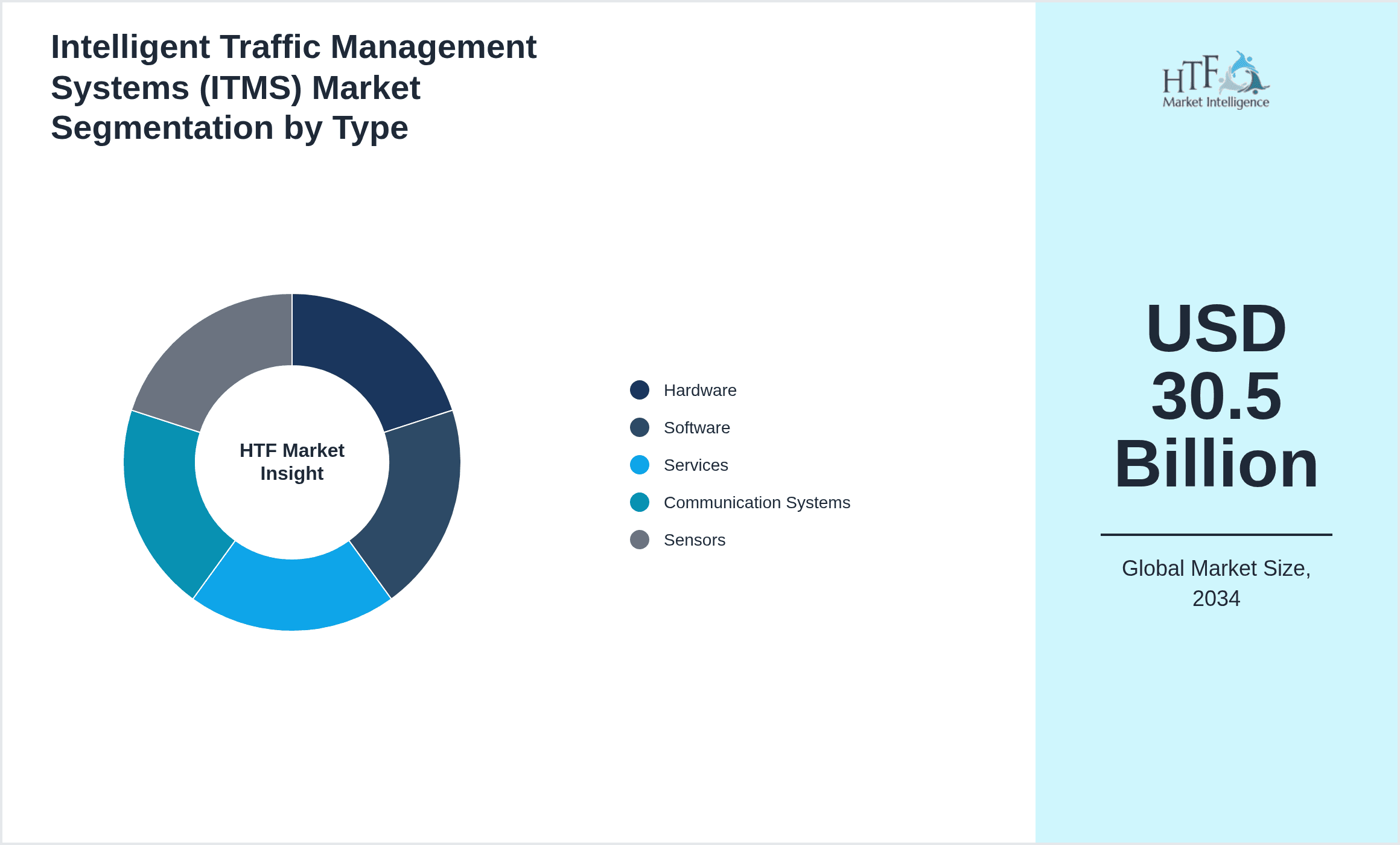
- •The global ITMS market is projected to grow from USD 12.8 Billion in 2025 to USD 30.5 Billion by 2034, reflecting a CAGR of 9.5%, driven by urbanization, smart city projects, and technological advancements including IoT and AI integration.
- •North America currently dominates the market with a 34% share, benefiting from early adoption and extensive infrastructure, while Asia-Pacific is the fastest growing region with an 11.2% CAGR, fueled by rapid urban development and government investments in intelligent transport systems.

Competitive Landscape
The global Intelligent Traffic Management Systems market is highly competitive with major players focusing on innovation, strategic partnerships, and regional expansion to strengthen their market positions. Companies employ differentiated strategies including product portfolio enhancement, integration of AI and IoT for smarter solutions, and collaborations with government bodies to secure long-term projects. The market features a mix of multinational corporations and regional specialists leveraging technological advancements to optimize traffic management efficiency. Pricing strategies are balanced with service quality to address diverse customer segments. Market entry barriers include high capital requirements and regulatory compliance complexities, while regional competition varies due to differing infrastructure maturity levels. Future competitive trends will likely emphasize sustainability, increased automation, and data-driven traffic analytics to offer comprehensive urban mobility solutions.
Leading Companies in Intelligent Traffic Management Systems Market
- •Siemens AG (Germany)
- •IBM Corporation (United States)
- •Cisco Systems, Inc. (United States)
- •Kapsch TrafficCom AG (Austria)
- •Hitachi, Ltd. (Japan)
- •Schneider Electric SE (France)
- •HR Green (United States)
- •Indra Sistemas, S.A. (Spain)
- •Thales Group (France)
- •Huawei Technologies Co., Ltd. (China)
- •TransCore, LP (United States)
- •Iteris, Inc. (United States)
- •Cubic Corporation (United States)
- •NEC Corporation (Japan)
- •Garmin Ltd. (Switzerland)
- •Q-Free ASA (Norway)
- •FLIR Systems, Inc. (United States)
- •Sensys Networks, Inc. (United States)
- •Kapsch TrafficCom (Austria)
- •TomTom International BV (Netherlands)
- •Genetec Inc. (Canada)
- •Econolite Group, Inc. (United States)
- •Mitsubishi Electric Corporation (Japan)
- •Bosch Security Systems (Germany)
- •Panasonic Corporation (Japan)

Market Breakdown
- •By Type
- ◦Hardware
- ◦Software
- ◦Services
- ◦Communication Systems
- ◦Sensors
- •By Application
- ◦Traffic Control
- ◦Incident Detection
- ◦Parking Management
- ◦Toll Collection
- ◦Public Transport Management
- •By Deployment Model
- ◦Cloud-based
- ◦On-premise
- ◦Hybrid
- •By Technology
- ◦Artificial Intelligence
- ◦Internet of Things
- ◦Machine Learning
- ◦Big Data Analytics
Growth Dynamics
The global Intelligent Traffic Management Systems market growth is primarily driven by increasing urbanization and the rising need for efficient traffic flow and safety. Urban centers face mounting congestion challenges, prompting governments to invest in smart traffic solutions that reduce delays and environmental impact. Technological advancements such as AI and IoT integration enable real-time data processing and adaptive traffic control, enhancing system responsiveness and effectiveness. Furthermore, government initiatives promoting smart city infrastructure and sustainable transportation bolster market expansion. The rise in vehicle ownership and the demand for connected vehicle solutions further stimulate growth. The proliferation of cloud computing and edge technologies facilitates scalable and cost-effective ITMS deployments. These factors collectively underpin robust market growth through 2034.
Market Trends
The Intelligent Traffic Management Systems market is witnessing a strong trend towards AI-driven predictive analytics that enable proactive traffic incident management and congestion mitigation. Integration of IoT devices and sensors is becoming standard, allowing comprehensive data collection and enhanced situational awareness. Increasing adoption of cloud-based deployment models offers scalability and remote management capabilities, reducing infrastructure costs. Sustainability is a growing focus, with ITMS solutions designed to minimize emissions and support eco-friendly transportation modes. Additionally, collaboration between public and private sectors is fostering innovation and accelerating smart city implementations globally.

Market Opportunities
The expanding smart city initiatives across emerging economies present significant opportunities for ITMS providers to deploy scalable and cost-effective solutions. Growing demand for integrated multi-modal traffic management systems that combine road, rail, and public transport data offers avenues for product innovation. The rise of connected and autonomous vehicles necessitates advanced traffic management infrastructure, creating new market segments. Additionally, untapped regions in Latin America and the Middle East offer growth potential due to increasing infrastructure investments. Partnerships with technology firms and local governments can drive solution customization and market penetration.
Market Challenges
The Intelligent Traffic Management Systems market faces challenges including high initial deployment costs and complex integration with legacy infrastructure, which can delay adoption. Data privacy and cybersecurity concerns regarding traffic data and connected devices pose significant risks. Regulatory fragmentation across regions complicates compliance for global solution providers. Additionally, the shortage of skilled professionals to manage and maintain sophisticated ITMS solutions hinders efficient implementation. Variability in urban infrastructure readiness and funding availability also impacts market growth, especially in developing regions.
Regulatory Framework
Between 2020 and 2025, regulatory frameworks for Intelligent Traffic Management Systems evolved significantly to address data privacy, cybersecurity, and interoperability standards. The European Union implemented stringent GDPR guidelines impacting data handling within ITMS solutions, compelling providers to enhance data protection mechanisms. In North America, the Federal Highway Administration introduced policies promoting intelligent transportation system deployments with emphasis on safety and environmental impact reduction. Asian countries, including Japan and South Korea, developed national standards for communication protocols and system integration to foster regional interoperability. Additionally, regulations increasingly mandate compliance with emission reduction targets, encouraging adoption of eco-friendly traffic management technologies. These evolving standards require ITMS vendors to continuously adapt products and services to meet legal and operational requirements globally.
Market Intelligence
- •15th March 2025, Siemens AG announced the launch of an advanced AI-powered traffic management platform that integrates real-time data analytics with adaptive control algorithms. The platform targets urban municipalities aiming to reduce congestion and emissions, featuring cloud-based deployment and enhanced cybersecurity protocols. This initiative aligns with global smart city trends and is expected to drive substantial market uptake across Europe and North America. Siemens aims to partner with local governments to customize solutions for diverse traffic environments. Source: Siemens Official Press Release
- •2nd June 2025, IBM Corporation introduced a new IoT-enabled traffic monitoring system leveraging edge computing to process sensor data locally for faster incident detection. This system enhances responsiveness in complex urban traffic networks and supports integration with autonomous vehicle infrastructure. IBM targets adoption in Asia-Pacific markets where rapid urbanization demands scalable solutions. The product launch is part of IBM’s strategy to expand its intelligent transportation portfolio and support sustainable urban mobility goals. Source: IBM Newsroom
- •10th August 2025, Cisco Systems, Inc. announced a strategic partnership with several city governments to deploy secure communication networks for traffic management. This collaboration focuses on enhancing data privacy and interoperability among diverse ITMS components, facilitating real-time traffic data sharing. The initiative supports expanding smart city infrastructure in North America and Europe, with plans for future expansion into Latin America. Cisco’s network solutions aim to provide a robust foundation for next-generation traffic management systems. Source: Cisco Corporate Website
- •Recent market developments and strategic initiatives are continuously tracked through industry publications, company announcements, and regulatory filings. For the most current information, stakeholders are advised to monitor official corporate communications and recognized market intelligence platforms.
Regional Outlook
The North America currently holds a significant share of the market, primarily due to several key factors: increasing consumption rates, a burgeoning population, and robust economic momentum. These elements collectively drive demand, positioning this region as a leader in the market. On the other hand, Asia-Pacific is rapidly emerging as the fastest-growing area within the industry. This remarkable growth can be attributed to swift infrastructure development, the expansion of various industrial sectors, and a marked increase in consumer demand. These dynamics make this region a crucial player in shaping future market growth.
In our report, we cover a comprehensive analysis of the following regions and countries:
- North America
- LATAM
- West Europe
- Central & Eastern Europe
- Northern Europe
- Southern Europe
- East Asia
- Southeast Asia
- South Asia
- Central Asia
- Oceania
- MEA
| Feature | Details |
|---|---|
| Base Year Market Size | USD 12.8 Billion |
| Forecast Year Market Size | USD 30.5 Billion |
| CAGR | 9.5% |
| Forecast Period | 2026 to 2033 |
| YoY Growth | 9.1% |
| Scope of Report | Market is segmented by Type (Hardware, Software, Services, Communication Systems, Sensors), Application (Traffic Control, Incident Detection, Parking Management, Toll Collection, Public Transport Management), Deployment Model (Cloud-based, On-premise, Hybrid), Technology (Artificial Intelligence, Internet of Things, Machine Learning, Big Data Analytics) |
| Regions Covered | North America, LATAM, West Europe, Central & Eastern Europe, Northern Europe, Southern Europe, East Asia, Southeast Asia, South Asia, Central Asia, Oceania, MEA |
| Key Companies | Siemens AG (Germany), IBM Corporation (United States), Cisco Systems, Inc. (United States), Kapsch TrafficCom AG (Austria), Hitachi, Ltd. (Japan), Schneider Electric SE (France), HR Green (United States), Indra Sistemas, S.A. (Spain), Thales Group (France), Huawei Technologies Co., Ltd. (China), TransCore, LP (United States), Iteris, Inc. (United States), Cubic Corporation (United States), NEC Corporation (Japan), Garmin Ltd. (Switzerland), Q-Free ASA (Norway), FLIR Systems, Inc. (United States), Sensys Networks, Inc. (United States), Kapsch TrafficCom (Austria), TomTom International BV (Netherlands), Genetec Inc. (Canada), Econolite Group, Inc. (United States), Mitsubishi Electric Corporation (Japan), Bosch Security Systems (Germany), Panasonic Corporation (Japan) |
Global Intelligent Traffic Management Systems Market Size, Growth & Revenue 2025-2034 - Table of Contents
Frequently Asked Questions (FAQ):
The Compact Track Loaders market is projected to grow at a CAGR of 6.8% from 2025 to 2030, driven by increasing demand in construction and agricultural sectors.
North America currently leads the market with approximately 45% market share, followed by Europe at 28% and Asia-Pacific at 22%. The remaining regions account for 5% of the global market.
Key growth drivers include increasing construction activities, rising demand for versatile equipment in agriculture, technological advancements in track loader design, and growing preference for compact equipment in urban construction projects.