
South America Smart Plug For Personal Use Market Size, Growth & Revenue 2024-2034
South America Smart Plug For Personal Use Market is segmented by Type (Wi-Fi Enabled Smart Plugs, Bluetooth Smart Plugs, Zigbee Smart Plugs, Z-Wave Smart Plugs, Others), Application (Lighting Control, Appliance Management, Energy Monitoring, Security Systems, Home Automation), Distribution Channel (Online Retail, Specialty Stores, Electronics Retailers, Direct Sales), Technology (Wi-Fi, Bluetooth, Zigbee, Z-Wave), and Geography (Brazil, Argentina, Chile, Peru, Colombia, Rest of South America)
Pricing
Report Overview
Executive Summary
- •The South America Smart Plug For Personal Use market includes smart electrical outlets enabling remote and automated control of household devices. It covers Wi-Fi, Bluetooth, Zigbee, and Z-Wave enabled plugs used for lighting, appliance management, energy monitoring, security, and home automation.
- •Market growth is driven by rising smart home adoption, increasing consumer focus on energy savings, and technological advancements in wireless connectivity. The market size is projected to grow from USD 0.48 Billion in 2024 to USD 1.75 Billion by 2034 at a CAGR of 13.4%.
- •Smart plugs offer convenience, energy efficiency, and enhanced security, making them vital in the evolving smart home ecosystem. This market holds strategic importance for device manufacturers, IoT service providers, and consumers seeking smart living solutions.

Competitive Landscape
The South America Smart Plug For Personal Use market is highly competitive, with companies focusing on innovation, pricing strategies, and channel expansion. Leading players invest significantly in R&D to introduce multi-protocol compatible plugs and energy-efficient models. Market rivalry centers on enhancing connectivity features, user interface improvements, and integration capabilities with popular smart home platforms. Regional manufacturers compete with global brands by tailoring products to local preferences and regulatory standards. Strategic partnerships and collaborations with telecom providers and retailers are common to expand market reach. Companies adopt aggressive marketing and after-sales service to build brand loyalty. Entry barriers include technology patents and distribution networks, while sustained innovation and customer-centric solutions remain critical to maintaining competitive advantage. The evolving consumer demand for interoperable and secure smart plugs drives companies to continuously upgrade offerings and engage in ecosystem development.
Leading Companies in South America Smart Plug For Personal Use Market
- •TP-Link Technologies Co., Ltd. (China)
- •Belkin International, Inc. (United States)
- •Samsung Electronics Co., Ltd. (South Korea)
- •Siemens AG (Germany)
- •Legrand SA (France)
- •Leviton Manufacturing Co., Inc. (United States)
- •GE Lighting (United States)
- •BroadLink Corp. (China)
- •Xiaomi Corporation (China)
- •Etekcity Corporation (United States)
- •D-Link Corporation (Taiwan)
- •Honeywell International Inc. (United States)
- •Amazon.com, Inc. (United States)
- •Google LLC (United States)
- •Schneider Electric SE (France)
- •Meross Technology Limited (China)
- •Sonoff (China)
- •Innr Lighting (Netherlands)
- •Philips Lighting (Netherlands)
- •TP Vision (Netherlands)
- •Vimar SpA (Italy)
- •Orvibo Technology Co., Ltd. (China)
- •Broadcom Inc. (United States)
- •Fibaro (Poland)
- •Honyar Group Co., Ltd. (China)

Market Breakdown
- •By Type
- ◦Wi-Fi Enabled Smart Plugs
- ◦Bluetooth Smart Plugs
- ◦Zigbee Smart Plugs
- ◦Z-Wave Smart Plugs
- ◦Others
- •By Application
- ◦Lighting Control
- ◦Appliance Management
- ◦Energy Monitoring
- ◦Security Systems
- ◦Home Automation
- •By Distribution Channel
- ◦Online Retail
- ◦Specialty Stores
- ◦Electronics Retailers
- ◦Direct Sales
- •By Technology
- ◦Wi-Fi
- ◦Bluetooth
- ◦Zigbee
- ◦Z-Wave
Growth Drivers
- •Rising urbanization and increasing disposable income across South American countries are propelling demand for smart home devices, especially smart plugs that enhance convenience and energy efficiency. The growing penetration of smartphones and improved internet infrastructure enable seamless control of personal devices, driving adoption.
- •Government initiatives promoting energy conservation and smart city projects encourage consumers to integrate energy-efficient technologies such as smart plugs. These plugs help monitor and reduce electricity consumption, aligning with broader sustainability goals.
- •The surge in awareness regarding home automation benefits among millennials and tech-savvy consumers fosters market growth. Integration with voice assistants like Alexa and Google Assistant enhances user experience, making smart plugs highly desirable.
- •Declining prices of smart plug devices due to technological advancements and competitive manufacturing further facilitate affordability and mass adoption in the South America market.
- •Expansion of e-commerce platforms in South America provides easy access to a broad range of smart plugs, increasing market penetration and consumer choice.

Market Trends
- •An increasing trend toward multi-protocol smart plugs supporting Wi-Fi, Zigbee, and Z-Wave simultaneously is observed, enabling users to integrate devices across different ecosystems with enhanced interoperability.
- •Manufacturers are focusing on incorporating AI-driven energy analytics within smart plugs, providing consumers with actionable insights to optimize electricity usage and reduce costs.
- •Integration of smart plugs with voice-controlled home assistants continues to grow, simplifying device management and promoting hands-free operation.
- •Sustainability-driven innovations emphasize eco-friendly materials and low-power consumption designs in smart plugs, aligning with consumer preferences for green products.
- •The rise of subscription-based services offering advanced features such as remote diagnostics and enhanced security for smart plugs is gaining traction within the market.
Market Opportunities
- •South America presents significant opportunity due to low smart home device penetration compared to developed regions, allowing early movers to establish strong brand presence and customer loyalty.
- •Integration of smart plugs with renewable energy systems such as solar panels offers a niche market segment, enabling effective energy management and cost savings.
- •Collaborations between smart plug manufacturers and telecom providers can facilitate bundled offerings, increasing accessibility and affordability for consumers.
- •Customization of smart plug features catering to regional power standards and consumer preferences can differentiate products and capture diverse market segments.
- •Expansion into rural and semi-urban areas through targeted distribution channels presents untapped markets with growing interest in smart home solutions.
Market Challenges
- •Inconsistent electrical infrastructure and voltage standards across South American countries pose challenges in designing universally compatible smart plugs, increasing manufacturing complexity.
- •Security and privacy concerns regarding data collected by smart plugs limit consumer adoption due to fears of unauthorized access and cyber threats.
- •High import tariffs and logistical costs in certain South American countries increase end-user prices, restricting widespread penetration of smart plug devices.
- •Limited consumer awareness and understanding of smart plug functionalities in less urbanized regions slow down market expansion and acceptance.
- •Competition from low-cost unbranded products can erode market share of established players and impact overall profitability.
Regulatory Framework
- •From 2020 to 2024, South American countries have introduced electrical safety regulations requiring smart plugs to comply with national certification standards to ensure consumer safety and device reliability.
- •Data privacy laws enacted in Brazil (LGPD) and other countries mandate stringent handling of user data collected via smart home devices, impacting smart plug manufacturers' software design and data management.
- •Energy efficiency labeling requirements have been implemented in key markets like Brazil and Argentina, encouraging manufacturers to develop low-power consumption smart plugs that meet defined standards.
- •Certain countries have introduced import tariffs and tax incentives aimed at promoting local manufacturing of IoT devices, influencing supply chain strategies for smart plug companies.
- •Government initiatives supporting smart city and digital home infrastructure projects provide regulatory support and funding opportunities for smart plug deployment.
Industry Insights
- •In March 2023, TP-Link expanded its smart plug portfolio in South America by launching a new line of multi-protocol devices supporting Wi-Fi and Zigbee, designed to improve energy monitoring capabilities for personal use. This launch aims to capture the growing demand among tech-savvy consumers seeking integrated home automation solutions.
- •In November 2022, Belkin International introduced a Bluetooth-enabled smart plug tailored for South American households, offering enhanced security features and simplified setup via mobile applications. This strategic move targets expanding user base in emerging markets with affordability and ease of use.
Mergers & Acquisitions
- •In July 2023, Schneider Electric acquired a regional smart home device manufacturer in Brazil to strengthen its product portfolio in South America. This acquisition enables Schneider to leverage local market expertise, expand distribution networks, and accelerate adoption of smart plugs integrated with its existing energy management solutions.
- •In February 2024, Xiaomi Corporation completed the acquisition of a Chilean IoT startup specializing in smart home connectivity solutions. This strategic move aims to enhance Xiaomi’s smart plug offerings by incorporating advanced wireless technologies and expanding its footprint across Latin America.
Recent Industry News
- •15th January 2024, Amazon.com, Inc. announced the launch of its Alexa-compatible smart plug in Brazil, featuring improved energy monitoring and voice control functionalities. This product introduction expands Amazon's smart home ecosystem in South America, offering consumers seamless integration with existing Alexa services. Source: Amazon Official Press Release
- •10th September 2023, Samsung Electronics Co., Ltd. unveiled its new line of Bluetooth and Wi-Fi enabled smart plugs in Argentina, focused on enhanced security and remote management features. The launch targets growing demand for connected home solutions in the region. Source: Samsung Corporate Website
- •5th June 2022, Legrand SA partnered with a leading South American telecommunications provider to bundle smart plugs with broadband services, aiming to accelerate smart home adoption through combined offerings and promotional campaigns. Source: Industry Publication
- •22nd March 2021, BroadLink Corp. expanded its distribution network in Chile and Peru by collaborating with major electronics retailers to make smart plugs more accessible to consumers, enhancing brand visibility and sales. Source: Company Press Release
Market Statistics
- •CAGR by 2034: 13.4%
- •Market Size by 2034: USD 1.75 Billion
- •Market Size in 2025: USD 0.54 Billion
- •Dominating Type: Wi-Fi Enabled Smart Plugs; Next-Following Type: Zigbee Smart Plugs
- •Dominating Application: Lighting Control; Next-Following Application: Appliance Management
- •Dominating Region: Brazil; Second-Leading Region: Argentina
- •Region with Highest Growth Rate: Argentina
- •Dominating Country: Brazil
Market Share Table
- •Market Share (%) of Dominating vs Followed Type: Wi-Fi Enabled Smart Plugs 45%, Zigbee Smart Plugs 22%
- •Market Share (%) of Dominating vs Followed Application: Lighting Control 40%, Appliance Management 25%
- •Growth Rate (%) of Dominating vs Followed Type: Wi-Fi Enabled Smart Plugs 14%, Zigbee Smart Plugs 17%
- •Growth Rate (%) of Dominating vs Followed Application: Lighting Control 13%, Appliance Management 15%
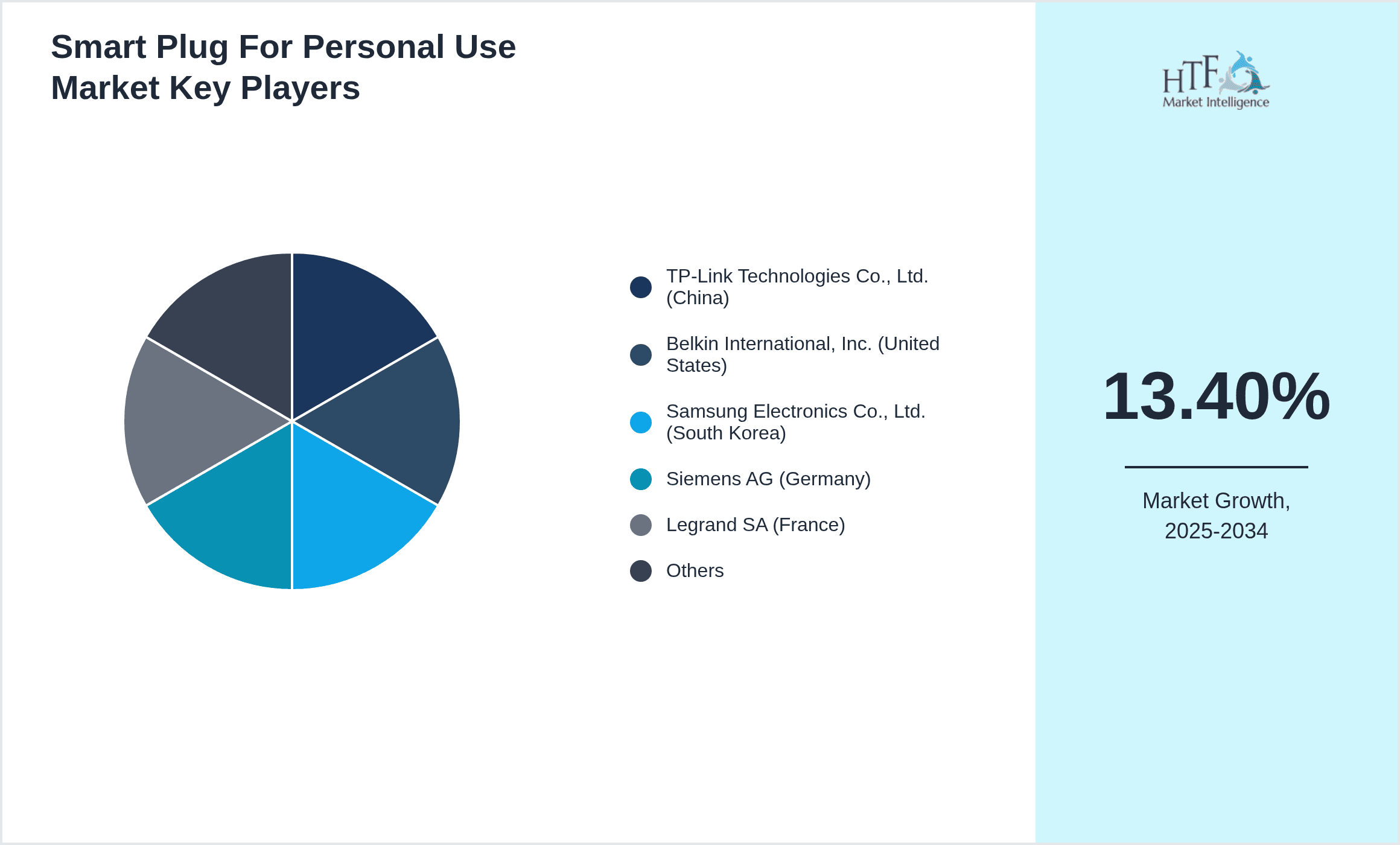
Top Companies Profiled in South America Smart Plug For Personal Use Market
- •TP-Link Technologies Co., Ltd. (China)
- •Belkin International, Inc. (United States)
- •Samsung Electronics Co., Ltd. (South Korea)
- •Siemens AG (Germany)
- •Legrand SA (France)
Regional Outlook
The Brazil currently holds a significant share of the market, primarily due to several key factors: increasing consumption rates, a burgeoning population, and robust economic momentum. These elements collectively drive demand, positioning this region as a leader in the market. On the other hand, Argentina is rapidly emerging as the fastest-growing area within the industry. This remarkable growth can be attributed to swift infrastructure development, the expansion of various industrial sectors, and a marked increase in consumer demand. These dynamics make this region a crucial player in shaping future market growth.
In our report, we cover a comprehensive analysis of the following regions and countries:
- Brazil
- Argentina
- Chile
- Peru
- Colombia
- Rest of South America
| Feature | Details |
|---|---|
| Base Year Market Size | USD 0.48 Billion |
| Forecast Year Market Size | USD 1.75 Billion |
| CAGR | 13.4% |
| Forecast Period | 2026 to 2033 |
| YoY Growth | 12.7% |
| Regions Covered | Brazil, Argentina, Chile, Peru, Colombia, Rest of South America |
| Key Companies | TP-Link Technologies Co., Ltd. (China), Belkin International, Inc. (United States), Samsung Electronics Co., Ltd. (South Korea), Siemens AG (Germany), Legrand SA (France), Leviton Manufacturing Co., Inc. (United States), GE Lighting (United States), BroadLink Corp. (China), Xiaomi Corporation (China), Etekcity Corporation (United States), D-Link Corporation (Taiwan), Honeywell International Inc. (United States), Amazon.com, Inc. (United States), Google LLC (United States), Schneider Electric SE (France), Meross Technology Limited (China), Sonoff (China), Innr Lighting (Netherlands), Philips Lighting (Netherlands), TP Vision (Netherlands), Vimar SpA (Italy), Orvibo Technology Co., Ltd. (China), Broadcom Inc. (United States), Fibaro (Poland), Honyar Group Co., Ltd. (China) |
South America Smart Plug For Personal Use Market Size, Growth & Revenue 2024-2034 - Table of Contents
Frequently Asked Questions (FAQ):
The Compact Track Loaders market is projected to grow at a CAGR of 6.8% from 2025 to 2030, driven by increasing demand in construction and agricultural sectors.
North America currently leads the market with approximately 45% market share, followed by Europe at 28% and Asia-Pacific at 22%. The remaining regions account for 5% of the global market.
Key growth drivers include increasing construction activities, rising demand for versatile equipment in agriculture, technological advancements in track loader design, and growing preference for compact equipment in urban construction projects.