
South America Biobanking Market Size, Growth & Revenue 2024-2034
South America Biobanking Market is segmented by Type (Cryopreservation Biobanks, Tissue Biobanks, Blood Biobanks, DNA Biobanks, Others), Application (Research & Development, Clinical Trials, Personalized Medicine, Drug Discovery, Regenerative Medicine), and Geography (Brazil, Argentina, Chile, Peru, Colombia, Rest of South America)
Pricing
Report Overview
Executive Summary
- •The South America Biobanking market involves the systematic collection, preservation, and management of biological samples such as blood, tissue, and DNA to facilitate biomedical research, personalized medicine, and clinical trials. It spans multiple biobank types including cryopreservation, tissue, blood, and DNA biobanks, serving research, drug discovery, and regenerative medicine applications across Brazil, Argentina, Chile, Peru, and Colombia.
- •With a base market size of USD 0.85 Billion in 2024, the market is poised to reach USD 2.15 Billion by 2034, exhibiting a CAGR of 9.3%. Brazil dominates with a 40% share, while Chile leads growth at 12.1% CAGR, driven by rising investments and expanding biobanking infrastructure.
- •The market’s strategic importance lies in enabling advancements in healthcare research, accelerating drug development, and supporting precision therapies. Increasing collaborations among academia, pharmaceutical firms, and healthcare providers underscore its vital role in South America’s biomedical innovation ecosystem.

Competitive Landscape
The South America Biobanking market is characterized by moderate competition among both regional and global players striving to expand their footprint through innovation, strategic partnerships, and infrastructure enhancement. Market leaders focus on investing in cutting-edge preservation technologies and digital biobank management systems to improve sample quality and accessibility. The rivalry is intensified by increasing demand for biobanking in personalized medicine and clinical research, compelling companies to differentiate through service quality, compliance with regulatory frameworks, and collaborative research agreements. Furthermore, emerging local players are gaining traction by catering to country-specific needs and government-supported initiatives, enhancing competitive dynamics. Market entrants face barriers such as high capital requirements and stringent quality standards, which consolidate the position of established companies. Future competition is expected to revolve around technological advancements, data integration capabilities, and expansion into underserved regions within South America.
Leading Companies in South America Biobanking Market
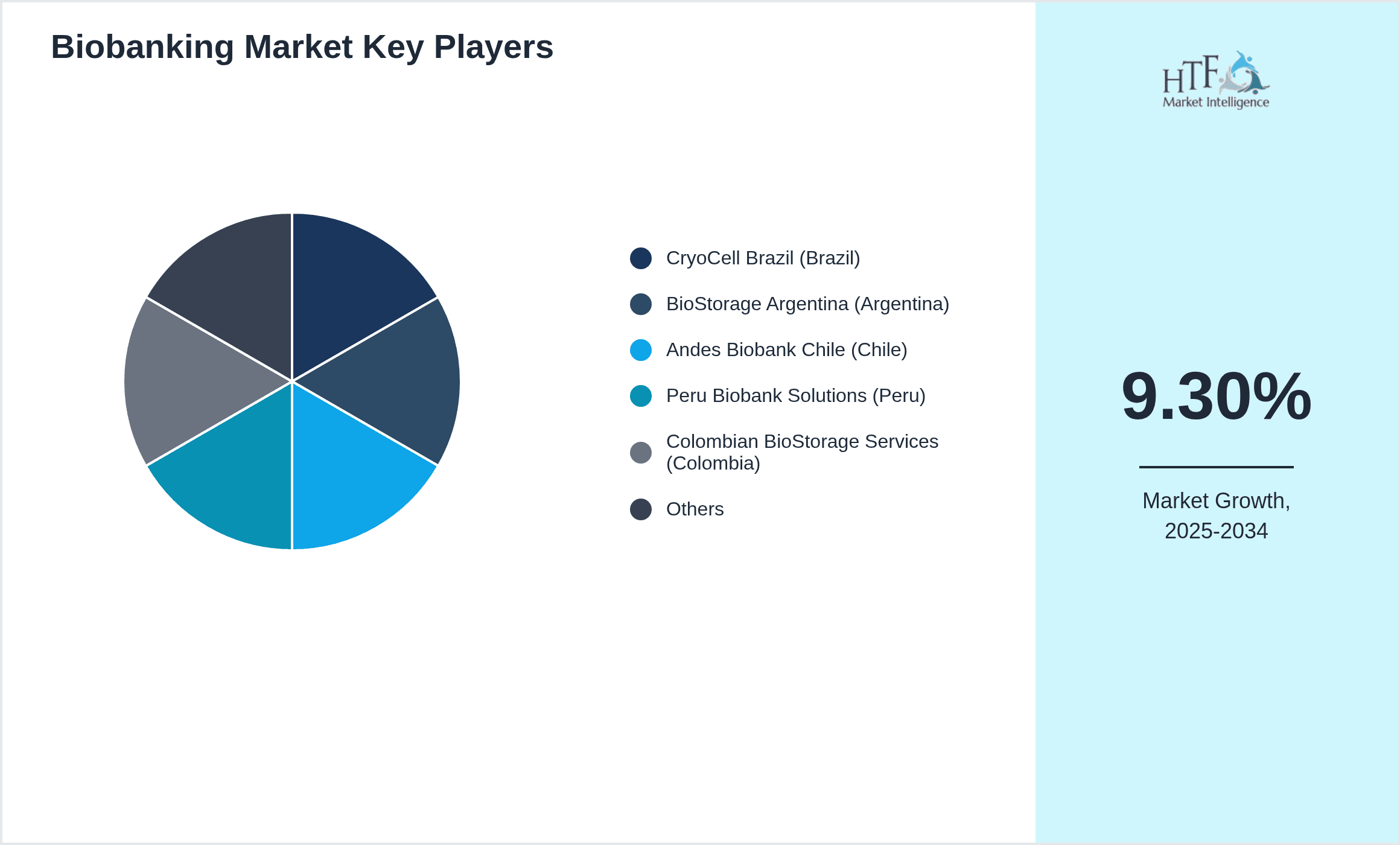
- •CryoCell Brazil (Brazil)
- •BioStorage Argentina (Argentina)
- •Andes Biobank Chile (Chile)
- •Peru Biobank Solutions (Peru)
- •Colombian BioStorage Services (Colombia)
- •Latin America Biobank Network (Brazil)
- •Sangre Viva Biobank (Argentina)
- •Patagonia Tissue Bank (Chile)
- •Andean Cell Services (Peru)
- •Amazonia Bioservices (Brazil)
- •BioPreserve SA (Chile)
- •TissueSafe Argentina (Argentina)
- •Genoma Biobank Colombia (Colombia)
- •CordLife South America (Brazil)
- •BioVault Peru (Peru)
- •CellSafe Chile (Chile)
- •Biobank Solutions Argentina (Argentina)
- •BioGen Storage Colombia (Colombia)
- •CryoStore Brazil (Brazil)
- •MedTissue Chile (Chile)
- •BioCell Argentina (Argentina)
- •GenBank Colombia (Colombia)
- •CryoLife Peru (Peru)
- •South America Stem Cell Bank (Brazil)
- •Andes Genetic Storage (Chile)

Market Breakdown
- •By Type
- ◦Cryopreservation Biobanks
- ◦Tissue Biobanks
- ◦Blood Biobanks
- ◦DNA Biobanks
- ◦Others (e.g., Cell Line Biobanks)
- •By Application
- ◦Research & Development
- ◦Clinical Trials
- ◦Personalized Medicine
- ◦Drug Discovery
- ◦Regenerative Medicine
- •By End User
- ◦Academic & Research Institutes
- ◦Pharmaceutical & Biotechnology Companies
- ◦Hospitals & Healthcare Providers
- ◦Government & Public Health Organizations
- •By Distribution Channel
- ◦Direct Sales
- ◦Online Platforms
- ◦Third-Party Service Providers
Growth Drivers
The South America Biobanking market is propelled by increasing investments in biomedical research and rising prevalence of chronic diseases in the region, driving demand for high-quality biological samples. Government initiatives promoting personalized medicine and public health research have spurred biobanking infrastructure development, especially in Brazil and Argentina. Advances in cryopreservation and data management technologies enhance sample viability and accessibility, attracting pharmaceutical companies conducting clinical trials locally. Furthermore, growing awareness among healthcare providers about the benefits of biobanks in regenerative therapies supports market growth. Collaborations between academic institutions and private entities foster innovation and resource sharing, facilitating market expansion. The surge in demand for precision medicine and targeted therapies is also encouraging expansion of DNA and tissue biobanks, creating new growth avenues. Overall, the convergence of technological advancements, strategic funding, and regulatory support form a robust foundation for sustained market growth in South America.

Market Trends
Emerging trends in the South America Biobanking market include the integration of artificial intelligence and blockchain technologies to enhance sample tracking, data security, and operational efficiency. Increasing adoption of cloud-based biobank management systems facilitates real-time data access and collaboration across institutions. There is a growing focus on ethical biobanking practices, including informed consent and data privacy, aligning with evolving regulatory frameworks. Expansion of public-private partnerships is enabling resource pooling and infrastructure development in underserved countries like Peru and Colombia. Additionally, the rise of regenerative medicine and gene therapy research is driving diversification of biobank specimen types, moving beyond traditional blood and tissue samples. These trends collectively improve biobank quality, scalability, and relevance to cutting-edge biomedical research in South America.
Market Restraints
Despite promising growth, the South America Biobanking market faces challenges such as limited funding in certain countries, inadequate infrastructure, and shortage of skilled personnel trained in biobank management. Stringent regulatory requirements and complex ethical considerations can delay project approvals and increase operational costs. Fragmented market with inconsistent standards across countries hinders interoperability and sample sharing. Additionally, logistical challenges related to sample transportation and storage in remote regions impact biobank reliability. Data privacy concerns and lack of unified data governance frameworks further restrict biobank utilization. These restraints collectively slow market penetration and require coordinated efforts to harmonize regulations, improve infrastructure, and enhance workforce capabilities across South America.
Market Opportunities
Significant opportunities exist in expanding biobanking services to emerging markets within South America, such as Peru and Colombia, where healthcare infrastructure is evolving rapidly. Investment in advanced cryopreservation and genomic technologies can enhance biobank capabilities and attract international collaborations. The increasing focus on rare diseases and population-specific genetic research opens avenues for specialized biobank development. Public-private partnerships present opportunities to leverage funding and expertise for large-scale biobanking projects. Furthermore, growth in regenerative medicine and personalized therapies creates demand for diverse biological samples, stimulating innovation in storage and data analytics solutions. Digital transformation and AI-driven biobank management offer potential for operational efficiency and improved research outcomes, positioning market participants favorably for future growth.
Market Challenges
The South America Biobanking market grapples with challenges including high initial capital expenditure for establishing biobank facilities and maintaining stringent quality control. Variability in regulatory environments across countries complicates compliance efforts for multi-national operators. Data standardization and integration issues limit collaborative research potential. Limited public awareness and ethical concerns around sample usage can impact donor participation rates. Supply chain disruptions, especially in remote or underdeveloped areas, affect sample preservation integrity. Additionally, competition from established global biobanks poses barriers for regional players seeking to expand. Addressing these challenges requires harmonized policies, investment in education and infrastructure, and development of robust data management frameworks to sustain market growth.
Regulatory Overview
Recent regulatory developments in South America have focused on harmonizing biobanking standards and enhancing ethical compliance. Brazil’s ANVISA updated guidelines between 2020 and 2024 to strengthen donor consent protocols and sample traceability, impacting operational procedures. Argentina introduced data protection laws aligning with international norms to safeguard donor privacy. Chile has implemented mandatory biobank registration and accreditation to ensure quality and transparency. These regulations encourage standardization but increase compliance complexity, requiring biobanks to invest in updated IT systems and staff training. Governments are also promoting frameworks facilitating cross-border sample sharing to support collaborative research. Overall, evolving regulations aim to balance innovation with ethical integrity, fostering a secure and efficient biobanking environment in South America.
Market Intelligence
- •In March 2023, CryoCell Brazil launched an advanced cryopreservation service integrating AI-based sample tracking and temperature monitoring systems, enhancing sample integrity and operational efficiency. This innovation targeted clinical trial sponsors and research institutions, positioning CryoCell as a technology leader in South America’s biobanking market. The launch included partnerships with academic centers to accelerate translational research.
- •In September 2024, Andes Biobank Chile expanded its facility to include a next-generation DNA biobank platform supporting large-scale genomic studies. The expansion was part of a strategic initiative to meet growing demand from personalized medicine and pharmaceutical research sectors, backed by government funding and international collaborations.
- •Recent market developments and strategic initiatives are continuously tracked through industry publications, company announcements, and regulatory filings. For the most current information, stakeholders are advised to monitor official corporate communications and recognized market intelligence platforms.
Mergers & Acquisitions
- •In November 2023, BioStorage Argentina acquired TissueSafe Argentina, consolidating their market presence and expanding their biobanking portfolio across blood and tissue samples. This acquisition enhanced service coverage and operational capacity, enabling broader client engagement in clinical trials and biomedical research in Argentina and neighboring countries.
- •In July 2024, CordLife South America completed the acquisition of Amazonia Bioservices in Brazil, strengthening its position in the cryopreservation segment. The merger aimed to leverage combined technological expertise and expand biobank infrastructure, accelerating growth in personalized medicine applications throughout South America.
Recent Industry News
- •15th January 2024, BioGen Storage Colombia announced a strategic partnership with a leading pharmaceutical company to provide biobanking services for drug discovery projects targeting tropical diseases. The collaboration focuses on expanding biobank specimen diversity and enhancing data analytics capabilities to accelerate therapeutic development. Source: BioGen Storage Colombia Official Release.
- •20th August 2023, CryoStore Brazil inaugurated a state-of-the-art biobank facility equipped with automated sample management and AI-driven quality control systems. This expansion supports increased demand from clinical trials and personalized medicine sectors across Brazil and South America. Source: CryoStore Brazil Press Statement.
- •5th May 2022, Andes Genetic Storage Chile launched a mobile biobanking unit to provide sample collection and preservation services in remote areas, improving accessibility and supporting population-specific research initiatives. This innovation addresses logistical challenges in South America’s diverse geography. Source: Andes Genetic Storage Chile News.
- •30th November 2021, Latin America Biobank Network initiated a regional data integration platform to facilitate collaboration among biobanks across South America, enhancing interoperability and accelerating translational research. The platform includes secure data sharing protocols compliant with regional regulations. Source: Latin America Biobank Network Announcement.
Market Statistics
- •CAGR by 2034: 9.3%
- •Market Size by 2034: USD 2.15 Billion
- •Market Size in 2025: USD 0.93 Billion
- •Dominating Type: Cryopreservation Biobanks
- •Next-following Type: DNA Biobanks
- •Dominating Application: Research & Development
- •Next-following Application: Clinical Trials
- •Dominating Region: Brazil
- •Second-leading Region: Argentina
- •Region with Highest Growth Rate: Chile
- •Dominating Country: Brazil
Market Share Table
- •Market Share (%) of Dominating vs Followed Type
- ◦Cryopreservation Biobanks: 45%
- ◦DNA Biobanks: 25%
- •Market Share (%) of Dominating vs Followed Application
- ◦Research & Development: 38%
- ◦Clinical Trials: 30%
- •Growth Rate (%) of Dominating vs Followed Type
- ◦Cryopreservation Biobanks: 8.7%
- ◦DNA Biobanks: 11.2%
- •Growth Rate (%) of Dominating vs Followed Application
- ◦Research & Development: 9.1%
- ◦Clinical Trials: 10.4%
Top 5 Global Players
- •Thermo Fisher Scientific (United States)
- •Sartorius AG (Germany)
- •Cytiva (United States)
- •QIAGEN N.V. (Netherlands)
- •BioStorage Technologies (United States)
Regional Outlook
The Brazil currently holds a significant share of the market, primarily due to several key factors: increasing consumption rates, a burgeoning population, and robust economic momentum. These elements collectively drive demand, positioning this region as a leader in the market. On the other hand, Chile is rapidly emerging as the fastest-growing area within the industry. This remarkable growth can be attributed to swift infrastructure development, the expansion of various industrial sectors, and a marked increase in consumer demand. These dynamics make this region a crucial player in shaping future market growth.
In our report, we cover a comprehensive analysis of the following regions and countries:
- Brazil
- Argentina
- Chile
- Peru
- Colombia
- Rest of South America
| Feature | Details |
|---|---|
| Base Year Market Size | USD 0.85 Billion |
| Forecast Year Market Size | USD 2.15 Billion |
| CAGR | 9.3% |
| Forecast Period | 2026 to 2033 |
| YoY Growth | 9.3% |
| Regions Covered | Brazil, Argentina, Chile, Peru, Colombia, Rest of South America |
| Key Companies | CryoCell Brazil (Brazil), BioStorage Argentina (Argentina), Andes Biobank Chile (Chile), Peru Biobank Solutions (Peru), Colombian BioStorage Services (Colombia), Latin America Biobank Network (Brazil), Sangre Viva Biobank (Argentina), Patagonia Tissue Bank (Chile), Andean Cell Services (Peru), Amazonia Bioservices (Brazil), BioPreserve SA (Chile), TissueSafe Argentina (Argentina), Genoma Biobank Colombia (Colombia), CordLife South America (Brazil), BioVault Peru (Peru), CellSafe Chile (Chile), Biobank Solutions Argentina (Argentina), BioGen Storage Colombia (Colombia), CryoStore Brazil (Brazil), MedTissue Chile (Chile), BioCell Argentina (Argentina), GenBank Colombia (Colombia), CryoLife Peru (Peru), South America Stem Cell Bank (Brazil), Andes Genetic Storage (Chile) |
South America Biobanking Market Size, Growth & Revenue 2024-2034 - Table of Contents
Frequently Asked Questions (FAQ):
The Compact Track Loaders market is projected to grow at a CAGR of 6.8% from 2025 to 2030, driven by increasing demand in construction and agricultural sectors.
North America currently leads the market with approximately 45% market share, followed by Europe at 28% and Asia-Pacific at 22%. The remaining regions account for 5% of the global market.
Key growth drivers include increasing construction activities, rising demand for versatile equipment in agriculture, technological advancements in track loader design, and growing preference for compact equipment in urban construction projects.