
Japan Online Personal Training Software Market Scope & Changing Dynamics 2024-2034
Japan Online Personal Training Software Market is segmented by Type (Subscription-based Software, One-time Purchase Software, Freemium Models, Customized Solutions, AI-powered Platforms), Application (Individual Fitness, Corporate Wellness, Rehabilitation, Athlete Training, Weight Management), End User (Individual Consumers, Fitness Centers, Healthcare Providers, Sports Teams, Corporate Clients), Distribution Channel (Direct Online Sales, App Stores, B2B Partnerships, Fitness Equipment Bundles), and Geography (Hokkaido, Tohoku, Kanto, Chubu, Kansai, Chugoku, Shikoku, Kyushu)
Pricing
Report Overview
Executive Summary
- •The Japan Online Personal Training Software market encompasses digital platforms designed for remote fitness coaching, personalized workout management, and virtual trainer-client engagement. It includes subscription, freemium, one-time purchase, customized, and AI-driven software catering to individuals, corporations, rehabilitation, athletes, and weight management segments within Japan.
- •Key highlights include a base market size of USD 0.95 Billion in 2024, projected to reach USD 3.2 Billion by 2034, reflecting a CAGR of 12.1%. The Kanto region dominates with a 38% market share, while Kyushu & Okinawa is the fastest-growing sub-region with 14.5% CAGR.
- •This market holds strategic value for fitness professionals, corporate wellness providers, and software developers due to growing health awareness, technological advancements like AI integration, and increasing adoption of virtual fitness solutions in Japan's technologically adept society.

Competitive Landscape
Competition in the Japan Online Personal Training Software market is characterized by intense rivalry among established software developers and innovative startups. Market leaders focus on continuous innovation through AI integration, personalized user experiences, and seamless platform interoperability. Companies employ aggressive pricing, strategic partnerships with fitness centers, and robust digital marketing to gain market share. Innovation is central, with emphasis on real-time data analytics, virtual reality workouts, and gamification to enhance user engagement. Barriers to entry include high development costs and the need for localized content tailored to Japanese consumers. Regional competition is strong, particularly in Kanto and Kansai regions, with companies leveraging local fitness trends and technological infrastructure. Future trends point towards consolidation via mergers and acquisitions to expand service portfolios and geographic reach, while maintaining competitive differentiation through advanced technology adoption and user-centric design.
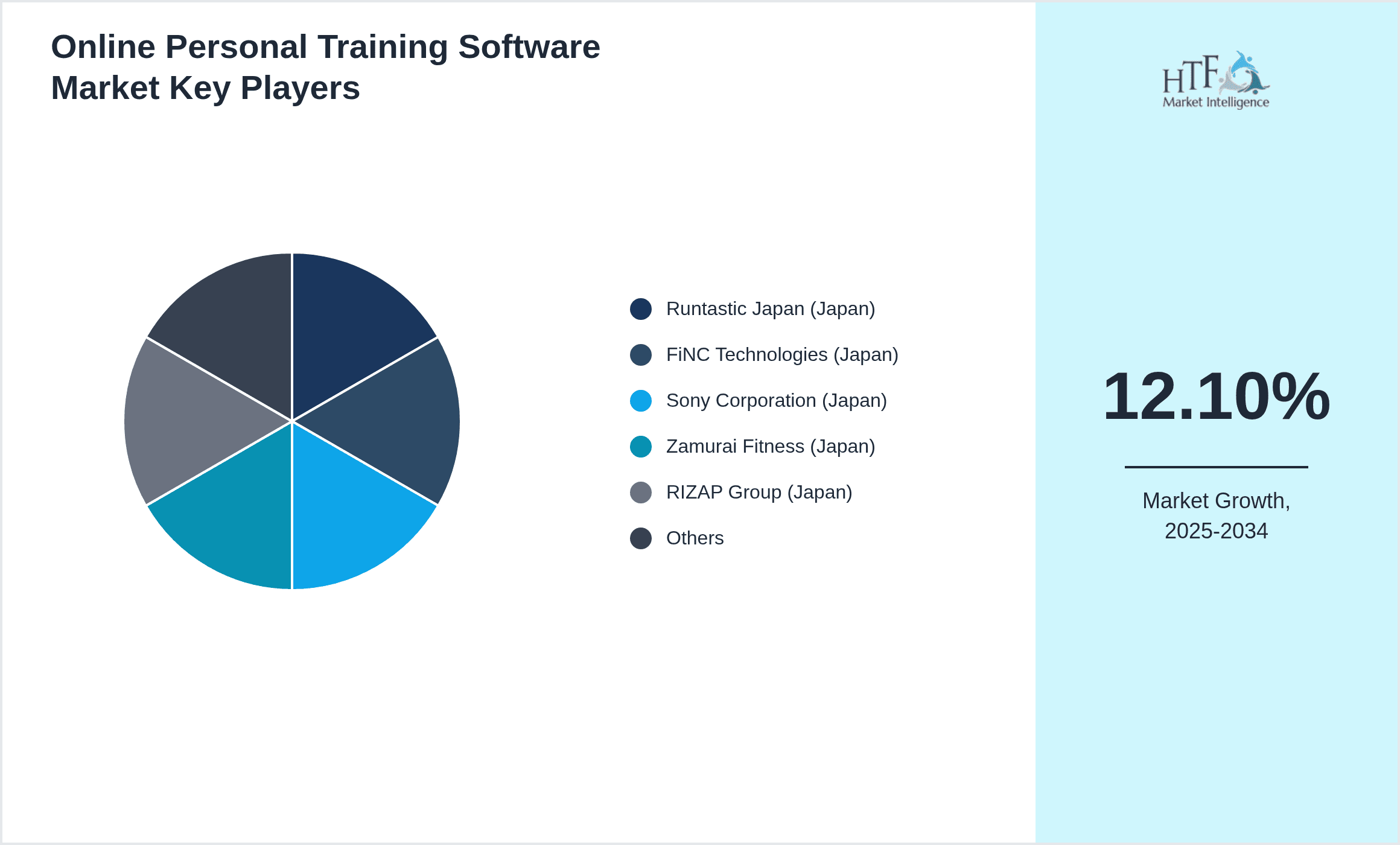
Leading Companies in Japan Online Personal Training Software Market
- •Runtastic Japan (Japan)
- •FiNC Technologies (Japan)
- •Sony Corporation (Japan)
- •Zamurai Fitness (Japan)
- •RIZAP Group (Japan)
- •Fitbit Japan (Japan)
- •Trainiac Japan (Japan)
- •Asics Digital (Japan)
- •Mira Robotics (Japan)
- •Team Lab Fitness (Japan)
- •Walnut Inc. (Japan)
- •Lifely Inc. (Japan)
- •Noom Japan (Japan)
- •BetterMe Japan (Japan)
- •Freeletics Japan (Japan)
- •Peloton Japan (Japan)
- •Nike Japan (Japan)
- •Under Armour Japan (Japan)
- •Tonal Japan (Japan)
- •Mirror Japan (Japan)
- •MyFitnessPal Japan (Japan)
- •Fitbit Inc. (United States)
- •Peloton Interactive (United States)
- •Technogym (Italy)
- •Zwift Inc. (United States)
Market Breakdown
- •By Type
- ◦Subscription-based Software
- ◦One-time Purchase Software
- ◦Freemium Models
- ◦Customized Solutions
- ◦AI-powered Platforms
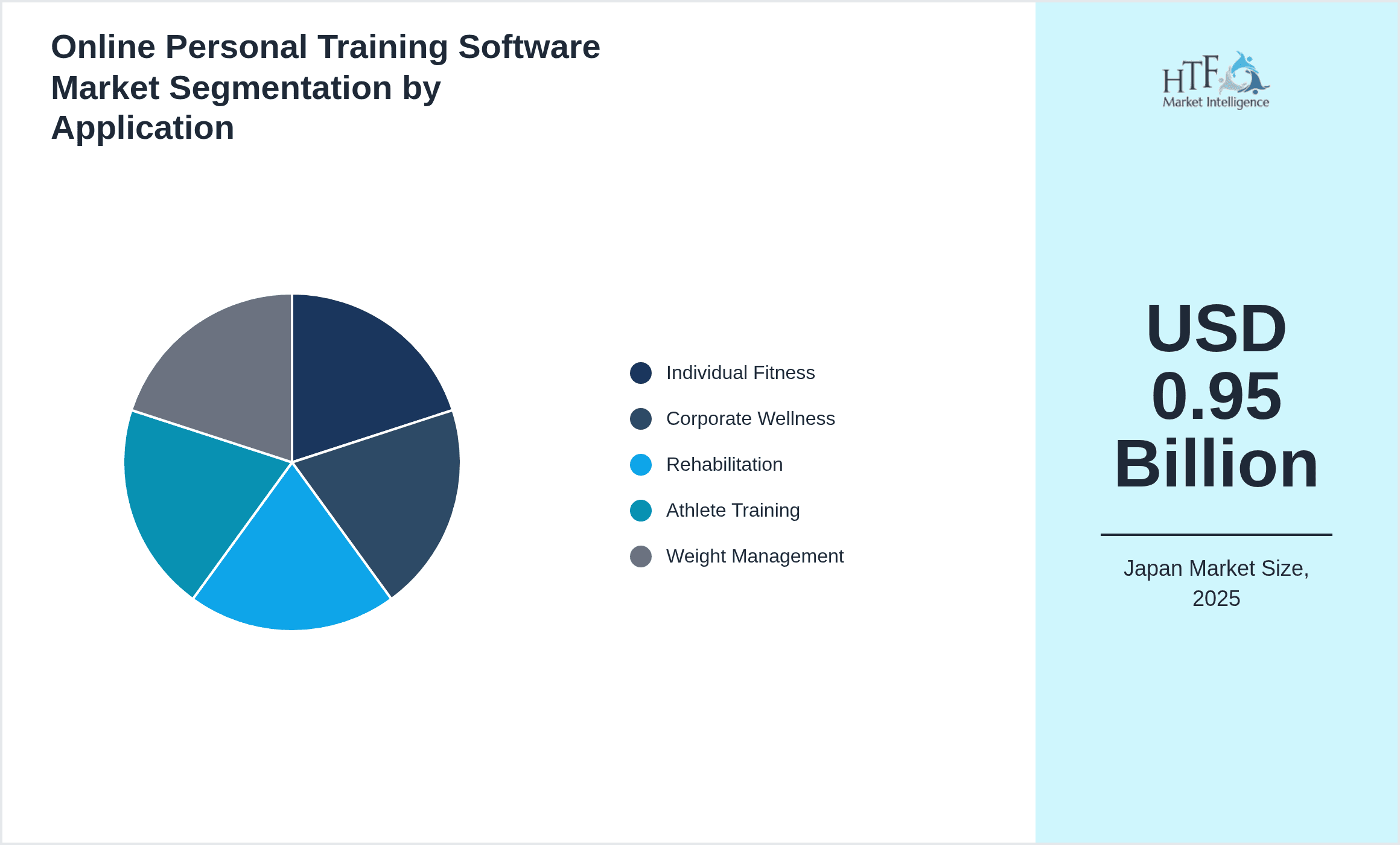
- •By Application
- ◦Individual Fitness
- ◦Corporate Wellness
- ◦Rehabilitation
- ◦Athlete Training
- ◦Weight Management
- •By End User
- ◦Individual Consumers
- ◦Fitness Centers
- ◦Healthcare Providers
- ◦Sports Teams
- ◦Corporate Clients
- •By Distribution Channel
- ◦Direct Online Sales
- ◦App Stores
- ◦B2B Partnerships
- ◦Fitness Equipment Bundles
Growth Drivers
The Japan Online Personal Training Software market growth is propelled by increasing health consciousness among the Japanese population, particularly in urban centers like Kanto. Rising demand for flexible, remote fitness solutions due to busy lifestyles and aging demographics fuels adoption. Advances in AI and machine learning enhance personalization, improving user experience and retention. Corporate wellness programs are increasingly integrating online training platforms to boost employee health and productivity, creating substantial B2B demand. Additionally, government initiatives promoting physical activity and digital health technologies foster market expansion. The growing penetration of smartphones and high-speed internet further supports software accessibility across regional zones, including Kansai and Kyushu & Okinawa. These factors collectively contribute to a CAGR of 12.1% through 2034, reinforcing the significance of technology-driven fitness solutions in Japan.

Market Trends
Japan’s Online Personal Training Software market is witnessing rapid integration of AI-powered coaching and real-time biometric feedback, driving more effective training outcomes. Subscription-based models dominate, yet freemium and customized solutions are gaining traction among younger demographics. Gamification and virtual reality workouts are emerging trends enhancing user engagement. Corporate wellness adoption is expanding, with software tailored for employee health management. Regional zones like Kanto and Chubu lead digital fitness innovation, while Kyushu & Okinawa show growing uptake. Additionally, cross-platform compatibility and integration with wearable devices are becoming standard features, reflecting consumer demand for seamless fitness experiences. Sustainability in digital health platforms is also gaining importance, aligning with Japan’s broader environmental goals.
Restraints
Despite growth, the market faces challenges such as user privacy concerns and stringent data protection regulations in Japan, which complicate software development and deployment. High initial costs for AI integration and platform customization limit accessibility for smaller providers. Cultural preferences for in-person training and skepticism towards digital coaching hinder mass adoption among older populations, especially in regions like Shikoku and Tohoku. Additionally, inconsistent internet connectivity in rural areas restricts software usability nationwide. The competitive landscape intensifies pricing pressures, reducing profit margins. Limited awareness about the benefits of online personal training in certain regional zones also restrains market penetration. These factors collectively slow the market’s growth pace, requiring strategic approaches to overcome adoption barriers.
Market Opportunities
Japan’s aging population creates a significant opportunity for rehabilitation-focused online personal training software, addressing mobility and chronic disease management. Integration with emerging wearable healthcare devices offers potential for enhanced data-driven coaching. Expansion into corporate wellness programs, especially in the Kansai and Kyushu & Okinawa regions, presents lucrative B2B growth avenues. Increasing demand for AI-powered personalized fitness solutions among tech-savvy youth enables development of innovative, gamified platforms. Partnerships with healthcare providers and sports teams can diversify application scope. Furthermore, untapped rural markets with improving internet infrastructure represent future growth frontiers. Leveraging multilingual platforms to cater to inbound tourism and expatriates also offers expansion potential. These opportunities align with Japan’s digital transformation initiatives and health-oriented policies, promising robust market development through 2034.
Market Challenges
The Japan Online Personal Training Software market encounters challenges such as regulatory compliance with strict data privacy laws, requiring significant investment in cybersecurity infrastructure. Market fragmentation with numerous small players complicates consolidation and standardization efforts. Resistance from traditional fitness providers and limited digital literacy among elderly users inhibit widespread adoption. Technological complexity in integrating AI and wearable device data demands skilled workforce and ongoing R&D expenditure. Additionally, intense price competition pressures profitability while ensuring high service quality remains challenging. Regional disparities in technology access and consumer behavior, notably in Tohoku and Chugoku, further complicate market uniformity. Addressing these challenges is critical for sustained growth and requires strategic innovation, education, and regulatory alignment.
Regulatory Framework
Between 2020 and 2024, Japan enacted updated data privacy regulations aligned with the Act on the Protection of Personal Information (APPI), emphasizing stricter controls on health data collected by online personal training software. Compliance mandates include explicit user consent, secure data storage, and breach notification requirements, impacting software design and operations. The Ministry of Health, Labour and Welfare promotes digital health integration while issuing guidelines ensuring software safety and efficacy. Regulations also encourage interoperability standards to facilitate integration with medical devices and wearables, fostering innovation. Additionally, government incentives support startups developing AI-powered health technologies, creating a favorable environment within regulatory boundaries. These frameworks influence market dynamics by balancing user protection with technological advancement.
Industry Insights
In March 2023, FiNC Technologies launched an AI-driven personalized fitness coaching platform tailored for the Japanese market, integrating biometric sensors and real-time feedback to optimize workout efficiency. This innovation targets urban professionals seeking flexible fitness solutions. In October 2024, RIZAP Group expanded its digital training services by partnering with wearable device manufacturers to enhance data integration and user engagement across regional zones such as Kanto and Kansai. These strategic moves reflect increasing market maturity and the growing importance of technology-enabled personalized training in Japan’s fitness industry.
Mergers & Acquisitions
- •In July 2023, Sony Corporation acquired a majority stake in Walnut Inc., a Japan-based AI-powered personal training software developer. This acquisition aims to leverage Sony’s technological expertise and Walnut’s fitness platform to accelerate innovation and expand market reach across key Japanese regions like Kanto and Kyushu. The strategic move enhances Sony’s digital health portfolio, positioning it strongly in the evolving online fitness market.
- •In November 2024, Runtastic Japan merged with Lifely Inc., combining their complementary strengths in subscription-based and customized personal training software. The merger facilitates broader product offerings, improved user experience, and expanded distribution channels throughout Japan’s regional zones, fostering competitive advantage and accelerating growth in the online personal training segment.
Recent Industry News
- •15th April 2023, FiNC Technologies announced the launch of 'FiNC Home Coach', an AI-powered online personal training software that integrates with popular wearable fitness trackers to provide real-time coaching and personalized workout plans. Targeting busy urban populations in Japan, the product aims to revolutionize home fitness experiences and boost user engagement. Source: FiNC Technologies Official Press Release
- •10th September 2023, RIZAP Group partnered with a leading Japanese health insurance provider to offer corporate wellness programs incorporating their online personal training software. The collaboration seeks to promote employee health and reduce healthcare costs, enhancing corporate productivity across Japan, especially in the Kanto and Kansai regions. Source: RIZAP Group Corporate News
- •22nd January 2024, Sony Corporation unveiled 'Sony Fit AI', a new AI-driven personal training platform with advanced motion tracking and virtual coaching capabilities. The platform is designed for integration with Sony’s wearable devices and targets fitness enthusiasts across Japan’s major regional zones. Source: Sony Corporation Newsroom
- •5th May 2024, Trainiac Japan expanded its service offerings by launching a multilingual online personal training platform to cater to Japan’s growing expatriate community. The platform features culturally customized workout plans and virtual trainer support, enhancing inclusivity and market reach. Source: Trainiac Japan Press Release
Market Statistics
- •CAGR by 2034: 12.1%
- •Market Size by 2034: USD 3.2 Billion
- •Market Size in 2025: USD 1.07 Billion
- •Dominating Type: Subscription-based Software; Next-following Type: AI-powered Platforms
- •Dominating Application: Individual Fitness; Next-following Application: Corporate Wellness
- •Dominating Region: Kanto; Second-leading Region: Kansai
- •Region with Highest Growth Rate: Kyushu & Okinawa
- •Dominating Country: Japan
Market Share Table
- •Market Share (%) of Subscription-based Software: 45% vs AI-powered Platforms: 25%
- •Market Share (%) of Individual Fitness: 50% vs Corporate Wellness: 30%
- •Growth Rate (%) of Subscription-based Software: 11.5% vs AI-powered Platforms: 14.5%
- •Growth Rate (%) of Individual Fitness: 12.0% vs Corporate Wellness: 13.0%
Top 5 Global Players
- •FiNC Technologies (Japan)
- •Sony Corporation (Japan)
- •RIZAP Group (Japan)
- •Fitbit Inc. (United States)
- •Peloton Interactive (United States)
Regional Outlook
The Kanto currently holds a significant share of the market, primarily due to several key factors: increasing consumption rates, a burgeoning population, and robust economic momentum. These elements collectively drive demand, positioning this region as a leader in the market. On the other hand, Kyushu & Okinawa is rapidly emerging as the fastest-growing area within the industry. This remarkable growth can be attributed to swift infrastructure development, the expansion of various industrial sectors, and a marked increase in consumer demand. These dynamics make this region a crucial player in shaping future market growth.
In our report, we cover a comprehensive analysis of the following regions and countries:
- Hokkaido
- Tohoku
- Kanto
- Chubu
- Kansai
- Chugoku
- Shikoku
- Kyushu
| Feature | Details |
|---|---|
| Base Year Market Size | USD 0.95 Billion |
| Forecast Year Market Size | USD 3.2 Billion |
| CAGR | 12.1% |
| Forecast Period | 2026 to 2033 |
| YoY Growth | 12% |
| Scope of Report | Market is segmented by Type (Subscription-based Software, One-time Purchase Software, Freemium Models, Customized Solutions, AI-powered Platforms), Application (Individual Fitness, Corporate Wellness, Rehabilitation, Athlete Training, Weight Management), End User (Individual Consumers, Fitness Centers, Healthcare Providers, Sports Teams, Corporate Clients), Distribution Channel (Direct Online Sales, App Stores, B2B Partnerships, Fitness Equipment Bundles) |
| Regions Covered | Hokkaido, Tohoku, Kanto, Chubu, Kansai, Chugoku, Shikoku, Kyushu |
| Key Companies | Runtastic Japan (Japan), FiNC Technologies (Japan), Sony Corporation (Japan), Zamurai Fitness (Japan), RIZAP Group (Japan), Fitbit Japan (Japan), Trainiac Japan (Japan), Asics Digital (Japan), Mira Robotics (Japan), Team Lab Fitness (Japan), Walnut Inc. (Japan), Lifely Inc. (Japan), Noom Japan (Japan), BetterMe Japan (Japan), Freeletics Japan (Japan), Peloton Japan (Japan), Nike Japan (Japan), Under Armour Japan (Japan), Tonal Japan (Japan), Mirror Japan (Japan), MyFitnessPal Japan (Japan), Fitbit Inc. (United States), Peloton Interactive (United States), Technogym (Italy), Zwift Inc. (United States) |
Japan Online Personal Training Software Market Scope & Changing Dynamics 2024-2034 - Table of Contents
Frequently Asked Questions (FAQ):
The Compact Track Loaders market is projected to grow at a CAGR of 6.8% from 2025 to 2030, driven by increasing demand in construction and agricultural sectors.
North America currently leads the market with approximately 45% market share, followed by Europe at 28% and Asia-Pacific at 22%. The remaining regions account for 5% of the global market.
Key growth drivers include increasing construction activities, rising demand for versatile equipment in agriculture, technological advancements in track loader design, and growing preference for compact equipment in urban construction projects.