
GCC Intelligent Community System Market Scope & Changing Dynamics 2024-2034
GCC Intelligent Community System Market is segmented by Type (Smart Infrastructure Systems, Communication Networks, Data Analytics Platforms, Security & Surveillance Systems, IoT Integration), Application (Urban Planning, Public Safety, Transportation Management, Energy Management, Citizen Services), End User (Government Agencies, Urban Developers, Utility Providers, Transportation Authorities, Private Sector Enterprises), Deployment Model (Cloud-based, On-premise, Hybrid), and Geography (Bahrain, Kuwait, Oman, Qatar, Saudi Arabia, United Arab Emirates)
Pricing
Report Overview
Executive Summary
- •The GCC Intelligent Community System Market integrates smart infrastructure systems, communication networks, data analytics platforms, security surveillance, and IoT integration technologies to enable sustainable urban development and enhance public services across GCC countries. It addresses urban planning, transportation, energy management, and citizen engagement through intelligent digital frameworks.
- •Key market highlights include a base market size of USD 2.1 Billion in 2025, with a forecast to reach USD 6.7 Billion by 2034, representing a CAGR of 13.2%. The United Arab Emirates leads the region with 35% market share, while Qatar exhibits the highest growth rate at 16.8% CAGR.
- •This market’s strategic importance lies in driving digital transformation initiatives, improving operational efficiency, and supporting the GCC’s vision for smart cities. It offers stakeholders opportunities to leverage cutting-edge technologies for economic diversification and enhanced quality of life.

Competitive Landscape
Competition in the GCC Intelligent Community System Market is characterized by intense rivalry among regional and global technology providers focusing on innovation, strategic partnerships, and customized solutions tailored to GCC urban challenges. Market players prioritize R&D to enhance system integration, data analytics capabilities, and security features. Companies leverage local government collaborations and smart city initiatives to secure long-term contracts. Competitive strategies also include diversification of service portfolios and aggressive pricing to capture emerging segments. The market is moderately consolidated with a mix of multinational corporations and agile local firms. Innovation in AI-driven analytics and IoT connectivity forms a key basis for competitive advantage. Market entry barriers include high capital investment and regulatory compliance. Future competition will intensify with rising digital infrastructure investments and evolving consumer expectations, emphasizing scalable, interoperable, and sustainable intelligent community solutions.
Leading Companies in GCC Intelligent Community System Market
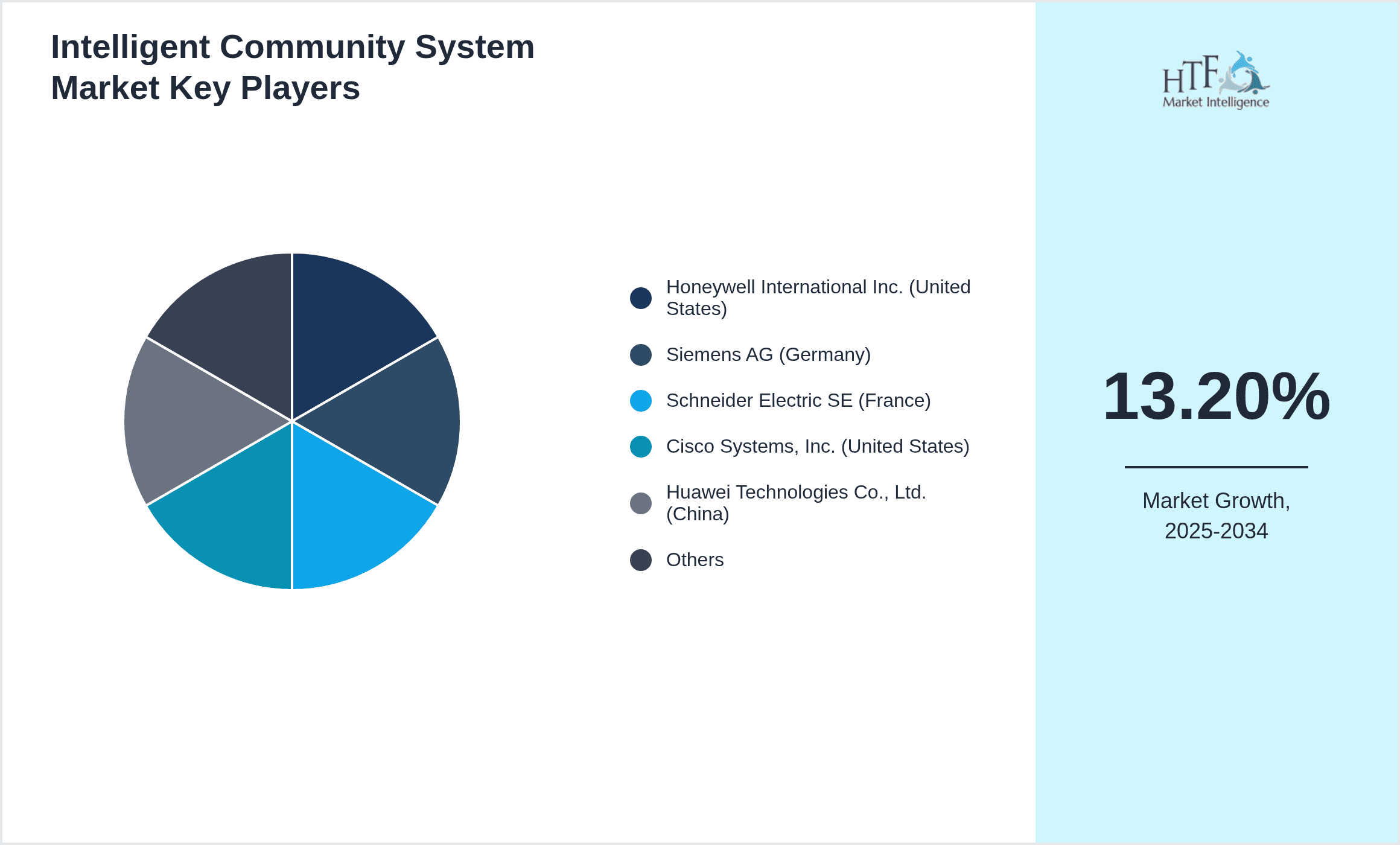
- •Honeywell International Inc. (United States)
- •Siemens AG (Germany)
- •Schneider Electric SE (France)
- •Cisco Systems, Inc. (United States)
- •Huawei Technologies Co., Ltd. (China)
- •IBM Corporation (United States)
- •ABB Ltd (Switzerland)
- •NEOM (Saudi Arabia)
- •Etisalat Group (United Arab Emirates)
- •Ooredoo Group (Qatar)
- •Zain Group (Kuwait)
- •STC (Saudi Telecom Company) (Saudi Arabia)
- •Oracle Corporation (United States)
- •Microsoft Corporation (United States)
- •SAP SE (Germany)
- •Dell Technologies Inc. (United States)
- •Cisco Middle East (United Arab Emirates)
- •NEOM Bay La Sun (Saudi Arabia)
- •Smart Dubai (United Arab Emirates)
- •Honeywell Middle East (United Arab Emirates)

Market Breakdown
- •By Type
- ◦Smart Infrastructure Systems
- ◦Communication Networks
- ◦Data Analytics Platforms
- ◦Security & Surveillance Systems
- ◦IoT Integration
- •By Application
- ◦Urban Planning
- ◦Public Safety
- ◦Transportation Management
- ◦Energy Management
- ◦Citizen Services
- •By End User
- ◦Government Agencies
- ◦Urban Developers
- ◦Utility Providers
- ◦Transportation Authorities
- ◦Private Sector Enterprises
- •By Deployment Model
- ◦Cloud-based
- ◦On-premise
- ◦Hybrid
Growth Drivers
- •Rapid urbanization and population growth in GCC nations have accelerated the demand for intelligent community systems that optimize resource management and improve urban livability. Governments’ Vision 2030-related initiatives emphasize smart city frameworks, fueling investments in digital infrastructure and IoT integration to support sustainable development and economic diversification.
- •Technological advancements including AI, big data analytics, and 5G communication networks enable enhanced real-time data processing and decision-making capabilities, driving adoption of intelligent community solutions for transportation, energy, and public safety sectors.
- •Strong governmental support through regulatory incentives and funding programs motivates private sector participation and public-private partnerships, facilitating accelerated deployment and integration of smart systems across urban environments.
- •Increasing awareness among citizens and businesses regarding benefits of connected services and smart city ecosystems propels demand for innovative applications that enhance quality of life and operational efficiency.
- •Rising cybersecurity concerns and the need for robust surveillance and monitoring solutions drive investments in security and surveillance systems as integral components of intelligent community frameworks.

Market Trends
- •Integration of AI-powered analytics and machine learning algorithms is enabling predictive maintenance and optimized resource allocation in GCC smart city projects, improving operational efficiency and reducing costs across sectors.
- •Adoption of cloud-based deployment models is increasing, offering scalability and flexibility for intelligent community systems, while hybrid models balance local data control with centralized processing advantages.
- •Growing emphasis on sustainability and green technologies is influencing system design, with energy management applications incorporating renewable energy sources and smart grid technologies to reduce carbon footprints.
- •Collaborative ecosystems are emerging among technology providers, telecom operators, and government agencies, fostering innovation through partnerships focused on interoperability and standardization of smart city solutions.
- •Increased deployment of IoT sensors and edge computing devices is enhancing real-time data acquisition and processing capabilities, enabling responsive and adaptive urban management systems.
Market Opportunities
- •The GCC’s ambitious smart city projects and economic diversification plans present significant opportunities for vendors to offer integrated intelligent community solutions tailored to regional requirements and regulatory frameworks.
- •Emerging demand for advanced data analytics platforms and AI-driven services opens avenues for technology providers to introduce innovative products that enhance decision-making and citizen engagement.
- •Expansion of 5G networks across GCC countries enables deployment of high-speed, low-latency communication infrastructures, facilitating adoption of next-generation smart systems and IoT applications.
- •Growing focus on public safety and security creates opportunities for specialized surveillance and monitoring solutions integrated with intelligent community frameworks.
- •Potential for regional collaborations and knowledge sharing among GCC member states can accelerate market growth through harmonized standards and joint initiatives.
Market Challenges
- •High initial capital investment and complex integration requirements pose significant barriers for small and medium enterprises seeking to enter the GCC intelligent community system market.
- •Fragmented regulatory environments and varying standards across GCC countries complicate deployment and interoperability of smart city technologies, requiring adaptive strategies by vendors.
- •Cybersecurity threats and data privacy concerns present ongoing challenges, necessitating robust security protocols and compliance with strict regional regulations to protect sensitive information.
- •Limited skilled workforce and expertise in advanced technologies hinder rapid implementation and maintenance of intelligent community systems in some GCC regions.
- •Market competition from global technology giants intensifies pricing pressure and demands continuous innovation to maintain competitive advantage.
Regulatory Framework
- •Between 2020 and 2025, GCC countries implemented data protection laws mandating compliance with privacy and cybersecurity standards for intelligent community system deployments, impacting design and operation protocols.
- •Telecommunications authorities across the GCC introduced regulations governing 5G network rollouts and IoT device certifications to ensure secure and reliable smart city communications.
- •Environmental regulations promoting sustainable energy use have influenced energy management applications within intelligent community systems, encouraging integration of renewable sources.
- •Smart city initiatives led by government mandates require adherence to interoperability and open data standards to foster ecosystem collaboration and vendor neutrality.
- •Incentive programs and grants from regional authorities support investments in digital infrastructure, encouraging private sector participation in intelligent community system projects.
Market Intelligence
- •In February 2024, Etisalat Group launched an advanced AI-driven traffic management platform in the UAE, designed to optimize urban transportation flow using real-time data analytics and IoT sensor integration, aiming to reduce congestion and emissions significantly.
- •In November 2023, NEOM announced the deployment of a comprehensive smart infrastructure system incorporating blockchain-enabled data security and autonomous energy management, positioning itself as a global leader in futuristic urban development.
- •In March 2025, Huawei Technologies introduced a next-generation 5G-enabled community surveillance solution tailored for GCC urban centers, enhancing public safety through high-definition video analytics and AI-based threat detection capabilities.
- •Recent market developments and strategic initiatives are continuously tracked through industry publications, company announcements, and regulatory filings. For the most current information, stakeholders are advised to monitor official corporate communications and recognized market intelligence platforms.
- •Source: Etisalat Press Release, NEOM Official Website, Huawei Corporate News
Regional Outlook
The United Arab Emirates currently holds a significant share of the market, primarily due to several key factors: increasing consumption rates, a burgeoning population, and robust economic momentum. These elements collectively drive demand, positioning this region as a leader in the market. On the other hand, Qatar is rapidly emerging as the fastest-growing area within the industry. This remarkable growth can be attributed to swift infrastructure development, the expansion of various industrial sectors, and a marked increase in consumer demand. These dynamics make this region a crucial player in shaping future market growth.
In our report, we cover a comprehensive analysis of the following regions and countries:
- Bahrain
- Kuwait
- Oman
- Qatar
- Saudi Arabia
- United Arab Emirates
| Feature | Details |
|---|---|
| Base Year Market Size | USD 2.1 Billion |
| Forecast Year Market Size | USD 6.7 Billion |
| CAGR | 13.2% |
| Forecast Period | 2026 to 2033 |
| YoY Growth | 12.5% |
| Scope of Report | Market is segmented by Type (Smart Infrastructure Systems, Communication Networks, Data Analytics Platforms, Security & Surveillance Systems, IoT Integration), Application (Urban Planning, Public Safety, Transportation Management, Energy Management, Citizen Services), End User (Government Agencies, Urban Developers, Utility Providers, Transportation Authorities, Private Sector Enterprises), Deployment Model (Cloud-based, On-premise, Hybrid) |
| Regions Covered | Bahrain, Kuwait, Oman, Qatar, Saudi Arabia, United Arab Emirates |
| Key Companies | Honeywell International Inc. (United States), Siemens AG (Germany), Schneider Electric SE (France), Cisco Systems, Inc. (United States), Huawei Technologies Co., Ltd. (China), IBM Corporation (United States), ABB Ltd (Switzerland), NEOM (Saudi Arabia), Etisalat Group (United Arab Emirates), Ooredoo Group (Qatar), Zain Group (Kuwait), STC (Saudi Telecom Company) (Saudi Arabia), Oracle Corporation (United States), Microsoft Corporation (United States), SAP SE (Germany), Dell Technologies Inc. (United States), Cisco Middle East (United Arab Emirates), NEOM Bay La Sun (Saudi Arabia), Smart Dubai (United Arab Emirates), Honeywell Middle East (United Arab Emirates) |
GCC Intelligent Community System Market Scope & Changing Dynamics 2024-2034 - Table of Contents
Frequently Asked Questions (FAQ):
The Compact Track Loaders market is expected to see value worth 5.3 Billion in 2025.
North America currently leads the market with approximately 45% market share, followed by Europe at 28% and Asia-Pacific at 22%. The remaining regions account for 5% of the global market.
Key growth drivers include increasing construction activities, rising demand for versatile equipment in agriculture, technological advancements in track loader design, and growing preference for compact equipment in urban construction projects.