
Asia-Pacific Push-rod Sewer Camera Market Size, Growth & Revenue 2024-2034
Asia-Pacific Push-rod Sewer Camera Market is segmented by Type (Standard Push-rod Camera, High-definition Push-rod Camera, Digital Push-rod Camera, Wireless Push-rod Camera, Robotic Push-rod Camera), Application (Municipal Sewer Inspection, Industrial Pipeline Inspection, Residential Plumbing, Environmental Monitoring, Construction Maintenance), End User (Government Municipalities, Industrial Facilities, Residential Property Owners, Construction Companies), Distribution Channel (Direct Sales, Third-Party Distributors, Online Retail, Rental Services), and Geography (Aisa-Pacific)
Pricing
Report Overview
Executive Summary
- •The Asia-Pacific Push-rod Sewer Camera Market refers to the segment of inspection cameras designed to traverse sewer and pipeline systems using flexible rods to capture real-time video for maintenance and monitoring. This market covers various camera technologies such as high-definition, digital, wireless, and robotic push-rod cameras, serving municipal, industrial, residential, and environmental applications across Asia-Pacific countries.
- •The market is poised for significant growth, driven by rapid urbanization, increasing infrastructure investments, and heightened demand for efficient pipeline inspection solutions. By 2034, the market is forecasted to reach USD 2.65 Billion from USD 0.85 Billion in 2024, reflecting a CAGR of 11.8%. Key growth segments include high-definition and wireless push-rod cameras, with China dominating market share and India showing the fastest growth trajectory.
- •Push-rod sewer cameras offer strategic value in reducing maintenance costs, minimizing service disruptions, and enhancing the accuracy of sewer system diagnostics. These solutions are critical for municipal authorities, industrial operators, and construction firms aiming to maintain sustainable sewer infrastructure and comply with environmental regulations in the Asia-Pacific region.

Competitive Landscape
The Asia-Pacific push-rod sewer camera market is characterized by intense competition among global and regional manufacturers emphasizing innovation and strategic partnerships. Leading players focus on developing high-definition imaging, wireless data transmission, and robotic navigation technologies to differentiate their offerings. Market rivalry is intensified by aggressive pricing, product customization for diverse applications, and expanding distribution networks. Companies invest heavily in R&D to incorporate AI-enabled analytics and enhance operational efficiency. The competitive environment is further shaped by collaborations with municipal bodies and infrastructure companies to pilot smart inspection solutions. Market entrants face high barriers due to the technical complexity and need for regulatory compliance. Future competitive trends include integration of IoT capabilities and cloud-based monitoring platforms to capture emerging opportunities in smart city deployments.
Leading Companies in Asia-Pacific Push-rod Sewer Camera Market
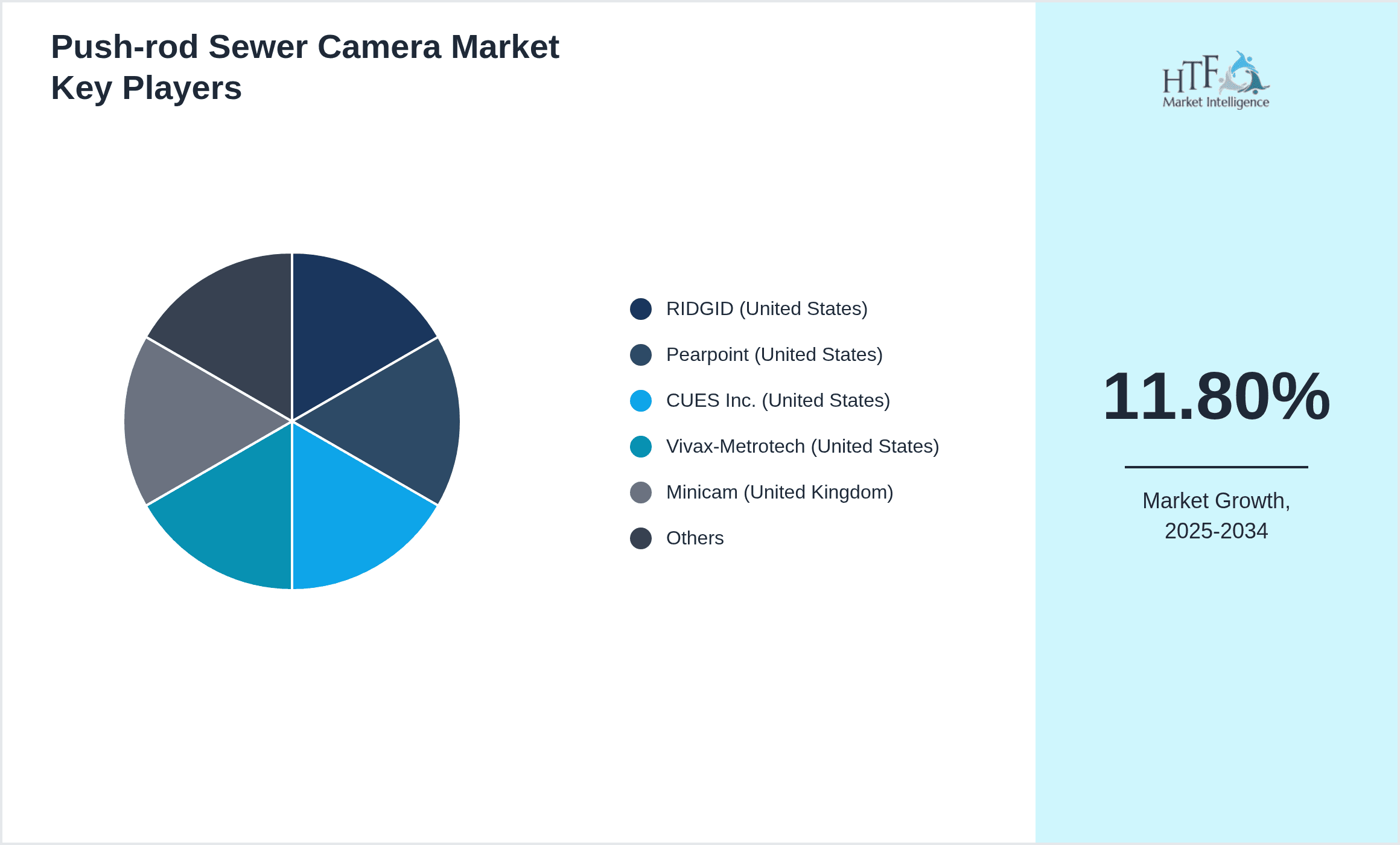
- •RIDGID (United States)
- •Pearpoint (United States)
- •CUES Inc. (United States)
- •Vivax-Metrotech (United States)
- •Minicam (United Kingdom)
- •IBAK Helmut Hunger GmbH & Co. KG (Germany)
- •Envirosight (United States)
- •Subsite Electronics (United States)
- •Jetter Equipment (United States)
- •SPYTEC (South Korea)
- •Rausch Electronics (Germany)
- •Nobi (Japan)
- •Sewerin (Germany)
- •CCTV Inspection Solutions (Australia)
- •Teledyne Technologies (United States)
- •Wisy AG (Germany)
- •Pioneer Inspection Service (China)
- •Yushin Precision Equipment (Japan)
- •Hazen Equipment (China)
- •Seeker Industries (Australia)
- •Kawasaki Heavy Industries (Japan)
- •Aqua-Tech (India)
- •Metech Equipment (South Korea)
- •Sewer Vision Solutions (China)
- •Pipeline Inspection Co. (India)
Market Breakdown
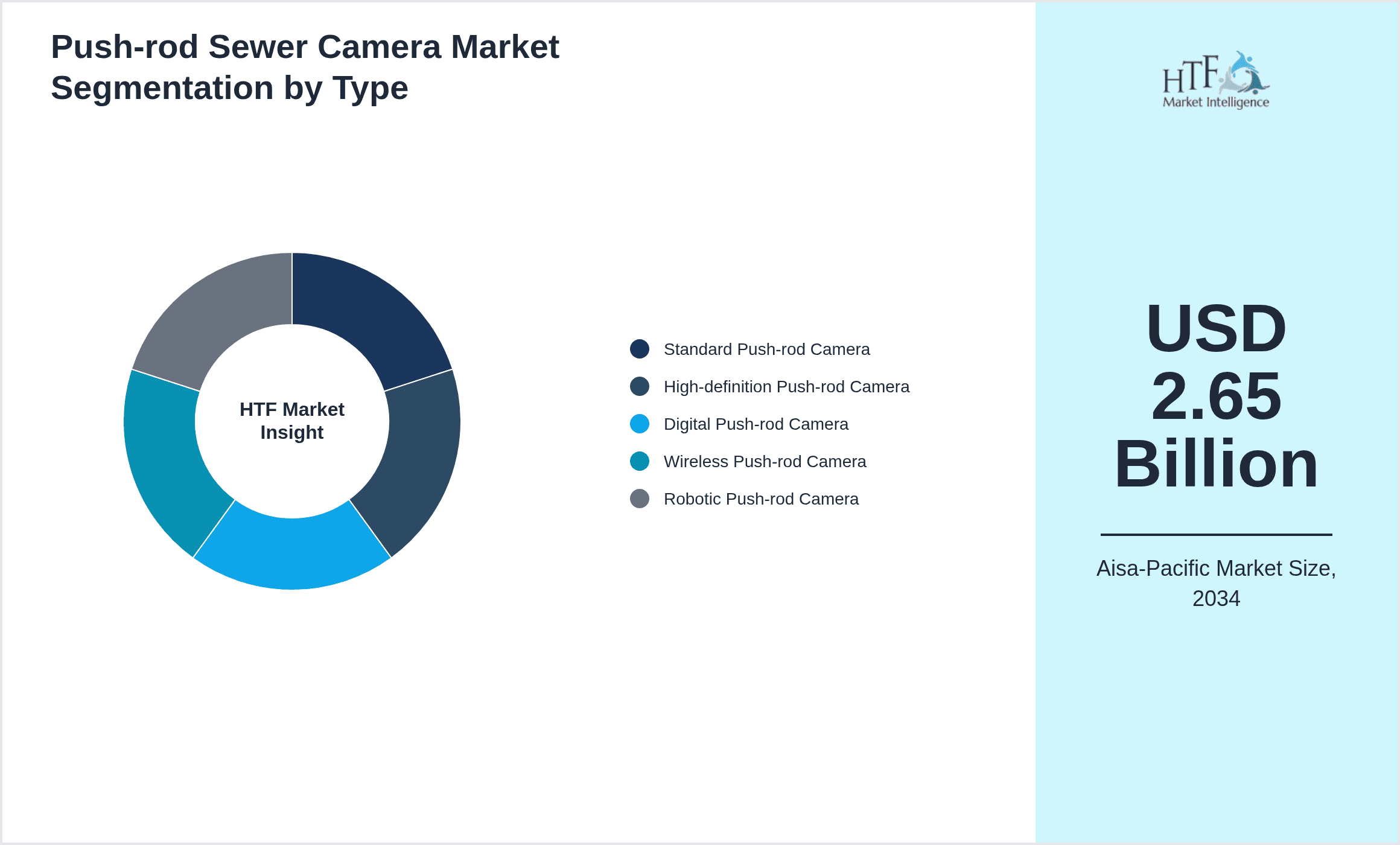
- •By Type
- ◦Standard Push-rod Camera
- ◦High-definition Push-rod Camera
- ◦Digital Push-rod Camera
- ◦Wireless Push-rod Camera
- ◦Robotic Push-rod Camera
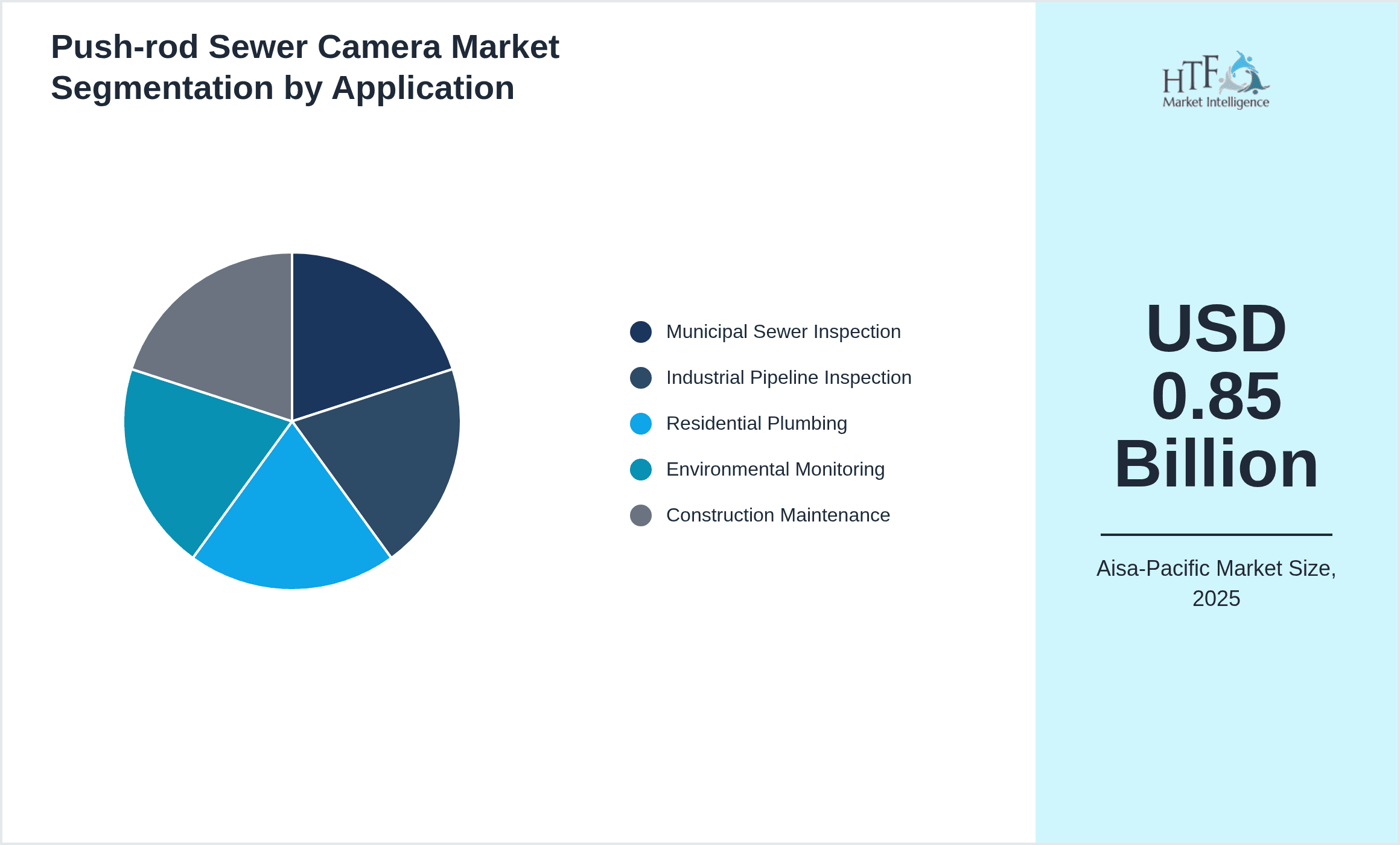
- •By Application
- ◦Municipal Sewer Inspection
- ◦Industrial Pipeline Inspection
- ◦Residential Plumbing
- ◦Environmental Monitoring
- ◦Construction Maintenance
- •By End User
- ◦Government Municipalities
- ◦Industrial Facilities
- ◦Residential Property Owners
- ◦Construction Companies
- •By Distribution Channel
- ◦Direct Sales
- ◦Third-Party Distributors
- ◦Online Retail
- ◦Rental Services
Growth Drivers
- •Rapid urbanization across Asia-Pacific is fueling demand for efficient sewer infrastructure maintenance, driving adoption of push-rod sewer cameras to reduce downtime and improve pipeline diagnostics.
- •Government investments in smart city projects and infrastructure modernization are accelerating deployment of advanced inspection technologies, boosting market growth.
- •Technological advancements such as high-definition imaging and wireless connectivity enhance the reliability and ease of sewer inspections, attracting industrial and municipal users.
- •Growing environmental concerns and stringent regulations on wastewater management encourage the use of non-invasive sewer inspection tools like push-rod cameras.
- •Rising awareness among residential property owners about pipeline health and leak detection is expanding the consumer base for push-rod sewer cameras.
Market Trends
- •Integration of AI and machine learning with push-rod sewer cameras to enable automated defect detection and predictive maintenance is becoming increasingly prevalent.
- •Wireless and robotic push-rod cameras are gaining traction due to their enhanced maneuverability and real-time data transmission capabilities.
- •Collaborations between camera manufacturers and municipal agencies for pilot projects in smart sewer monitoring are shaping market innovation.
- •Sustainability-driven initiatives are promoting the use of eco-friendly materials and energy-efficient camera designs in the industry.
- •The rise of rental and service-based models for sewer inspection equipment is providing flexible access to advanced cameras for smaller enterprises.
Market Opportunities
- •Expanding sewer infrastructure in emerging economies like India and Southeast Asia presents significant opportunities for market penetration and revenue growth.
- •Development of modular and customizable push-rod camera solutions tailored to specific industrial and municipal needs can capture niche market segments.
- •Integration with cloud-based monitoring platforms offers prospects for advanced analytics services and remote diagnostics.
- •Partnerships with construction and environmental agencies to embed inspection technologies in new projects can open long-term contracts.
- •Growing demand for wireless and robotic inspection systems provides avenues for product innovation and differentiation.
Market Challenges
- •High initial investment and maintenance costs for advanced push-rod sewer cameras can restrain adoption among smaller municipalities and contractors.
- •Technical challenges related to camera durability and navigation in complex sewer networks affect user confidence and market growth.
- •Regulatory uncertainties and varying standards across Asia-Pacific countries complicate compliance and market entry strategies.
- •Competition from alternative inspection methods, such as drone-based or robotic crawlers, poses substitution risks.
- •Limited skilled workforce for operating sophisticated inspection equipment restricts market expansion in certain regions.
Regulatory Framework
- •Between 2019 and 2024, several Asia-Pacific countries implemented wastewater management and pipeline safety regulations mandating periodic inspection using certified devices, directly impacting push-rod sewer camera demand.
- •China's recent environmental protection laws require enhanced sewer monitoring, prompting stricter compliance and adoption of high-precision inspection cameras.
- •India's Smart Cities Mission includes guidelines promoting digital infrastructure for sewer maintenance, facilitating push-rod camera usage in urban projects.
- •Japan and South Korea have updated standards for equipment safety and electromagnetic compatibility, influencing product design and certification processes.
- •Government incentives and subsidies for environmentally friendly technologies in Australia support investments in advanced sewer inspection equipment.
Market Intelligence
- •In March 2024, RIDGID launched a new wireless push-rod sewer camera model featuring enhanced battery life and real-time 4K video streaming, targeting urban municipalities in Asia-Pacific to improve sewer inspection efficiency and reduce maintenance downtime. This innovation aligns with increasing demand for mobility and high-resolution imaging in sewer diagnostics. Source: RIDGID Official Press Release.
- •In August 2023, Pioneer Inspection Service (China) introduced an AI-powered sewer camera system capable of automated defect recognition and cloud data integration, designed for industrial and municipal applications. This launch represents a strategic move to cater to smart city initiatives across Asia-Pacific, enhancing predictive maintenance capabilities. Source: Pioneer Inspection Service Corporate Announcement.
- •Recent market developments and strategic initiatives are continuously tracked through industry publications, company announcements, and regulatory filings. For the most current information, stakeholders are advised to monitor official corporate communications and recognized market intelligence platforms.
Mergers & Acquisitions
- •In February 2024, Minicam (UK) completed the acquisition of a leading Asia-Pacific digital push-rod camera manufacturer to expand its footprint in the region. This strategic deal enhances Minicam’s product portfolio with advanced wireless technology and strengthens its distribution network across key markets including China, India, and Southeast Asia, positioning the company for accelerated growth.
- •In November 2023, Teledyne Technologies (USA) acquired a regional robotic inspection solutions provider based in Japan, integrating cutting-edge robotic push-rod camera systems into its offerings. This acquisition aims to leverage Japan’s technological expertise and meet increasing demand for automated sewer inspections in Asia-Pacific urban centers.
Recent Industry News
- •On 15th January 2025, RIDGID announced a strategic partnership with Aqua-Tech (India) to distribute wireless push-rod sewer cameras across the Indian market, facilitating faster adoption of smart inspection technologies in municipal and industrial sectors. This collaboration is expected to accelerate market penetration and enhance after-sales support. Source: Industry Today.
- •On 3rd March 2025, Pioneer Inspection Service (China) expanded its manufacturing facility to increase production capacity of high-definition push-rod cameras, responding to growing demand from Southeast Asian infrastructure projects. The expansion includes integration of AI-driven quality control systems. Source: Manufacturing Weekly.
- •On 22nd May 2025, Minicam (UK) launched a rental service program in Australia offering flexible access to advanced push-rod sewer cameras, targeting construction and municipal clients with limited capital expenditure budgets. This initiative aims to broaden customer base and promote technology adoption. Source: Equipment Rental News.
- •On 10th July 2025, Teledyne Technologies unveiled a new robotic push-rod camera platform with enhanced navigation and 3D mapping capabilities, designed for complex sewer networks in urban Asia-Pacific areas. The product launch underscores the trend towards integrating robotics and digital mapping in sewer inspection. Source: Tech Industry Journal.
Regional Outlook
The China currently holds a significant share of the market, primarily due to several key factors: increasing consumption rates, a burgeoning population, and robust economic momentum. These elements collectively drive demand, positioning this region as a leader in the market. On the other hand, India is rapidly emerging as the fastest-growing area within the industry. This remarkable growth can be attributed to swift infrastructure development, the expansion of various industrial sectors, and a marked increase in consumer demand. These dynamics make this region a crucial player in shaping future market growth.
In our report, we cover a comprehensive analysis of the following regions and countries:
| Feature | Details |
|---|---|
| Base Year Market Size | USD 0.85 Billion |
| Forecast Year Market Size | USD 2.65 Billion |
| CAGR | 11.8% |
| Forecast Period | 2026 to 2033 |
| YoY Growth | 11.2% |
| Scope of Report | Market is segmented by Type (Standard Push-rod Camera, High-definition Push-rod Camera, Digital Push-rod Camera, Wireless Push-rod Camera, Robotic Push-rod Camera), Application (Municipal Sewer Inspection, Industrial Pipeline Inspection, Residential Plumbing, Environmental Monitoring, Construction Maintenance), End User (Government Municipalities, Industrial Facilities, Residential Property Owners, Construction Companies), Distribution Channel (Direct Sales, Third-Party Distributors, Online Retail, Rental Services) |
| Key Companies | RIDGID (United States), Pearpoint (United States), CUES Inc. (United States), Vivax-Metrotech (United States), Minicam (United Kingdom), IBAK Helmut Hunger GmbH & Co. KG (Germany), Envirosight (United States), Subsite Electronics (United States), Jetter Equipment (United States), SPYTEC (South Korea), Rausch Electronics (Germany), Nobi (Japan), Sewerin (Germany), CCTV Inspection Solutions (Australia), Teledyne Technologies (United States), Wisy AG (Germany), Pioneer Inspection Service (China), Yushin Precision Equipment (Japan), Hazen Equipment (China), Seeker Industries (Australia), Kawasaki Heavy Industries (Japan), Aqua-Tech (India), Metech Equipment (South Korea), Sewer Vision Solutions (China), Pipeline Inspection Co. (India) |
Asia-Pacific Push-rod Sewer Camera Market Size, Growth & Revenue 2024-2034 - Table of Contents
Frequently Asked Questions (FAQ):
The Compact Track Loaders market is expected to see value worth 5.3 Billion in 2025.
North America currently leads the market with approximately 45% market share, followed by Europe at 28% and Asia-Pacific at 22%. The remaining regions account for 5% of the global market.
Key growth drivers include increasing construction activities, rising demand for versatile equipment in agriculture, technological advancements in track loader design, and growing preference for compact equipment in urban construction projects.