
Europe Rubber Mixing Mill Market Size, Growth & Revenue 2024-2034
Europe Rubber Mixing Mill Market is segmented by Application (Automotive, Industrial Manufacturing, Construction, Consumer Goods, Electrical & Electronics), Type (Two-roll Mixing Mill, Open Mixing Mill, Internal Mixer, Continuous Mixer, Banbury Mixer), and Geography (Germany, France, The United Kingdom, BeNeLux, Spain, Italy, NORDIC, CEE, Others)
Pricing
Report Overview
Executive Summary
- •The Europe Rubber Mixing Mill market pertains to the machinery and equipment used for blending raw rubber with additives to produce uniform rubber compounds with desired physical and chemical properties. It includes various types such as two-roll mixing mills, open mixing mills, internal mixers, continuous mixers, and Banbury mixers, serving multiple end-use industries including automotive, industrial manufacturing, construction, consumer goods, and electrical & electronics. The market is defined by the integration of advanced technologies, focus on energy efficiency, and compliance with rigorous European quality and environmental standards, facilitating high-performance rubber products. Europe’s manufacturing hubs in Germany, France, UK, and neighboring countries form the core of this market, leveraging innovation and sustainability to address evolving industry requirements.
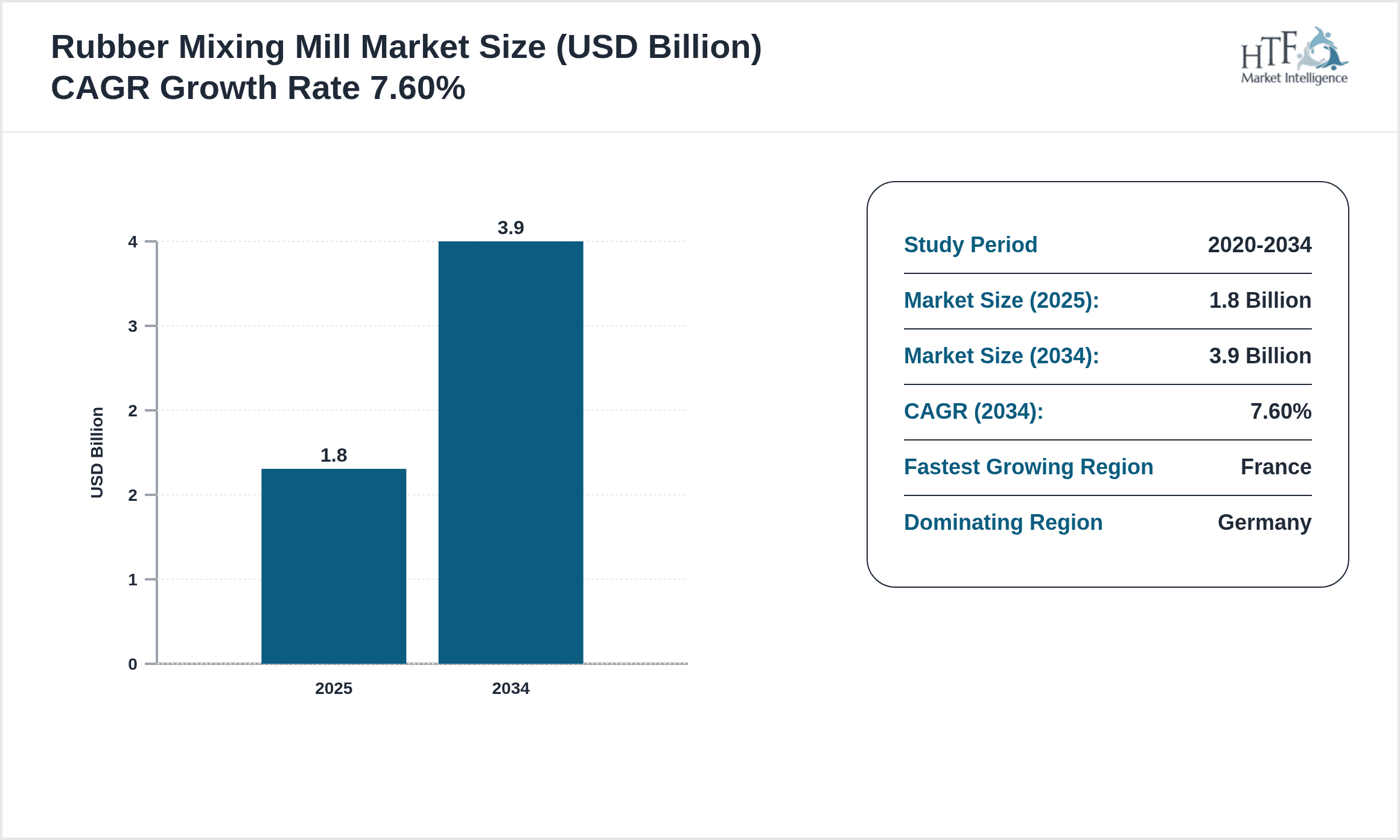
- •Key highlights include a growing demand driven by the automotive industry's expansion, increased industrial infrastructure developments, and rising consumer goods production requiring specialized rubber components. The market is projected to grow at a CAGR of 7.6% from USD 1.8 Billion in 2024 to USD 3.9 Billion by 2034, reflecting robust growth supported by technological advancements and strategic investments in manufacturing capabilities across Europe.
- •The market presents significant value propositions by enabling manufacturers to produce uniform, high-quality rubber compounds essential for durability and performance. This strategic importance extends to diverse sectors, enhancing product reliability, sustainability, and compliance with stringent regulations, thereby fostering competitive advantage and growth opportunities within Europe’s industrial ecosystem.
Competitive Landscape
The Europe Rubber Mixing Mill market is highly competitive with a diverse mix of global and regional players focusing on innovation, product differentiation, and strategic partnerships to enhance market position. Companies invest heavily in R&D to develop energy-efficient, automated, and digitally integrated mixing mills that meet Europe’s stringent quality and environmental standards. Competition is driven by technological leadership, customization capabilities, and after-sales service excellence. Market players adopt strategies such as collaborations, expansions, and acquisitions to consolidate their presence and expand product portfolios. The rivalry is intensified by the demand for sustainable solutions and the need to cater to multiple industry verticals, fostering continuous innovation and competitive pricing. Distribution networks and regional manufacturing hubs also play critical roles in shaping competitive dynamics, with Germany and France being central to market leadership and innovation deployment.
Leading Companies in Europe Rubber Mixing Mill Market
- •Buss AG (Germany)
- •Farrel Pomini (Italy)
- •Henschel Mischtechnik GmbH (Germany)
- •Rheavendors S.p.A. (Italy)
- •Winkler + Dünnebier GmbH (Germany)
- •KraussMaffei Berstorff GmbH (Germany)
- •Harburg-Freudenberger Maschinenbau GmbH (Germany)
- •Müller Group (Germany)
- •Mixaco Maschinenbau GmbH (Germany)
- •Ishigaki Europe GmbH (Germany)
- •Kobelco Machinery Europe B.V. (Netherlands)
- •FrymaKoruma GmbH (Germany)
- •Toyo Seikan Group Holdings (Germany)
- •Uhle GmbH (Germany)
- •Eirich Machines, Inc. (Germany)
- •Gneuss Kunststofftechnik GmbH (Germany)
- •Schenck Process Europe GmbH (Germany)
- •Leistritz AG (Germany)
- •Maag Group (Switzerland)
- •Netzsch Group (Germany)
- •Gebrüder Lödige Maschinenbau GmbH (Germany)
- •Zumbach Electronics AG (Switzerland)
- •Paul O. Abbe (Germany)
- •Wanner Engineering AG (Switzerland)
- •Hosokawa Alpine AG (Germany)
Market Breakdown
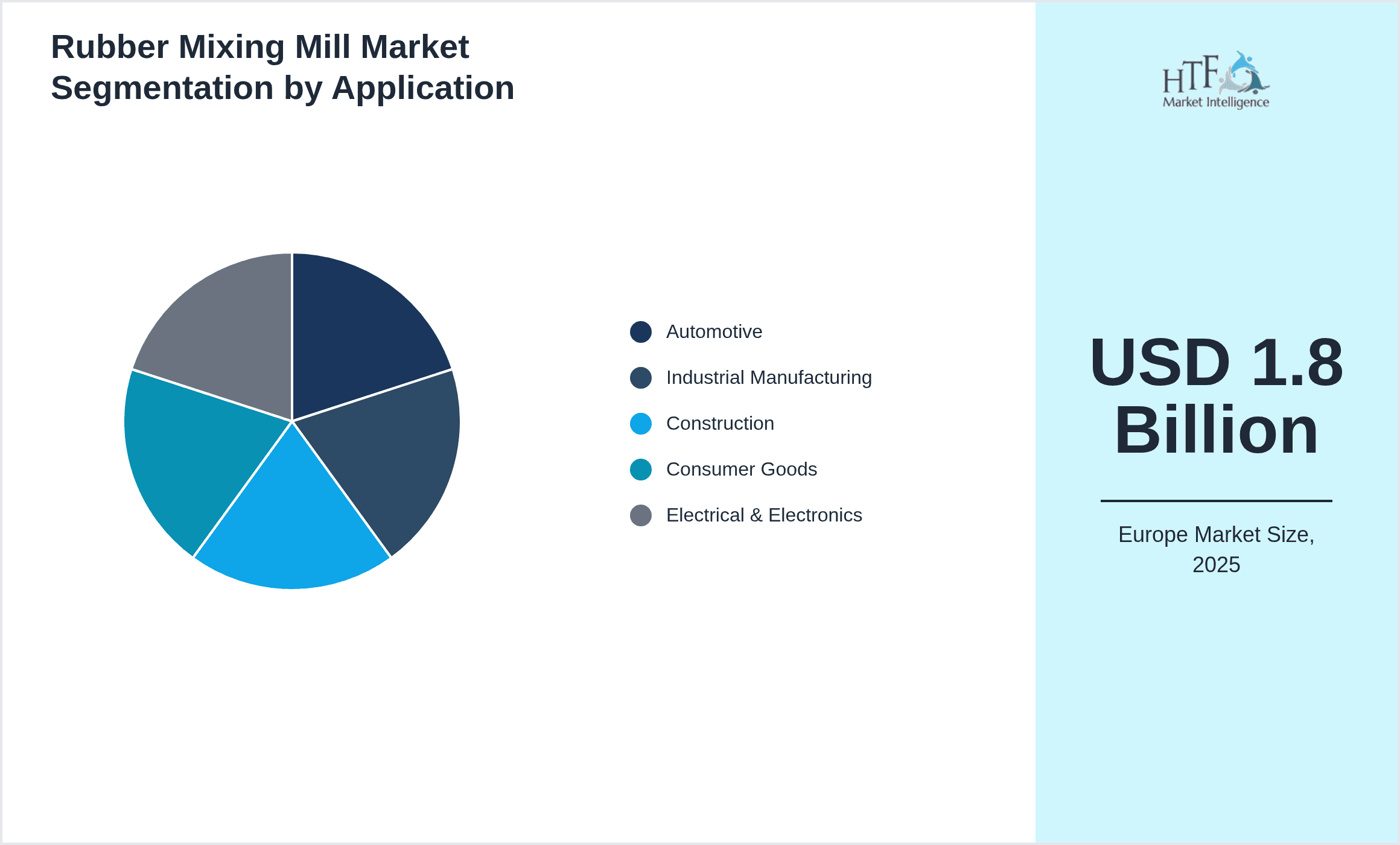
- •By Type
- ◦Two-roll Mixing Mill
- ◦Open Mixing Mill
- ◦Internal Mixer
- ◦Continuous Mixer
- ◦Banbury Mixer
- •By Application
- ◦Automotive
- ◦Industrial Manufacturing
- ◦Construction
- ◦Consumer Goods
- ◦Electrical & Electronics
- •By End User
- ◦OEM Manufacturers
- ◦Aftermarket Suppliers
- ◦Rubber Product Manufacturers
- ◦Contract Manufacturing
- •By Distribution Channel
- ◦Direct Sales
- ◦Distributors & Dealers
- ◦Online Platforms
Growth Drivers
The Europe Rubber Mixing Mill market is propelled by the expanding automotive sector requiring high-performance rubber components for tires, seals, and hoses. Increasing industrialization and infrastructure projects drive demand for durable rubber products, enhancing the need for efficient mixing technology. Technological advancements such as automation and digitalization improve mixing precision and reduce energy consumption, attracting manufacturers to upgrade equipment. Additionally, stringent European environmental regulations encourage the adoption of sustainable mixing mills with lower emissions and waste, fostering market growth. The rising demand for customized rubber compounds in consumer electronics and electrical appliances further stimulates investment in advanced mixing mills. These factors cumulatively create a robust demand environment, catalyzing market expansion across key European countries like Germany, France, and the UK.

Market Trends
The Europe Rubber Mixing Mill market exhibits a significant trend towards Industry 4.0 integration, with companies adopting IoT-enabled and AI-driven mixing mills to optimize process control and predictive maintenance. Sustainability is a major focus, leading to the development of energy-efficient mills that reduce carbon footprint and comply with EU green directives. There is also a growing preference for modular and compact designs that enhance operational flexibility and space efficiency in manufacturing plants. Collaborative innovation between mill manufacturers and end-users is increasing, enabling tailored solutions to meet specific compound requirements. Furthermore, digital platforms for equipment monitoring and remote troubleshooting are gaining traction, improving service efficiency and reducing downtime. These trends reflect the market’s evolution towards smarter, greener, and customer-centric solutions within Europe’s competitive landscape.
Market Restraints
High capital expenditure and maintenance costs associated with advanced rubber mixing mills pose significant barriers to market entry and expansion, especially for small and medium enterprises. The complexity of integrating new technologies such as automation and digitalization requires skilled labor, which is in limited supply across certain European regions, restricting adoption. Strict regulatory compliance necessitates continuous upgrades, increasing operational costs. Fluctuations in raw material prices, particularly rubber and additives, impact production economics and investment decisions. Additionally, competition from low-cost equipment manufacturers outside Europe challenges market growth by creating pricing pressures. These restraints collectively hinder rapid market penetration and slow down equipment modernization in some segments, necessitating strategic planning and investment to overcome these obstacles effectively.
Market Opportunities
Emerging opportunities in Europe’s electric vehicle and renewable energy sectors are driving demand for specialized rubber compounds, necessitating advanced mixing mill technologies capable of processing innovative materials. Expansion of aftermarket services and contract manufacturing offers scope for equipment leasing and retrofit services. The increasing adoption of sustainable manufacturing practices opens pathways for eco-friendly mixing solutions with reduced energy consumption and waste generation. Additionally, rising investments in smart factory initiatives and digital transformation provide opportunities for manufacturers to develop integrated, AI-powered mixing mills offering enhanced process control. The growing demand for customized rubber products in niche industrial applications such as medical devices and aerospace further broadens the market potential. These opportunities encourage innovation and diversification, positioning companies to capitalize on evolving industry needs across Europe.
Market Challenges
The Europe Rubber Mixing Mill market confronts challenges including technological obsolescence as rapidly evolving automation and digitalization require continuous investment in R&D. Supply chain disruptions, particularly in sourcing critical components and raw materials, affect production timelines and costs. Compliance with heterogeneous regulations across European countries adds complexity to product design and certification. Market fragmentation with numerous small-scale manufacturers creates pricing pressures and limits economies of scale. Skilled labor shortages hinder efficient operation and maintenance of advanced mixing mills. Additionally, the volatility of global rubber prices and geopolitical uncertainties pose risks to stable market growth. Navigating these challenges demands strategic foresight, collaboration, and investment in innovation and workforce development to sustain long-term competitiveness.
Regulatory Framework
Recent regulatory updates in Europe emphasize stringent environmental standards for manufacturing equipment, including rubber mixing mills, mandating reductions in energy consumption and emissions. The EU Eco-Design Directive enforces efficiency and sustainability criteria, influencing equipment design and operational practices. Compliance with REACH regulations requires manufacturers to ensure safe use and handling of chemicals during mixing processes. Noise and workplace safety directives necessitate enhanced protective features and ergonomic designs. Additionally, national regulations across countries such as Germany’s Federal Immission Control Act reinforce environmental compliance. These regulations collectively drive manufacturers to innovate greener, safer, and more efficient rubber mixing mills while ensuring adherence to evolving European legal frameworks.
Market Intelligence
In March 2023, Buss AG launched its latest two-roll mixing mill equipped with IoT-enabled sensors for real-time monitoring and predictive maintenance, enhancing operational efficiency and reducing downtime for European manufacturers. This innovation aligns with Industry 4.0 trends and supports sustainability goals by optimizing energy use and minimizing waste. In September 2024, Farrel Pomini announced a strategic partnership with a leading rubber compound producer to co-develop customized internal mixers tailored for electric vehicle tire manufacturing, addressing the growing demand for high-performance, eco-friendly rubber materials. These developments underscore the market’s focus on technological advancement and sector-specific solutions within Europe.
Mergers & Acquisitions
- •In July 2023, KraussMaffei Berstorff GmbH completed the acquisition of a specialized German rubber mixing technology firm, enhancing its product portfolio with advanced continuous mixers and expanding its footprint across Europe. This strategic acquisition enables the company to offer comprehensive mixing solutions for diverse industrial applications, strengthening its competitive position and accelerating innovation capabilities in line with growing market demand.
- •In November 2024, Henschel Mischtechnik GmbH merged with a leading Swiss compound machinery manufacturer, combining expertise to develop next-generation Banbury mixers with enhanced energy efficiency and digital integration. This merger fosters technological synergies and broadens market access throughout Europe, positioning the new entity as a formidable player in the rubber mixing mill market.
Recent Industry News
- •In May 2022, Winkler + Dünnebier GmbH expanded its manufacturing facility in Germany to increase production capacity of two-roll mixing mills, responding to rising demand from automotive and industrial sectors. The expansion includes integration of automated assembly lines and enhanced quality control systems, improving delivery timelines and product reliability. This move reinforces the company’s leadership in the European rubber mixing mill market. Source: Industry Weekly
- •In January 2023, Mixaco Maschinenbau GmbH introduced a modular internal mixer system featuring smart temperature control and adaptive mixing cycles, designed to optimize compound uniformity and reduce energy consumption. The innovation targets sustainable manufacturing initiatives and has received positive feedback from key European rubber manufacturers, signaling strong market acceptance. Source: Manufacturing Today
- •In August 2024, Müller Group announced a strategic collaboration with a French automotive parts manufacturer to co-develop continuous mixers optimized for electric vehicle component production. This partnership aims to accelerate the adoption of advanced rubber mixing technologies tailored to emerging EV market requirements, enhancing product performance and sustainability. Source: AutoTech News
- •In December 2021, IMA Europe GmbH launched a digital platform offering remote diagnostics and real-time process analytics for rubber mixing mills, enabling predictive maintenance and reducing operational costs for European customers. This platform integrates seamlessly with existing equipment, marking a significant step towards Industry 4.0 adoption in the rubber processing sector. Source: Tech Industry Journal
Market Statistics
- •CAGR by 2034: 7.6%
- •Market Size by 2034: USD 3.9 Billion
- •Market Size in 2025: USD 1.9 Billion
- •Dominating Type: Two-roll Mixing Mill
- •Next-Following Type: Internal Mixer
- •Dominating Application: Automotive
- •Next-Following Application: Industrial Manufacturing
- •Dominating Region: Germany
- •Second-Leading Region: France
- •Region with Highest Growth Rate: France
- •Dominating Country: Germany
Market Share Table
- •Market Share (%) of Dominating vs Followed Type: Two-roll Mixing Mill 40%, Internal Mixer 28%
- •Market Share (%) of Dominating vs Followed Application: Automotive 45%, Industrial Manufacturing 30%
- •Growth Rate (%) of Dominating vs Followed Type: Two-roll Mixing Mill 6.8%, Internal Mixer 9.2%
- •Growth Rate (%) of Dominating vs Followed Application: Automotive 7.0%, Industrial Manufacturing 8.1%
Top 5 Global Players
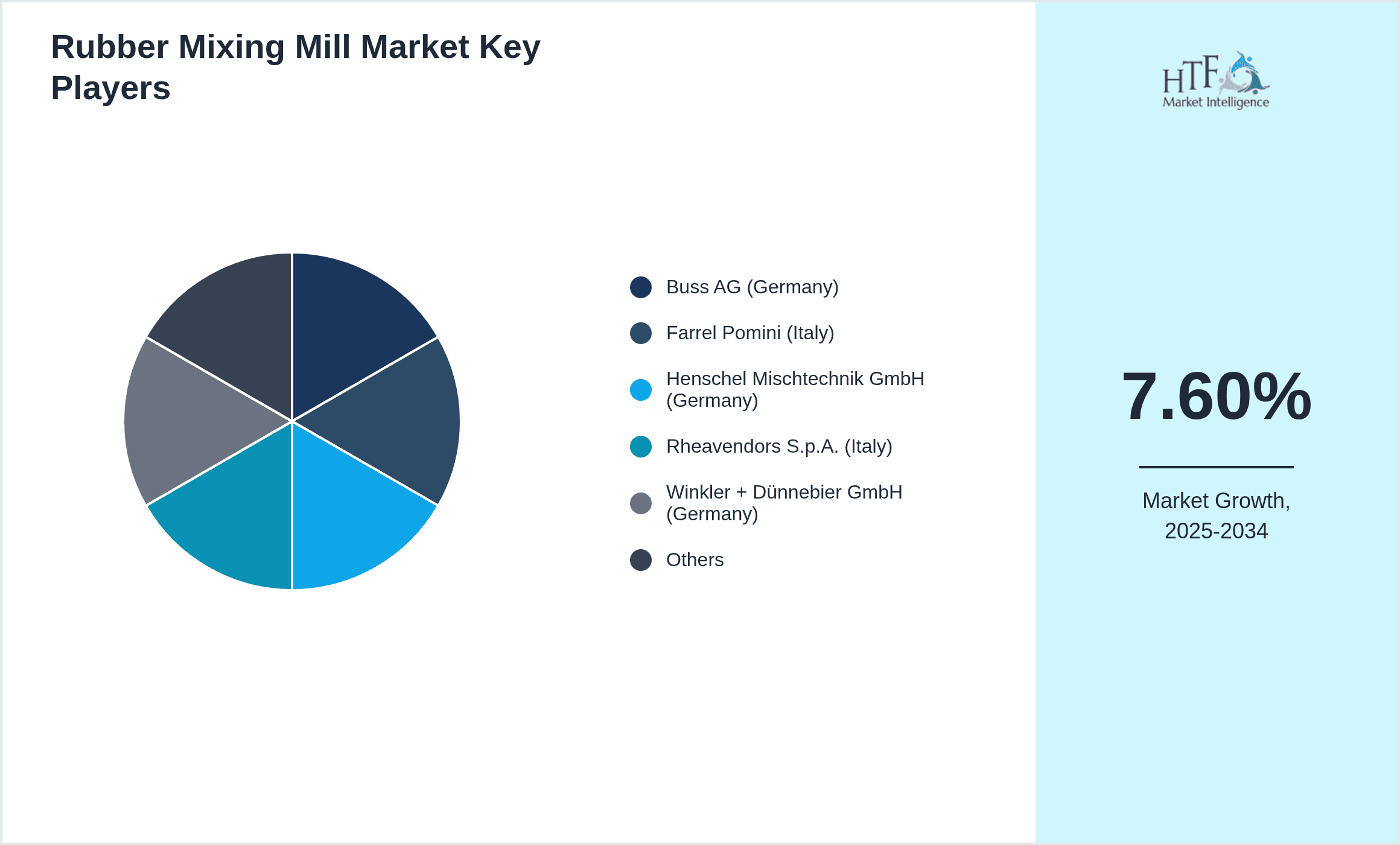
- •Buss AG (Germany)
- •Farrel Pomini (Italy)
- •Henschel Mischtechnik GmbH (Germany)
- •Rheavendors S.p.A. (Italy)
- •Winkler + Dünnebier GmbH (Germany)
Regional Outlook
The Germany currently holds a significant share of the market, primarily due to several key factors: increasing consumption rates, a burgeoning population, and robust economic momentum. These elements collectively drive demand, positioning this region as a leader in the market. On the other hand, France is rapidly emerging as the fastest-growing area within the industry. This remarkable growth can be attributed to swift infrastructure development, the expansion of various industrial sectors, and a marked increase in consumer demand. These dynamics make this region a crucial player in shaping future market growth.
In our report, we cover a comprehensive analysis of the following regions and countries:
- Germany
- France
- The United Kingdom
- BeNeLux
- Spain
- Italy
- NORDIC
- CEE
- Others
| Feature | Details |
|---|---|
| Base Year Market Size | USD 1.8 Billion |
| Forecast Year Market Size | USD 3.9 Billion |
| CAGR | 7.6% |
| Forecast Period | 2026 to 2033 |
| YoY Growth | 7.3% |
| Regions Covered | Germany, France, The United Kingdom, BeNeLux, Spain, Italy, NORDIC, CEE, Others |
| Key Companies | Buss AG (Germany), Farrel Pomini (Italy), Henschel Mischtechnik GmbH (Germany), Rheavendors S.p.A. (Italy), Winkler + Dünnebier GmbH (Germany), KraussMaffei Berstorff GmbH (Germany), Harburg-Freudenberger Maschinenbau GmbH (Germany), Müller Group (Germany), Mixaco Maschinenbau GmbH (Germany), Ishigaki Europe GmbH (Germany), Kobelco Machinery Europe B.V. (Netherlands), FrymaKoruma GmbH (Germany), Toyo Seikan Group Holdings (Germany), Uhle GmbH (Germany), Eirich Machines, Inc. (Germany), Gneuss Kunststofftechnik GmbH (Germany), Schenck Process Europe GmbH (Germany), Leistritz AG (Germany), Maag Group (Switzerland), Netzsch Group (Germany), Gebrüder Lödige Maschinenbau GmbH (Germany), Zumbach Electronics AG (Switzerland), Paul O. Abbe (Germany), Wanner Engineering AG (Switzerland), Hosokawa Alpine AG (Germany) |
Europe Rubber Mixing Mill Market Size, Growth & Revenue 2024-2034 - Table of Contents
Frequently Asked Questions (FAQ):
The Compact Track Loaders market is projected to grow at a CAGR of 6.8% from 2025 to 2030, driven by increasing demand in construction and agricultural sectors.
North America currently leads the market with approximately 45% market share, followed by Europe at 28% and Asia-Pacific at 22%. The remaining regions account for 5% of the global market.
Key growth drivers include increasing construction activities, rising demand for versatile equipment in agriculture, technological advancements in track loader design, and growing preference for compact equipment in urban construction projects.