
Asia-Pacific Special Optical Fiber for Communication Market Size, Growth & Revenue 2025-2034
Asia-Pacific Special Optical Fiber for Communication Market is segmented by Type (Single-mode Special Optical Fiber, Multimode Special Optical Fiber, Polarization Maintaining Fiber, Dispersion Compensating Fiber, Nonlinear Optical Fiber), Application (Telecommunication Networks, Data Centers, Military & Aerospace, Medical Imaging, Industrial Sensors), Deployment Model (Cloud-based Communication Infrastructure, On-premise Network Deployments, Hybrid Models), Service Type (Fiber Manufacturing, Installation & Maintenance Services, Testing & Certification Services, Consulting & System Integration), and Geography (Aisa-Pacific)
Pricing
Report Overview
Executive Summary
- •The Asia-Pacific Special Optical Fiber for Communication market includes advanced optical fibers such as single-mode, multimode, polarization maintaining, dispersion compensating, and nonlinear fibers used in telecommunication, data centers, military, medical, and industrial sensing applications. These fibers enhance signal quality, bandwidth, and transmission distance to meet the region's growing communication demands.
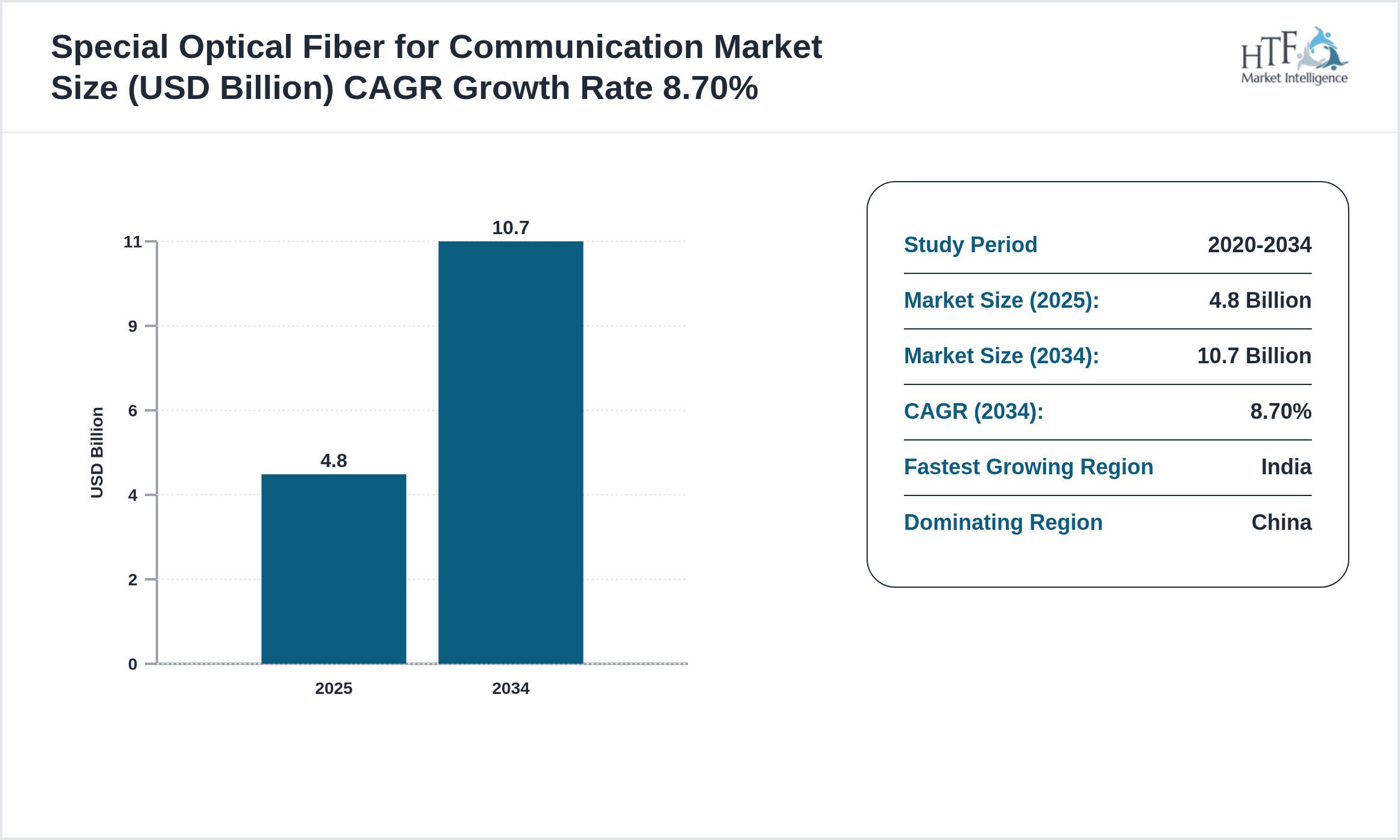
- •Key market drivers include rapid digital transformation, expansion of telecom infrastructure, increasing data center capacity, and rising defense and medical technology investments. The market forecast anticipates a robust CAGR of 8.7% from 2025 to 2034, growing from USD 4.8 billion in 2025 to USD 10.7 billion by 2034.
- •Asia-Pacific's diverse economic growth and technology adoption make special optical fibers critical for next-generation communication networks. The market offers strategic value for telecom operators, technology providers, government agencies, and industrial users seeking reliable, high-speed data transmission capabilities.
Competitive Landscape
The Asia-Pacific special optical fiber for communication market is characterized by intense competition among major global and regional players focusing on technological innovation, strategic partnerships, and capacity expansion. Leading companies leverage advanced R&D to develop fibers with superior performance characteristics such as low attenuation, enhanced bandwidth, and environmental robustness. Market participants pursue mergers and acquisitions, joint ventures, and collaborations to strengthen their product portfolios and expand geographic reach. Pricing strategies are influenced by raw material costs and demand fluctuations, while companies emphasize customization to meet specific application requirements. Distribution channels include direct sales, channel partners, and OEM alliances. Regional competition varies with China dominating production and India emerging as a high-growth market due to infrastructure investments. Future trends point to increased adoption of nonlinear and specialty fibers supporting 5G, IoT, and cloud computing, intensifying the competitive dynamics while driving innovation and market consolidation.
Leading Companies in Special Optical Fiber for Communication Market
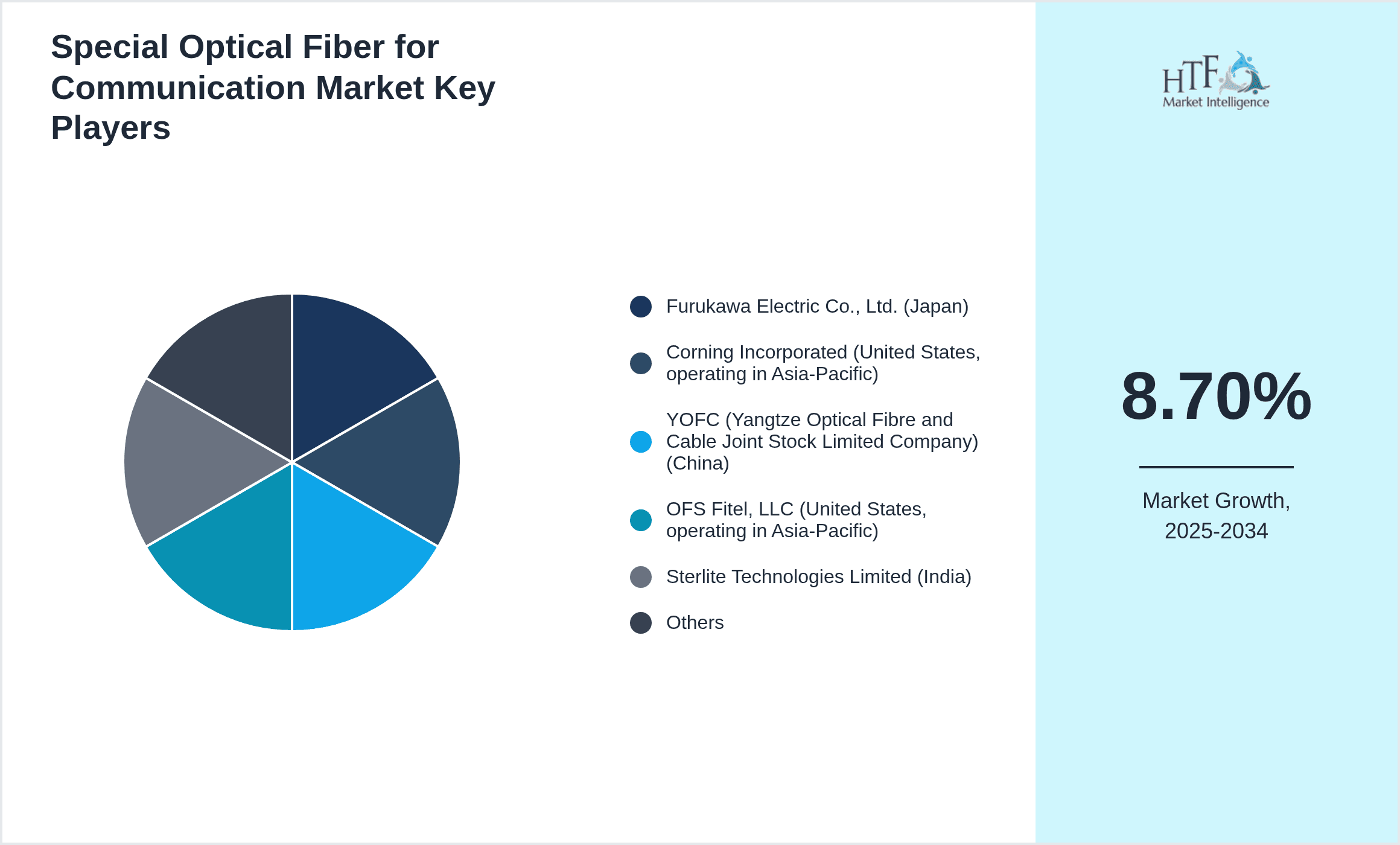
- •Furukawa Electric Co., Ltd. (Japan)
- •Corning Incorporated (United States, operating in Asia-Pacific)
- •YOFC (Yangtze Optical Fibre and Cable Joint Stock Limited Company) (China)
- •OFS Fitel, LLC (United States, operating in Asia-Pacific)
- •Sterlite Technologies Limited (India)
- •Sumitomo Electric Industries, Ltd. (Japan)
- •Furukawa Electric Co., Ltd. (Japan)
- •Hengtong Group Co., Ltd. (China)
- •Prysmian Group (Italy, operating in Asia-Pacific)
- •ZTT International Limited (China)
- •LS Cable & System Ltd. (South Korea)
- •Fujikura Ltd. (Japan)
- •Sumitomo Electric Industries (Japan)
- •Furukawa Electric Co. (Japan)
- •Hengtong Group (China)
- •Sterlite Technologies (India)
- •Corning Optical Communications (United States, Asia-Pacific operations)
- •Yangtze Optical Fibre and Cable (China)
- •OFS (United States, Asia-Pacific operations)
- •Fujikura Ltd. (Japan)
- •LS Cable & System (South Korea)
- •Prysmian Group (Italy, Asia-Pacific operations)
- •ZTT International (China)
- •Furukawa Electric Co., Ltd. (Japan)
- •Sterlite Technologies Limited (India)
Market Breakdown
- •By Type
- ◦Single-mode Special Optical Fiber
- ◦Multimode Special Optical Fiber
- ◦Polarization Maintaining Fiber
- ◦Dispersion Compensating Fiber
- ◦Nonlinear Optical Fiber
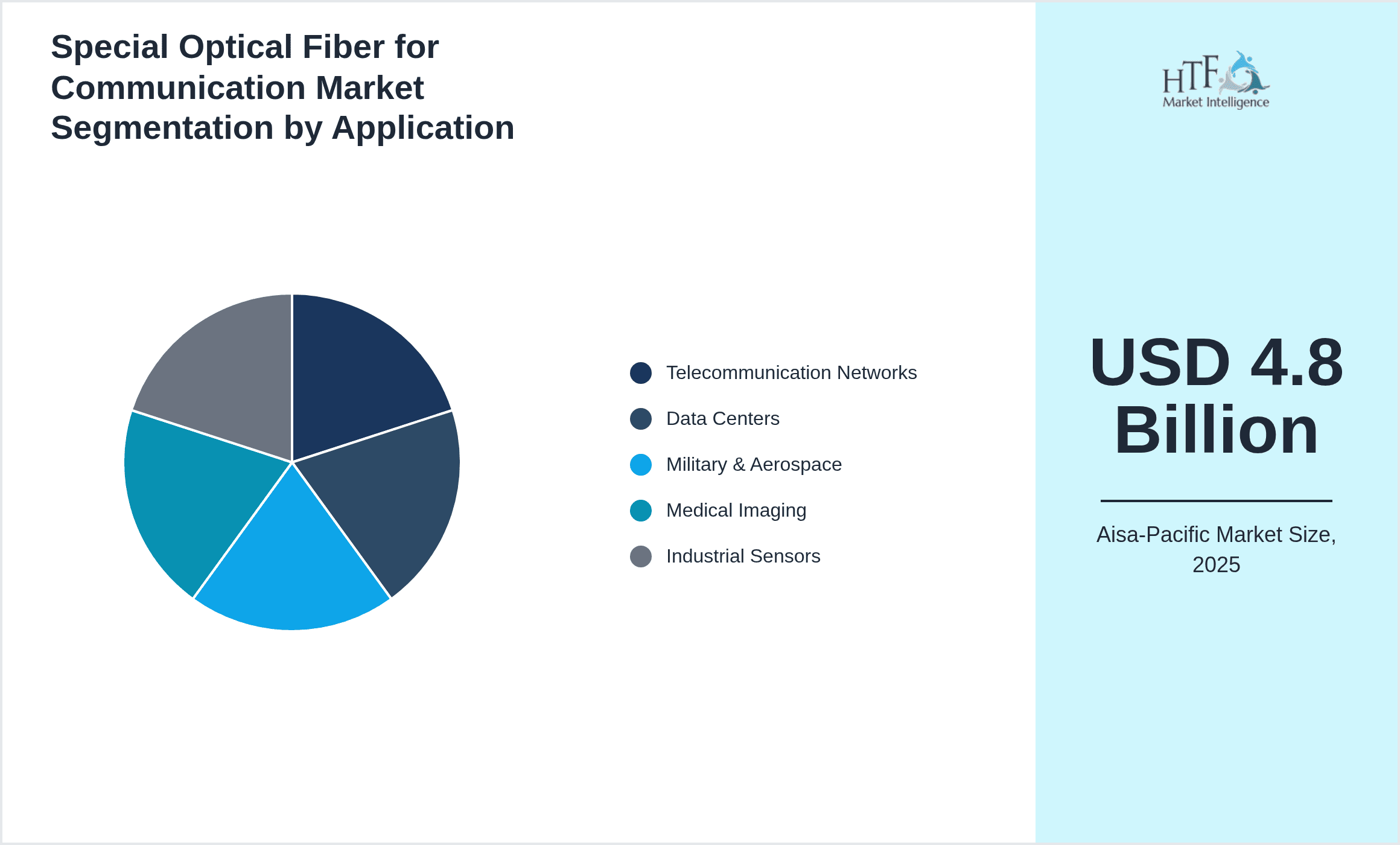
- •By Application
- ◦Telecommunication Networks
- ◦Data Centers
- ◦Military & Aerospace
- ◦Medical Imaging
- ◦Industrial Sensors
- •By Deployment Model
- ◦Cloud-based Communication Infrastructure
- ◦On-premise Network Deployments
- ◦Hybrid Models
- •By Service Type
- ◦Fiber Manufacturing
- ◦Installation & Maintenance Services
- ◦Testing & Certification Services
- ◦Consulting & System Integration
Growth Dynamics
The Asia-Pacific special optical fiber market is propelled by the rapid expansion of telecommunication infrastructure, including 5G and fiber-to-the-home (FTTH) deployments, which demand high-capacity, low-latency communication channels. Government initiatives in countries like China and India to improve digital connectivity are major growth drivers. Increased data consumption and cloud computing adoption fuel demand for advanced fibers in data centers. Military and aerospace sectors require specialized fibers for secure, high-performance communication, further boosting market growth. Technological advancements in fiber design enhance performance and reduce operational costs, attracting investments from telecom operators and enterprises. Regional economic growth and urbanization increase demand for reliable communication networks. The growing need for environmental robustness and bandwidth efficiency in optical fibers also drives innovation and market expansion in this region.

Market Trends
A significant trend in the Asia-Pacific special optical fiber market is the integration of nonlinear optical fibers to support high-capacity, long-distance communication with improved signal integrity. Adoption of polarization maintaining fibers is rising for applications requiring stable polarization states such as quantum communications and sensors. The market also witnesses increasing use of dispersion compensating fibers to address chromatic dispersion issues in ultra-high-speed networks. Growth in submarine cable deployments in the region supports the demand for specialized fibers with enhanced durability. Additionally, manufacturers focus on eco-friendly production processes and recyclable materials, aligning with sustainability trends. Collaborative innovation between fiber manufacturers and telecom operators is shaping market offerings, accelerating the deployment of next-generation communication networks.
Market Opportunities
Emerging opportunities in the Asia-Pacific special optical fiber market include expanding applications in the growing 5G infrastructure, where high-performance fibers are critical for backhaul and fronthaul networks. The rise of data centers in countries like India and Southeast Asia offers potential for specialized fibers that support high bandwidth and low latency. Defense modernization programs in the region present opportunities for fibers with enhanced security and environmental resistance. The increasing adoption of IoT and smart city projects creates demand for industrial sensor fibers capable of precise data transmission. Furthermore, innovation in nonlinear and polarization maintaining fibers opens new avenues in medical imaging and quantum communication technologies, driving diversified market growth.
Market Challenges
The Asia-Pacific special optical fiber market faces challenges such as high production costs due to complex manufacturing processes and expensive raw materials, impacting pricing competitiveness. Technical challenges in developing fibers with consistent quality and advanced properties limit rapid scalability. Regulatory complexities across different countries in the region create compliance hurdles for manufacturers and distributors. Market fragmentation with numerous small players results in intense competition, affecting profitability. Supply chain disruptions, including shortages of specialty glass and chemicals, pose risks to timely delivery. Additionally, rapid technological changes require continuous R&D investments, which may strain financial resources. Limited skilled workforce in specialized fiber manufacturing and installation further constrains market growth.
Regulatory Framework
Between 2020 and 2025, Asia-Pacific countries have implemented regulations focusing on telecommunications infrastructure quality and environmental safety to ensure reliable and sustainable deployment of optical fiber networks. China has enforced stringent standards for optical fiber manufacturing processes, including compliance with GB/T standards that regulate fiber attenuation and mechanical durability. India’s Department of Telecommunications mandates certification for fiber optic cables to uphold network security and performance, supported by Bureau of Indian Standards guidelines. Japan and South Korea emphasize environmental compliance under respective green manufacturing policies, restricting hazardous substances in fiber production. Regional trade agreements facilitate harmonization of quality standards, easing cross-border distribution. Regulatory bodies also promote the adoption of eco-friendly materials and recycling protocols in the optical fiber industry. These frameworks collectively enhance product safety, interoperability, and environmental responsibility across Asia-Pacific markets.
Market Intelligence
- •15th March 2025, YOFC (Yangtze Optical Fibre and Cable Joint Stock Limited Company) announced the launch of a new ultra-low loss single-mode special optical fiber designed for next-generation 5G and data center applications. The fiber features enhanced bandwidth and reduced signal attenuation enabling longer transmission distances without repeaters. This launch aligns with YOFC’s strategic focus on expanding its product portfolio to meet growing demand in the Asia-Pacific region, particularly in China and Southeast Asia. The company aims to strengthen its market leadership by catering to telecom operators upgrading network infrastructure. This innovation supports higher data throughput and energy efficiency, positioning YOFC competitively amid increasing regional digitalization. Source: YOFC Official Press Release
- •10th May 2025, Sterlite Technologies Limited unveiled its latest polarization maintaining special optical fiber optimized for quantum communication and aerospace applications. The product integrates advanced materials and proprietary fabrication techniques to improve polarization stability and environmental resistance. Sterlite’s initiative targets emerging defense and secure communication sectors in India and neighboring countries. This development underscores the company's commitment to technological leadership and diversification into high-growth niche markets. The fiber’s enhanced performance supports critical applications requiring precise signal control and integrity, contributing to Sterlite’s competitive positioning in the Asia-Pacific special optical fiber market. Source: Sterlite Technologies Corporate Announcement
- •Recent market developments and strategic initiatives are continuously tracked through industry publications, company announcements, and regulatory filings. For the most current information, stakeholders are advised to monitor official corporate communications and recognized market intelligence platforms.
Market Size & Growth Table for Asia-Pacific Special Optical Fiber for Communication
- •2025 Market Size: USD 4.8 Billion
- •2020 Market Size: USD 3.1 Billion
- •2034 Market Size: USD 10.7 Billion
- •CAGR: 8.7%
- •Year-on-Year Growth: 8.3%
Regional Performance Analysis
- •Dominating Country: China
- •Fastest Growing Country: India
Regional Analysis
The Asia-Pacific region dominates the special optical fiber market with China leading due to its massive telecommunications infrastructure investments, extensive fiber manufacturing capacity, and government support for digitalization. China’s focus on 5G rollout, smart city projects, and data center expansion drives demand for advanced optical fibers. India is the fastest growing country, propelled by increasing internet penetration, government initiatives like Digital India, and rising investments in telecom and data infrastructure. Japan, South Korea, and Southeast Asia also contribute significantly with strong technology adoption and industrial use cases. Variations in regulatory policies, economic development levels, and technology maturity across countries influence market dynamics. Regional integration through trade agreements facilitates supply chain efficiencies and market access. Emerging economies in Southeast Asia present growth potential driven by urbanization and digital transformation.
Market Entropy
The Asia-Pacific special optical fiber for communication market exhibits moderate entropy characterized by rapidly evolving technology, diverse regional demand, and competitive fragmentation. The presence of numerous manufacturers with varying capabilities results in heterogeneous product quality and innovation pace. Market uncertainty arises from fluctuating raw material costs, shifting regulatory requirements, and geopolitical tensions affecting supply chains. Technological disruptions such as the emergence of quantum communication fibers and nonlinear fibers increase complexity. Customer preferences vary widely across countries with different infrastructure needs and investment capacities. This dynamic environment requires companies to continuously adapt strategies, invest in R&D, and engage in partnerships to maintain market relevance. Market entropy also reflects in pricing volatility and uneven regional growth rates, demanding agile business models to capitalize on emerging opportunities while mitigating risks.
Investment and Funding Scenario
Recent years have seen increasing investments in the Asia-Pacific special optical fiber sector, supported by government funding programs and private capital influx. Strategic investments focus on scaling manufacturing capabilities, developing next-generation fiber technologies, and expanding R&D centers. Notable funding includes venture capital backing for startups innovating in nonlinear and quantum optical fibers, and corporate investments by leading players to upgrade production lines. Government initiatives in China and India promote infrastructure development with financial incentives encouraging foreign direct investment. The funding environment fosters collaborations between academia and industry, accelerating commercialization of novel fiber technologies. While exact 2025 merger and acquisition activities are currently limited, ongoing funding trends indicate a robust pipeline for future consolidation and innovation-driven growth.
Competitive Innovation Radar
Innovation in the Asia-Pacific special optical fiber market centers on enhancing fiber properties such as reduced attenuation, improved polarization maintenance, and dispersion control. Companies invest in advanced materials and fabrication techniques to enable fibers suitable for emerging applications like quantum communications, high-speed data centers, and harsh environmental conditions. Collaborative R&D projects between industry leaders and research institutions drive breakthroughs in nonlinear fibers and eco-friendly manufacturing processes. Innovations also include integration of fibers with optical amplifiers and sensors for industrial automation and defense sectors. The competitive landscape rewards rapid prototyping and customization capabilities, with firms leveraging intellectual property portfolios to secure market share. Continuous innovation is pivotal to addressing evolving customer requirements and sustaining growth amid increasing competition.
Regional Outlook
The China currently holds a significant share of the market, primarily due to several key factors: increasing consumption rates, a burgeoning population, and robust economic momentum. These elements collectively drive demand, positioning this region as a leader in the market. On the other hand, India is rapidly emerging as the fastest-growing area within the industry. This remarkable growth can be attributed to swift infrastructure development, the expansion of various industrial sectors, and a marked increase in consumer demand. These dynamics make this region a crucial player in shaping future market growth.
In our report, we cover a comprehensive analysis of the following regions and countries:
| Feature | Details |
|---|---|
| Base Year Market Size | USD 4.8 Billion |
| Forecast Year Market Size | USD 10.7 Billion |
| CAGR | 8.7% |
| Forecast Period | 2026 to 2033 |
| YoY Growth | 8.3% |
| Scope of Report | Market is segmented by Type (Single-mode Special Optical Fiber, Multimode Special Optical Fiber, Polarization Maintaining Fiber, Dispersion Compensating Fiber, Nonlinear Optical Fiber), Application (Telecommunication Networks, Data Centers, Military & Aerospace, Medical Imaging, Industrial Sensors), Deployment Model (Cloud-based Communication Infrastructure, On-premise Network Deployments, Hybrid Models), Service Type (Fiber Manufacturing, Installation & Maintenance Services, Testing & Certification Services, Consulting & System Integration) |
| Key Companies | Furukawa Electric Co., Ltd. (Japan), Corning Incorporated (United States, operating in Asia-Pacific), YOFC (Yangtze Optical Fibre and Cable Joint Stock Limited Company) (China), OFS Fitel, LLC (United States, operating in Asia-Pacific), Sterlite Technologies Limited (India), Sumitomo Electric Industries, Ltd. (Japan), Furukawa Electric Co., Ltd. (Japan), Hengtong Group Co., Ltd. (China), Prysmian Group (Italy, operating in Asia-Pacific), ZTT International Limited (China), LS Cable & System Ltd. (South Korea), Fujikura Ltd. (Japan), Sumitomo Electric Industries (Japan), Furukawa Electric Co. (Japan), Hengtong Group (China), Sterlite Technologies (India), Corning Optical Communications (United States, Asia-Pacific operations), Yangtze Optical Fibre and Cable (China), OFS (United States, Asia-Pacific operations), Fujikura Ltd. (Japan), LS Cable & System (South Korea), Prysmian Group (Italy, Asia-Pacific operations), ZTT International (China), Furukawa Electric Co., Ltd. (Japan), Sterlite Technologies Limited (India) |
Asia-Pacific Special Optical Fiber for Communication Market Size, Growth & Revenue 2025-2034 - Table of Contents
Frequently Asked Questions (FAQ):
The Compact Track Loaders market is projected to grow at a CAGR of 6.8% from 2025 to 2030, driven by increasing demand in construction and agricultural sectors.
North America currently leads the market with approximately 45% market share, followed by Europe at 28% and Asia-Pacific at 22%. The remaining regions account for 5% of the global market.
Key growth drivers include increasing construction activities, rising demand for versatile equipment in agriculture, technological advancements in track loader design, and growing preference for compact equipment in urban construction projects.