
Japan Hole Transport Layer Materials for OLED Market - Japan Size & Outlook 2025-2034
Japan Hole Transport Layer Materials for OLED Market is segmented by Type (Polymeric HTL Materials, Small Molecule HTL Materials, Hybrid HTL Materials, Dopant-free HTL Materials, Conductive Polymers), Application (Smartphones, Televisions, Wearable Devices, Lighting, Automotive Displays), End User (Consumer Electronics Manufacturers, Automotive OEMs, Lighting Solution Providers, Wearable Device Manufacturers), Distribution Channel (Direct Sales, Distributors, Online Platforms), and Geography (Hokkaido, Tohoku, Kanto, Chubu, Kansai, Chugoku, Shikoku, Kyushu)
Pricing
Report Overview
Executive Summary
- •The Japan Hole Transport Layer (HTL) Materials for OLED market includes materials designed to facilitate efficient hole transport in OLED devices, enhancing performance and durability across various electronic applications such as smartphones, TVs, and automotive displays.
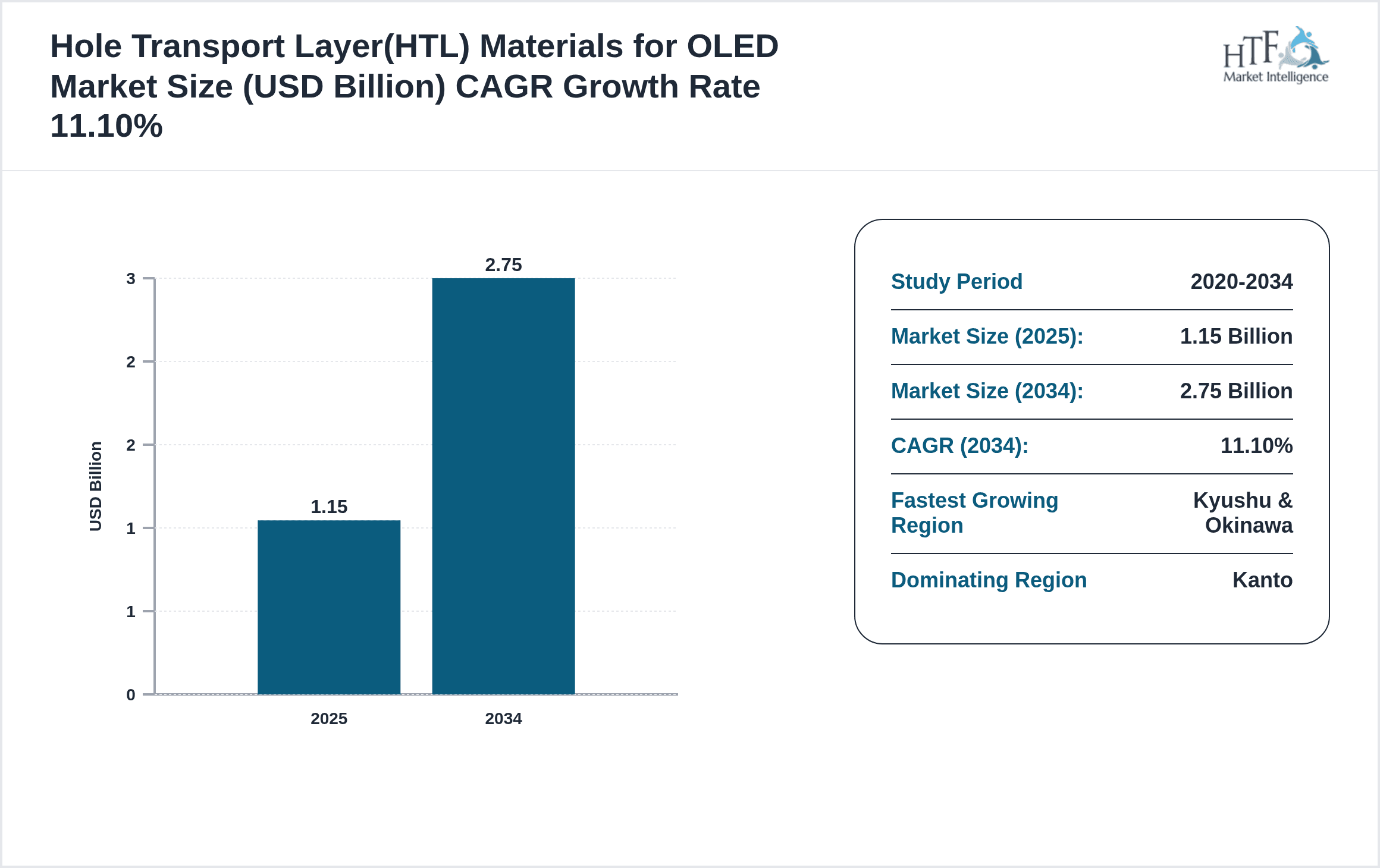
- •Key market highlights include a base market size of USD 1.15 Billion in 2025 with a projected CAGR of 11.1% through 2034, driven by increasing OLED adoption in consumer electronics and automotive sectors within Japan.
- •The market’s strategic importance lies in supporting Japan's advanced OLED manufacturing ecosystem, fostering innovation in display technologies, and meeting growing demand for energy-efficient, high-performance OLED devices.
Competitive Landscape
The Japan Hole Transport Layer Materials for OLED market is characterized by intense competition among domestic and international material manufacturers, focusing on innovation in polymeric and small molecule HTL materials to enhance OLED efficiency. Companies employ advanced R&D, strategic collaborations, and integration of dopant-free technologies to differentiate their product offerings. Market rivalry is intensified by the rapid adoption of OLED displays in consumer electronics and automotive sectors, compelling firms to continually improve material performance and cost-effectiveness. The competitive landscape also features partnerships with OLED panel manufacturers to customize HTL materials for specific applications, strengthening market positioning. Regional players leverage proximity to key OLED display fabricators in the Kanto and Kansai regions to maintain supply chain agility and reinforce competitive advantage.
Prominent Players in Japan Hole Transport Layer Materials for OLED Market
- •Sumitomo Chemical Co., Ltd. (Japan)
- •DIC Corporation (Japan)
- •JNC Corporation (Japan)
- •Idemitsu Kosan Co., Ltd. (Japan)
- •Mitsubishi Chemical Corporation (Japan)
- •AGC Inc. (Japan)
- •Taiyo Nippon Sanso Corporation (Japan)
- •Tokuyama Corporation (Japan)
- •Novaled GmbH (Germany)
- •Universal Display Corporation (United States)
- •LG Chem Ltd. (South Korea)
- •Merck KGaA (Germany)
- •Evonik Industries AG (Germany)
- •Beijing Beida Jade Bird Universal Sci-Tech Co., Ltd. (China)
- •BOE Technology Group Co., Ltd. (China)
- •Samsung SDI Co., Ltd. (South Korea)
- •Umicore (Belgium)
- •Heliatek GmbH (Germany)
- •Korea Kumho Petrochemical Co., Ltd. (South Korea)
- •Evonik Corporation (United States)
- •Asahi Kasei Corporation (Japan)
- •Hanwha Solutions Corporation (South Korea)
- •Clariant AG (Switzerland)
- •Sumitomo Bakelite Co., Ltd. (Japan)
- •Dai Nippon Printing Co., Ltd. (Japan)

Market Breakdown
- •By Type
- ◦Polymeric HTL Materials
- ◦Small Molecule HTL Materials
- ◦Hybrid HTL Materials
- ◦Dopant-free HTL Materials
- ◦Conductive Polymers
- •By Application
- ◦Smartphones
- ◦Televisions
- ◦Wearable Devices
- ◦Lighting
- ◦Automotive Displays
- •By End User
- ◦Consumer Electronics Manufacturers
- ◦Automotive OEMs
- ◦Lighting Solution Providers
- ◦Wearable Device Manufacturers
- •By Distribution Channel
- ◦Direct Sales
- ◦Distributors
- ◦Online Platforms
Growth Drivers
- •Rising adoption of OLED technology in smartphones and televisions within Japan is accelerating demand for advanced HTL materials that enhance device efficiency and longevity, supporting market expansion.
- •Government initiatives promoting energy-efficient and sustainable display technologies are encouraging manufacturers to invest in innovative HTL materials that reduce power consumption in OLED devices.
- •Technological advancements in dopant-free and hybrid HTL materials are improving charge transport properties, attracting OEMs focused on higher performance and cost-effective OLED solutions.
- •Growing automotive display applications in Japan, especially in luxury and electric vehicles, are creating new avenues for HTL materials tailored to ruggedness and flexible display requirements.
- •Strategic collaborations between HTL material manufacturers and OLED panel producers in Japan are accelerating product innovation and commercialization, driving market growth.

Market Trends
- •Shift towards dopant-free HTL materials is gaining momentum due to their simplified fabrication processes and enhanced stability, reflecting a significant trend in Japan’s OLED materials market.
- •Integration of flexible and transparent HTL materials aligns with the rising demand for foldable smartphones and wearable displays in Japan, pushing material innovation.
- •Sustainability considerations are influencing manufacturers to develop eco-friendly HTL materials with reduced environmental impact during production and disposal.
- •Increased investment in R&D by Japanese chemical companies is fostering next-generation HTL materials with superior charge mobility and thermal stability.
- •Adoption of hybrid HTL materials combining polymeric and small molecule properties is broadening application horizons and enhancing device performance.

Market Opportunities
- •Expanding OLED display production in Japan offers significant growth potential for HTL material suppliers to capture rising demand in consumer electronics and automotive sectors.
- •Emerging applications in flexible and wearable OLED devices provide opportunities for innovative HTL materials designed for mechanical flexibility and durability.
- •Collaborative R&D ventures between material manufacturers and display fabricators can accelerate commercialization of next-gen HTL materials with enhanced performance metrics.
- •Increasing exports of Japanese OLED panels to global markets open avenues for HTL material producers to expand beyond domestic demand.
- •Government subsidies for advanced materials research encourage investments in environmentally sustainable and energy-efficient HTL solutions.
Market Challenges
- •High production costs and complex synthesis processes of advanced HTL materials limit widespread adoption, posing a significant barrier to market growth in Japan.
- •Stringent environmental regulations and safety standards challenge manufacturers to develop compliant HTL materials without compromising performance.
- •Intense competition from alternative charge transport materials and emerging technologies creates pressure on HTL material suppliers to continuously innovate.
- •Supply chain disruptions affecting raw material availability can delay production cycles and increase costs for HTL material manufacturers.
- •Limited scalability of novel HTL materials from laboratory to mass production hinders rapid commercialization and market penetration.
Regulatory Framework
- •Between 2020 and 2025, Japan implemented stricter chemical substance control laws requiring HTL material manufacturers to comply with enhanced safety and environmental standards, impacting production protocols.
- •The Ministry of Economy, Trade and Industry (METI) mandates eco-labeling for OLED components, encouraging manufacturers to adopt sustainable HTL materials and reduce hazardous substance use.
- •Recent amendments to the Chemical Substances Control Law (CSCL) enforce rigorous testing and reporting for new HTL material compounds, ensuring safer commercialization.
- •Regulations promoting energy-saving technologies incentivize development of HTL materials that enhance OLED device efficiency and reduce power consumption.
- •Japan’s environmental policies align with global standards such as RoHS and REACH, compelling HTL material producers to maintain compliance for export markets.
Industry Insights
- •In March 2024, Sumitomo Chemical launched a new series of dopant-free HTL materials designed to improve OLED device stability and manufacturing efficiency. This innovation supports Japan’s leadership in flexible OLED displays and reduces production complexity, catering to rising demand in smartphones and wearable devices. The company’s strategic focus on eco-friendly and high-performance materials aligns with market trends towards sustainability and enhanced device longevity.
- •In November 2023, Mitsubishi Chemical Corporation announced a collaborative development project with leading OLED panel manufacturers in Kanto to produce hybrid HTL materials optimized for automotive display applications. This initiative aims to address stringent automotive industry requirements for durability and energy efficiency, opening new growth avenues in Japan’s expanding automotive OLED segment.
Mergers & Acquisitions
- •In August 2024, DIC Corporation acquired a majority stake in a specialized HTL materials startup based in Osaka, aiming to strengthen its OLED materials portfolio and accelerate innovation in polymeric and dopant-free HTL products. This acquisition is expected to enhance DIC’s competitive position within Japan’s OLED supply chain by integrating advanced R&D capabilities and expanding manufacturing capacity.
- •In February 2023, JNC Corporation completed the acquisition of a domestic small molecule HTL materials producer to diversify its product offerings and consolidate its market presence. This strategic move enables JNC to leverage synergies in production technology and customer networks, reinforcing its leadership in Japan’s HTL materials market for OLED devices.
Recent Industry News
- •15th January 2025, Sumitomo Chemical announced the commercial launch of its next-generation polymeric HTL material, featuring enhanced thermal stability and charge mobility. This product targets OLED smartphone manufacturers seeking longer device lifespans and improved energy efficiency. The launch is anticipated to catalyze adoption in Japan’s consumer electronics market, supporting increased OLED display penetration. Source: Sumitomo Chemical Official Release.
- •27th March 2025, Mitsubishi Chemical Corporation expanded its OLED materials manufacturing facility in the Chubu region to meet rising domestic and export demand. The expansion includes state-of-the-art synthesis equipment to produce dopant-free and hybrid HTL materials at scale, positioning the company for leadership in Asia. Source: Mitsubishi Chemical Press Statement.
- •5th June 2025, JNC Corporation entered into a strategic partnership with a leading Japanese automotive OEM to co-develop HTL materials tailored for flexible automotive OLED displays. The collaboration focuses on enhancing durability and reducing production costs, aiming to address growing requirements in electric and autonomous vehicles. Source: JNC Corporation News.
- •18th September 2025, DIC Corporation launched an eco-friendly conductive polymer HTL material compliant with Japan’s latest environmental regulations. The material offers improved charge transport while reducing hazardous chemical usage, aligning with global sustainability trends and expanding applications in wearable devices. Source: DIC Corporation Press Release.
Regional Outlook
The Kanto currently holds a significant share of the market, primarily due to several key factors: increasing consumption rates, a burgeoning population, and robust economic momentum. These elements collectively drive demand, positioning this region as a leader in the market. On the other hand, Kyushu & Okinawa is rapidly emerging as the fastest-growing area within the industry. This remarkable growth can be attributed to swift infrastructure development, the expansion of various industrial sectors, and a marked increase in consumer demand. These dynamics make this region a crucial player in shaping future market growth.
In our report, we cover a comprehensive analysis of the following regions and countries:
- Hokkaido
- Tohoku
- Kanto
- Chubu
- Kansai
- Chugoku
- Shikoku
- Kyushu
| Feature | Details |
|---|---|
| Base Year Market Size | USD 1.15 Billion |
| Forecast Year Market Size | USD 2.75 Billion |
| CAGR | 11.1% |
| Forecast Period | 2026 to 2033 |
| YoY Growth | 11.1% |
| Scope of Report | Market is segmented by Type (Polymeric HTL Materials, Small Molecule HTL Materials, Hybrid HTL Materials, Dopant-free HTL Materials, Conductive Polymers), Application (Smartphones, Televisions, Wearable Devices, Lighting, Automotive Displays), End User (Consumer Electronics Manufacturers, Automotive OEMs, Lighting Solution Providers, Wearable Device Manufacturers), Distribution Channel (Direct Sales, Distributors, Online Platforms) |
| Regions Covered | Hokkaido, Tohoku, Kanto, Chubu, Kansai, Chugoku, Shikoku, Kyushu |
| Key Companies | Sumitomo Chemical Co., Ltd. (Japan), DIC Corporation (Japan), JNC Corporation (Japan), Idemitsu Kosan Co., Ltd. (Japan), Mitsubishi Chemical Corporation (Japan), AGC Inc. (Japan), Taiyo Nippon Sanso Corporation (Japan), Tokuyama Corporation (Japan), Novaled GmbH (Germany), Universal Display Corporation (United States), LG Chem Ltd. (South Korea), Merck KGaA (Germany), Evonik Industries AG (Germany), Beijing Beida Jade Bird Universal Sci-Tech Co., Ltd. (China), BOE Technology Group Co., Ltd. (China), Samsung SDI Co., Ltd. (South Korea), Umicore (Belgium), Heliatek GmbH (Germany), Korea Kumho Petrochemical Co., Ltd. (South Korea), Evonik Corporation (United States), Asahi Kasei Corporation (Japan), Hanwha Solutions Corporation (South Korea), Clariant AG (Switzerland), Sumitomo Bakelite Co., Ltd. (Japan), Dai Nippon Printing Co., Ltd. (Japan) |
Japan Hole Transport Layer Materials for OLED Market - Japan Size & Outlook 2025-2034 - Table of Contents
Frequently Asked Questions (FAQ):
The Compact Track Loaders market is projected to grow at a CAGR of 6.8% from 2025 to 2030, driven by increasing demand in construction and agricultural sectors.
North America currently leads the market with approximately 45% market share, followed by Europe at 28% and Asia-Pacific at 22%. The remaining regions account for 5% of the global market.
Key growth drivers include increasing construction activities, rising demand for versatile equipment in agriculture, technological advancements in track loader design, and growing preference for compact equipment in urban construction projects.