
EMEA Plastic Household Item Market Size, Growth & Revenue 2024-2034
EMEA Plastic Household Item Market is segmented by Type (Polypropylene (PP), Polyethylene (PE), Polyvinyl Chloride (PVC), Acrylonitrile Butadiene Styrene (ABS), Polystyrene (PS)), Application (Kitchenware, Storage Solutions, Cleaning Tools, Decorative Items, Bathroom Accessories), Distribution Channel (Supermarkets & Hypermarkets, Specialty Retailers, Online Retail, Wholesale Distributors), End User (Residential Households, Commercial Establishments, Hospitality Sector, Institutional Users), and Geography (Germany, France, Italy, United Kingdom, Nordics, Rest of Europe, South Africa, Egypt, Turkey, United Arab Emirates, Israel, Saudi Arabia, Rest of EMEA)
Pricing
Report Overview
Executive Summary
- •The EMEA Plastic Household Item market includes diverse consumer plastic products for kitchenware, storage, cleaning, decorative, and bathroom uses, emphasizing durability and affordability while responding to sustainability demands.
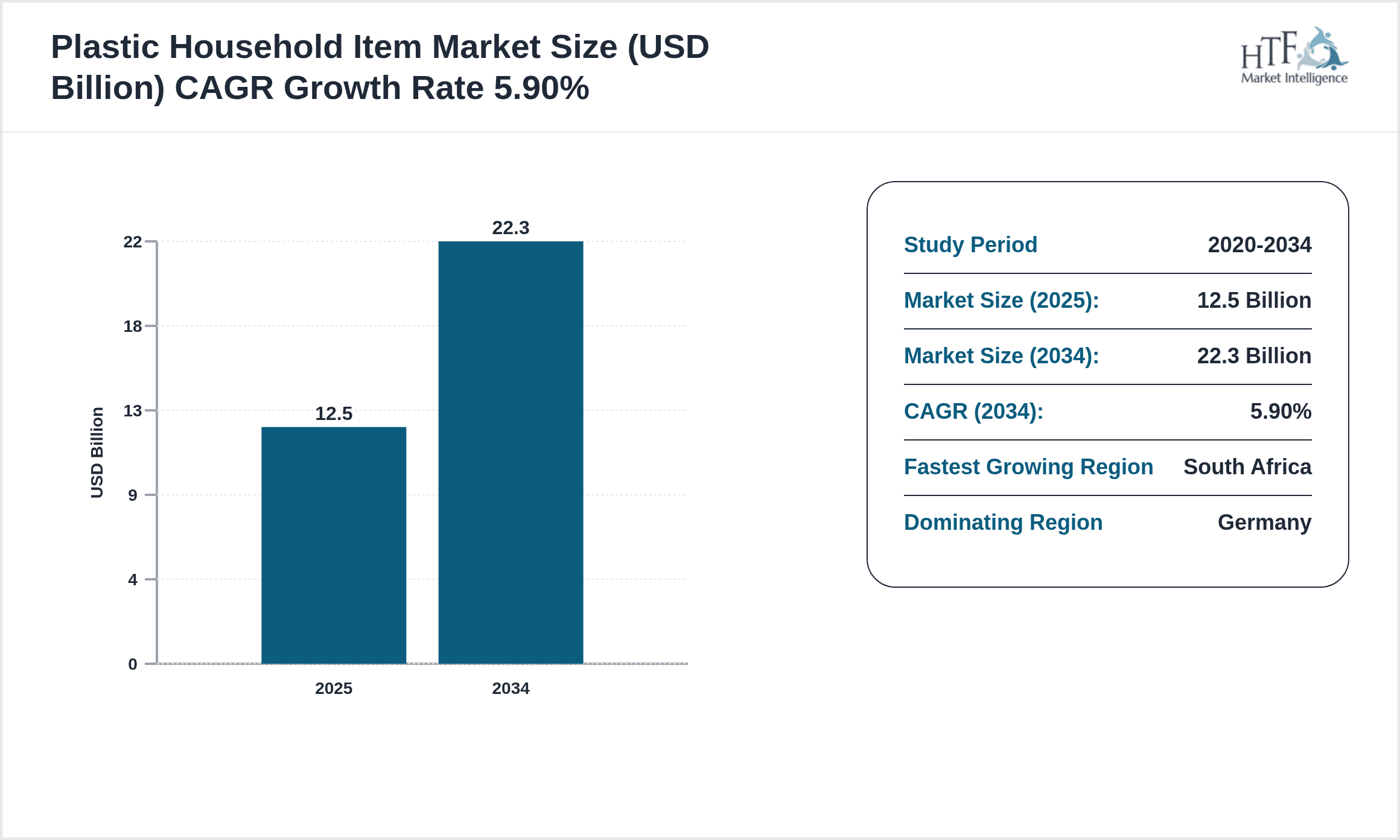
- •Key highlight: The market size is estimated at USD 12.5 Billion in 2024 and projected to reach USD 22.3 Billion by 2034, growing at a CAGR of 5.9%. Polypropylene leads product types, while kitchenware dominates applications.
- •The market's value proposition lies in providing practical, lightweight, and cost-efficient household solutions that align with consumer lifestyle trends and regulatory frameworks across diverse EMEA regions.
Competitive Landscape
Competition in the EMEA Plastic Household Item market is intense, characterized by numerous global and regional players striving for innovation in material technology and design. Market leaders invest heavily in sustainable product development and eco-friendly manufacturing to meet tightening environmental regulations. Rivalry centers on product differentiation, pricing strategies, and expanding distribution networks across Europe, the Middle East, and Africa. Companies leverage strategic partnerships and acquisitions to enhance market presence and operational efficiencies. Innovation focuses on biodegradable plastics and multifunctional household items, while branding efforts emphasize quality and sustainability. Market entry barriers include compliance with strict regional regulations and the need for robust supply chains. Overall, competition fosters continuous advancement and regional adaptation, shaping the market’s evolution.
Leading Companies in Plastic Household Item Market
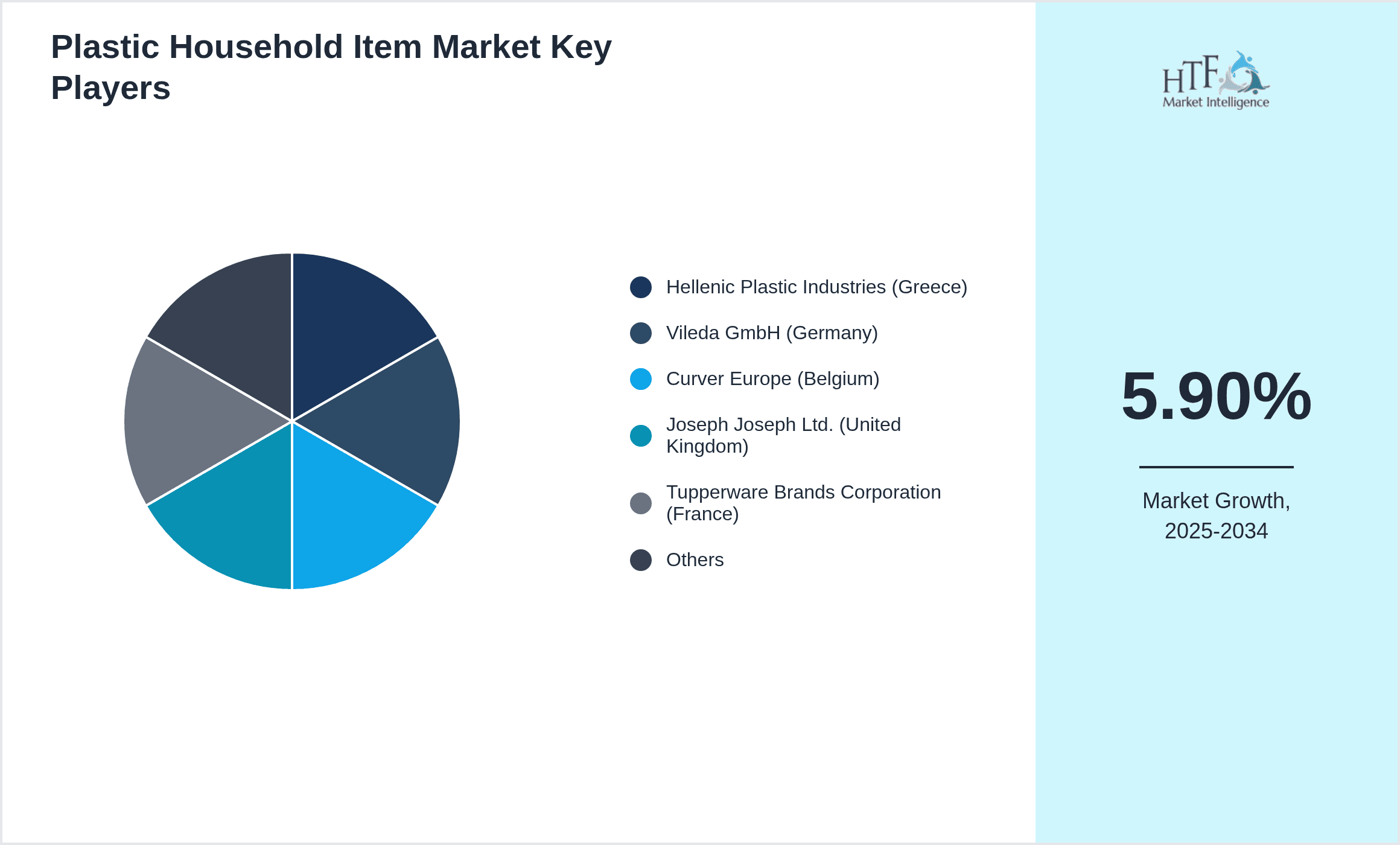
- •Hellenic Plastic Industries (Greece)
- •Vileda GmbH (Germany)
- •Curver Europe (Belgium)
- •Joseph Joseph Ltd. (United Kingdom)
- •Tupperware Brands Corporation (France)
- •Rotho Kunststoff AG (Switzerland)
- •Albayrak Plastik (Turkey)
- •Plastika Kritis S.A. (Greece)
- •Domo Kunststoff GmbH (Austria)
- •Interplast Europe (Italy)
- •Mondi Group (South Africa)
- •Sibelco Europe (Belgium)
- •Rosti Group (Sweden)
- •Emballages Plásticos S.A. (Spain)
- •Alpla Werke Alwin Lehner GmbH & Co KG (Austria)
Market Breakdown
- •By Type
- ◦Polypropylene (PP)
- ◦Polyethylene (PE)
- ◦Polyvinyl Chloride (PVC)
- ◦Acrylonitrile Butadiene Styrene (ABS)
- ◦Polystyrene (PS)
- •By Application
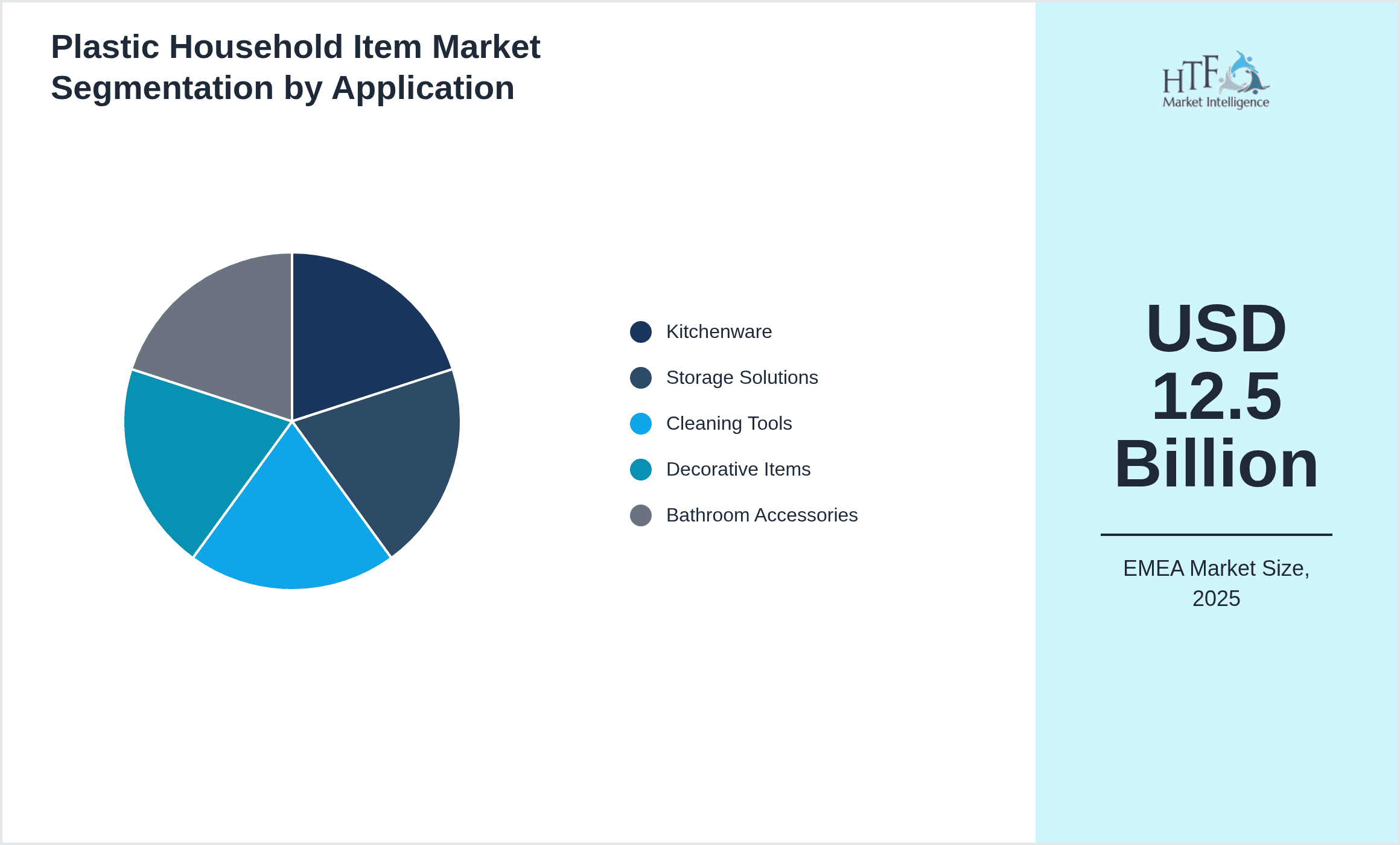
- ◦Kitchenware
- ◦Storage Solutions
- ◦Cleaning Tools
- ◦Decorative Items
- ◦Bathroom Accessories
- •By Distribution Channel
- ◦Supermarkets & Hypermarkets
- ◦Specialty Retailers
- ◦Online Retail
- ◦Wholesale Distributors
- •By End User
- ◦Residential Households
- ◦Commercial Establishments
- ◦Hospitality Sector
- ◦Institutional Users
Growth Drivers
- •Increasing demand for lightweight, durable, and cost-effective household products drives growth, with polypropylene-based items preferred for their versatility and recyclability across EMEA households.
- •Rising urbanization and changing lifestyle patterns in emerging EMEA economies, such as South Africa and Turkey, fuel demand for innovative storage and kitchenware solutions enhancing household convenience.
- •Government initiatives promoting sustainable plastic use and recycling encourage manufacturers to develop eco-friendly household items, attracting environmentally conscious consumers and expanding market reach.
- •Growth of e-commerce channels in Europe and the Middle East facilitates wider product accessibility, boosting sales of plastic household items through online platforms with enhanced consumer engagement.
- •Technological advancements in polymer processing and design enable production of multifunctional and aesthetically appealing plastic household products, meeting evolving consumer preferences and increasing market penetration.

Market Trends
- •Sustainability is a dominant trend, with manufacturers adopting biodegradable plastics and recycled materials to reduce environmental impact and comply with strict EMEA regulatory frameworks.
- •Customization and modular design gain traction as consumers seek personalized household solutions that combine functionality with stylish aesthetics, reflected in innovative storage and kitchenware offerings.
- •Digital transformation in retail, including augmented reality tools for virtual product trials, enhances consumer experience and drives online sales growth in plastic household items across EMEA.
- •Collaborations between plastic manufacturers and design firms lead to the launch of premium product lines blending durability with modern design, appealing to upscale market segments in Western Europe.
- •Circular economy models are increasingly integrated, with companies adopting take-back schemes and recycling programs to close the plastic lifecycle loop within EMEA markets.
Market Opportunities
- •Expanding middle-class populations in North Africa and the Middle East present untapped demand for affordable plastic household items, offering growth potential through targeted product development and marketing.
- •Integration of smart technologies into household items, such as sensor-enabled cleaning tools, opens innovative avenues to differentiate products and capture tech-savvy consumers.
- •Growth in online retail infrastructure across EMEA enables companies to reach remote regions, broadening market access and stimulating sales of plastic household products.
- •Adoption of eco-label certifications and green marketing strategies can enhance brand reputation and consumer trust, driving preference for sustainable plastic household items.
- •Collaborative ventures between European and Middle Eastern plastic manufacturers facilitate knowledge transfer, technology sharing, and market expansion opportunities within the EMEA region.
Market Challenges
- •Stringent environmental regulations on plastic production and waste management increase compliance costs and constrain manufacturing flexibility for plastic household item producers in EMEA.
- •Consumer awareness of plastic pollution drives demand for alternatives, pressuring manufacturers to innovate rapidly and invest in sustainable materials that may have higher costs.
- •Volatility in raw material prices, influenced by global oil markets, affects profitability and pricing strategies throughout the plastic household product supply chain.
- •Fragmentation of regulations across diverse EMEA countries complicates market entry and product standardization for companies operating region-wide.
- •Competition from alternative materials like glass, metal, and bamboo in household products challenges plastic items’ market share, particularly in environmentally conscious segments.
Regulatory Framework
- •Between 2020 and 2024, the European Union implemented the Single-Use Plastics Directive mandating reduction and recycling targets for plastic household items, influencing production practices and material choices.
- •The REACH regulation enforces strict chemical safety standards for plastic components used in household items, requiring thorough compliance documentation from manufacturers.
- •Middle Eastern countries, including UAE and Saudi Arabia, introduced policies incentivizing use of recycled plastics and penalizing non-compliance with environmental standards starting in 2022.
- •South Africa's Plastic Bag Levy, updated in 2023, encourages manufacturers and consumers to reduce single-use plastic consumption, indirectly impacting plastic household product demand.
- •Ongoing harmonization efforts aim to streamline plastic product regulations across EMEA, facilitating cross-border trade and standardizing certification processes.
Industry Insights
The EMEA plastic household item market has witnessed increased innovation in sustainable product lines, with companies launching biodegradable kitchenware and recycled storage solutions in late 2023. For example, Vileda GmbH introduced a new range of eco-friendly cleaning tools in October 2023, featuring biodegradable components to reduce environmental footprint while maintaining durability and performance. Additionally, Joseph Joseph Ltd. launched modular kitchen storage systems in March 2024, designed for urban households emphasizing space optimization and recyclability. These developments reflect growing consumer demand for environmentally responsible products and drive competitive dynamics across EMEA markets.
Mergers & Acquisitions
- •In November 2023, Rotho Kunststoff AG completed the acquisition of a regional plastic household product manufacturer based in Poland, aiming to expand its footprint in Eastern Europe. The deal includes integration of advanced polymer processing technologies and access to new distribution channels across Central and Eastern Europe. This strategic acquisition enhances Rotho’s product portfolio, particularly in storage solutions and cleaning tools, reinforcing its position as a leading player in the EMEA market while leveraging synergies in sustainable product development.
- •In May 2024, Mondi Group finalized the acquisition of a South African plastic household item producer specializing in eco-friendly packaging and storage products. The acquisition supports Mondi’s sustainability goals and expands its market presence in Africa. The integration will focus on scaling up production capacity and introducing innovative biodegradable plastics, aligning with increasing regional environmental regulations. This move positions Mondi as a key player driving sustainable innovation within the EMEA plastic household item sector.
Recent Industry News
- •15th February 2025, Joseph Joseph Ltd. announced a strategic partnership with a leading European recycling company to develop closed-loop recycling processes for plastic kitchenware. This initiative aims to reduce plastic waste by ensuring end-of-life products are efficiently recycled into new household items. The collaboration will leverage advanced sorting technologies and consumer take-back programs across key EMEA markets, reinforcing Joseph Joseph’s commitment to sustainability and circular economy principles. Source: Industry Weekly Report
- •10th April 2025, Vileda GmbH expanded its product line with the launch of smart cleaning tools embedded with IoT sensors to monitor usage and optimize cleaning efficiency. Targeting tech-savvy consumers, these products integrate with mobile applications, offering real-time feedback and maintenance alerts. The launch marks Vileda’s entry into the smart household segment within EMEA, aiming to capture growing demand for connected home solutions. Source: Corporate Press Release
- •22nd June 2025, Tupperware Brands Corporation opened a new manufacturing facility in Turkey focused on producing recyclable polypropylene storage containers for the Middle Eastern and European markets. The facility utilizes renewable energy sources and advanced waste reduction technologies, aligning with regional environmental regulations. This expansion is expected to increase production capacity by 30% and shorten supply chains within EMEA. Source: Market News Daily
- •5th August 2025, Curver Europe announced the launch of a collection of decorative plastic household items utilizing 100% recycled plastics. The collection features innovative designs targeting millennials and eco-conscious consumers in Western Europe. This launch supports Curver’s broader sustainability strategy and aims to differentiate its brand in a competitive market. Source: Sustainability Insights Magazine
Regional Outlook
The Germany currently holds a significant share of the market, primarily due to several key factors: increasing consumption rates, a burgeoning population, and robust economic momentum. These elements collectively drive demand, positioning this region as a leader in the market. On the other hand, South Africa is rapidly emerging as the fastest-growing area within the industry. This remarkable growth can be attributed to swift infrastructure development, the expansion of various industrial sectors, and a marked increase in consumer demand. These dynamics make this region a crucial player in shaping future market growth.
In our report, we cover a comprehensive analysis of the following regions and countries:
- Germany
- France
- Italy
- United Kingdom
- Nordics
- Rest of Europe
- South Africa
- Egypt
- Turkey
- United Arab Emirates
- Israel
- Saudi Arabia
- Rest of EMEA
| Feature | Details |
|---|---|
| Base Year Market Size | USD 12.5 Billion |
| Forecast Year Market Size | USD 22.3 Billion |
| CAGR | 5.9% |
| Forecast Period | 2026 to 2033 |
| YoY Growth | 5.7% |
| Scope of Report | Market is segmented by Type (Polypropylene (PP), Polyethylene (PE), Polyvinyl Chloride (PVC), Acrylonitrile Butadiene Styrene (ABS), Polystyrene (PS)), Application (Kitchenware, Storage Solutions, Cleaning Tools, Decorative Items, Bathroom Accessories), Distribution Channel (Supermarkets & Hypermarkets, Specialty Retailers, Online Retail, Wholesale Distributors), End User (Residential Households, Commercial Establishments, Hospitality Sector, Institutional Users) |
| Regions Covered | Germany, France, Italy, United Kingdom, Nordics, Rest of Europe, South Africa, Egypt, Turkey, United Arab Emirates, Israel, Saudi Arabia, Rest of EMEA |
| Key Companies | Hellenic Plastic Industries (Greece), Vileda GmbH (Germany), Curver Europe (Belgium), Joseph Joseph Ltd. (United Kingdom), Tupperware Brands Corporation (France), Rotho Kunststoff AG (Switzerland), Albayrak Plastik (Turkey), Plastika Kritis S.A. (Greece), Domo Kunststoff GmbH (Austria), Interplast Europe (Italy), Mondi Group (South Africa), Sibelco Europe (Belgium), Rosti Group (Sweden), Emballages Plásticos S.A. (Spain), Alpla Werke Alwin Lehner GmbH & Co KG (Austria) |
EMEA Plastic Household Item Market Size, Growth & Revenue 2024-2034 - Table of Contents
Frequently Asked Questions (FAQ):
The Compact Track Loaders market is expected to see value worth 5.3 Billion in 2025.
North America currently leads the market with approximately 45% market share, followed by Europe at 28% and Asia-Pacific at 22%. The remaining regions account for 5% of the global market.
Key growth drivers include increasing construction activities, rising demand for versatile equipment in agriculture, technological advancements in track loader design, and growing preference for compact equipment in urban construction projects.