
EMEA Pick and Place Robots Market Size, Growth & Revenue 2024-2034
EMEA Pick and Place Robots Market is segmented by Type (Cartesian Robots, SCARA Robots, Articulated Robots, Delta Robots, Cylindrical Robots), Application (Electronics Assembly, Automotive Manufacturing, Food & Beverage Packaging, Pharmaceutical Handling, Consumer Goods), End User Industry (Automotive, Electronics, Pharmaceuticals, Food & Beverage, Consumer Goods), Distribution Channel (Direct Sales, Distributors, Online Sales, System Integrators), and Geography (Germany, France, Italy, United Kingdom, Nordics, Rest of Europe, South Africa, Egypt, Turkey, United Arab Emirates, Israel, Saudi Arabia, Rest of EMEA)
Pricing
Report Overview
Executive Summary
- •The EMEA Pick and Place Robots market includes robotic automation solutions designed to efficiently handle the precise movement of goods in manufacturing and packaging across Europe, the Middle East, and Africa. These robots optimize operations in automotive, electronics, pharmaceuticals, food & beverage, and consumer goods sectors by improving speed, accuracy, and reducing manual labor.
- •Market growth is driven by rising industrial automation adoption, technological innovations in robot design, and increasing demand for flexible manufacturing systems. The market is projected to grow from USD 1.2 Billion in 2024 to USD 3.7 Billion by 2034, with a CAGR of approximately 11.2%.
- •The strategic importance of pick and place robots lies in their ability to enhance production efficiency, ensure product quality, and support smart factory initiatives, making them critical assets for manufacturers aiming to remain competitive in the EMEA industrial landscape.

Competitive Landscape
Competition within the EMEA Pick and Place Robots market is intense, characterized by key players focusing on innovation, product differentiation, and strategic partnerships. Leading companies invest heavily in R&D to develop robots with enhanced speed, precision, and adaptability to diverse industrial applications. The rivalry drives continuous improvements in automation solutions and pushes market participants to adopt aggressive pricing and expand service networks across EMEA. Collaborative ventures and technology licensing are common strategies to accelerate technology adoption and regional penetration. Market dynamics also include the emergence of startups specializing in niche robotic technologies, contributing to innovation but intensifying competition. Regulatory compliance and customization to local industrial requirements further influence competitive positioning. Overall, companies strive to balance technological leadership with cost efficiency to capture growing demand fueled by Industry 4.0 transformations in EMEA manufacturing sectors.
Leading Companies in Pick and Place Robots Market
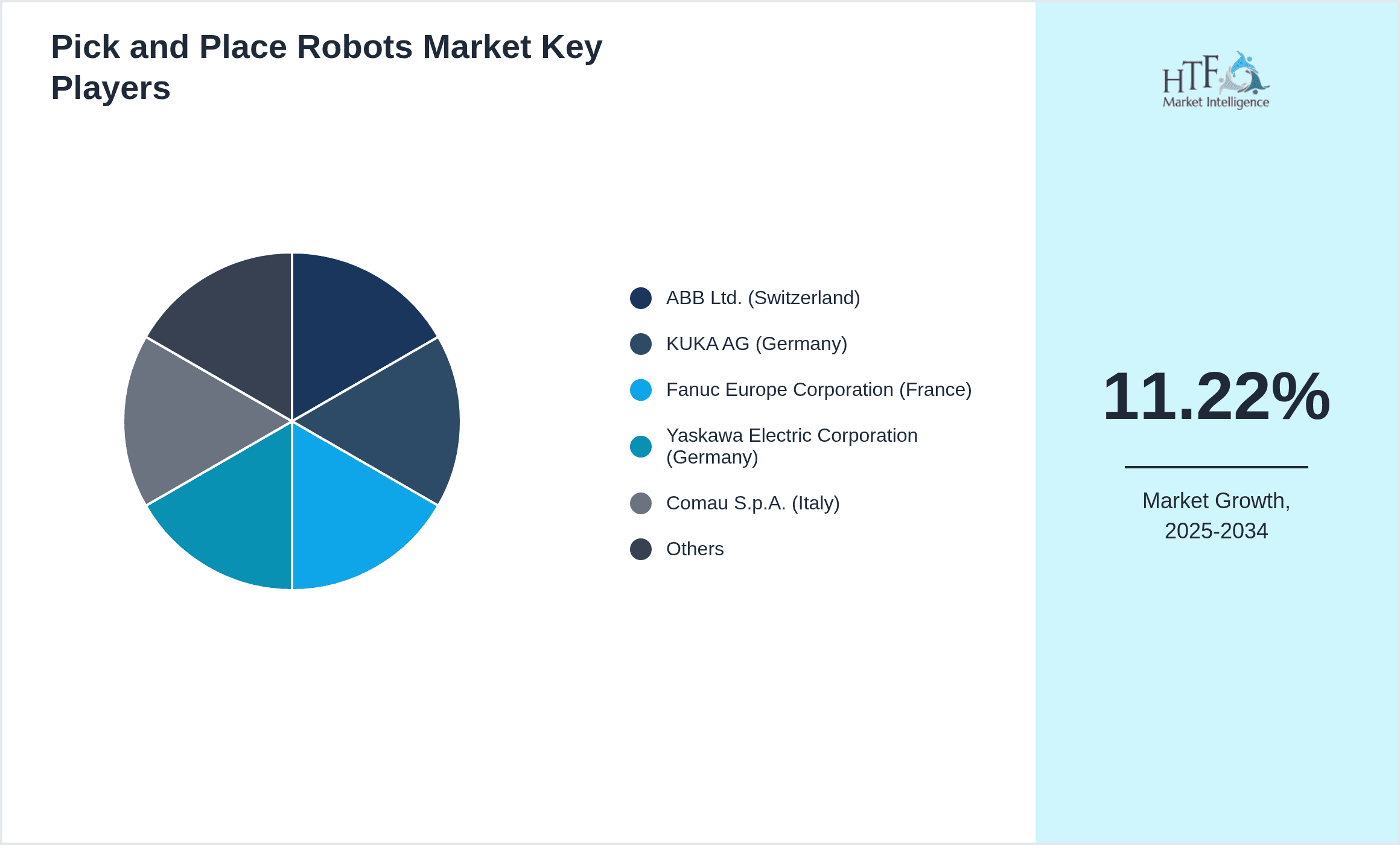
- •ABB Ltd. (Switzerland)
- •KUKA AG (Germany)
- •Fanuc Europe Corporation (France)
- •Yaskawa Electric Corporation (Germany)
- •Comau S.p.A. (Italy)
- •Universal Robots A/S (Denmark)
- •Epson Robots Europe (France)
- •Staubli International AG (Switzerland)
- •Mitsubishi Electric Europe B.V. (Netherlands)
- •Omron Corporation (Netherlands)
- •Denso Robotics Europe (Germany)
- •Bosch Rexroth AG (Germany)
- •Schunk GmbH & Co. KG (Germany)
- •Palletizing Robotics GmbH (Germany)
- •Techman Robot Inc. (France)
- •Kawasaki Robotics Europe (Germany)
- •Adept Technology Inc. (Ireland)
- •Universal Logic Inc. (United Kingdom)
- •FANUC UK Ltd. (United Kingdom)
- •Bosch Packaging Technology (Germany)
- •Adept Technology GmbH (Germany)
- •Comau Robotics (Italy)
- •Jaka Robotics Europe (France)
- •Yamaha Robotics Europe (France)
- •Staubli Robotics UK Ltd. (United Kingdom)

Market Breakdown
- •By Type
- ◦Cartesian Robots
- ◦SCARA Robots
- ◦Articulated Robots
- ◦Delta Robots
- ◦Cylindrical Robots
- •By Application
- ◦Electronics Assembly
- ◦Automotive Manufacturing
- ◦Food & Beverage Packaging
- ◦Pharmaceutical Handling
- ◦Consumer Goods
- •By End User Industry
- ◦Automotive
- ◦Electronics
- ◦Pharmaceuticals
- ◦Food & Beverage
- ◦Consumer Goods
- •By Distribution Channel
- ◦Direct Sales
- ◦Distributors
- ◦Online Sales
- ◦System Integrators
Growth Drivers
- •Rapid adoption of Industry 4.0 and smart manufacturing in EMEA has significantly increased demand for pick and place robots, enabling higher production speed and precision in automotive and electronics sectors.
- •Rising labor costs and scarcity of skilled workers in key EMEA countries drive manufacturers to automate repetitive tasks, boosting the uptake of pick and place robotic systems across industries.
- •Technological advancements such as enhanced AI integration, vision systems, and flexible gripping solutions enhance the capabilities of pick and place robots, broadening their application scope.
- •Government initiatives promoting automation and digital transformation in manufacturing hubs like Germany and France create favorable conditions for market expansion.
- •Growing pharmaceutical and food safety standards in EMEA necessitate precise and contamination-free handling, increasing reliance on robotic automation for pick and place tasks.

Market Trends
- •Emergence of collaborative pick and place robots designed to work alongside human operators is gaining traction, improving workplace safety and operational flexibility within EMEA factories.
- •Integration of IoT and cloud connectivity in robot systems enables real-time monitoring and predictive maintenance, optimizing uptime and efficiency in EMEA manufacturing plants.
- •Shift towards modular and scalable robotic solutions allows manufacturers to customize pick and place operations based on fluctuating production volumes and product types.
- •Sustainability-driven innovations focus on energy-efficient robotic designs and recyclable materials, aligning with EMEA’s environmental regulatory frameworks and corporate responsibility goals.
- •Increasing adoption of advanced vision and AI-powered recognition systems enhances the precision and speed of pick and place robots, expanding their utility in complex assembly lines.
Market Opportunities
- •Expansion opportunities exist in emerging EMEA markets such as Eastern Europe and the Middle East, where industrial automation infrastructure is rapidly developing.
- •Growing pharmaceutical manufacturing and packaging demand post-pandemic opens avenues for specialized pick and place robotic solutions with stringent hygiene compliance.
- •Increasing penetration of e-commerce is driving demand for automated packaging and sorting, creating new applications for pick and place robots in logistics centers across EMEA.
- •Collaborations between robotics manufacturers and AI firms offer potential for innovative, adaptable robots tailored for multi-product assembly lines in automotive and electronics sectors.
- •Government subsidies and incentives for automation in several EMEA countries encourage SMEs to adopt pick and place solutions, expanding the customer base beyond large manufacturers.
Market Challenges
- •High upfront capital investment and integration complexity limit adoption among small and medium enterprises within the EMEA region despite evident operational benefits.
- •Lack of skilled personnel to program and maintain advanced robotic systems poses a significant barrier to market growth, especially in emerging EMEA economies.
- •Stringent regional safety and regulatory standards require continuous compliance efforts and may delay deployment timelines for new robotic systems.
- •Intense competition from low-cost Asian manufacturers challenges EMEA suppliers to maintain pricing competitiveness while investing in innovation.
- •Customization needs for diverse industrial applications increase complexity and cost, hindering standardization and scalability of pick and place solutions.
Regulatory Framework
- •Between 2021 and 2024, the EMEA region has reinforced machinery safety directives requiring enhanced robot safety features such as emergency stops and collaborative operation safeguards, impacting pick and place robot designs.
- •The European Union’s Machinery Directive 2006/42/EC updates mandate stricter compliance for industrial robots, focusing on risk assessment and operator safety, influencing manufacturing and deployment standards.
- •Environmental regulations emphasizing energy efficiency and waste reduction have driven manufacturers to develop eco-friendly pick and place robots adhering to EU energy labeling and RoHS compliance.
- •Data protection laws like GDPR affect the integration of IoT-enabled robots, requiring manufacturers to implement robust cybersecurity measures for connected robotic systems.
- •Country-specific regulations in Germany and France offer incentives and subsidies for automation investments, fostering faster market adoption of pick and place robots.
Market Intelligence
- •15th March 2024, ABB Ltd. launched the next-generation Cartesian pick and place robot featuring enhanced AI-based vision systems and modular end-effectors, targeting automotive and electronics manufacturers in Germany and France. The new model promises up to 20% increased throughput and reduced setup times, aligning with Industry 4.0 standards and sustainability goals.
- •30th November 2024, Universal Robots A/S introduced a collaborative delta robot designed for high-speed packaging applications in the EMEA food and beverage sector. The robot integrates advanced safety sensors allowing seamless human-robot interaction, facilitating flexible production lines and reducing labor costs.
- •10th January 2025, KUKA AG announced a strategic partnership with an AI software provider to incorporate machine learning algorithms into articulated pick and place robots, enhancing adaptability and predictive maintenance capabilities. This initiative aims to strengthen KUKA’s presence in the pharmaceutical and electronics industries across France and the UK.
- •22nd April 2025, Fanuc Europe Corporation expanded its robotic solutions portfolio by launching energy-efficient SCARA robots with integrated IoT connectivity, designed for precision assembly in the automotive sector. The launch supports EMEA manufacturers in achieving sustainability targets and operational excellence.
- •Source: Official company announcements and industry publications
Mergers & Acquisitions
- •In June 2023, Comau S.p.A. completed the acquisition of a robotics AI startup based in France, expanding its capabilities in intelligent pick and place systems. The acquisition enables Comau to integrate advanced machine learning and vision technologies into its robot portfolio, enhancing performance in automotive and electronics assembly lines across EMEA. This strategic move is expected to accelerate product innovation and strengthen Comau’s competitive position in the region’s growing automation market.
- •In September 2024, ABB Ltd. acquired a Netherlands-based automation software firm specializing in cloud-based robot fleet management. This acquisition broadens ABB’s digital offerings for its pick and place robots, allowing customers in EMEA to optimize robot utilization and maintenance remotely. The deal supports ABB’s push towards Industry 4.0 solutions and reinforces its leadership in integrated manufacturing automation across the region.
Recent Industry News
- •12th January 2025, Staubli International AG announced a partnership with a leading pharmaceutical packaging company in Germany to deploy advanced delta pick and place robots in sterile environments. This collaboration aims to enhance production speed and ensure compliance with strict hygiene standards, reflecting growing automation demand in pharmaceutical manufacturing across EMEA. The project is expected to scale to additional sites in France and Italy by late 2025. Source: Industry news portal
- •5th March 2025, Fanuc Europe Corporation inaugurated a new robotics R&D center in the UK focused on developing AI-driven articulated pick and place robots for automotive assembly. The center will accelerate innovation in adaptive robotics technologies and support local manufacturing industries aiming to automate complex tasks. This investment reflects Fanuc’s commitment to expanding its footprint and technological leadership in the EMEA region. Source: Official company release
- •18th April 2025, Universal Robots A/S expanded its distribution network by partnering with a major system integrator in Spain to broaden access to collaborative pick and place robots in Southern Europe. The partnership will facilitate customized automation solutions for SMEs in automotive and electronics sectors, addressing rising demand for flexible, easy-to-deploy robotic systems. Source: Trade publication
- •9th May 2025, KUKA AG launched a new line of energy-efficient SCARA robots with integrated IoT features targeting food and beverage packaging industries in France and Italy. The launch supports manufacturers’ sustainability goals and operational efficiency improvements, positioning KUKA as a key player in the environmentally conscious automation market. Source: Company announcement
Market Statistics
- •CAGR by 2034: 11.22%
- •Market Size by 2034: USD 3.7 Billion
- •Market Size in 2025: USD 1.3 Billion
- •Dominating Type: Cartesian Robots
- •Next-following Type: Delta Robots
- •Dominating Application: Electronics Assembly
- •Next-following Application: Automotive Manufacturing
- •Dominating Region: Germany
- •Second-leading Region: United Kingdom
- •Region with Highest Growth Rate: France
- •Dominating Country: Germany
Market Share Table
- •Market Share (%) - Dominating Type (Cartesian Robots): 35% vs Followed Type (Delta Robots): 25%
- •Market Share (%) - Dominating Application (Electronics Assembly): 40% vs Followed Application (Automotive Manufacturing): 30%
- •Growth Rate (%) - Dominating Type (Cartesian Robots): 10.5% vs Followed Type (Delta Robots): 13.5%
- •Growth Rate (%) - Dominating Application (Electronics Assembly): 11.0% vs Followed Application (Automotive Manufacturing): 12.0%
Top 5 Global Players
- •ABB Ltd. (Switzerland)
- •KUKA AG (Germany)
- •Fanuc Europe Corporation (France)
- •Universal Robots A/S (Denmark)
- •Comau S.p.A. (Italy)
Regional Outlook
The Germany currently holds a significant share of the market, primarily due to several key factors: increasing consumption rates, a burgeoning population, and robust economic momentum. These elements collectively drive demand, positioning this region as a leader in the market. On the other hand, France is rapidly emerging as the fastest-growing area within the industry. This remarkable growth can be attributed to swift infrastructure development, the expansion of various industrial sectors, and a marked increase in consumer demand. These dynamics make this region a crucial player in shaping future market growth.
In our report, we cover a comprehensive analysis of the following regions and countries:
- Germany
- France
- Italy
- United Kingdom
- Nordics
- Rest of Europe
- South Africa
- Egypt
- Turkey
- United Arab Emirates
- Israel
- Saudi Arabia
- Rest of EMEA
| Feature | Details |
|---|---|
| Base Year Market Size | USD 1.2 Billion |
| Forecast Year Market Size | USD 3.7 Billion |
| CAGR | 11.22% |
| Forecast Period | 2026 to 2033 |
| YoY Growth | 11% |
| Scope of Report | Market is segmented by Type (Cartesian Robots, SCARA Robots, Articulated Robots, Delta Robots, Cylindrical Robots), Application (Electronics Assembly, Automotive Manufacturing, Food & Beverage Packaging, Pharmaceutical Handling, Consumer Goods), End User Industry (Automotive, Electronics, Pharmaceuticals, Food & Beverage, Consumer Goods), Distribution Channel (Direct Sales, Distributors, Online Sales, System Integrators) |
| Regions Covered | Germany, France, Italy, United Kingdom, Nordics, Rest of Europe, South Africa, Egypt, Turkey, United Arab Emirates, Israel, Saudi Arabia, Rest of EMEA |
| Key Companies | ABB Ltd. (Switzerland), KUKA AG (Germany), Fanuc Europe Corporation (France), Yaskawa Electric Corporation (Germany), Comau S.p.A. (Italy), Universal Robots A/S (Denmark), Epson Robots Europe (France), Staubli International AG (Switzerland), Mitsubishi Electric Europe B.V. (Netherlands), Omron Corporation (Netherlands), Denso Robotics Europe (Germany), Bosch Rexroth AG (Germany), Schunk GmbH & Co. KG (Germany), Palletizing Robotics GmbH (Germany), Techman Robot Inc. (France), Kawasaki Robotics Europe (Germany), Adept Technology Inc. (Ireland), Universal Logic Inc. (United Kingdom), FANUC UK Ltd. (United Kingdom), Bosch Packaging Technology (Germany), Adept Technology GmbH (Germany), Comau Robotics (Italy), Jaka Robotics Europe (France), Yamaha Robotics Europe (France), Staubli Robotics UK Ltd. (United Kingdom) |
EMEA Pick and Place Robots Market Size, Growth & Revenue 2024-2034 - Table of Contents
Frequently Asked Questions (FAQ):
The Compact Track Loaders market is projected to grow at a CAGR of 6.8% from 2025 to 2030, driven by increasing demand in construction and agricultural sectors.
North America currently leads the market with approximately 45% market share, followed by Europe at 28% and Asia-Pacific at 22%. The remaining regions account for 5% of the global market.
Key growth drivers include increasing construction activities, rising demand for versatile equipment in agriculture, technological advancements in track loader design, and growing preference for compact equipment in urban construction projects.