
Middle East Industrial Conveyor and Drive Belt Market Size, Growth & Revenue 2025-2034
Middle East Industrial Conveyor and Drive Belt Market is segmented by Application (Mining, Manufacturing, Food Processing, Logistics & Warehousing, Construction), Type (Rubber Conveyor Belts, PVC Conveyor Belts, PU Conveyor Belts, Fabric Conveyor Belts, Steel Cord Conveyor Belts), and Geography (Turkey, Egypt, United Arab Emirates, Saudi Arabia, Israel, Others)
Pricing
Report Overview
Market Definition
- •The Middle East Industrial Conveyor and Drive Belt market covers mechanical belts used for transporting materials and transmitting power in industrial settings.
- •Included are belts made of rubber, PVC, polyurethane, fabric, and steel cords, designed for durability in mining, manufacturing, food processing, logistics, and construction sectors.
- •Excluded are automotive belts, personal-use belts, and non-industrial belt types.
- •By Type
- ◦Rubber Conveyor Belts
- ◦PVC Conveyor Belts
- ◦PU Conveyor Belts
- ◦Fabric Conveyor Belts
- ◦Steel Cord Conveyor Belts
- •By Application
- ◦Mining
- ◦Manufacturing
- ◦Food Processing
- ◦Logistics & Warehousing
- ◦Construction
- •By Material Composition
- ◦Natural Rubber
- ◦Synthetic Rubber
- ◦Polyvinyl Chloride (PVC)
- ◦Polyurethane (PU)
- ◦Fabric Reinforced
- •By End-User Industry
- ◦Heavy Industry
- ◦Packaging
- ◦Agriculture
- ◦Oil & Gas
- ◦Transportation

Report Coverage
- •Driver
- ◦The industrial growth across the Middle East, fueled by infrastructure projects and diversification away from oil dependency, propels demand for conveyor and drive belts. Particularly, the surge in logistics and warehousing amid e-commerce growth nudges conveyor adoption. However, adoption rates vary; some traditional industries resist modernization, sticking to older equipment and delaying belt upgrades. The harsh Middle Eastern environment—extreme temperatures and dust—also shapes product choices and complicates maintenance, sometimes leading to inconsistent performance despite high demand. While manufacturing expansion is a clear driver, the actual uptake can be uneven, impacted by fluctuating oil prices affecting capital expenditure cycles. The drive towards automation, albeit slower than expected in some sectors, still pushes for more advanced belt solutions. Overall, the driver is strong, but real-world adoption reflects a patchy pattern with pockets of rapid growth alongside slower segments.
- •Trend
- ◦A notable trend is the gradual shift towards PU conveyor belts due to their better resistance to abrasion and chemicals, which suits food processing and pharmaceutical sectors expanding in the region. Yet, rubber belts still dominate heavy industries where cost considerations override material enhancements. Digital monitoring and IoT integration in conveyor systems are gaining attention, but implementation is sporadic, often limited to larger industrial players. In some cases, outdated infrastructure and lack of skilled technicians slow down these tech adoptions. Sustainability concerns are emerging but have yet to become a major influence on procurement decisions. The market is a mix of old and new, with modernization unevenly distributed across countries and industries.
- •Opportunity
- ◦Growth in non-oil sectors like food processing and pharmaceuticals opens new avenues for belt manufacturers, especially with demand for hygienic and chemical-resistant conveyor belts. The rise in logistics hubs and free zones in countries like UAE and Saudi Arabia creates potential for large-scale belt installations. Additionally, the push for automation and Industry 4.0 in the Middle East, although gradual, presents long-term opportunities for advanced belt technologies integrated with sensors and predictive maintenance. Despite some hesitation in adoption, early movers stand to gain as regional industries modernize. Export potential to neighboring regions also adds opportunity layers. However, success will require navigating local operational challenges and regulatory requirements.
- •Challenges
- ◦High ambient temperatures and dust levels in the Middle East create operational challenges, reducing belt lifespan and increasing maintenance frequency. Supply chain disruptions and dependence on imports for specialized belts add cost and delay issues. Inconsistent infrastructure quality across countries means some markets are less ready for advanced belt technologies. Skilled labor shortages complicate installation and upkeep. Price sensitivity in emerging sectors leads to preference for cheaper, lower-quality belts, impacting overall market growth quality. Compliance with varying regional regulations adds complexity. Also, economic volatility related to oil price fluctuations causes erratic investment patterns, making market forecasting difficult.
- •Market Entropy
- ◦The Middle East market is somewhat fragmented with a mix of global brands and local suppliers operating in parallel. Market behavior is unpredictable at times; for example, some sectors show rapid growth while others stagnate or regress due to economic or geopolitical factors. Adoption of new technologies is patchy, with pockets of high-tech solutions coexisting with traditional, manual systems. The maintenance and quality standards vary widely, affecting overall market reliability. Import regulations, tariffs, and political uncertainties contribute to fluctuating supply chains. Market players often face inconsistent demand, and buyers can be hesitant to invest heavily without assured ROI. This entropy leads to a market that’s dynamic but not always linear in growth, with surprises and setbacks interspersed with progress.
- •Merger & Acquisition News
- •Regional Analysis
- ◦Saudi Arabia leads the Middle East market with the largest industrial base and significant infrastructure investments driving conveyor belt demand. UAE follows closely, benefiting from its logistics hubs and diverse manufacturing sector. Qatar and Oman have smaller but growing markets, often influenced by government projects and industrial diversification policies. Kuwait shows steady demand but is more conservative in adopting new technologies. The regional market faces inconsistent development; while some countries accelerate modern industrial practices, others remain heavily dependent on legacy systems. Political stability and investment climates vary, impacting procurement cycles. Cross-border trade within GCC countries facilitates equipment flow but regulatory differences pose hurdles. Overall, the Middle East market is a patchwork of fast-growing centers and slower adopters, shaped by national priorities and economic conditions.
- •Regulatory Landscape
- ◦Regulations in the Middle East affecting industrial conveyor and drive belts mostly revolve around safety standards, environmental compliance, and import controls. Countries like UAE and Saudi Arabia have introduced stricter occupational safety regulations mandating regular equipment inspections, indirectly boosting demand for higher-quality belts. Environmental rules are emerging, especially related to waste management and chemical use in manufacturing, influencing material choices for belts. Import tariffs and customs procedures differ across countries, sometimes causing delays and added costs. Certifications such as ISO and local equivalents are increasingly required, though enforcement varies. Compliance challenges arise due to fragmented regulatory frameworks within the region. Some markets lack clear standards for conveyor system installations, complicating vendor operations. Overall, regulations are evolving and becoming more stringent, but uneven enforcement and gaps in harmonization create a complex operating environment.
- •Investment and Funding Scenario
- ◦Investment in the industrial conveyor and drive belt sector is largely tied to broader infrastructure and manufacturing funding programs. Countries like Saudi Arabia and UAE have allocated substantial capital towards industrial diversification, indirectly supporting belt market growth. Private sector interest is growing but cautious, reflecting economic uncertainties and fluctuating oil revenues. Funding for technology upgrades and automation remains limited to larger corporations, while SMEs struggle to access capital. Public-private partnerships and industrial free zones offer some funding opportunities, yet overall financial backing for advanced belt technologies is moderate. Venture capital or dedicated funding for conveyor technologies specifically is minimal, with investments more dispersed across general industrial equipment sectors.
- •Competitive Innovation Radar
- ◦Competition in the Middle East conveyor and drive belt market features a mix of international suppliers and local distributors adapting global products to regional needs. Innovation is focused on material improvements to withstand extreme heat and abrasive environments. Some companies invest in IoT-enabled belts for predictive maintenance, but adoption is uneven and mostly limited to large industrial players. Local customization and service quality often differentiate competitors more than pure product innovation. Price competition remains fierce, especially among local manufacturers offering lower-cost alternatives with variable quality. Partnerships between global brands and regional firms to enhance distribution and service networks are common. Overall, innovation is practical and incremental, driven by necessity rather than breakthrough technology, reflecting the market’s cautious modernization approach.
Market Size & Growth Table for Middle East Industrial Conveyor and Drive Belt
- •Year
- ◦2020
- ◦2025
- ◦2034
- •Market Size (USD Billion)
- ◦1.2
- ◦1.8
- ◦3.7
- •CAGR
- ◦-
- ◦7.8%
- •Year-on-Year Growth
- ◦-
- ◦7.6%
Regional Performance Analysis
- •Dominating Country
- ◦Saudi Arabia
- •Fastest Growing Country
- ◦United Arab Emirates
Players List of Middle East Industrial Conveyor and Drive Belt
- •Al-Babtain Power & Telecommunication Co. (Saudi Arabia)
- •Mubadala Industrial Manufacturing (United Arab Emirates)
- •Gulf Conveyor Belts Co. (Kuwait)
- •Oman Industrial Products Co. (Oman)
- •Qatar Industrial Manufacturing Co. (Qatar)
- •Abu Dhabi National Energy Co. (United Arab Emirates)
- •Saudi Mechanical Equipment Co. (Saudi Arabia)
- •Emirates Industrial Enterprises (United Arab Emirates)
- •Saudi Arabian Conveyor Solutions (Saudi Arabia)
- •Kuwait Industrial Belting Co. (Kuwait)
- •Oman Belt Manufacturing (Oman)
- •Qatar Belt Systems (Qatar)
- •Dubai Industrial Supplies (United Arab Emirates)
- •Riyadh Mechanical Systems (Saudi Arabia)
- •Middle East Conveyor Tech (United Arab Emirates)
- •KSA Industrial Components (Saudi Arabia)
- •Abu Dhabi Belt Solutions (United Arab Emirates)
- •Kuwait Conveyor Systems (Kuwait)
- •Oman Mechanical Solutions (Oman)
- •Qatar Industrial Components (Qatar)
- •Sharjah Industrial Belting (United Arab Emirates)
- •Jeddah Conveyor Equipment (Saudi Arabia)
- •Dubai Belt Manufacturers (United Arab Emirates)
- •Saudi Industrial Supplies (Saudi Arabia)
- •Kuwait Mechanical Industries (Kuwait)
Competitive Analysis
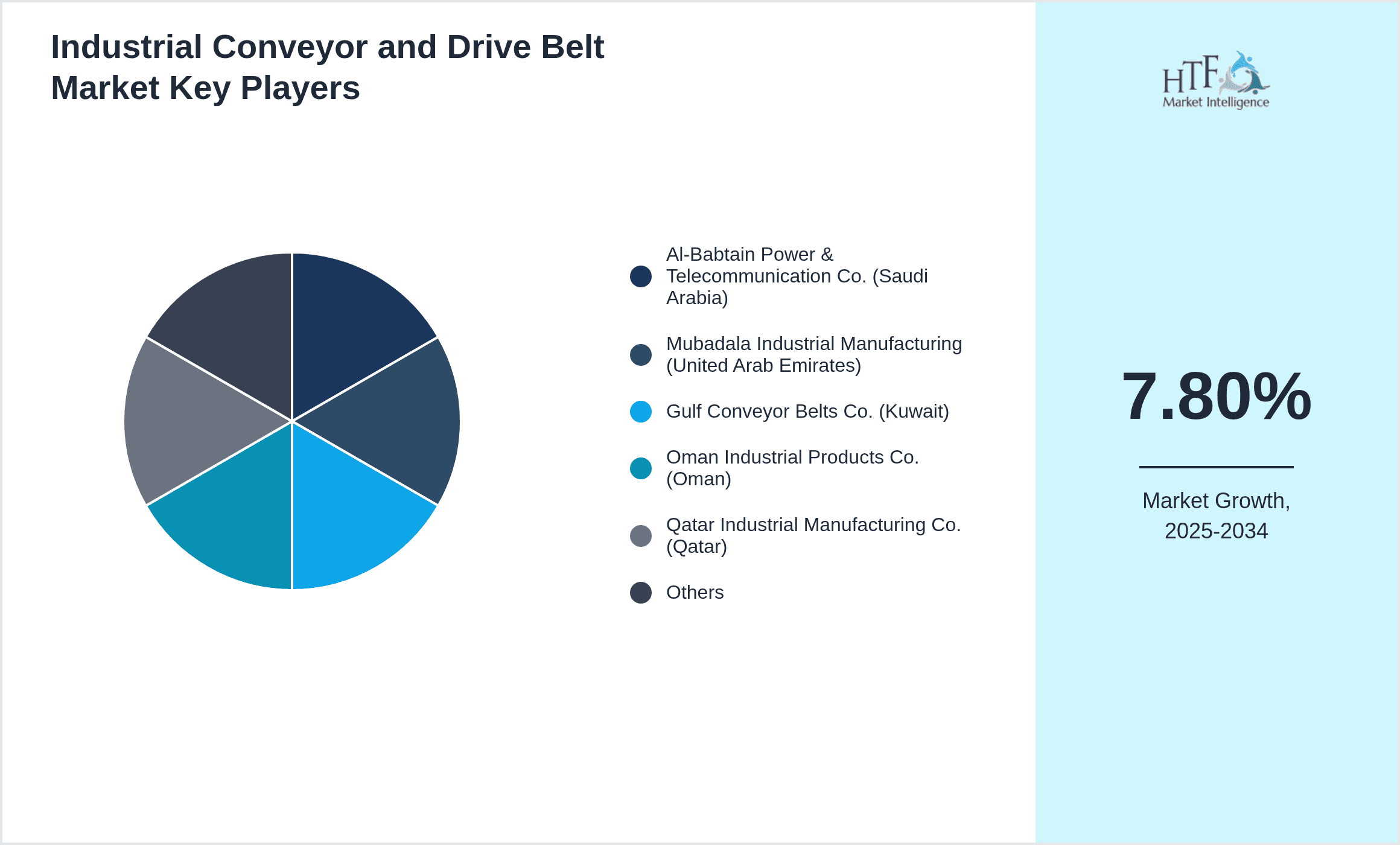
The competitive environment in the Middle East Industrial Conveyor and Drive Belt market is a mixed bag. You have global manufacturers with established reputations competing alongside smaller, local companies that try to undercut on price but sometimes sacrifice quality. The market is quite price-sensitive, especially in emerging sectors where cost pressures push buyers toward cheaper solutions, which can affect reliability and long-term vendor relationships. Innovation is more about incremental improvements—better materials to handle heat or dust—than radical new tech. Partnerships between international brands and local distributors are common, helping navigate regional regulations and service expectations. Some players focus heavily on after-sales service as a differentiator, recognizing that maintenance is a big concern here. Market entry barriers exist but are not insurmountable; local knowledge and compliance with variable regulatory standards are key. Overall, competition is steady, with no single dominant player but rather a constellation of firms each carving out niches based on material expertise, pricing tactics, and service capabilities.
Regional Outlook
The Saudi Arabia currently holds a significant share of the market, primarily due to several key factors: increasing consumption rates, a burgeoning population, and robust economic momentum. These elements collectively drive demand, positioning this region as a leader in the market. On the other hand, United Arab Emirates is rapidly emerging as the fastest-growing area within the industry. This remarkable growth can be attributed to swift infrastructure development, the expansion of various industrial sectors, and a marked increase in consumer demand. These dynamics make this region a crucial player in shaping future market growth.
In our report, we cover a comprehensive analysis of the following regions and countries:
- Turkey
- Egypt
- United Arab Emirates
- Saudi Arabia
- Israel
- Others
| Feature | Details |
|---|---|
| Base Year Market Size | USD 1.8 Billion |
| Forecast Year Market Size | USD 3.7 Billion |
| CAGR | 7.8% |
| Forecast Period | 2026 to 2033 |
| YoY Growth | 7.6% |
| Regions Covered | Turkey, Egypt, United Arab Emirates, Saudi Arabia, Israel, Others |
| Key Companies | Al-Babtain Power & Telecommunication Co. (Saudi Arabia), Mubadala Industrial Manufacturing (United Arab Emirates), Gulf Conveyor Belts Co. (Kuwait), Oman Industrial Products Co. (Oman), Qatar Industrial Manufacturing Co. (Qatar), Abu Dhabi National Energy Co. (United Arab Emirates), Saudi Mechanical Equipment Co. (Saudi Arabia), Emirates Industrial Enterprises (United Arab Emirates), Saudi Arabian Conveyor Solutions (Saudi Arabia), Kuwait Industrial Belting Co. (Kuwait), Oman Belt Manufacturing (Oman), Qatar Belt Systems (Qatar), Dubai Industrial Supplies (United Arab Emirates), Riyadh Mechanical Systems (Saudi Arabia), Middle East Conveyor Tech (United Arab Emirates), KSA Industrial Components (Saudi Arabia), Abu Dhabi Belt Solutions (United Arab Emirates), Kuwait Conveyor Systems (Kuwait), Oman Mechanical Solutions (Oman), Qatar Industrial Components (Qatar), Sharjah Industrial Belting (United Arab Emirates), Jeddah Conveyor Equipment (Saudi Arabia), Dubai Belt Manufacturers (United Arab Emirates), Saudi Industrial Supplies (Saudi Arabia), Kuwait Mechanical Industries (Kuwait) |
Middle East Industrial Conveyor and Drive Belt Market Size, Growth & Revenue 2025-2034 - Table of Contents
Frequently Asked Questions (FAQ):
The Compact Track Loaders market is expected to see value worth 5.3 Billion in 2025.
North America currently leads the market with approximately 45% market share, followed by Europe at 28% and Asia-Pacific at 22%. The remaining regions account for 5% of the global market.
Key growth drivers include increasing construction activities, rising demand for versatile equipment in agriculture, technological advancements in track loader design, and growing preference for compact equipment in urban construction projects.