
Asia-Pacific Biometric Point-of-Sale Terminals Market - Outlook 2024-2034
Asia-Pacific Biometric Point-of-Sale Terminals Market is segmented by Type (Fingerprint Recognition Terminals, Iris Recognition Terminals, Facial Recognition Terminals, Palm Vein Recognition Terminals, Voice Recognition Terminals), Application (Retail Stores, Hospitality, Healthcare, Banking & Finance, Transportation), Deployment Model (Cloud-based, On-premise, Hybrid), End User (Small and Medium Enterprises (SMEs), Large Enterprises, Government Organizations), and Geography (Japan, China, Southeast Asia, India, Australia, South Korea, Others)
Pricing
Report Overview
Executive Summary
- •The Asia-Pacific biometric point-of-sale terminals market revolves around POS devices embedding biometric authentication such as fingerprint, facial, iris, palm vein, and voice recognition to enhance transaction security and customer convenience. It mainly serves sectors like retail, banking, healthcare, hospitality, and transportation, offering hardware and software solutions for seamless payments and access control. This market excludes non-biometric POS devices and standalone biometric systems not tied to payment processing. The scope covers the integration trends, regional adoption disparities, and the evolving regulatory landscape influencing deployment across key countries including China, India, Japan, Southeast Asia, Australia, and South Korea.
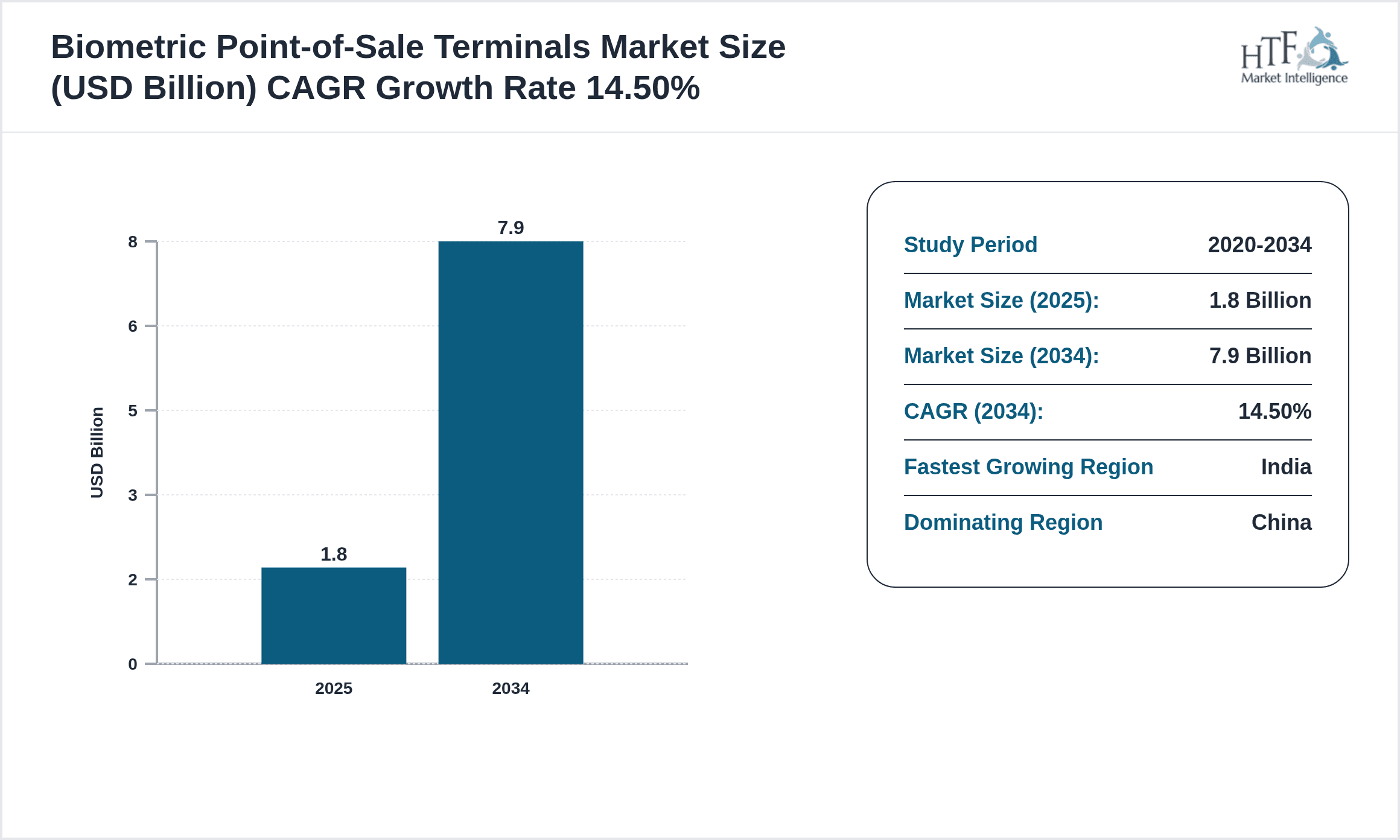
- •Market growth is driven by heightened security concerns, rising digital payment penetration, and government initiatives promoting cashless transactions. The forecast to 2034 indicates a robust CAGR of approximately 14.5%, with China dominating current market share while India emerges as the fastest growing market due to expanding retail infrastructure and increasing consumer awareness. Fingerprint recognition remains the leading technology type, though facial recognition terminals are rapidly gaining traction. Adoption patterns show inconsistency, with some regions lagging due to infrastructural and regulatory challenges.
- •The strategic importance lies in addressing fraud mitigation and improving user authentication in high-volume transaction environments. Biometric POS terminals offer enhanced customer experience and operational efficiency, making them attractive to retailers and financial institutions alike. However, challenges such as privacy concerns, interoperability, and cost barriers persist. The market thus represents a complex interplay of technology advancement, regulatory compliance, and region-specific adoption dynamics, offering significant opportunities for innovation and market expansion.
Competitive Landscape
Competition in the Asia-Pacific biometric POS terminals market is intense with a mix of global technology leaders and agile local players. Market positioning hinges on innovation in sensor technology, software integration capabilities, and cost competitiveness. Companies are investing in R&D to improve accuracy, speed, and user-friendliness, while also forming partnerships to expand distribution. Rivalry often centers on proprietary biometric algorithms and compliance with regional data protection laws. Pricing strategies vary widely, reflecting diverse customer segments from premium retail chains to small businesses. Market entry barriers include technological complexity and the need for localized solutions. Future competition is expected to intensify around AI integration and multi-modal biometric authentication, with regional nuances shaping strategic moves.
Leading Companies in Asia-Pacific Biometric Point-of-Sale Terminals Market
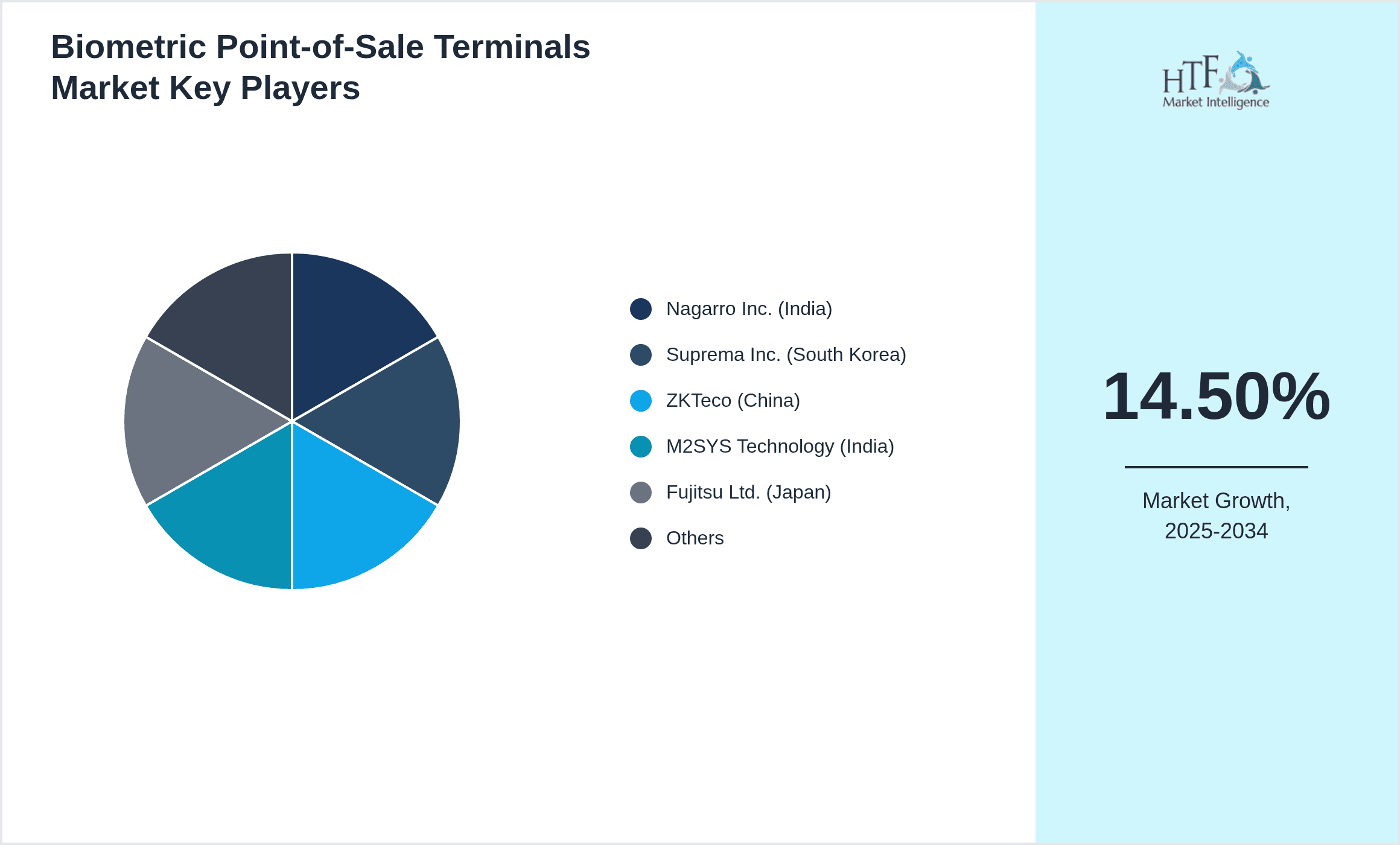
- •Nagarro Inc. (India)
- •Suprema Inc. (South Korea)
- •ZKTeco (China)
- •M2SYS Technology (India)
- •Fujitsu Ltd. (Japan)
- •NEC Corporation (Japan)
- •IDEX Biometrics ASA (Norway, Asia-Pacific Operations)
- •HID Global (United States, Asia-Pacific Branch)
- •Crossmatch Technologies (United States, Asia-Pacific Subsidiary)
- •Aware Inc. (United States, Asia-Pacific Presence)
- •Synaptics Incorporated (United States, Asia-Pacific Operations)
- •Aware Inc. (United States, Asia-Pacific Presence)
- •Anviz Global (China)
- •Sagemcom (France, Asia-Pacific Operations)
- •Honeywell International Inc. (United States, Asia-Pacific Subsidiary)
- •Morpho (Safran Group) (France, Asia-Pacific Branch)
- •VeriFone Systems Inc. (United States, Asia-Pacific Segment)
- •Square Inc. (United States, Asia-Pacific Expansion)
- •Ingenico Group (France, Asia-Pacific Operations)
- •Paytm (India)
Market Breakdown
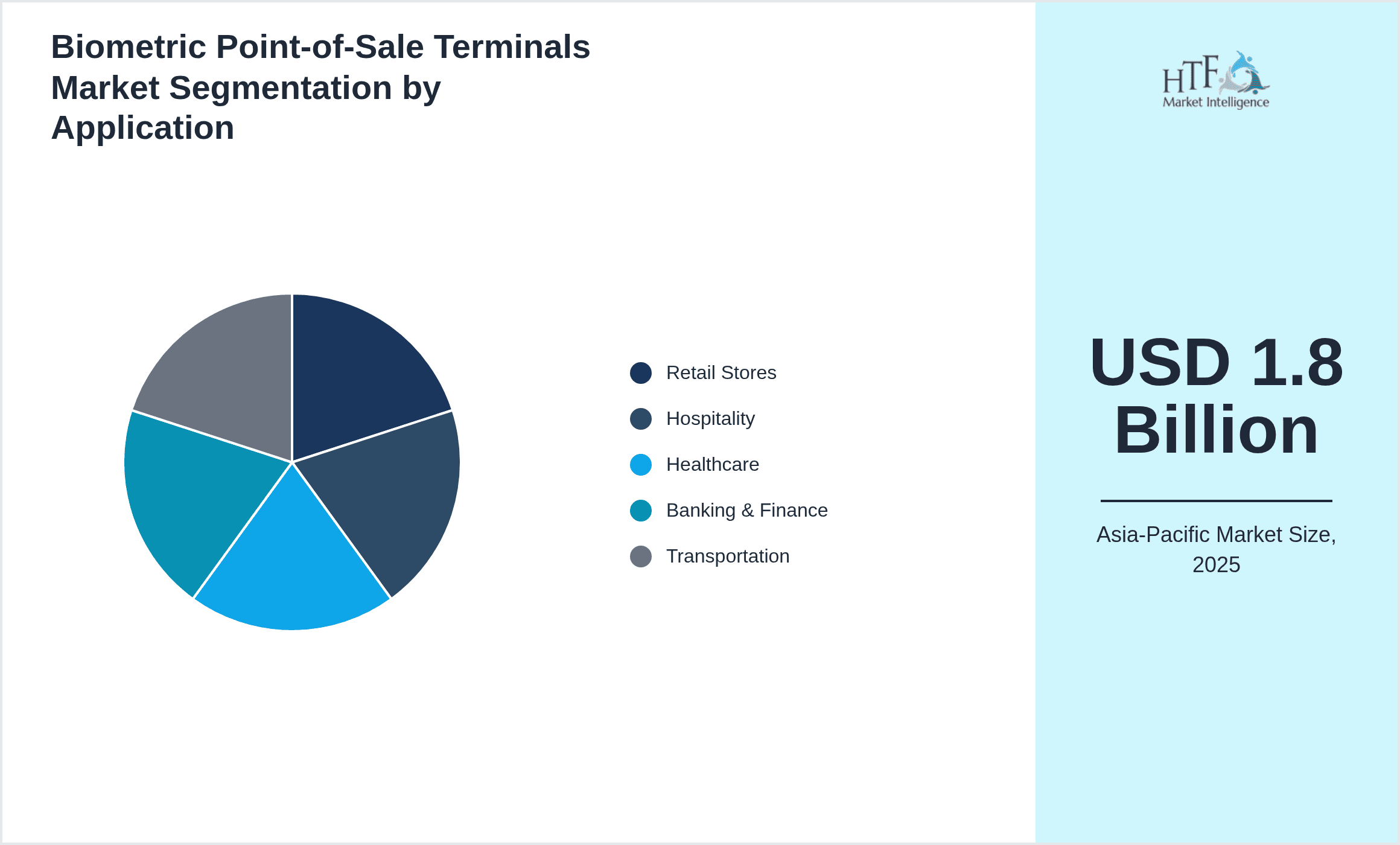
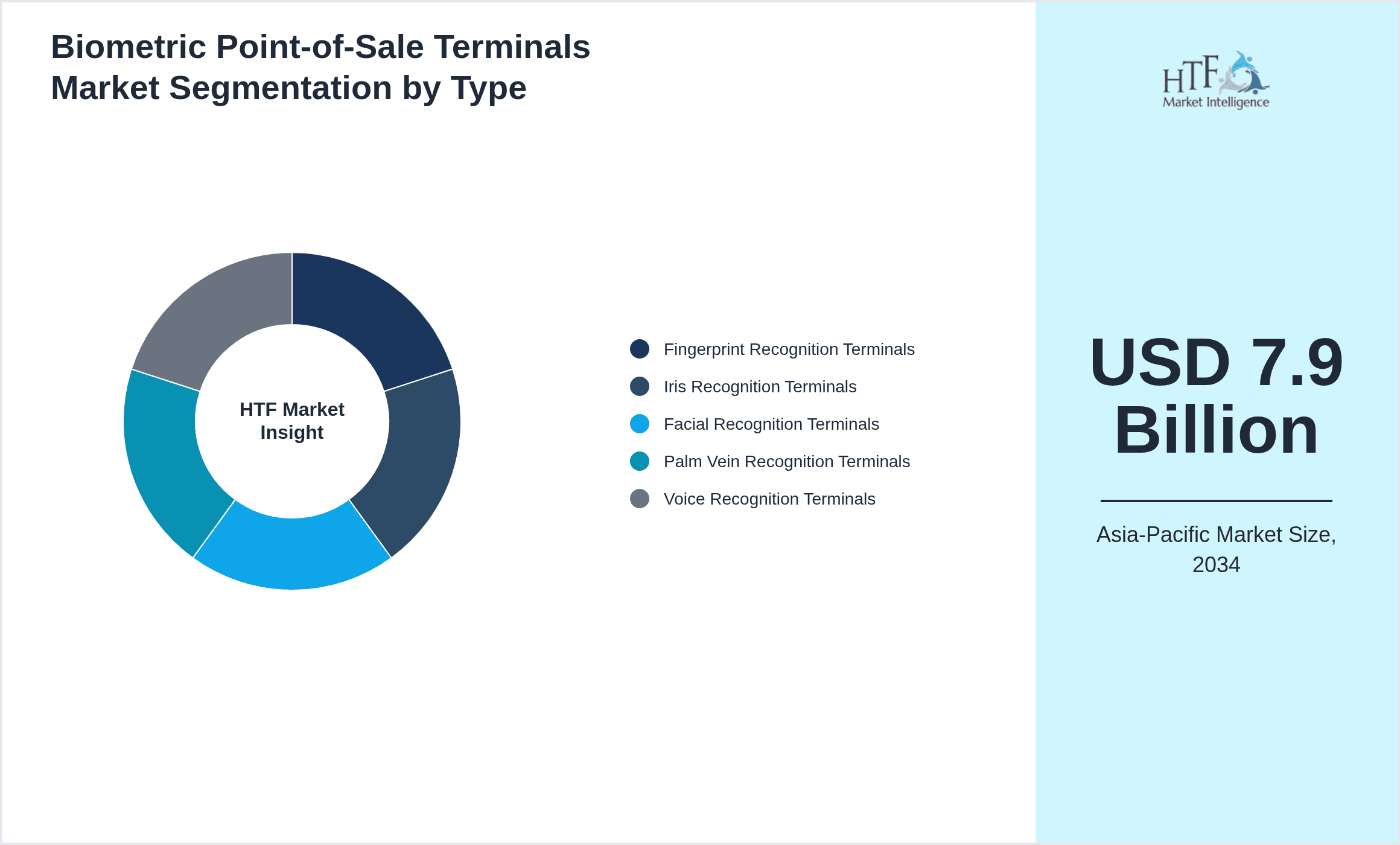
- •By Type
- ◦Fingerprint Recognition Terminals
- ◦Iris Recognition Terminals
- ◦Facial Recognition Terminals
- ◦Palm Vein Recognition Terminals
- ◦Voice Recognition Terminals
- •By Application
- ◦Retail Stores
- ◦Hospitality
- ◦Healthcare
- ◦Banking & Finance
- ◦Transportation
- •By Deployment Model
- ◦Cloud-based
- ◦On-premise
- ◦Hybrid
- •By End User
- ◦Small and Medium Enterprises (SMEs)
- ◦Large Enterprises
- ◦Government Organizations
Growth Dynamics
- •Growth Drivers: The surge in contactless payments and heightened security demands across Asia-Pacific have been major catalysts. Governments pushing cashless economies, especially in India and China, have accelerated biometric POS adoption. Retailers seek to reduce fraud and improve checkout speed. The growing smartphone penetration and rising consumer preference for biometric authentication also feed into growth. Yet, adoption remains uneven due to infrastructural challenges in rural or less developed regions, where network issues or lack of awareness slow uptake.
- •Trends: Facial recognition terminals are picking up faster than expected, especially in hospitality and banking sectors, tied to AI advances and better camera tech. Fingerprint recognition, while dominant, faces privacy concerns which some users voice hesitantly. Cloud-based deployments are becoming more common, yet many enterprises still prefer on-premise due to data security worries. Partnerships between biometric tech firms and payment solution providers rise, though integration complexity sometimes stalls deployments.
- •Restraints: Despite interest, high initial costs and compatibility issues with legacy POS systems hamper widespread use. Regulatory uncertainties around biometric data privacy vary significantly across Asia-Pacific countries, causing hesitation. Inconsistent infrastructure—especially internet connectivity—limits cloud-based solutions in some areas. Also, consumer mistrust around biometric data handling leads to slower acceptance in certain markets. Such factors create a patchy adoption landscape, with pockets of strong growth and other areas lagging behind.
- •Opportunities: Expansion into emerging Southeast Asian markets shows promise as retail modernization progresses. Multi-modal biometric terminals that combine fingerprint and facial recognition can address privacy and accuracy concerns, creating product differentiation. Integration with mobile wallets and e-commerce platforms opens new use cases. Government smart city initiatives and financial inclusion programs provide fertile ground for growth. Moreover, upscaling biometric POS in healthcare for patient verification and insurance claims processing is an under-explored niche with potential.
- •Challenges: Navigating the complex regulatory environment with varying data protection laws is a major hurdle. Ensuring interoperability across diverse POS infrastructure and varied biometric standards complicates deployments. User acceptance fluctuates with cultural attitudes towards biometrics, leading to inconsistent market penetration. Technical issues like false rejection rates, environmental impacts on sensors, and maintenance costs add to challenges. Companies also face competition from alternative authentication methods like QR codes or NFC payments that are simpler and cheaper.
Market Trends
- •The rise of AI-powered biometric recognition is reshaping terminal capabilities, enabling faster and more accurate authentication under varied lighting and angles. This trend aligns with increasing demand for frictionless customer experiences in retail and hospitality. Simultaneously, hybrid deployment models blending cloud and on-premise solutions are gaining traction, reflecting security concerns balanced against scalability needs. Regionally, Southeast Asia is embracing biometric POS more swiftly than anticipated, spurred by government digitization initiatives, though adoption remains patchy across rural-urban divides.
- •Another trend is the integration of biometric data with loyalty and CRM programs, allowing personalized marketing while enhancing security. However, privacy debates continue to impact rollout speed, with some markets enacting stricter data protection rules. Additionally, biometric POS terminals are increasingly bundled with mobile payment systems, reflecting consumer shifts towards smartphone-based transactions. Yet, the market sees uneven technology acceptance, with fingerprint recognition still prevailing despite growing facial recognition interest, partly due to cost and infrastructure considerations.
Market Opportunities
- •Rising demand for contactless and secure payment methods across Asia-Pacific's expanding retail sector presents vast growth avenues. Adoption in small and medium enterprises, often underserved by traditional POS providers, offers untapped potential. Emerging markets like Indonesia, Malaysia, and Vietnam are beginning to modernize payment infrastructure, creating entry points for biometric POS vendors. Additionally, healthcare and banking sectors increasingly require robust user verification, opening specialized application opportunities. Multi-modal biometric terminals that enhance accuracy and user trust can differentiate offerings. Collaboration with mobile wallet providers and fintech startups can foster innovative integrated solutions.
- •Government initiatives promoting digital payments and financial inclusion, especially in India and Southeast Asia, are creating conducive ecosystems. Smart city projects incorporating biometric authentication for public services and transit amplify opportunities for biometric POS terminals. Moreover, evolving AI and sensor technologies reduce hardware costs and improve reliability, making deployment feasible in cost-sensitive markets. Expansion through partnerships with local system integrators and channel partners can accelerate market penetration. Lastly, increasing awareness about fraud prevention and improved customer experience acts as a catalyst for greater adoption.
Market Challenges
The fragmented regulatory landscape across Asia-Pacific complicates compliance efforts, with countries having different stances on biometric data privacy, retention, and usage. This uncertainty deters some enterprises from investing heavily in biometric POS technology. Additionally, the initial capital expenditure for upgrading existing POS infrastructure to support biometric features is a deterrent, especially for SMEs. Technical issues such as sensor failures due to environmental factors (humidity, dust) affect reliability in certain regions. Consumer reluctance towards biometric data sharing, fueled by privacy concerns and lack of awareness, also slows adoption in several markets. Lastly, entrenched legacy payment systems and alternative authentication methods like QR codes or NFC present competitive challenges.
Regulatory Framework
Between 2018 and 2023, several Asia-Pacific countries introduced or updated biometric data protection laws impacting biometric POS terminal deployment. India’s Personal Data Protection Bill mandates strict consent and data localization requirements, affecting biometric data handling. China’s Cybersecurity Law enforces stringent controls on biometric data processing and cross-border data transfer. Japan updated its Act on the Protection of Personal Information to include biometric identifiers as sensitive data necessitating enhanced safeguards. Southeast Asian nations like Singapore and Malaysia have also enacted regulations emphasizing data privacy and security. Compliance with these evolving regulations remains a critical consideration for market participants to ensure lawful operation and consumer trust.
Market Intelligence
- •15th January 2024, Suprema Inc. launched its next-generation fingerprint recognition POS terminal integrated with AI-based spoof detection, targeting retail chains in Southeast Asia. The product features enhanced speed and accuracy, aiming to reduce fraud and improve user experience in high-volume transaction environments. Suprema’s strategic focus includes expanding its footprint in India and Indonesia, leveraging local partnerships for distribution and support. This launch reflects growing demand for secure, reliable biometric POS solutions amid increasing digital payment adoption. Source: Suprema Official Press Release
- •22nd October 2023, ZKTeco unveiled a facial recognition POS terminal with multi-modal biometric authentication combining facial and palm vein technologies. Designed for banking and healthcare sectors, the terminal addresses privacy concerns and improves authentication accuracy. The device supports cloud and on-premise deployment models, catering to diverse client needs across Asia-Pacific. ZKTeco aims to capitalize on growing demand for contactless payment solutions accelerated by the COVID-19 pandemic. The innovation enhances user convenience while maintaining stringent security standards. Source: ZKTeco Corporate Announcement
Mergers & Acquisitions
- •In March 2024, M2SYS Technology acquired a regional biometric sensor manufacturer based in Singapore to strengthen its hardware capabilities and expand product offerings in Southeast Asia. This strategic acquisition enables M2SYS to integrate advanced sensor technologies into its biometric POS terminals, enhancing accuracy and reducing costs. The acquisition also provides better access to local markets through established distribution channels. This move aligns with M2SYS’s goal to consolidate its position as a leading biometric solutions provider in Asia-Pacific by leveraging synergies in R&D and supply chain management.
- •August 2023 saw NEC Corporation complete its acquisition of a facial recognition software startup headquartered in India, aiming to bolster its AI-driven biometric POS terminal portfolio. The integration of the startup’s proprietary algorithms improves NEC’s product accuracy and speeds up authentication processes. This acquisition reflects NEC’s strategic intent to tap into the fast-growing Indian market and address the demand for multi-modal biometric authentication in retail and banking sectors. The deal enhances NEC’s competitive edge through technology innovation and regional market penetration.
Recent Industry News
- •10th February 2025, HID Global partnered with a leading Southeast Asian payment solutions provider to co-develop biometric POS terminals optimized for retail and transportation sectors. This collaboration aims to integrate HID’s advanced fingerprint and facial recognition technologies with regional payment infrastructures, enhancing security and customer convenience. The partnership includes plans for joint marketing and localized service support to accelerate adoption across Indonesia, Malaysia, and Vietnam. This strategic alliance reflects growing interest in biometric authentication as a standard for secure transactions. Source: HID Global Press Release
- •5th May 2025, Suprema Inc. announced the expansion of its manufacturing facility in South Korea to increase production capacity of biometric POS terminals. The expansion aims to meet rising demand from Asia-Pacific markets, particularly China and India. Suprema plans to introduce new product lines featuring AI-enhanced biometric sensors and cloud integration capabilities. This move supports Suprema’s growth strategy focused on innovation and regional supply chain resilience. The increased capacity is expected to improve delivery timelines and reduce costs. Source: Suprema Corporate News
- •18th July 2025, ZKTeco launched a cloud-based biometric POS terminal platform offering seamless software updates and remote management for retail clients across Asia-Pacific. The platform supports multiple biometric modalities and integrates with popular mobile wallets and loyalty programs. This launch responds to increasing demand for scalable, flexible POS solutions amid rapid digital payment adoption. Early adopters report improved operational efficiency and customer satisfaction. ZKTeco aims to leverage this innovation to strengthen its market share in emerging economies like India and Southeast Asia. Source: ZKTeco Official Announcement
- •30th September 2025, Paytm introduced biometric POS terminals featuring palm vein recognition for contactless payments targeting the Indian retail sector. The terminals are designed to comply with India’s strict data privacy regulations and integrate with Paytm’s extensive digital payments ecosystem. Early trials in metropolitan areas indicate positive user feedback on speed and convenience. Paytm plans to scale deployment nationally, focusing on SMEs and urban markets. This initiative highlights the growing role of biometric authentication in India’s transition to a cashless economy. Source: Paytm Press Release
Market Statistics
- •CAGR by 2034: 14.5%
- •Market Size by 2034: USD 7.9 Billion
- •Market Size in 2025: USD 2.3 Billion
- •Dominating Type: Fingerprint Recognition Terminals
- •Next-following Type: Facial Recognition Terminals
- •Dominating Application: Retail Stores
- •Next-following Application: Banking & Finance
- •Dominating Region: China
- •Second-leading Region with Highest Growth Rate: India
- •Dominating Country: China
Market Share Table
- •Market Share (%) of Dominating vs Followed Type
- ◦Fingerprint Recognition Terminals: 42%
- ◦Facial Recognition Terminals: 28%
- •Market Share (%) of Dominating vs Followed Application
- ◦Retail Stores: 38%
- ◦Banking & Finance: 26%
- •Growth Rate (%) of Dominating vs Followed Type
- ◦Fingerprint Recognition Terminals: 13.8%
- ◦Facial Recognition Terminals: 17.5%
- •Growth Rate (%) of Dominating vs Followed Application
- ◦Retail Stores: 14.2%
- ◦Banking & Finance: 15.8%
Top 5 Global Players
- •Suprema Inc. (South Korea)
- •ZKTeco (China)
- •Fujitsu Ltd. (Japan)
- •NEC Corporation (Japan)
- •M2SYS Technology (India)
Regional Outlook
The China currently holds a significant share of the market, primarily due to several key factors: increasing consumption rates, a burgeoning population, and robust economic momentum. These elements collectively drive demand, positioning this region as a leader in the market. On the other hand, India is rapidly emerging as the fastest-growing area within the industry. This remarkable growth can be attributed to swift infrastructure development, the expansion of various industrial sectors, and a marked increase in consumer demand. These dynamics make this region a crucial player in shaping future market growth.
In our report, we cover a comprehensive analysis of the following regions and countries:
- Japan
- China
- Southeast Asia
- India
- Australia
- South Korea
- Others
| Feature | Details |
|---|---|
| Base Year Market Size | USD 1.8 Billion |
| Forecast Year Market Size | USD 7.9 Billion |
| CAGR | 14.5% |
| Forecast Period | 2026 to 2033 |
| YoY Growth | 14.7% |
| Scope of Report | Market is segmented by Type (Fingerprint Recognition Terminals, Iris Recognition Terminals, Facial Recognition Terminals, Palm Vein Recognition Terminals, Voice Recognition Terminals), Application (Retail Stores, Hospitality, Healthcare, Banking & Finance, Transportation), Deployment Model (Cloud-based, On-premise, Hybrid), End User (Small and Medium Enterprises (SMEs), Large Enterprises, Government Organizations) |
| Regions Covered | Japan, China, Southeast Asia, India, Australia, South Korea, Others |
| Key Companies | Nagarro Inc. (India), Suprema Inc. (South Korea), ZKTeco (China), M2SYS Technology (India), Fujitsu Ltd. (Japan), NEC Corporation (Japan), IDEX Biometrics ASA (Norway, Asia-Pacific Operations), HID Global (United States, Asia-Pacific Branch), Crossmatch Technologies (United States, Asia-Pacific Subsidiary), Aware Inc. (United States, Asia-Pacific Presence), Synaptics Incorporated (United States, Asia-Pacific Operations), Aware Inc. (United States, Asia-Pacific Presence), Anviz Global (China), Sagemcom (France, Asia-Pacific Operations), Honeywell International Inc. (United States, Asia-Pacific Subsidiary), Morpho (Safran Group) (France, Asia-Pacific Branch), VeriFone Systems Inc. (United States, Asia-Pacific Segment), Square Inc. (United States, Asia-Pacific Expansion), Ingenico Group (France, Asia-Pacific Operations), Paytm (India) |
Asia-Pacific Biometric Point-of-Sale Terminals Market - Outlook 2024-2034 - Table of Contents
Frequently Asked Questions (FAQ):
The Compact Track Loaders market is projected to grow at a CAGR of 6.8% from 2025 to 2030, driven by increasing demand in construction and agricultural sectors.
North America currently leads the market with approximately 45% market share, followed by Europe at 28% and Asia-Pacific at 22%. The remaining regions account for 5% of the global market.
Key growth drivers include increasing construction activities, rising demand for versatile equipment in agriculture, technological advancements in track loader design, and growing preference for compact equipment in urban construction projects.