
GCC Vertical Cartoners Market - Middle East Size & Outlook 2025-2034
GCC Vertical Cartoners Market is segmented by Type (Automatic Vertical Cartoners, Semi-Automatic Vertical Cartoners, Manual Vertical Cartoners), Application (Pharmaceutical, Food & Beverage, Cosmetics, Chemicals, Others), End User (Large-Scale Manufacturers, Small & Medium Enterprises (SMEs), Contract Packaging Providers), Distribution Channel (Direct Sales, Distributors & Dealers, Online Platforms), and Geography (Bahrain, Kuwait, Oman, Qatar, Saudi Arabia, United Arab Emirates)
Pricing
Report Overview
Executive Summary
- •The GCC Vertical Cartoners market involves advanced packaging machinery designed for vertical carton erection, filling, and sealing, primarily serving pharmaceutical, food & beverage, cosmetics, and chemical industries. The machines vary from manual to fully automatic systems, catering to diverse production capacities and operational needs.
- •Key market highlights include strong regional industrial growth, rising FMCG demand, and regulatory pressures driving adoption of automated vertical cartoners, with the market forecasted to grow at a CAGR of approximately 8.65% through 2034, reaching nearly USD 0.98 Billion.
- •This market is strategically important to manufacturers and packaging service providers in the GCC as it enhances packaging efficiency, reduces labor dependency, and ensures compliance with international quality standards, thereby supporting export competitiveness and domestic consumption growth.

Competitive Landscape
The GCC Vertical Cartoners market is characterized by moderate competition with several multinational and regional players vying for market share through innovation, customization, and service excellence. Companies focus on technological advancements such as IoT-enabled equipment and modular designs to enhance operational flexibility. Competition is intensified by the need for energy-efficient and compact machines tailored for the GCC’s diverse industries, including pharmaceuticals and food processing. Market players adopt strategic partnerships and localized manufacturing to reduce costs and improve delivery timelines. Pricing strategies balance between automation levels and affordability for small to medium enterprises. The rivalry also extends to after-sales services and maintenance contracts, crucial for customer retention in this capital-intensive market. Overall, competitive dynamics are shaped by investment in R&D, regional presence, and ability to meet stringent regulatory standards.
Leading Companies in GCC Vertical Cartoners Market
- •IMA Group (Italy)
- •Bosch Packaging Technology (Germany)
- •Marchesini Group (Italy)
- •Coesia Group (Italy)
- •Syntegon Technology GmbH (Germany)
- •Tetra Pak International S.A. (Switzerland)
- •Krones AG (Germany)
- •Multivac Group (Germany)
- •Optima Packaging Group GmbH (Germany)
- •Paxiom Group (UK)
- •Mespack (Spain)
- •Barry-Wehmiller Companies Inc. (USA)
- •PAC Machinery (UK)
- •All-Fill Inc. (USA)
- •TNA Solutions (Australia)
- •Nichrome India Ltd. (India)
- •Ulma Packaging (Spain)
- •Hayssen Flexible Systems (USA)
- •Pester Pac Automation GmbH & Co. KG (Germany)
- •Jornen Machinery (China)

Market Breakdown
- •By Type
- ◦Automatic Vertical Cartoners
- ◦Semi-Automatic Vertical Cartoners
- ◦Manual Vertical Cartoners
- •By Application
- ◦Pharmaceutical
- ◦Food & Beverage
- ◦Cosmetics
- ◦Chemicals
- ◦Others
- •By End User
- ◦Large-Scale Manufacturers
- ◦Small & Medium Enterprises (SMEs)
- ◦Contract Packaging Providers
- •By Distribution Channel
- ◦Direct Sales
- ◦Distributors & Dealers
- ◦Online Platforms
Growth Drivers
- •The GCC Vertical Cartoners market growth is propelled by rapid industrialization and expanding pharmaceutical and FMCG sectors, necessitating efficient, automated packaging solutions to meet increasing product demand and regulatory requirements. Government investments in healthcare infrastructure and food safety standards further accelerate demand.
- •Rising consumer preference for packaged and branded products in the GCC drives adoption of vertical cartoners that improve packaging speed and quality, enhancing shelf appeal and product protection, which is critical in the competitive retail environment.
- •Technological advancements, including IoT integration and smart sensors in vertical cartoners, enable real-time monitoring, predictive maintenance, and reduced downtime, significantly boosting operational efficiency and attracting end-users towards automated solutions.
- •Increasing labor costs and workforce shortages in the GCC stimulate the shift towards automation, prompting manufacturers to invest in advanced vertical cartoning machinery that reduces manual intervention and enhances productivity.
- •Growing exports from GCC countries to global markets enforce stringent quality and packaging standards, making automated vertical cartoners essential to comply with international regulations and maintain competitive advantage.

Market Trends
- •A notable trend in the GCC Vertical Cartoners market is the integration of Industry 4.0 technologies, including AI and IoT sensors, which facilitate smart packaging lines with enhanced traceability and data analytics capabilities, improving overall production efficiency.
- •Sustainability is gaining prominence, with manufacturers adopting eco-friendly carton materials and energy-efficient machinery to align with regional environmental regulations and corporate social responsibility goals.
- •Customization of vertical cartoners to accommodate diverse product sizes and materials is increasing, enabling GCC manufacturers to cater to niche markets and seasonal product variations effectively.
- •Collaborations between equipment suppliers and packaging material producers are fostering innovations in end-to-end packaging solutions, enhancing performance and reducing operational complexity for GCC clients.
- •The trend towards modular and compact vertical cartoning systems allows easier integration into existing production lines, appealing to SMEs and contract packagers within the GCC region.
Market Opportunities
- •Expanding pharmaceutical manufacturing hubs in Saudi Arabia and UAE offer significant opportunities for vertical cartoners tailored to high-precision and sterile packaging requirements, tapping into the growing demand for healthcare products.
- •The burgeoning e-commerce and retail sectors in the GCC create demand for customized packaging solutions, presenting opportunities for cartoners capable of handling variable carton sizes and designs with quick changeovers.
- •Investments in food processing industries, particularly for export-oriented products, open avenues for advanced vertical cartoners that ensure compliance with international food safety and packaging standards.
- •Adoption of digital twin technology and predictive maintenance services in packaging equipment offers aftermarket service revenue streams for manufacturers and suppliers in the GCC region.
- •Partnerships with local distributors and service providers can enable global manufacturers to expand their footprint and cater effectively to diverse GCC markets with tailored product offerings and support services.
Market Challenges
- •High initial capital expenditure for fully automated vertical cartoning systems poses a significant barrier for SMEs in the GCC, limiting market penetration and adoption rates despite the evident operational benefits.
- •Lack of skilled technical workforce to operate and maintain sophisticated vertical cartoning machinery in certain GCC countries hinders smooth integration and long-term utilization of advanced systems.
- •Supply chain disruptions and dependence on imports for critical machinery components can delay equipment delivery and after-sales services, impacting customer satisfaction and market growth.
- •Variations in regulatory standards across GCC countries create complexity for manufacturers and suppliers aiming for region-wide market coverage, necessitating customized compliance solutions.
- •Price sensitivity in some GCC sectors challenges vendors to balance automation sophistication with affordability, often requiring flexible pricing and financing models to capture broader market segments.
Regulatory Overview
- •Recent regulatory updates in the GCC emphasize compliance with ISO packaging standards and GCC Standardization Organization (GSO) guidelines, mandating strict quality control and safety protocols for packaging machinery deployed in pharmaceutical and food sectors.
- •Environmental regulations targeting energy efficiency and waste reduction have led to incentives for adopting eco-friendly and energy-saving vertical cartoners, encouraging manufacturers to upgrade existing equipment in line with sustainability goals.
- •Import regulations have been streamlined in key GCC countries like UAE and Saudi Arabia to facilitate smoother customs clearance for high-tech packaging machinery, accelerating market availability and deployment cycles.
- •Mandatory certification for machinery safety and electromagnetic compatibility (EMC) under GCC conformity assessment programs ensures that vertical cartoners meet regional operational standards, enhancing user safety and reliability.
- •Government initiatives supporting industrial automation and 'Made in GCC' campaigns bolster local assembly and manufacturing of packaging equipment, potentially reducing dependency on imports and fostering regional supply chains.
Industry Insights
- •The GCC Vertical Cartoners market witnessed significant innovation with Bosch Packaging Technology unveiling a new automatic vertical cartoning machine in March 2023, featuring enhanced speed, precision, and IoT-enabled monitoring tailored for pharmaceutical packaging. The machine supports quick format changes and integrates seamlessly with upstream and downstream packaging lines, catering to the GCC’s growing pharmaceutical manufacturing hubs. This launch underscores the trend towards smart packaging solutions that reduce downtime and operational costs in the region.
- •In November 2022, the Marchesini Group expanded its presence in the GCC by establishing a regional service center in Dubai to provide faster maintenance and customized packaging solutions. This strategic move aims to strengthen client relationships across the GCC and support the rising demand for semi-automatic vertical cartoners among SMEs. The center enhances local technical support capabilities, offering training and spare parts management, which are critical for sustaining equipment uptime and client satisfaction.
Mergers & Acquisitions
- •In June 2023, Syntegon Technology GmbH completed the acquisition of a regional packaging solutions provider based in Dubai, aiming to consolidate its market leadership in the GCC vertical cartoners segment. This acquisition enables Syntegon to expand its product portfolio and service network, facilitating quicker market penetration and tailored solutions for GCC-based pharmaceutical and FMCG companies. The integration focuses on leveraging local expertise and global technology to accelerate innovation and customer responsiveness in the region.
- •In January 2024, Coesia Group acquired a UAE-based contract packaging firm specializing in vertical cartoning services, enhancing its operational footprint in the GCC. The acquisition strengthens Coesia's service offerings and provides access to a broader client base in the Middle East. This strategic move is expected to improve service delivery efficiency and enable scalable packaging solutions aligned with GCC market growth dynamics.
Recent Industry News
- •15th March 2024, Bosch Packaging Technology launched a next-generation automatic vertical cartoning machine at Gulfood Manufacturing Expo in Dubai, featuring AI-driven quality control and enhanced throughput capabilities designed for pharmaceutical and food packaging sectors in the GCC. This innovation addresses regional demands for high-speed, reliable packaging automation. Source: Official Bosch Packaging press release.
- •22nd October 2023, IMA Group signed a strategic partnership with a leading Saudi Arabian packaging distributor to expand its vertical cartoners presence across the GCC. The partnership aims to improve regional customer support and expedite equipment deployment, catering to rising demand in pharmaceuticals and FMCG industries. Source: IMA Group corporate announcement.
- •3rd July 2022, Marchesini Group introduced a semi-automatic vertical cartoner optimized for small and medium enterprises at the Saudi Manufacturing and Supply Chain Expo, focusing on cost-effectiveness and modular design. The product launch was well received by local manufacturers seeking flexible automation solutions. Source: Marchesini Group official news.
- •10th November 2021, Syntegon Technology GmbH expanded its service capabilities in the GCC by opening a new technical center in Abu Dhabi, enhancing maintenance and spare parts support for vertical cartoning equipment to meet growing regional demand. Source: Syntegon corporate news.
Market Statistics
- •CAGR by 2034: 8.65%
- •Market Size by 2034: USD 0.98 Billion
- •Market Size in 2025: USD 0.45 Billion
- •Dominating Type: Automatic Vertical Cartoners
- •Next-Following Type: Semi-Automatic Vertical Cartoners
- •Dominating Application: Pharmaceutical
- •Next-Following Application: Food & Beverage
- •Dominating Region: Saudi Arabia
- •Second-Leading Region: United Arab Emirates
- •Region with Highest Growth Rate: United Arab Emirates
- •Dominating Country: Saudi Arabia
Market Share Table
- •Market Share (%) by Type: Automatic Vertical Cartoners (55%), Semi-Automatic Vertical Cartoners (30%)
- •Market Share (%) by Application: Pharmaceutical (48%), Food & Beverage (35%)
- •Growth Rate (%) by Type: Automatic Vertical Cartoners (7.8%), Semi-Automatic Vertical Cartoners (10.2%)
- •Growth Rate (%) by Application: Pharmaceutical (8.4%), Food & Beverage (9.1%)
Top 5 Global Players
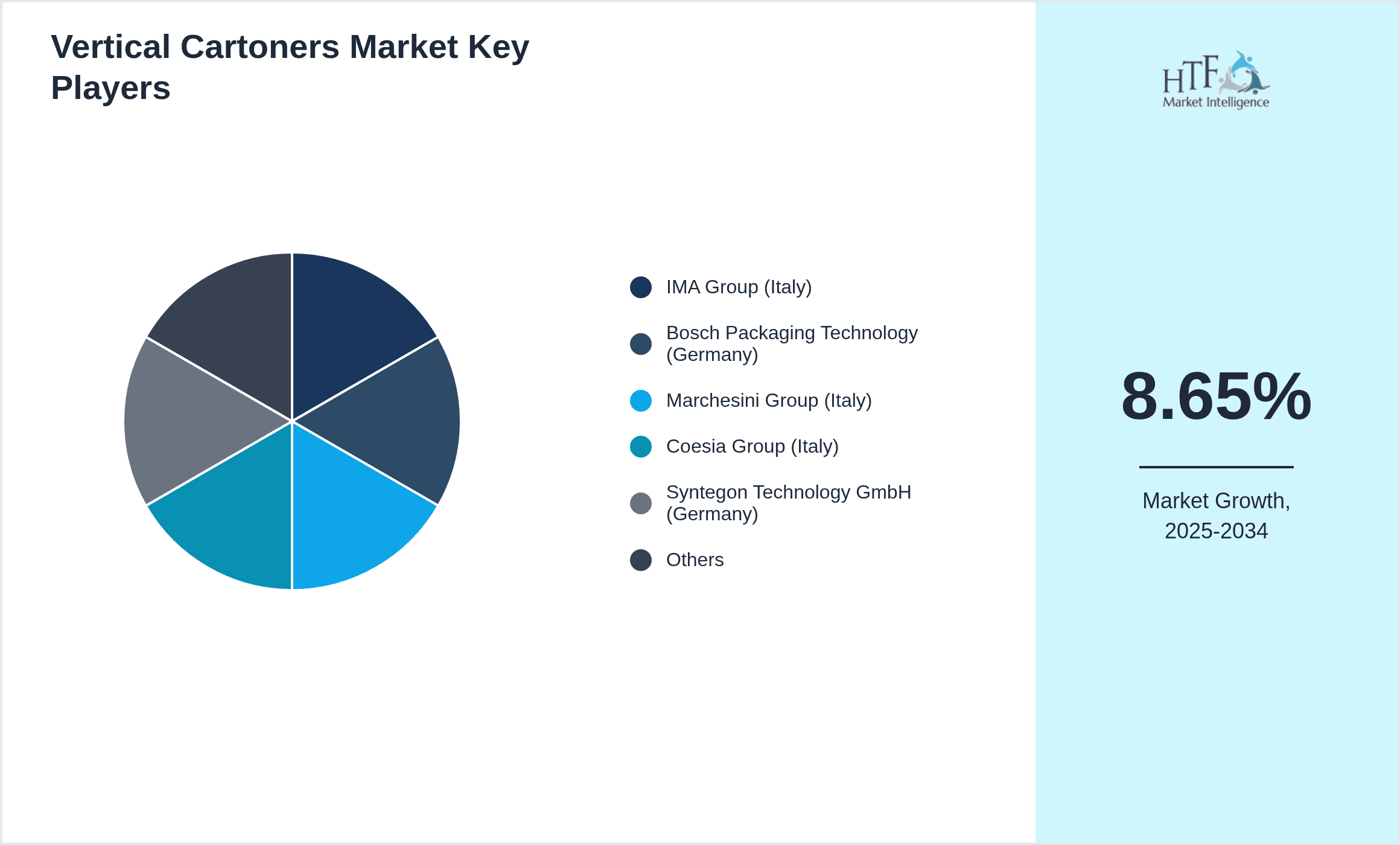
- •IMA Group (Italy)
- •Bosch Packaging Technology (Germany)
- •Marchesini Group (Italy)
- •Coesia Group (Italy)
- •Syntegon Technology GmbH (Germany)
Regional Outlook
The Saudi Arabia currently holds a significant share of the market, primarily due to several key factors: increasing consumption rates, a burgeoning population, and robust economic momentum. These elements collectively drive demand, positioning this region as a leader in the market. On the other hand, United Arab Emirates is rapidly emerging as the fastest-growing area within the industry. This remarkable growth can be attributed to swift infrastructure development, the expansion of various industrial sectors, and a marked increase in consumer demand. These dynamics make this region a crucial player in shaping future market growth.
In our report, we cover a comprehensive analysis of the following regions and countries:
- Bahrain
- Kuwait
- Oman
- Qatar
- Saudi Arabia
- United Arab Emirates
| Feature | Details |
|---|---|
| Base Year Market Size | USD 0.45 Billion |
| Forecast Year Market Size | USD 0.98 Billion |
| CAGR | 8.65% |
| Forecast Period | 2026 to 2033 |
| YoY Growth | 8.32% |
| Scope of Report | Market is segmented by Type (Automatic Vertical Cartoners, Semi-Automatic Vertical Cartoners, Manual Vertical Cartoners), Application (Pharmaceutical, Food & Beverage, Cosmetics, Chemicals, Others), End User (Large-Scale Manufacturers, Small & Medium Enterprises (SMEs), Contract Packaging Providers), Distribution Channel (Direct Sales, Distributors & Dealers, Online Platforms) |
| Regions Covered | Bahrain, Kuwait, Oman, Qatar, Saudi Arabia, United Arab Emirates |
| Key Companies | IMA Group (Italy), Bosch Packaging Technology (Germany), Marchesini Group (Italy), Coesia Group (Italy), Syntegon Technology GmbH (Germany), Tetra Pak International S.A. (Switzerland), Krones AG (Germany), Multivac Group (Germany), Optima Packaging Group GmbH (Germany), Paxiom Group (UK), Mespack (Spain), Barry-Wehmiller Companies Inc. (USA), PAC Machinery (UK), All-Fill Inc. (USA), TNA Solutions (Australia), Nichrome India Ltd. (India), Ulma Packaging (Spain), Hayssen Flexible Systems (USA), Pester Pac Automation GmbH & Co. KG (Germany), Jornen Machinery (China) |
GCC Vertical Cartoners Market - Middle East Size & Outlook 2025-2034 - Table of Contents
Frequently Asked Questions (FAQ):
The Compact Track Loaders market is expected to see value worth 5.3 Billion in 2025.
North America currently leads the market with approximately 45% market share, followed by Europe at 28% and Asia-Pacific at 22%. The remaining regions account for 5% of the global market.
Key growth drivers include increasing construction activities, rising demand for versatile equipment in agriculture, technological advancements in track loader design, and growing preference for compact equipment in urban construction projects.