
EMEA Electric Motorcycle Lithium Battery Market Size, Growth & Revenue 2025-2034
EMEA Electric Motorcycle Lithium Battery Market is segmented by Type (Lithium-ion, Lithium Polymer, Lithium Iron Phosphate, Solid-State Lithium Batteries), Application (Commuter Motorcycles, Off-Road Motorcycles, Delivery Vehicles, Two-Wheel Scooters), By Battery Capacity (Below 10 kWh, 10-20 kWh, Above 20 kWh), By Distribution Channel (OEM, Aftermarket), and Geography (Germany, France, Italy, United Kingdom, Nordics, Rest of Europe, South Africa, Egypt, Turkey, United Arab Emirates, Israel, Saudi Arabia, Rest of EMEA)
Pricing
Report Overview
Market Definition & Scope
- •The EMEA Electric Motorcycle Lithium Battery Market focuses on lithium-based batteries powering electric motorcycles across Europe, the Middle East, and Africa, covering multiple battery chemistries and capacities.
- •It includes applications in commuter, off-road, and delivery motorcycles, supporting both OEM and aftermarket distribution channels, reflecting a broad industry scope.
- •Market boundaries encompass battery technology development, manufacturing, supply chains, and integration with electric two-wheelers, driven by regional policies and infrastructure evolution.
- •The market plays a vital role in advancing sustainable mobility solutions, energy efficiency, and emission reduction initiatives across EMEA’s diverse transportation ecosystems.

The Future of Revolutionising Electric Mobility with Lithium Battery Technology
- •Lithium battery advancements are central to transforming electric motorcycle performance, range, and affordability in EMEA’s expanding electric vehicle market.
- •The synergy between evolving battery tech and regional urban mobility demands sets the stage for accelerated adoption and industry growth.
- •This transformation drives a new era of clean, efficient, and connected transportation solutions across EMEA’s urban and rural environments.
Industry Challenges in EMEA Electric Motorcycle Battery Adoption
- •High initial battery costs limit consumer access and slow mass adoption in price-sensitive markets within EMEA.
- •Inadequate charging infrastructure, especially in emerging EMEA regions, constrains operational convenience and use case expansion.
- •Regulatory fragmentation and inconsistent standards across countries create barriers to seamless market growth and cross-border trade.
Solid-State Lithium Batteries: The Game Changer
- •Solid-state technology offers higher energy density, enhanced safety, and longer lifecycle compared to conventional lithium-ion batteries.
- •This innovation reduces battery weight and charging times, delivering cost-efficiency over vehicle life and operational expenses.
- •End users benefit through extended range, improved reliability, and reduced maintenance, accelerating electric motorcycle penetration in EMEA.
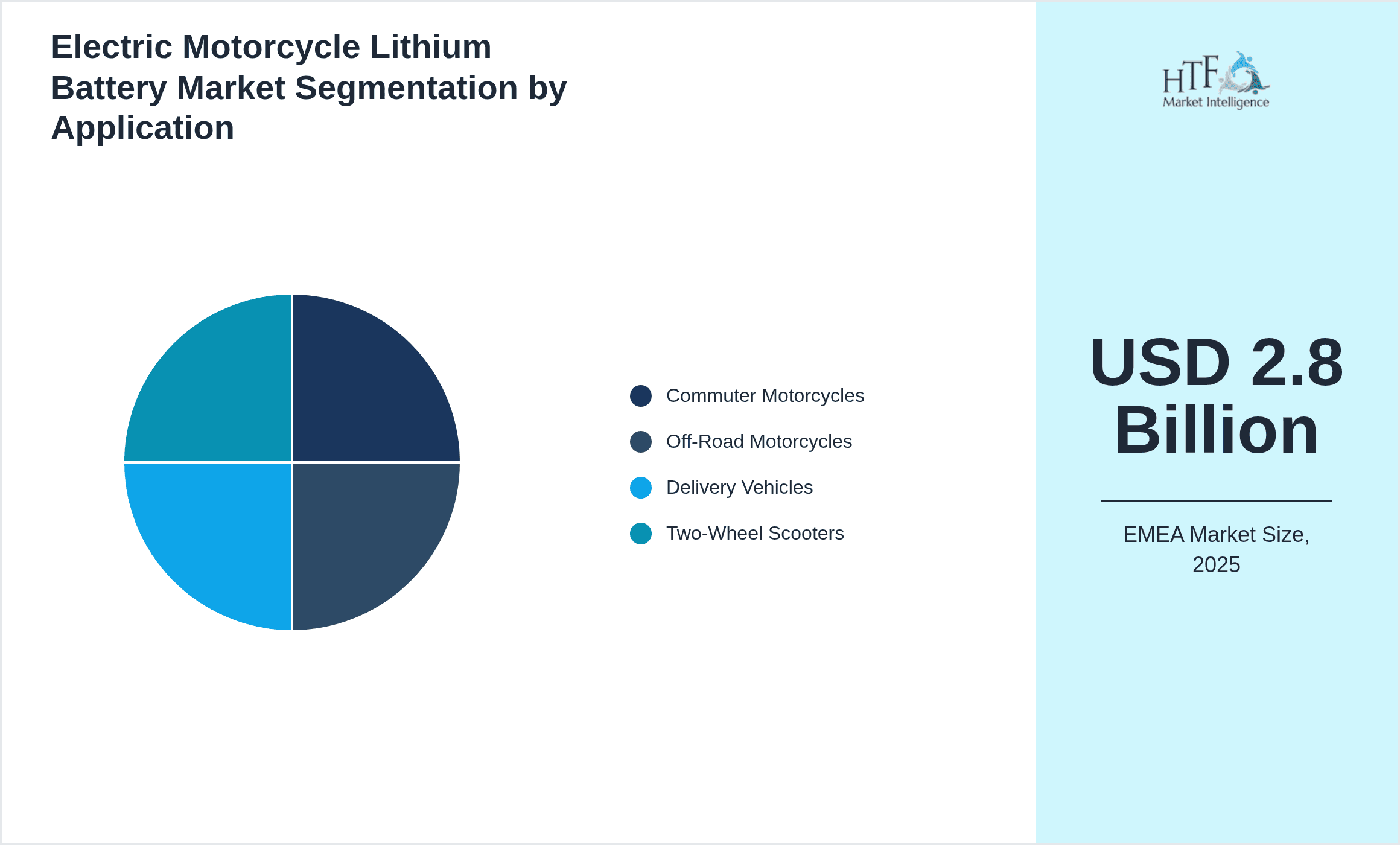
Market Segmentation
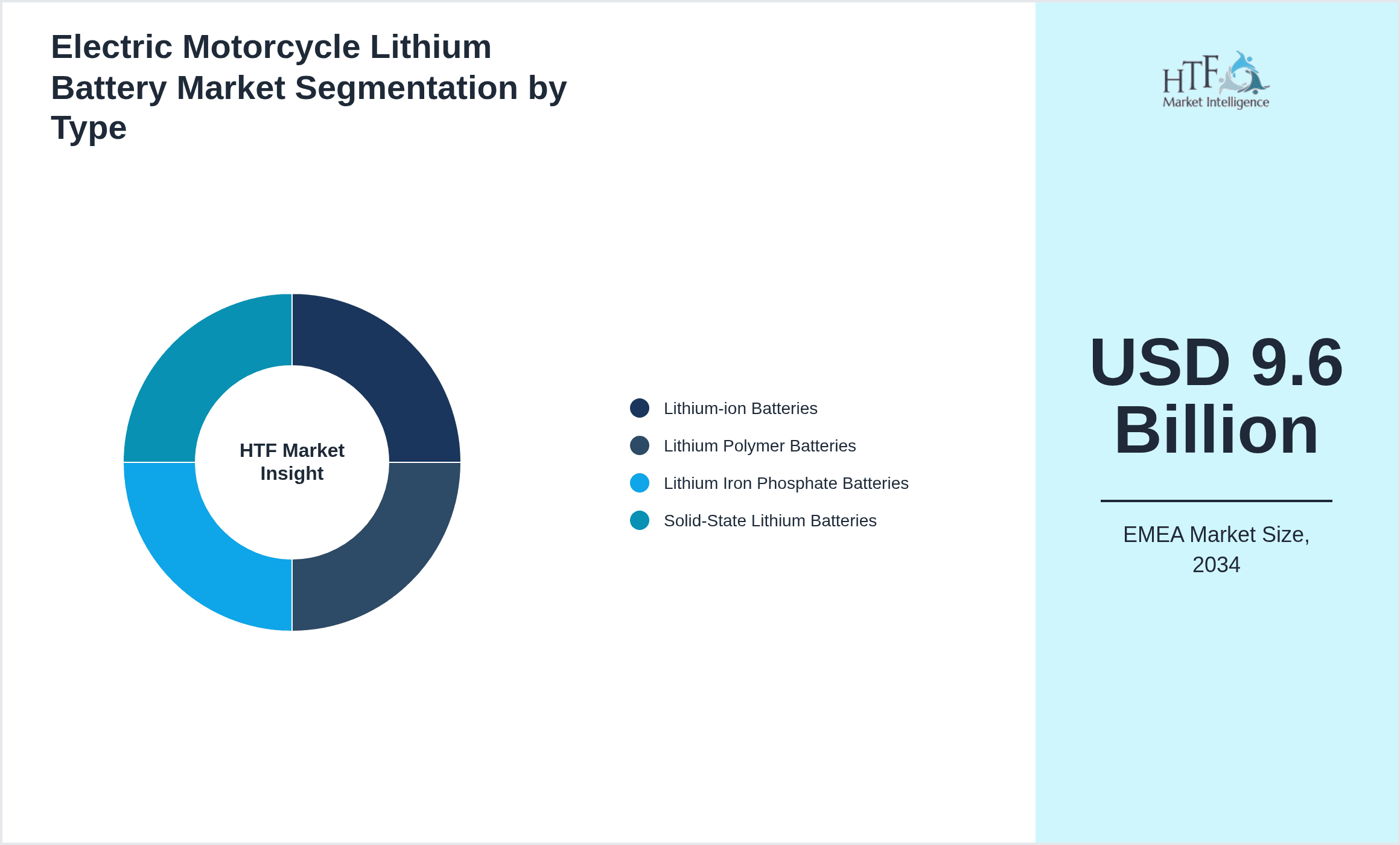
- •By Type
- ◦Lithium-ion Batteries
- ◦Lithium Polymer Batteries
- ◦Lithium Iron Phosphate Batteries
- ◦Solid-State Lithium Batteries
- •By Application
- ◦Commuter Motorcycles
- ◦Off-Road Motorcycles
- ◦Delivery Vehicles
- ◦Two-Wheel Scooters
- •By Battery Capacity
- ◦Below 10 kWh
- ◦10-20 kWh
- ◦Above 20 kWh
- •By Distribution Channel
- ◦OEM
- ◦Aftermarket
Market Explosion: A Rapidly Growing Sector
- •The market value reached USD 2.8 billion in 2025, reflecting strong regional demand for electric motorcycles and battery solutions.
- •Projections estimate growth to USD 9.6 billion by 2034, supported by rising adoption and technological advances.
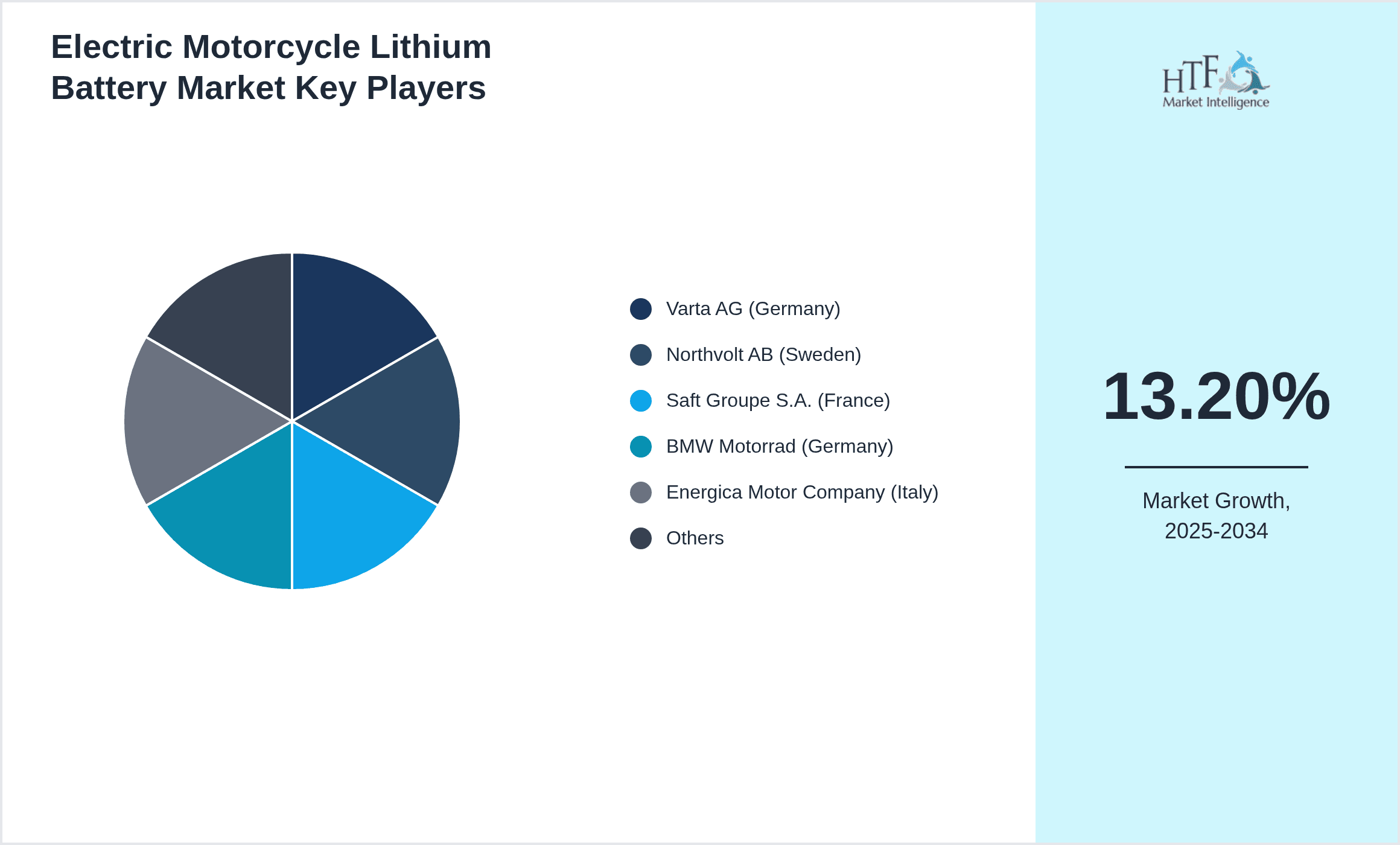
- •The sector is expanding at a robust CAGR of 13.2%, with year-over-year growth averaging 12.7%.
Key Drivers of Growth
- •Progressive government incentives and emissions regulations throughout Europe and the Middle East stimulate market uptake.
- •Strategic collaborations between battery manufacturers and motorcycle OEMs enhance product development and market reach.
- •Continuous technological innovation improves battery efficiency, safety, and lifecycle, addressing consumer and commercial needs.
Dominant Segments
- •Lithium-ion batteries lead the product segment due to their balance of performance, cost, and availability.
- •Commuter motorcycles dominate application demand, driven by urban mobility trends and last-mile delivery growth.
- •OEM distribution channels remain the primary business model, leveraging integrated supply chains and partnerships.
Leading the Charge: Key Players and Innovations
- •Varta AG (Germany): Pioneering high-capacity lithium-ion battery cells optimized for electric motorcycles with enhanced thermal management.
- •Northvolt AB (Sweden): Expanding solid-state battery pilot production facilities targeting safer and longer-lasting motorcycle batteries.
- •Saft Groupe S.A. (France): Developing modular battery packs with rapid charging capabilities tailored for delivery fleet applications.
- •BMW Motorrad (Germany): Integrating proprietary lithium polymer battery technology in new electric motorcycle models for improved range.
- •Energica Motor Company (Italy): Innovating battery thermal regulation systems to boost performance in high-speed electric motorcycles.
- •Hero Electric (United Kingdom): Launching battery leasing programs to reduce upfront costs and enhance customer accessibility.
- •IONITY GmbH (Germany): Collaborating on fast-charging infrastructure expansion supporting electric motorcycle adoption across Europe.
- •Ferroamp Elektronik AB (Sweden): Introducing smart battery management systems enabling real-time monitoring and optimization.
- •Zero Motorcycles (UK subsidiary): Advancing solid-state battery integration to extend vehicle range and charging speed.
Competitive Landscape
The EMEA market is characterized by intense competition among established battery manufacturers, motorcycle OEMs, and technology innovators. Companies emphasize R&D investments to enhance energy density, safety, and cost-efficiency. Strategic partnerships and localized production networks are common to optimize supply chains and meet diverse regional regulations. Market rivalry drives rapid product innovation cycles, with a focus on solid-state and lithium polymer technologies. Differentiation arises through battery management systems, modular designs, and customer financing models. Pricing strategies balance premium quality with affordability to capture emerging customer bases. Regional players leverage government incentives and sustainability trends to strengthen market positioning. The competitive environment is dynamic, with frequent collaborations and acquisitions shaping future market leadership and expanding technological frontiers.
Future Outlook: A Connected and Sustainable Ecosystem
- •Expansion into smart battery solutions and integration with IoT-enabled electric motorcycles will define future growth.
- •Germany will maintain dominance due to strong industrial base and regulatory support, while the UK leads fastest adoption rates.
- •Long-term transformation includes circular economy practices, battery recycling innovations, and regional infrastructure scaling.
The Road Ahead: Embrace the Lithium Battery Revolution
- •The EMEA electric motorcycle lithium battery market is set to transform regional mobility by enabling cleaner, efficient transportation solutions.
- •Sustained innovation and strategic investments will secure long-term industry growth and a sustainable electrified transport ecosystem.
Regional Outlook
The Germany currently holds a significant share of the market, primarily due to several key factors: increasing consumption rates, a burgeoning population, and robust economic momentum. These elements collectively drive demand, positioning this region as a leader in the market. On the other hand, United Kingdom is rapidly emerging as the fastest-growing area within the industry. This remarkable growth can be attributed to swift infrastructure development, the expansion of various industrial sectors, and a marked increase in consumer demand. These dynamics make this region a crucial player in shaping future market growth.
In our report, we cover a comprehensive analysis of the following regions and countries:
- Germany
- France
- Italy
- United Kingdom
- Nordics
- Rest of Europe
- South Africa
- Egypt
- Turkey
- United Arab Emirates
- Israel
- Saudi Arabia
- Rest of EMEA
| Feature | Details |
|---|---|
| Base Year Market Size | USD 2.8 Billion |
| Forecast Year Market Size | USD 9.6 Billion |
| CAGR | 13.2% |
| Forecast Period | 2026 to 2033 |
| YoY Growth | 12.7% |
| Regions Covered | Germany, France, Italy, United Kingdom, Nordics, Rest of Europe, South Africa, Egypt, Turkey, United Arab Emirates, Israel, Saudi Arabia, Rest of EMEA |
| Key Companies | Varta AG (Germany), Northvolt AB (Sweden), Saft Groupe S.A. (France), BMW Motorrad (Germany), Energica Motor Company (Italy), Hero Electric (United Kingdom), IONITY GmbH (Germany), Ferroamp Elektronik AB (Sweden), Zero Motorcycles (UK subsidiary) |
EMEA Electric Motorcycle Lithium Battery Market Size, Growth & Revenue 2025-2034 - Table of Contents
Frequently Asked Questions (FAQ):
The Compact Track Loaders market is expected to see value worth 5.3 Billion in 2025.
North America currently leads the market with approximately 45% market share, followed by Europe at 28% and Asia-Pacific at 22%. The remaining regions account for 5% of the global market.
Key growth drivers include increasing construction activities, rising demand for versatile equipment in agriculture, technological advancements in track loader design, and growing preference for compact equipment in urban construction projects.