
Europe Bio Based Automotive Interior Parts Market Size, Growth & Revenue 2025-2034
Europe Bio Based Automotive Interior Parts Market is segmented by Type (Biopolymers, Natural Fibers, Bio-Composites, Bio-Based Foams, Bio-Based Adhesives), Application (Dashboard Components, Door Panels, Seat Covers, Headliners, Flooring), Material Source (Plant-Based Fibers, Recycled Biomass, Algae Derived Polymers, Wood-Based Composites), Vehicle Type (Passenger Cars, Commercial Vehicles, Electric Vehicles), Production Technology (Injection Molding, Compression Molding, 3D Printing), and Geography (Germany, France, The United Kingdom, BeNeLux, Spain, Italy, NORDIC, CEE, Others)
Pricing
Report Overview
Executive Summary
- •The Green Revolution Inside Your Car: Europe’s bio-based automotive interior parts market redefines sustainability by transforming renewable materials into high-performance vehicle components, merging ecological responsibility with automotive innovation.
- •This market thrives on replacing conventional plastic interiors with bio-composites and natural fibers, driven by Europe's strict environmental mandates and rising consumer eco-consciousness, projecting a robust CAGR above 13% through 2034.
- •Bio-based interiors represent more than materials—they embody Europe’s strategic commitment to circular economy principles, reducing emissions while enhancing vehicle aesthetics and safety, pivotal for automakers and regulators alike.

Competitive Landscape
The Europe Bio Based Automotive Interior Parts market showcases a dynamic competitive environment where innovation, sustainability, and strategic partnerships dictate success. Leading players leverage advancements in biopolymer formulation, natural fiber sourcing, and composite technologies to differentiate their offerings. Strategic collaborations between material scientists and automotive OEMs accelerate product development cycles, enhancing time-to-market for eco-friendly interiors. Companies focus on integrating lightweight bio-based components that meet or exceed traditional performance benchmarks, while navigating rigorous European regulatory frameworks. Competitive strategies include mergers, acquisitions, and regional expansions to secure supply chains and optimize production capabilities. The market’s competitive fabric is further shaped by rising consumer demand for green vehicles and regulatory pressures, compelling continuous innovation and cost optimization. Forward-looking firms invest heavily in R&D, exploring next-generation materials and digital manufacturing processes to capture long-term growth and establish leadership in Europe’s sustainable automotive landscape.
Leading Companies in Europe Bio Based Automotive Interior Parts Market
- •BASF SE (Germany)
- •Sika AG (Switzerland)
- •DSM Engineering Materials (Netherlands)
- •Borealis AG (Austria)
- •NatureWorks LLC (USA - active in Europe)
- •INEOS Group Limited (UK)
- •Lanxess AG (Germany)
- •Mitsubishi Chemical Europe GmbH (Germany)
- •Solvay S.A. (Belgium)
- •Stora Enso Oyj (Finland)
- •Green Dot Bioplastics (Europe operations)
- •Clariant AG (Switzerland)
- •Lenzing AG (Austria)
- •Toray Industries Europe (Germany)
- •Covestro AG (Germany)

Market Segments
- •By Type
- ◦Biopolymers
- ◦Natural Fibers
- ◦Bio-Composites
- ◦Bio-Based Foams
- ◦Bio-Based Adhesives
- •By Application
- ◦Dashboard Components
- ◦Door Panels
- ◦Seat Covers
- ◦Headliners
- ◦Flooring
- •By Material Source
- ◦Plant-Based Fibers
- ◦Recycled Biomass
- ◦Algae Derived Polymers
- ◦Wood-Based Composites
- •By Vehicle Type
- ◦Passenger Cars
- ◦Commercial Vehicles
- ◦Electric Vehicles
- •By Production Technology
- ◦Injection Molding
- ◦Compression Molding
- ◦3D Printing
Key Growth Drivers
- •Technology Advancements: Breakthroughs in bio-composite processing and biopolymer formulation enhance durability and aesthetics, aligning performance with traditional materials while reducing environmental impact.
- •Expanding Applications: Automotive OEMs increasingly adopt bio-based interiors across vehicle segments, driven by consumer demand for sustainable mobility and regulatory mandates targeting carbon neutrality.
- •Infrastructure & Investment Growth: European governments and private investors channel significant funding into bio-material research, production facilities, and supply chain optimization, fostering market expansion.
- •Regulatory Pressure: Stringent EU policies on emissions and material recyclability compel automakers to integrate bio-based components, accelerating market adoption and innovation.

Regional Insights
- •Germany leads Europe’s bio-based automotive interior parts market, anchored by its robust automotive manufacturing ecosystem and innovation hubs.
- •France emerges as the fastest-growing country, propelled by aggressive sustainability targets and expanding electric vehicle production.
- •United Kingdom, Italy, Spain, and the BeNeLux region also contribute significantly, supported by increasing investments in bio-material startups and circular economy initiatives.
Key Market Snapshot
- •Market Value 2025: USD 1.8 Billion
- •Forecast Value 2034: USD 5.6 Billion
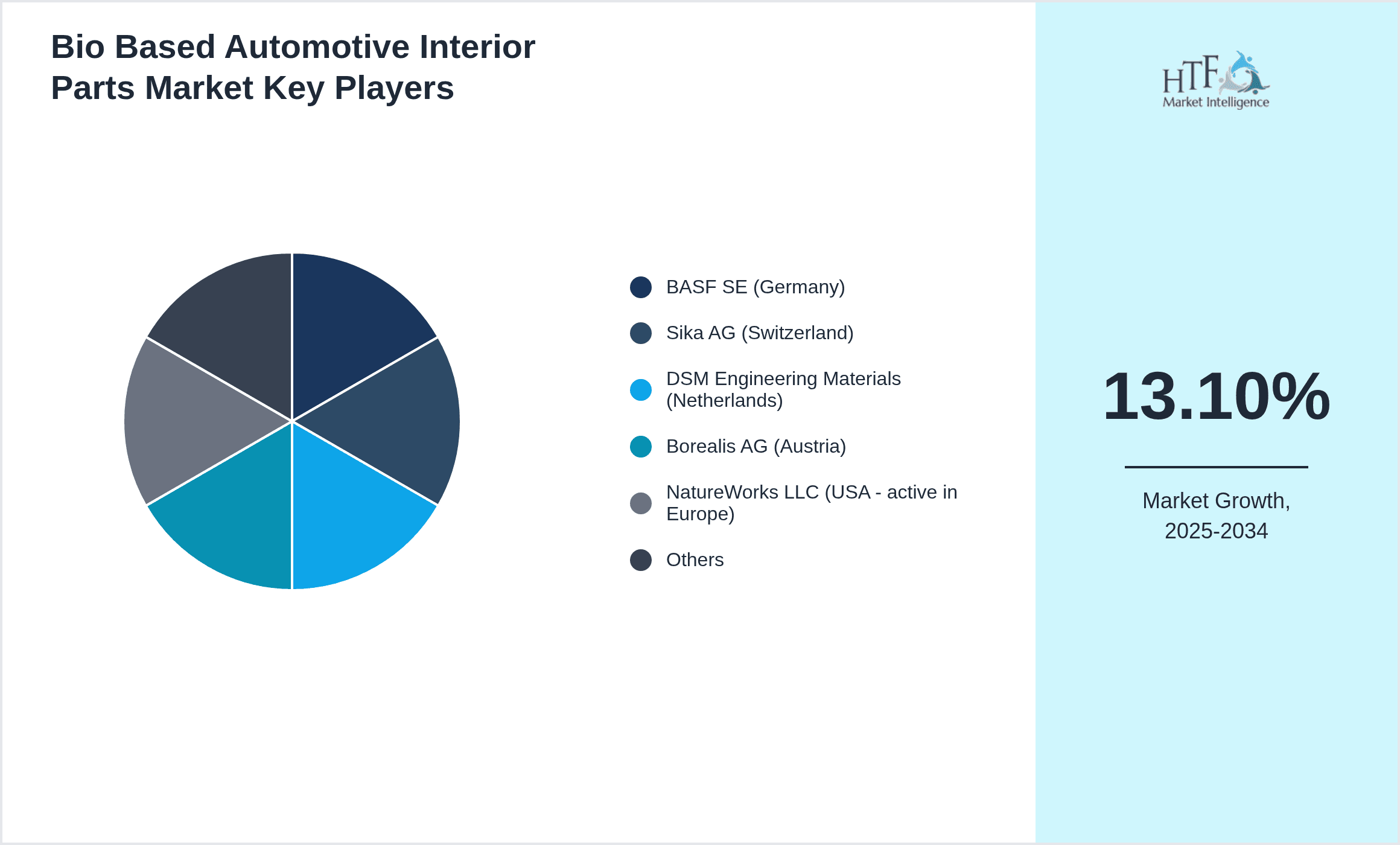
- •CAGR (2025 - 2034): 13.1%
- •The Europe bio-based automotive interior parts market is set for vigorous growth, underpinned by technological innovation, regulatory mandates, and shifting consumer preferences. This trajectory signals a transformative shift in automotive interiors, promising sustainability without compromising quality or functionality.
Segment Trends & Opportunities
- •Dominating Segment: Bio-Composites continue to lead, favored for their superior strength-to-weight ratio and recyclability.
- •Fastest-Growing Segment: Biopolymers gain traction, driven by advances in biodegradability and compatibility with electric vehicle interiors.
- •Emerging Technology Shift: Integration of digital manufacturing techniques such as 3D printing accelerates customization and reduces waste in bio-based part production.
Players Profiled
- •BASF SE (Germany): Leader in innovative bio-composite materials with extensive R&D in sustainable automotive interiors.
- •Sika AG (Switzerland): Pioneered bio-based adhesive solutions enhancing interior assembly sustainability.
- •DSM Engineering Materials (Netherlands): Advanced biopolymer developer driving lightweight interior components.
- •Borealis AG (Austria): Expanding bio-based polymer portfolio targeting European automotive OEMs.
- •NatureWorks LLC (USA - Europe operations): Innovator in polylactic acid (PLA) biopolymers for automotive applications.
- •INEOS Group Limited (UK): Investing in bio-based raw material production scaling to meet automotive demand.
- •Lanxess AG (Germany): Developing high-performance natural fiber composites for door panels and dashboards.
- •Mitsubishi Chemical Europe GmbH (Germany): Delivering cutting-edge bio-based foams with enhanced thermal properties.
- •Solvay S.A. (Belgium): Advancing sustainable polymer solutions with strong automotive application focus.
- •Stora Enso Oyj (Finland): Leading supplier of wood-based composites for eco-friendly automotive interiors.
- •Green Dot Bioplastics (Europe operations): Innovating biodegradable interior components tailored for European regulations.
- •Clariant AG (Switzerland): Developing bio-based additives enhancing material performance and recyclability.
- •Lenzing AG (Austria): Producer of sustainable cellulose fibers for automotive textiles and seat covers.
- •Toray Industries Europe (Germany): Specializing in carbon fiber bio-composites for high-end automotive interiors.
- •Covestro AG (Germany): Innovator in bio-based polyurethanes for cushioning and foam applications.
Future Outlook
- •Europe’s bio-based automotive interior parts market is poised for a future defined by digital transformation, with AI-driven material design and IoT-enabled supply chains enhancing production efficiency and customization. Emerging technologies will facilitate real-time quality monitoring and predictive maintenance of interior components. The convergence of sustainability and innovation will drive continual market evolution, fostering partnerships between tech firms, automotive OEMs, and bio-material startups. As electric vehicles gain dominance, bio-based interiors will become standard, reflecting Europe's commitment to carbon neutrality and circular economy principles.
- •Challenges versus Opportunity: While raw material sourcing and cost competitiveness remain hurdles, Europe's robust regulatory framework and strong R&D ecosystem create fertile ground for innovation. Collaborative ventures and government incentives offset supply chain complexities. The balance between ecological mandates and consumer expectations underscores a market rich with transformative potential, where sustainable automotive interiors evolve from niche to norm, opening avenues for new business models and technological breakthroughs.
Conclusion
- •Bio-based automotive interiors are central to Europe’s sustainable mobility vision, reshaping vehicle design toward ecological responsibility.
- •Robust market growth and innovation validate the sector’s strategic significance across automotive manufacturing and environmental policy.
- •Future innovation, fueled by AI, digitalization, and material science, will cement Europe’s leadership in bio-based automotive interior parts.
Regional Outlook
The Germany currently holds a significant share of the market, primarily due to several key factors: increasing consumption rates, a burgeoning population, and robust economic momentum. These elements collectively drive demand, positioning this region as a leader in the market. On the other hand, France is rapidly emerging as the fastest-growing area within the industry. This remarkable growth can be attributed to swift infrastructure development, the expansion of various industrial sectors, and a marked increase in consumer demand. These dynamics make this region a crucial player in shaping future market growth.
In our report, we cover a comprehensive analysis of the following regions and countries:
- Germany
- France
- The United Kingdom
- BeNeLux
- Spain
- Italy
- NORDIC
- CEE
- Others
| Feature | Details |
|---|---|
| Base Year Market Size | USD 1.8 Billion |
| Forecast Year Market Size | USD 5.6 Billion |
| CAGR | 13.1% |
| Forecast Period | 2026 to 2033 |
| YoY Growth | 12.5% |
| Scope of Report | Market is segmented by Type (Biopolymers, Natural Fibers, Bio-Composites, Bio-Based Foams, Bio-Based Adhesives), Application (Dashboard Components, Door Panels, Seat Covers, Headliners, Flooring), Material Source (Plant-Based Fibers, Recycled Biomass, Algae Derived Polymers, Wood-Based Composites), Vehicle Type (Passenger Cars, Commercial Vehicles, Electric Vehicles), Production Technology (Injection Molding, Compression Molding, 3D Printing) |
| Regions Covered | Germany, France, The United Kingdom, BeNeLux, Spain, Italy, NORDIC, CEE, Others |
| Key Companies | BASF SE (Germany), Sika AG (Switzerland), DSM Engineering Materials (Netherlands), Borealis AG (Austria), NatureWorks LLC (USA - active in Europe), INEOS Group Limited (UK), Lanxess AG (Germany), Mitsubishi Chemical Europe GmbH (Germany), Solvay S.A. (Belgium), Stora Enso Oyj (Finland), Green Dot Bioplastics (Europe operations), Clariant AG (Switzerland), Lenzing AG (Austria), Toray Industries Europe (Germany), Covestro AG (Germany) |
Europe Bio Based Automotive Interior Parts Market Size, Growth & Revenue 2025-2034 - Table of Contents
Frequently Asked Questions (FAQ):
The Compact Track Loaders market is projected to grow at a CAGR of 6.8% from 2025 to 2030, driven by increasing demand in construction and agricultural sectors.
North America currently leads the market with approximately 45% market share, followed by Europe at 28% and Asia-Pacific at 22%. The remaining regions account for 5% of the global market.
Key growth drivers include increasing construction activities, rising demand for versatile equipment in agriculture, technological advancements in track loader design, and growing preference for compact equipment in urban construction projects.