
EMEA Residential Air Treatment Systems Market Size, Growth & Revenue 2025-2034
EMEA Residential Air Treatment Systems Market is segmented by Type (HEPA Filters, Activated Carbon Filters, UV Air Purifiers, Ionizers, Electrostatic Precipitators), Application (Air Purification, Humidification, Dehumidification, Ventilation, Odor Control), Technology Integration (IoT-enabled Systems, Smart Sensors, Energy Efficient Models), Distribution Channel (Online Retail, Specialty Stores, Home Appliance Retailers, Direct Sales), and Geography (Germany, France, Italy, United Kingdom, Nordics, Rest of Europe, South Africa, Egypt, Turkey, United Arab Emirates, Israel, Saudi Arabia, Rest of EMEA)
Pricing
Report Overview
Executive Summary
- •The Unseen Guardian of EMEA Homes: Residential Air Treatment Systems redefine indoor living by purifying and conditioning air to combat pollutants, allergens, and pathogens, safeguarding health and enhancing comfort across diverse climates and urban landscapes.
- •Market momentum accelerates with rising health awareness, regulatory mandates, and technological breakthroughs, driving robust growth supported by expanding smart home integration and energy-efficient innovations.
- •This market delivers strategic value by improving respiratory health outcomes, reducing environmental hazards, and aligning with sustainability goals, making it indispensable to homeowners, policymakers, and industry innovators.

Competitive Landscape
The EMEA Residential Air Treatment Systems market exhibits fierce competition characterized by rapid innovation cycles, aggressive product differentiation, and strategic alliances. Leading players leverage advanced filtration technologies and digital connectivity to enhance user experience and efficiency. Market positioning hinges on multi-channel distribution, competitive pricing, and compliance with stringent environmental standards. Companies increasingly invest in R&D to develop compact, energy-saving units integrated with smart sensors and IoT platforms, ensuring real-time air quality management. Mergers and acquisitions streamline market share consolidation, while regional manufacturers capitalize on localized preferences and regulatory nuances. As consumer demand evolves, competitive strategies emphasize sustainable materials, noise reduction, and customizable features, driving a dynamic and fragmented landscape poised for continued technological disruption and geographic expansion.
Leading Companies in EMEA Residential Air Treatment Systems Market
- •Philips Domestic Appliances (Netherlands)
- •Dyson Ltd. (United Kingdom)
- •Electrolux AB (Sweden)
- •Honeywell International Inc. (United States - EMEA operations)
- •Sharp Corporation (Japan - EMEA operations)
- •Blueair AB (Sweden)
- •Levoit (China - EMEA presence)
- •Miele & Cie. KG (Germany)
- •Rowenta (France)
- •Panasonic Corporation (Japan - EMEA operations)
- •Samsung Electronics Co., Ltd. (South Korea - EMEA operations)
- •Bionaire (United States - EMEA presence)
- •De’Longhi Appliances S.r.l. (Italy)
- •Vornado Air LLC (United States - EMEA operations)
- •Xiaomi Corporation (China - EMEA presence)
Market Segments
- •By Type
- ◦HEPA Filters
- ◦Activated Carbon Filters
- ◦UV Air Purifiers
- ◦Ionizers
- ◦Electrostatic Precipitators
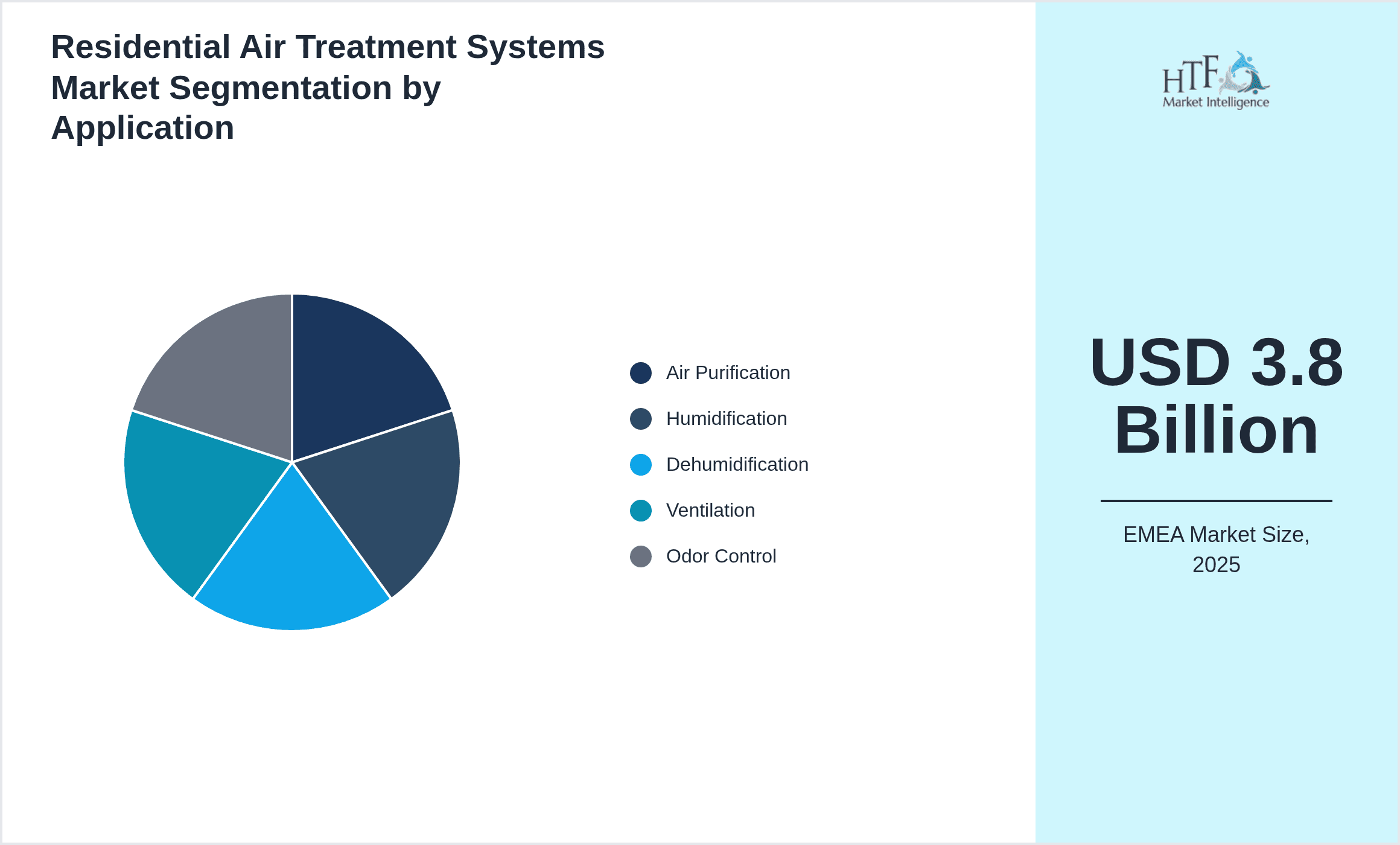
- •By Application
- ◦Air Purification
- ◦Humidification
- ◦Dehumidification
- ◦Ventilation
- ◦Odor Control
- •By Technology Integration
- ◦IoT-enabled Systems
- ◦Smart Sensors
- ◦Energy Efficient Models
- •By Distribution Channel
- ◦Online Retail
- ◦Specialty Stores
- ◦Home Appliance Retailers
- ◦Direct Sales
Key Growth Drivers
- •Technology Advancements: Cutting-edge filtration technologies and smart IoT integration elevate efficacy and user experience, boosting adoption across diverse residential settings.
- •Expanding Applications: Demand surges beyond purification to include humidity control and odor removal, reflecting homeowners’ desire for comprehensive indoor air quality management.
- •Infrastructure and Investment Growth: Robust urbanization and increasing investments in sustainable housing infrastructure stimulate market expansion throughout the EMEA region.
- •Regulatory Compliance: Strengthening environmental policies and indoor air quality standards compel manufacturers to innovate and align products with evolving norms.

Regional Insights
- •Germany leads the EMEA market with mature demand and strong manufacturing capabilities, while the UK and France sustain substantial market shares driven by environmental awareness and regulatory enforcement.
- •The Middle East emerges as the fastest-growing region, propelled by rapid urban development, rising disposable incomes, and increasing air pollution concerns.
- •Key countries such as Italy and Spain contribute through expanding smart home adoption and heightened consumer preference for energy-efficient air treatment solutions.

Players Profiled
- •Philips Domestic Appliances (Netherlands): Pioneer in integrating IoT-enabled air purifiers with advanced HEPA filtration for enhanced residential air quality.
- •Dyson Ltd. (United Kingdom): Leader in innovative bladeless designs combining air purification and ventilation with smart sensor automation.
- •Electrolux AB (Sweden): Expands product portfolio emphasizing energy efficiency and environment-friendly refrigerants in air treatment systems.
- •Honeywell International Inc. (United States - EMEA operations): Focuses on durable, high-performance systems meeting stringent EMEA air quality regulations.
- •Sharp Corporation (Japan - EMEA operations): Innovator in Plasmacluster ion technology enhancing virus and allergen removal efficacy.
- •Blueair AB (Sweden): Specializes in smart filtration solutions integrating mobile app controls for personalized air quality management.
- •Levoit (China - EMEA presence): Rapidly expanding with affordable, compact air purifiers optimized for urban apartments.
- •Miele & Cie. KG (Germany): Combines premium design with superior filtration standards targeting luxury residential segments.
- •Rowenta (France): Advances multi-functional devices delivering air purification alongside humidification and dehumidification.
- •Panasonic Corporation (Japan - EMEA operations): Drives innovation in UV-based air sterilization technologies for residential use.
- •Samsung Electronics Co., Ltd. (South Korea - EMEA operations): Incorporates AI-driven air quality sensors and smart home ecosystem integration.
- •Bionaire (United States - EMEA presence): Focused on compact, user-friendly designs with activated carbon filtration targeting odor control.
- •De’Longhi Appliances S.r.l. (Italy): Expands humidification and ventilation product lines with energy-saving features.
- •Vornado Air LLC (United States - EMEA operations): Innovates air circulation technology enhancing overall indoor air treatment efficiency.
- •Xiaomi Corporation (China - EMEA presence): Leverages smart connectivity and cost-effective solutions appealing to tech-savvy consumers.
Segment Trends & Opportunities
- •Dominating Segment: HEPA Filters retain dominance due to proven high-efficiency particulate removal and regulatory preference across EMEA markets.
- •Fastest-Growing Segment: UV Air Purifiers expand rapidly, driven by heightened health security concerns and demand for pathogen-neutralizing technologies.
- •Emerging Technology Shift: Integration of AI and IoT enables predictive air quality management and seamless smart home connectivity, revolutionizing user control and system responsiveness.
Future Outlook
- •Innovation accelerates as AI-powered sensors, IoT connectivity, and digital transformation redefine residential air treatment, delivering personalized, adaptive solutions that anticipate and respond to indoor air quality fluctuations with precision and efficiency.
- •Long-term market evolution will witness convergence of air treatment with energy management and home automation, fostering sustainable, health-centric living environments aligned with EMEA’s stringent environmental directives and consumer expectations.
- •Challenges such as high initial costs, complex regulatory landscapes, and consumer education gaps contrast with vast opportunities in expanding urbanization, rising health consciousness, and technological democratization, positioning the market for resilient, innovation-driven growth.
Conclusion
- •Residential air treatment systems stand as a cornerstone in EMEA’s pursuit of healthier indoor environments, influencing lifestyle and public health outcomes profoundly.
- •Validated by robust CAGR and expanding adoption, market growth reflects uncompromising demand for quality, efficiency, and innovation.
- •Future innovation will center on AI-driven personalization, sustainability, and seamless smart home integration, shaping the next generation of air treatment solutions.
Regional Outlook
The Germany currently holds a significant share of the market, primarily due to several key factors: increasing consumption rates, a burgeoning population, and robust economic momentum. These elements collectively drive demand, positioning this region as a leader in the market. On the other hand, Middle East is rapidly emerging as the fastest-growing area within the industry. This remarkable growth can be attributed to swift infrastructure development, the expansion of various industrial sectors, and a marked increase in consumer demand. These dynamics make this region a crucial player in shaping future market growth.
In our report, we cover a comprehensive analysis of the following regions and countries:
- Germany
- France
- Italy
- United Kingdom
- Nordics
- Rest of Europe
- South Africa
- Egypt
- Turkey
- United Arab Emirates
- Israel
- Saudi Arabia
- Rest of EMEA
| Feature | Details |
|---|---|
| Base Year Market Size | USD 3.8 Billion |
| Forecast Year Market Size | USD 7.9 Billion |
| CAGR | 8.9% |
| Forecast Period | 2026 to 2033 |
| YoY Growth | 8.5% |
| Scope of Report | Market is segmented by Type (HEPA Filters, Activated Carbon Filters, UV Air Purifiers, Ionizers, Electrostatic Precipitators), Application (Air Purification, Humidification, Dehumidification, Ventilation, Odor Control), Technology Integration (IoT-enabled Systems, Smart Sensors, Energy Efficient Models), Distribution Channel (Online Retail, Specialty Stores, Home Appliance Retailers, Direct Sales) |
| Regions Covered | Germany, France, Italy, United Kingdom, Nordics, Rest of Europe, South Africa, Egypt, Turkey, United Arab Emirates, Israel, Saudi Arabia, Rest of EMEA |
| Key Companies | Philips Domestic Appliances (Netherlands), Dyson Ltd. (United Kingdom), Electrolux AB (Sweden), Honeywell International Inc. (United States - EMEA operations), Sharp Corporation (Japan - EMEA operations), Blueair AB (Sweden), Levoit (China - EMEA presence), Miele & Cie. KG (Germany), Rowenta (France), Panasonic Corporation (Japan - EMEA operations), Samsung Electronics Co., Ltd. (South Korea - EMEA operations), Bionaire (United States - EMEA presence), De’Longhi Appliances S.r.l. (Italy), Vornado Air LLC (United States - EMEA operations), Xiaomi Corporation (China - EMEA presence) |
EMEA Residential Air Treatment Systems Market Size, Growth & Revenue 2025-2034 - Table of Contents
Frequently Asked Questions (FAQ):
The Compact Track Loaders market is projected to grow at a CAGR of 6.8% from 2025 to 2030, driven by increasing demand in construction and agricultural sectors.
North America currently leads the market with approximately 45% market share, followed by Europe at 28% and Asia-Pacific at 22%. The remaining regions account for 5% of the global market.
Key growth drivers include increasing construction activities, rising demand for versatile equipment in agriculture, technological advancements in track loader design, and growing preference for compact equipment in urban construction projects.