
Australia Bookkeeping Service Provider Services Market Scope & Changing Dynamics 2024-2034
Australia Bookkeeping Service Provider Services Market is segmented by Type (Traditional Bookkeeping, Cloud-based Bookkeeping, Outsourced Bookkeeping, Automated Bookkeeping), Application (Small and Medium Enterprises, Freelancers, Corporates, Non-Profit Organizations, Government Agencies), and Geography (New South Wales, Queensland, TASMANIA, Victoria, Western Australia, South Australia)
Pricing
Report Overview
Market Definition & Scope
So, the Australia bookkeeping service provider services market is basically, well, all about the different ways businesses manage their books financially, right? It’s not just the old-school pen-and-paper kind anymore, with cloud-based stuff taking off and some automated tools popping up here and there. The market covers everything from small freelancers trying to keep track of invoices to big corporates needing full-on payroll and tax compliance. It’s a bit messy sometimes because not everyone adopts cloud solutions at the same pace—some still like the traditional methods or prefer outsourcing to specialized firms. The scope also includes software platforms and pure service providers offering a mix of manual and tech-enabled bookkeeping. It’s a broad space, really, capturing the transition from manual to digital, with a bunch of different service models and client types all mixed in.
Market Segmentation
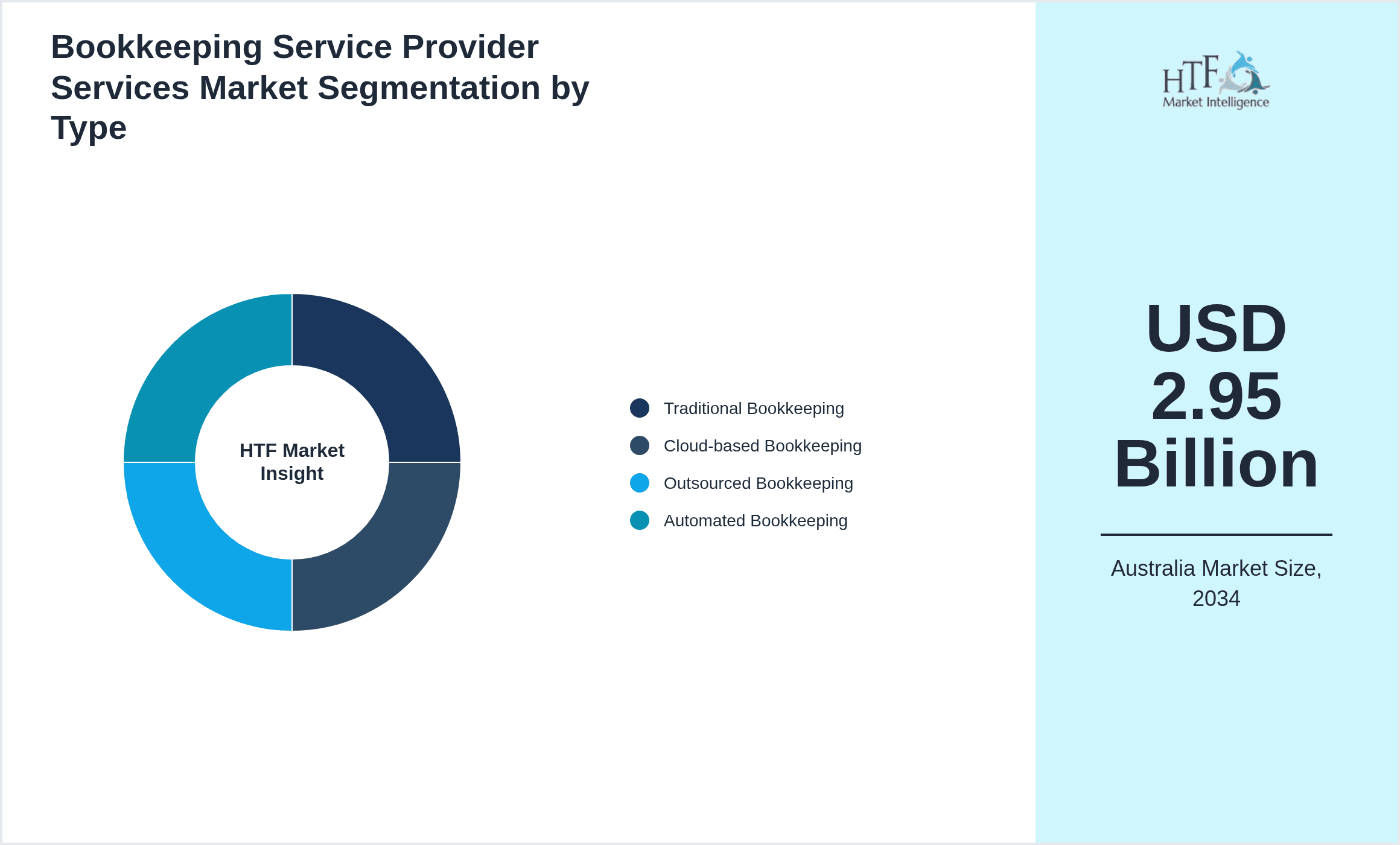
- •By Type
- ◦Traditional Bookkeeping
- ◦Cloud-based Bookkeeping
- ◦Outsourced Bookkeeping
- ◦Automated Bookkeeping
- •By Application
- ◦Small and Medium Enterprises
- ◦Freelancers
- ◦Corporates
- ◦Non-Profit Organizations
- ◦Government Agencies
- •By Client Industry
- ◦Retail and E-commerce
- ◦Professional Services
- ◦Construction and Real Estate
- ◦Healthcare
- ◦Education
- •By Service Delivery Model
- ◦On-premise
- ◦Cloud-based
- ◦Hybrid
Leading Companies in Australia Bookkeeping Service Provider Services Market
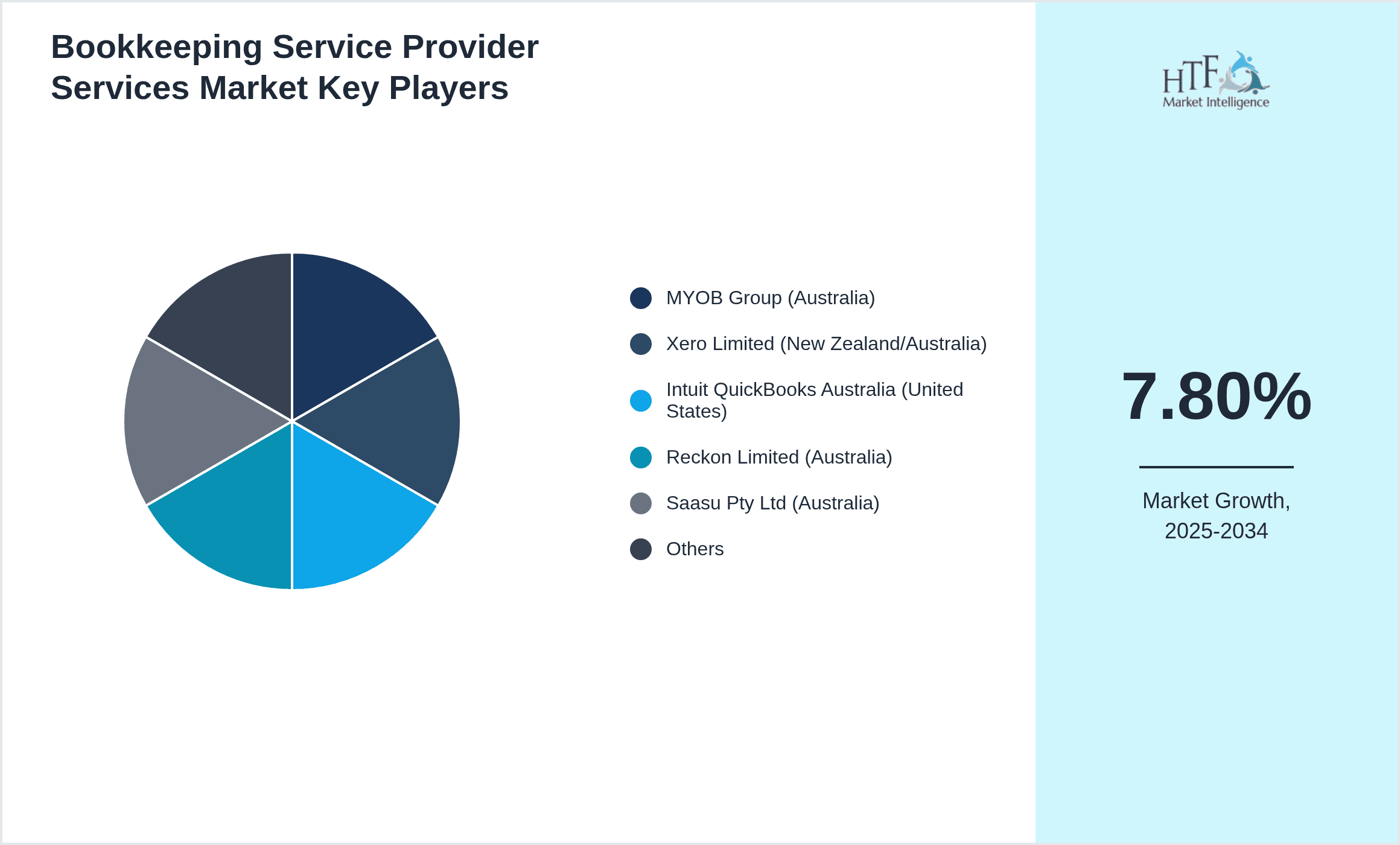
- •MYOB Group (Australia)
- •Xero Limited (New Zealand/Australia)
- •Intuit QuickBooks Australia (United States)
- •Reckon Limited (Australia)
- •Saasu Pty Ltd (Australia)
- •EzyLearn Pty Ltd (Australia)
- •Bookkeeper360 (Australia)
- •KPMG Australia (Australia)
- •PwC Australia (Australia)
- •Hnry (Australia)
- •BGL Corporate Solutions (Australia)
- •ClickAccounts (Australia)
- •E-Com Books (Australia)
- •SmartBooks (Australia)
- •Clear Books Australia (Australia)

Market Dynamics
- •Growth Drivers
- ◦Increasing adoption of cloud technologies among SMEs drives demand for cloud-based bookkeeping, although adoption uneven across industries.
- ◦Rising regulatory complexities and compliance requirements push businesses toward professional bookkeeping services.
- ◦Growing gig economy and freelancer base need specialized bookkeeping tailored to their workflows.
- ◦Outsourcing bookkeeping functions remains cost-effective for many SMEs, encouraging market growth.
- ◦Automation and AI integration improve service accuracy and reduce human error, attracting tech-savvy clients.
- •Trends
- ◦Shift from manual to hybrid models combining human expertise with AI tools, though some traditionalists resist change.
- ◦Emergence of mobile bookkeeping apps targeting freelancers and micro-businesses with on-the-go financial management.
- ◦Increased partnerships between bookkeeping firms and accounting software providers for integrated solutions.
- ◦Growing preference for subscription-based models over one-time service fees, reflecting changing client expectations.
- ◦Rise of data security concerns influencing provider selection and service design.
- •Restraints
- ◦Lack of digital literacy in certain regional zones slows cloud bookkeeping adoption despite availability.
- ◦Small businesses often rely on informal bookkeeping, limiting market penetration for professional services.
- ◦Price sensitivity among SMEs constrains willingness to invest in premium bookkeeping solutions.
- ◦Fragmented market with many small providers creates inconsistent service quality perceptions.
- ◦Regulatory changes sometimes lag behind technological advances, causing compliance uncertainty.
- •Opportunities
- ◦Expansion into under-served regional zones like South Australia and Western Australia with tailored service offerings.
- ◦Development of AI-driven predictive bookkeeping tools to offer proactive financial insights.
- ◦Collaborations between bookkeeping providers and fintech startups to enhance payment and invoicing automation.
- ◦Targeting non-profit organizations and government agencies with specialized compliance and reporting services.
- ◦Upselling integrated payroll and tax filing services alongside bookkeeping to increase client wallet share.
- •Challenges
- ◦High competition among numerous bookkeeping firms drives down margins and complicates differentiation.
- ◦Ensuring data privacy and cybersecurity compliance remains a constant operational challenge.
- ◦Difficulty in standardizing services due to diverse client requirements and varying industry regulations.
- ◦Talent shortage in skilled bookkeeping professionals with tech competency limits capacity expansion.
- ◦Resistance to change from traditional bookkeeping methods among older business owners slows technology adoption.
Industry Insights
In March 2024, MYOB Group launched an enhanced cloud bookkeeping platform integrating artificial intelligence to automate invoice processing and bank reconciliations, aimed at small and medium enterprises seeking efficiency gains. The update includes predictive cash flow analytics and mobile access, reflecting shifting user preferences towards convenience and real-time insights. This move signals intensified competition among providers focusing on technology-driven differentiation. Meanwhile, in November 2023, Xero Limited expanded its Australian market presence by partnering with several fintech startups to offer bundled bookkeeping and payment solutions, targeting gig economy workers and freelancers who require seamless financial management tools tailored to their irregular income streams.
Regulatory Overview
Recent regulatory updates in Australia have heightened compliance obligations for bookkeeping service providers, particularly around data privacy under the Privacy Act amendments effective 2023. Providers are required to implement stricter data handling and breach notification protocols. Additionally, the Australian Taxation Office (ATO) continues to push for real-time reporting standards, compelling bookkeeping firms to upgrade their systems for timely and accurate lodgment. These regulations impact service delivery models, especially for cloud-based and outsourced bookkeeping, necessitating ongoing investments in compliance infrastructure. The regulatory landscape remains dynamic, with expected further clarifications on digital record-keeping requirements within the next two years.
Competitive Landscape
Competition in the Australia bookkeeping service provider services market is robust with a blend of legacy firms and agile tech-focused entrants vying for market share. Established players leverage brand trust and comprehensive service portfolios, while newer companies push innovation with AI and cloud-first approaches. Rivalry is also shaped by pricing strategies—some providers compete on cost leadership targeting SMEs, whereas others emphasize premium, integrated offerings for corporates and freelancers. Strategic partnerships with fintech and software companies are common to enhance service capabilities. Market positioning often hinges on technological adaptability and client servicing models, with firms continuously balancing automation benefits against personalized service demands. Regional dominance varies, reflecting localized client preferences and provider penetration.
Mergers & Acquisitions
- •In August 2024, Intuit QuickBooks Australia acquired a local cloud bookkeeping startup specializing in AI-powered invoice management. This strategic acquisition aims to bolster Intuit’s technological capabilities and expand its footprint in the Australian SME segment. The deal allows Intuit to integrate advanced automation features into its existing platform, providing enhanced value propositions for small business clients increasingly demanding efficiency and accuracy in financial processes. The acquisition reflects a broader industry trend of consolidation as incumbents seek to accelerate innovation through targeted buyouts of niche technology providers.
- •In February 2023, MYOB Group completed the acquisition of a boutique bookkeeping service provider focused on non-profit organizations and government agencies. This move was aimed at diversifying MYOB’s client base and strengthening its compliance service offerings tailored to sector-specific regulatory demands. The acquisition enables MYOB to offer specialized reporting tools and customized bookkeeping workflows, addressing the growing demand for tailored solutions in public and social sectors, while reinforcing its competitive position in Australia’s fragmented bookkeeping market.
Recent Industry News
- •On 15th January 2025, Reckon Limited announced a strategic partnership with a leading Australian fintech firm to integrate automated payment reconciliation capabilities into its bookkeeping software suite. This collaboration aims to streamline cash flow management for SMEs by reducing manual data entry and accelerating financial close processes. The partnership is expected to enhance user experience through real-time transaction updates and improved reporting accuracy, positioning Reckon to better compete against cloud-first providers.
- •On 22nd March 2025, Saasu Pty Ltd launched a new mobile bookkeeping app designed specifically for freelancers and sole traders in Australia. The app features simple invoicing, expense tracking, and instant BAS calculation functionalities, catering to the unique needs of micro-businesses. This launch highlights growing market focus on mobile-first solutions that address flexible and on-the-go bookkeeping requirements.
- •On 10th May 2025, PwC Australia expanded its bookkeeping and financial advisory services by opening a dedicated innovation hub in Brisbane focused on integrating AI-driven analytics with traditional bookkeeping services. The initiative targets mid-sized enterprises seeking advanced insights from financial data, combining technology with expert advisory to support strategic business decisions.
- •On 5th July 2025, ClickAccounts partnered with multiple accounting firms across Victoria and New South Wales to offer hybrid bookkeeping services that blend cloud automation with personalized consultancy. This approach aims to capture clients hesitant about fully automated solutions by providing human oversight alongside technology, reflecting market nuances in service adoption preferences.
- •Source: Industry press releases and company announcements
Market Statistics
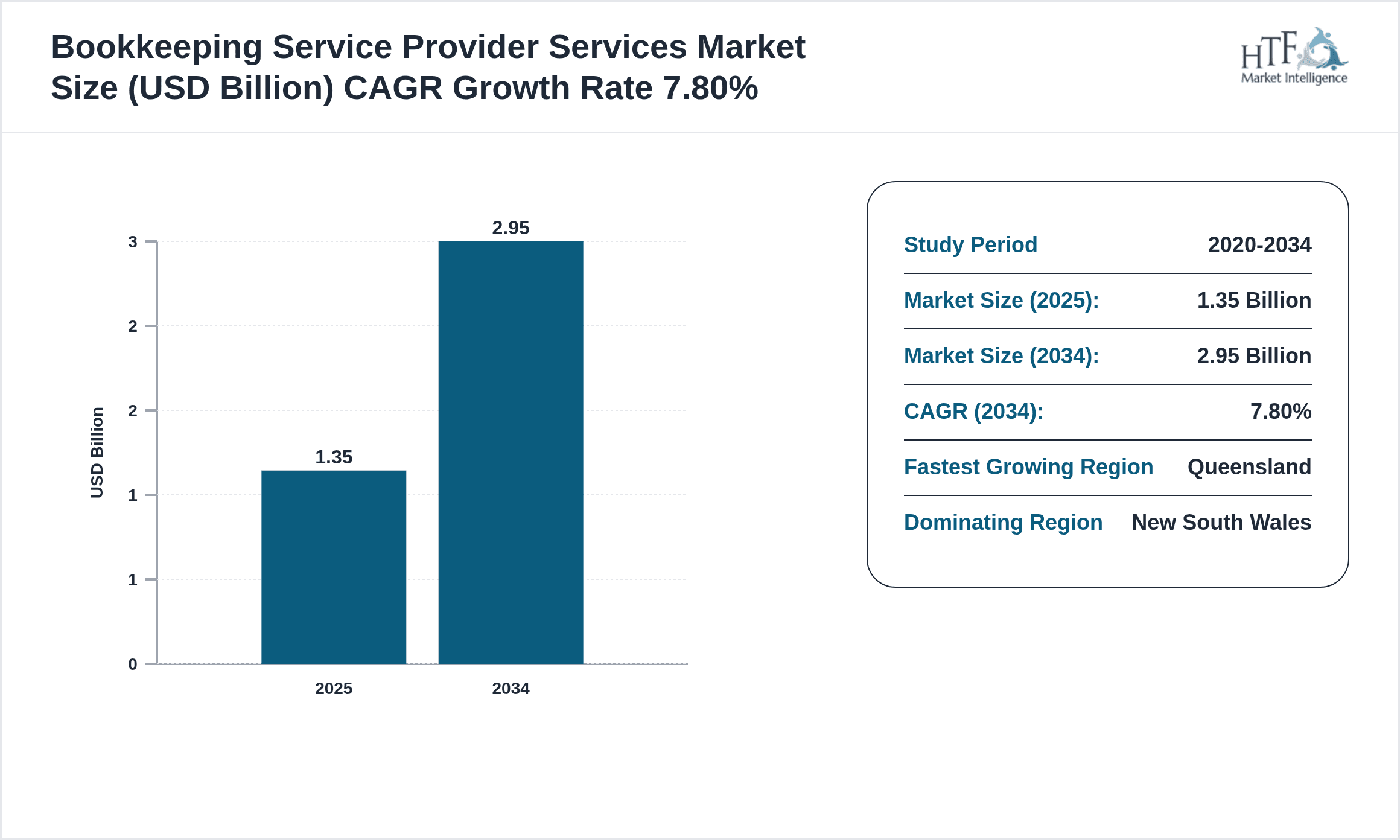
- •CAGR by 2034: 7.8%
- •Market Size by 2034: USD 2.95 Billion
- •Market Size in 2025: USD 1.45 Billion
- •Dominating Type: Cloud-based Bookkeeping
- •Next-Following Type: Automated Bookkeeping
- •Dominating Application: Small and Medium Enterprises
- •Next-Following Application: Freelancers
- •Dominating Region: New South Wales
- •Second-Leading Region: Victoria
- •Region with Highest Growth Rate: Queensland
- •Dominating Country: Australia
Market Share Table
- •Market Share (%) - Type: Cloud-based Bookkeeping 45%, Automated Bookkeeping 25%
- •Market Share (%) - Application: SMEs 60%, Freelancers 20%
- •Growth Rate (%) - Type: Cloud-based Bookkeeping 8.1%, Automated Bookkeeping 9.3%
- •Growth Rate (%) - Application: SMEs 7.5%, Freelancers 8.7%
Top 5 Global Players
- •MYOB Group (Australia)
- •Xero Limited (New Zealand/Australia)
- •Intuit QuickBooks Australia (United States)
- •Reckon Limited (Australia)
- •PwC Australia (Australia)
Regional Outlook
The New South Wales currently holds a significant share of the market, primarily due to several key factors: increasing consumption rates, a burgeoning population, and robust economic momentum. These elements collectively drive demand, positioning this region as a leader in the market. On the other hand, Queensland is rapidly emerging as the fastest-growing area within the industry. This remarkable growth can be attributed to swift infrastructure development, the expansion of various industrial sectors, and a marked increase in consumer demand. These dynamics make this region a crucial player in shaping future market growth.
In our report, we cover a comprehensive analysis of the following regions and countries:
- New South Wales
- Queensland
- TASMANIA
- Victoria
- Western Australia
- South Australia
| Feature | Details |
|---|---|
| Base Year Market Size | USD 1.35 Billion |
| Forecast Year Market Size | USD 2.95 Billion |
| CAGR | 7.8% |
| Forecast Period | 2026 to 2033 |
| YoY Growth | 7.5% |
| Regions Covered | New South Wales, Queensland, TASMANIA, Victoria, Western Australia, South Australia |
| Key Companies | MYOB Group (Australia), Xero Limited (New Zealand/Australia), Intuit QuickBooks Australia (United States), Reckon Limited (Australia), Saasu Pty Ltd (Australia), EzyLearn Pty Ltd (Australia), Bookkeeper360 (Australia), KPMG Australia (Australia), PwC Australia (Australia), Hnry (Australia), BGL Corporate Solutions (Australia), ClickAccounts (Australia), E-Com Books (Australia), SmartBooks (Australia), Clear Books Australia (Australia) |
Australia Bookkeeping Service Provider Services Market Scope & Changing Dynamics 2024-2034 - Table of Contents
Frequently Asked Questions (FAQ):
The Compact Track Loaders market is expected to see value worth 5.3 Billion in 2025.
North America currently leads the market with approximately 45% market share, followed by Europe at 28% and Asia-Pacific at 22%. The remaining regions account for 5% of the global market.
Key growth drivers include increasing construction activities, rising demand for versatile equipment in agriculture, technological advancements in track loader design, and growing preference for compact equipment in urban construction projects.